
Question 663 marksMedium
What are the conclusions drawn from the black body spectrum? State Wien’s displacement law. What is greenhouse effect?
Confirming your payment
Sign up now and get 250 free tokens.
Heat Transfer · Question 66 of 71
What are the conclusions drawn from the black body spectrum? State Wien’s displacement law. What is greenhouse effect?
Solution:
Concept: When the radiation from a black body is spread into a spectrum, the energy per unit wavelength range, , can be measured at each wavelength and plotted against for different temperatures.
Step 1 — Look at the spectrum. The figure shows against for a black body at three temperatures.
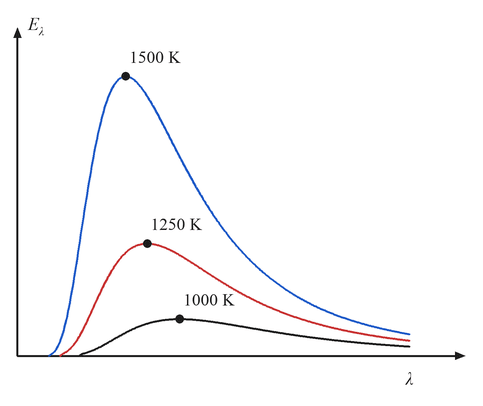
Step 2 — State the conclusions. The curves show that:
Step 3 — State Wien's displacement law. For a black body, the wavelength at which the intensity of radiation is greatest is inversely proportional to its absolute temperature:
Here is Wien's constant.
Step 4 — Explain the greenhouse effect. Sunlight passes through the atmosphere and warms the Earth's surface. The warm surface radiates long-wavelength infrared. Gases such as water vapour, carbon dioxide and methane absorb much of this infrared and re-emit part of it back towards the ground, so heat is trapped near the surface. This keeps the Earth's average temperature at about 15 °C instead of about −18 °C, and the increase of these gases from burning fossil fuels is now causing global warming.
Therefore, the black-body spectrum shows a peak that rises and moves to shorter wavelengths as increases, with total energy proportional to ; Wien's law is ; and the greenhouse effect is the trapping of the Earth's infrared radiation by atmospheric gases, which keeps the surface warm.