
Question 653 marksMedium
State Newton’s law of cooling. Describe an experiment to verify Newton’s law of cooling.
Confirming your payment
Sign up now and get 250 free tokens.
Heat Transfer · Question 65 of 71
State Newton’s law of cooling. Describe an experiment to verify Newton’s law of cooling.
Solution:
Concept: A hot body loses heat faster when it is much hotter than its surroundings. For small temperature differences the rate of loss is simply proportional to the excess temperature.
Step 1 — State the law. The rate of loss of heat from a body is directly proportional to the difference of temperature between the body and its surroundings, provided this difference is small:
Here is the temperature of the body, that of the surroundings and a constant depending on the area and nature of the surface.
Step 2 — Derive what to plot. Let be the heat held by the body, of mass and specific heat capacity . When its temperature changes by , its heat changes by (both are negative while it cools). Putting this into the law gives
Separating the variables gives
Integrating both sides gives
Here is a constant. So a graph of against should be a straight line with a negative slope.
Step 3 — Describe the apparatus. A double-walled vessel W has cold water between its walls, which keeps the surroundings at a steady temperature . Hot water is put in a calorimeter C, which stands inside W. Thermometer reads the temperature of the hot water, and thermometer reads .
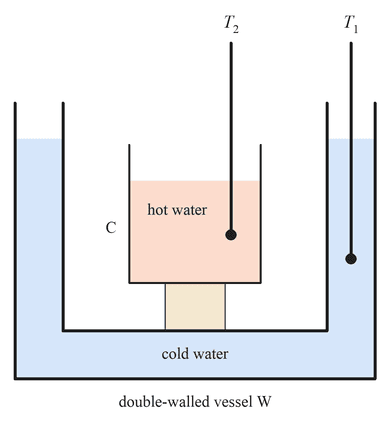
Step 4 — Describe the procedure. The readings of both thermometers are noted at equal intervals of time (say every minute) while the hot water cools. For each reading, is worked out.
Step 5 — Draw the graph and conclude. A graph of against time is plotted.
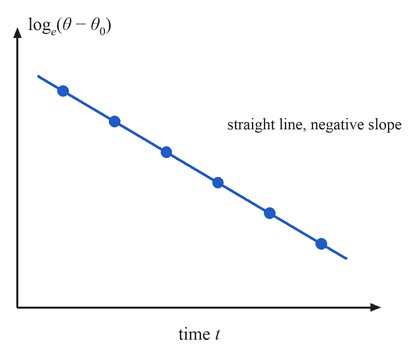
The points lie on a straight line with a negative slope, as the law predicts, which verifies Newton's law of cooling.
Therefore, Newton's law states that the rate of loss of heat is proportional to the excess temperature over the surroundings, and it is verified by finding that plotted against time is a straight line with a negative slope.