
Question 675 marksMedium
Describe an experiment to determine the coefficient of thermal conductivity of a good conductor by Searle’s method.
Confirming your payment
Sign up now and get 250 free tokens.
Heat Transfer · Question 67 of 71
Describe an experiment to determine the coefficient of thermal conductivity of a good conductor by Searle’s method.
Solution:
Concept: In the steady state the heat conducted along a lagged rod of area in time is , where is the temperature difference between two points a distance apart. If this heat is collected by flowing water, can be measured and found.
Step 1 — Describe the apparatus. A thick cylindrical rod AB of the metal (about 30 cm long and 4 cm across) is used, as in the figure.
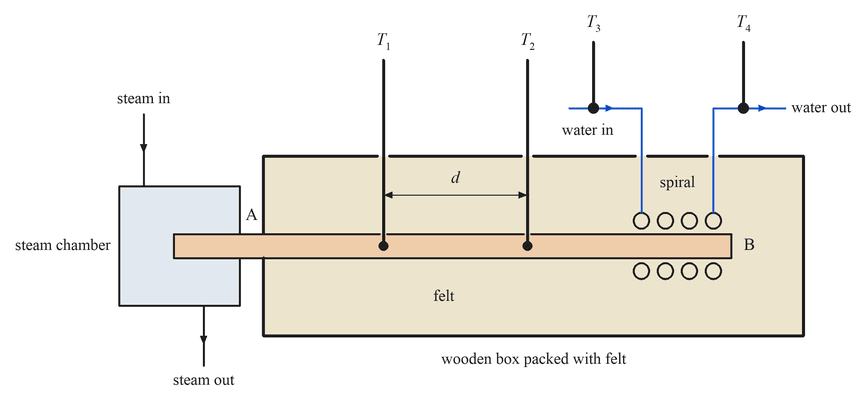
Step 2 — Take the readings. Steam is passed and water is circulated until all four thermometers show steady readings , , and (steady state). Then the water flowing out in a measured time is collected and its mass is found. The diameter of the rod is measured with vernier callipers, so its radius and area are known.
Step 3 — Write the heat conducted through the rod. In time the heat flowing across a section between and is
Step 4 — Write the heat taken up by the water. In the steady state all this heat is carried away by the water, which warms from to . With the specific heat capacity of water,
Step 5 — Find . Equating the two expressions for and solving for :
Step 6 — State the precautions. The method suits a good conductor. The rod is made thick so that it passes enough heat to warm the water measurably, and long so that and can be placed far enough apart for the small difference to be measured accurately. For accurate results:
Therefore, in Searle's method , found from the steady temperatures along a lagged rod and the heat carried away by the flowing water.