
Question 685 marksMedium
(a) Compare thermal conductivity and electrical conductivity.
(b) What is thermal resistance?
(c) Discuss the heat flow through a composite slab.
Confirming your payment
Sign up now and get 250 free tokens.
Heat Transfer · Question 68 of 71
(a) Compare thermal conductivity and electrical conductivity.
(b) What is thermal resistance?
(c) Discuss the heat flow through a composite slab.
Solution:
Concept: Steady heat flow obeys Fourier's law, , which has the same form as Ohm's law, .
Step 1 — Compare the two conductivities, part (a). The two are alike in several ways:
They also differ: electrical conductivity is measured in and thermal conductivity in ; and heat is conducted also by vibrations of atoms, so even electrical insulators conduct some heat, and there is no perfect heat insulator.
Step 2 — Define thermal resistance, part (b). Writing Fourier's law as shows that the quantity plays the part of a resistance. It is called the thermal resistance :
Thermal resistance is the opposition a body offers to the flow of heat: the temperature difference needed per unit rate of heat flow, . Its S.I. unit is .
Step 3 — Set up the composite slab, part (c). A composite slab is made of two slabs of thicknesses and and conductivities and , of the same area , placed face to face. The outer faces are at and , and the interface is at .
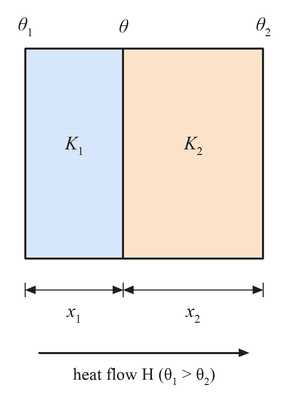
Step 4 — Write the heat current through each slab. In the steady state the same heat current passes through both slabs:
Step 5 — Add the temperature drops. Making each temperature difference the subject and adding removes :
Here and . The thermal resistances add, just like resistors in series.
Step 6 — Find the interface temperature. Equating the two expressions for and solving for gives
Step 7 — Find the equivalent conductivity. A single slab of thickness with the same total resistance has
For equal thicknesses this becomes . (If instead the two slabs are placed side by side, both between the same two temperatures, their heat currents add like resistors in parallel.)
Therefore, (a) thermal and electrical conductivity follow laws of the same form and in metals both come from free electrons; (b) thermal resistance is , in ; (c) through a composite slab , the resistances adding in series.