Solution:
Concept: As a body gets hotter it radiates more energy at every wavelength, and the peak of its spectrum moves to shorter wavelengths.
Step 1 — State Stefan's law. The total energy radiated per second per unit area of a black body is proportional to the fourth power of its absolute temperature:
E=σT4
Step 2 — State Wien's displacement law. The wavelength λm at which a black body radiates most strongly is inversely proportional to its absolute temperature:
λmT=b
Here b≈2.9×10⁻³ m K is Wien's constant.
Step 3 — Draw the graphs. The figure shows the spectrum of a black body at 1500 K, 1250 K and 1000 K.
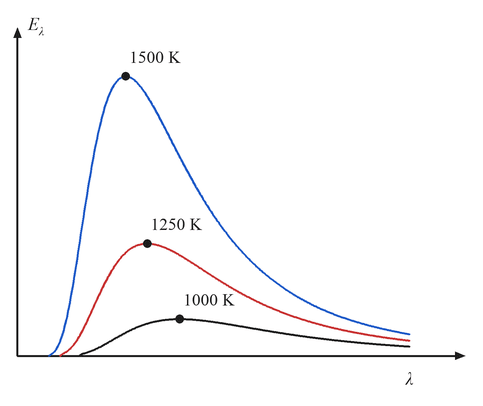
Step 4 — Name the plotted quantity. The quantity plotted against the wavelength is the spectral radiancy (spectral emissive power) Eλ: the energy emitted per second per unit area per unit range of wavelength around λ. The area under each curve is the total energy E emitted per second per unit area.
Step 5 — Explain the colours of heated iron. Iron behaves roughly like a black body:
- When it is cold or warm, it radiates only infrared, which we cannot see, so it shows no glow.
- At about 500 °C to 600 °C the short-wavelength tail of its spectrum just reaches the visible red, so it glows dull red.
- As it gets hotter, it emits more at every wavelength and the peak moves towards shorter wavelengths, so more orange and yellow light is added: it turns cherry red, then orange, then yellow.
- Near its melting point (about 1500 °C) all visible wavelengths are given out strongly and the iron looks white hot.
Even near the melting point the peak itself is still in the infrared, about 1.6 μm; what changes the colour is that the visible part of the spectrum shifts its balance towards the shorter wavelengths as the curve rises and moves left.
Therefore, E=σT4 and λmT=b; the graphs plot the spectral radiancy Eλ against λ; and heated iron glows dull red, then orange, yellow and finally white because its spectrum grows and shifts towards shorter wavelengths as its temperature rises.
