
Opening your dashboard
Class 11 Physics Chapter 17 Heat Transfer: Practice Questions
148 questions on Chapter 17, each worked through on its own page with the AI tutor. Class 11 Physics, ICSE 2026-27.
148 questions
1–4 marks · Mixed difficulty
- 11 mark
Question 1
A rooftop solar water heater has a flat black metal plate with copper tubes fixed to it, and a storage tank placed higher than the plate. In sunshine, energy reaches the plate from the Sun, passes through the walls of the copper tubes into the water inside them, and the warmed water rises into the tank while cooler water from the tank sinks into the tubes. The modes of heat transfer in these three stages are, respectively,
- 21 mark
Question 2
On a still night, a camper sits about from a bonfire and feels its warmth on their face. (Hypothetical data.) A friend holds a large plywood sheet between the fire and the camper's face, and the camper stops feeling the warmth almost at once, although the air around the camper is no cooler. The warmth on the camper's face was carried mainly by
- 33 marks
Question 3
An oil-filled radiator, whose surface is at about , is placed near the floor of a closed room. A halogen heater, which has a glowing element in front of a polished curved reflector, is used in a large, draughty hall. (Hypothetical data.)
(a) By which mode does the oil-filled radiator mainly warm the whole room? Explain how.
(b) Why does a person sitting in front of the halogen heater feel warm within seconds, even though the air in the hall stays cold?
(c) Why is the oil-filled radiator placed near the floor and not near the ceiling?
- 41 mark
Question 4
A high-power laser chip is mounted on a thin plate of synthetic diamond, which spreads its heat. Diamond conducts heat about five times better than copper (about against about ), yet it is an electrical insulator with almost no free electrons. This shows that in a solid
- 52 marks
Question 5
Energy from the Sun crosses about of nearly empty space to reach the Earth.
(a) Explain why this energy can reach the Earth only by radiation.
(b) Taking the speed of light as , find how long the energy takes to make the journey.
- 63 marks
Question 6
A uniform aluminium bar AB, long, is well lagged along its sides, and its ends are kept at two fixed temperatures. In the steady state, thermometers at P, from A, and at Q, from A, read and , as shown in the figure. (Hypothetical data.)

(a) Find the temperature gradient along the bar.
(b) Find the temperatures of the ends A and B, and suggest what each end could be kept in.
(c) How far from A is the point whose temperature is ?
- 71 mark
Question 7
Fourier's law for steady heat flow along a rod is written , where is measured along the rod in the direction in which the heat flows. The minus sign is there because
- 81 mark
Question 8
A rod of one metal is made of two halves of equal length . The left half has area of cross-section and the right half has area , as shown in the figure. The rod is lagged along its whole length, and its ends are kept at and , where .
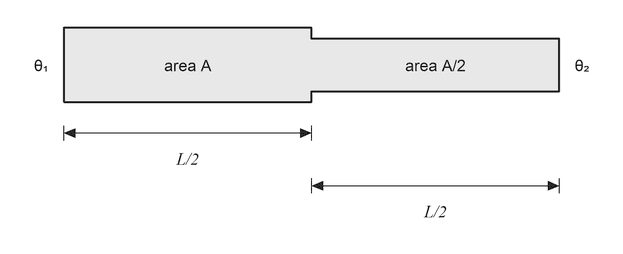
In the steady state, the graph of temperature against distance from the left end is
- 92 marks
Question 9
On a cold day, heat flows out of a person's body at a steady through a layer of fat thick covering an area of . The thermal conductivity of fat is . (Hypothetical data.)
(a) Find the temperature difference across the fat layer.
(b) Find the temperature gradient in the fat.
- 103 marks
Question 10
In a region of old continental rock, the temperature of the ground rises steadily with depth by per kilometre. The rock has thermal conductivity , and its surface is at . (Hypothetical data.)
(a) Write the temperature gradient in , and find the heat flowing up to each square metre of the surface.
(b) Estimate the temperature at the bottom of a borehole deep, assuming the gradient stays the same.
(c) How much heat is conducted up through of the surface in one day?
- 113 marks
Question 11
A pond in winter is covered by a layer of ice thick. The upper surface of the ice is at and the water just below the ice is at , as shown in the figure. For ice, take thermal conductivity , density and specific latent heat of fusion . (Hypothetical data.)
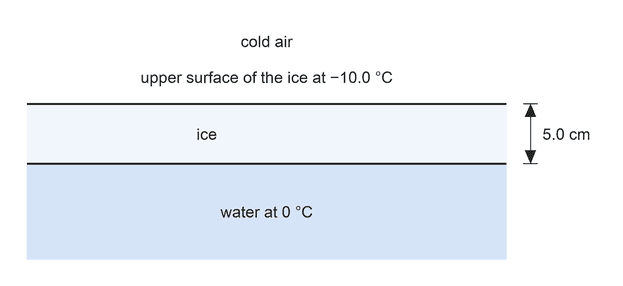
(a) Find the rate at which heat is conducted up through each square metre of the ice.
(b) Find the rate at which the ice grows thicker, in millimetres per hour.
(c) With the same upper-surface temperature, will the ice grow faster or slower when it is thick? Explain.
- 121 mark
Question 12
An LED floodlight turns part of its electrical input into heat, which flows at a steady straight through an aluminium mounting plate. The plate is thick and has a square face of side ; the thermal conductivity of aluminium is . (Hypothetical data.) The temperature difference between the two faces of the plate is about
- 133 marks
Question 13
In a guarded hot-plate test, a flat electric heater supplying is pressed between two identical boards of a building material, each and thick. Cooling plates hold the outer faces of the boards at , and in the steady state the faces touching the heater are at , as shown in the figure. Guard heaters round the edges stop heat escaping sideways. (Hypothetical data.)
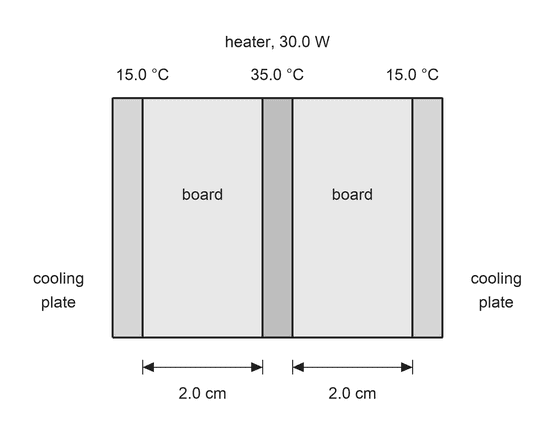
(a) How much heat flows through each board per second? Give a reason.
(b) Find the thermal conductivity of the material.
(c) What power would the heater need to keep its faces at if the cooling plates held the outer faces at instead?
- 141 mark
Question 14
A double-glazed window has two glass panes with a gap wide between them. Treat the gas in the gap as still, so that heat crosses it only by conduction, and keep the temperature difference across the gap the same. If the air in the gap () is replaced by argon (), the rate of heat flow across the gap
- 153 marks
Question 15
A hot-water storage tank has a total outer surface area of and is covered with polyurethane foam thick, of thermal conductivity . The water is kept at and the room is at . Treat the foam as a flat layer whose inner and outer faces are at the water and room temperatures. (Hypothetical data.)
(a) Find the rate of heat loss through the foam.
(b) Find the energy lost in one day, in joules and in kilowatt-hours.
(c) What thickness of the same foam would cut the rate of loss to ?
- 163 marks
Question 16
A pine plank is thick and has a face area of . The thermal conductivity of pine is . (Hypothetical data.)
(a) Find the thermal resistance of the plank for heat flowing through its thickness.
(b) Find the heat current through the plank when its two faces differ in temperature by .
(c) A thermocol sheet of the same area has thermal conductivity . How thick must it be to have the same thermal resistance as the plank?
- 174 marks
Question 17
Heat from a desktop processor passes, in turn, through a layer of thermal paste, a copper base plate and a finned heat sink into the air inside the computer case, as shown in the figure. The processor gives out . The paste is thick with thermal conductivity , and the copper base is thick with thermal conductivity ; both have a face of . The thermal resistance of the heat sink, from its base to the air, is , and the air is at . (Hypothetical data.)
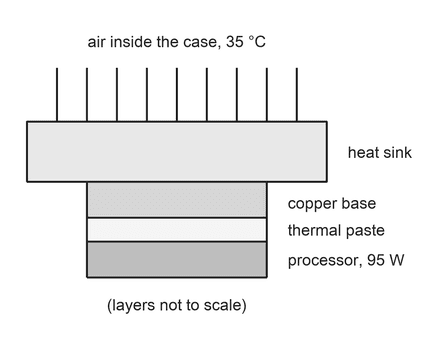
(a) Find the thermal resistances of the paste layer and of the copper base.
(b) Find the temperature of the top surface of the processor in the steady state.
(c) If the paste were left out, so that a layer of air thick (thermal conductivity ) filled the gap instead, what would this temperature become?
- 181 mark
Question 18
A wall panel of insulating board, thick with thermal conductivity , has a face area of . Steel pins (thermal conductivity ) pass straight through the board to hold it in place; their total area of cross-section is . The two faces of the panel are kept at fixed temperatures. (Hypothetical data.) The fraction of the total heat flow through the panel that is carried by the steel pins is about
- 193 marks
Question 19
The wall of a furnace has an inner layer of firebrick thick, of thermal conductivity , and an outer layer of insulating brick thick. In the steady state the inner face is at , the boundary between the layers is at and the outer face is at , as shown in the figure. (Hypothetical data.)
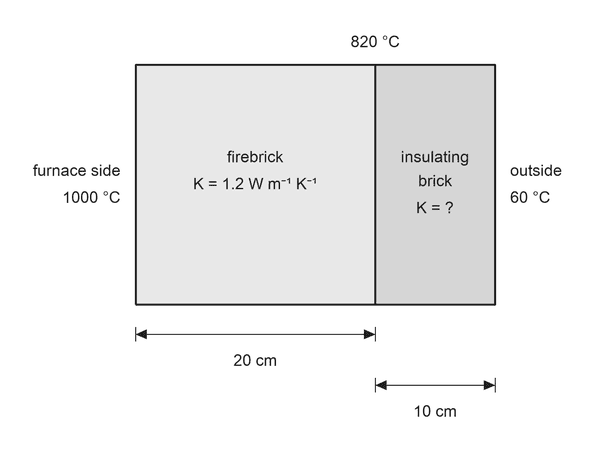
(a) Find the rate of heat flow through each square metre of the wall.
(b) Find the thermal conductivity of the insulating brick.
(c) Find the thermal resistance of each layer for of wall, and say which layer does more to keep the heat in.
- 201 mark
Question 20
A student wants a stack of cardboard sheets, each thick with thermal conductivity , pressed tightly together with no air between them, to have at least the same thermal resistance as a thermocol sheet thick with thermal conductivity . All the sheets have the same area. (Hypothetical data.) The smallest number of cardboard sheets needed is
- 213 marks
Question 21
In a Searle's experiment on a copper rod of diameter , the thermometers and are apart, as shown in the figure. In the steady state they read and . Water flowing through the coil enters at and leaves at , and of water is collected in . Take the specific heat capacity of water as . (Hypothetical data.)
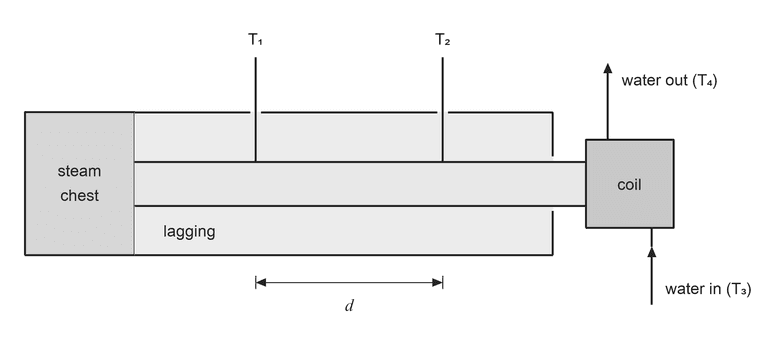
(a) Find the rate at which the water carries heat away.
(b) Find the thermal conductivity of copper.
(c) If in fact read a little too high, would the value of the thermal conductivity found be too large or too small? Explain.
- 221 mark
Question 22
In Searle's experiment, the readings of all four thermometers are taken only after they have stopped changing. This is necessary because, before then,
- 233 marks
Question 23
In a school laboratory, a Searle's apparatus fitted with a copper rod (thermal conductivity about ) warms the water flowing through its coil by in the steady state. A student suggests putting a glass rod of the same size (thermal conductivity about ) in its place to measure the conductivity of glass. (Hypothetical data.)
(a) If the same temperature difference were kept between and , how many times smaller would the heat current along the glass rod be?
(b) With the same rate of water flow, by how much would the water now warm?
(c) Use your answers to explain why Searle's method is not used for poor conductors such as glass.
- 242 marks
Question 24
Answer these questions about Searle's experiment.
(a) Why are the holes in the rod for the thermometers and filled with a little oil (or mercury) before the bulbs are put in?
(b) Why is a thick rod used, with the thermometers and placed well apart?
- 253 marks
Question 25
A Searle's apparatus is to be built for an aluminium rod of diameter (thermal conductivity ), with the thermometers and placed apart. In the steady state the temperature difference between them is expected to be about . (Hypothetical data.)
(a) Find the expected rate of heat flow along the rod.
(b) The water must warm by at least as it passes through the coil, so that its rise can be measured accurately. Find the greatest rate of water flow, in , that allows this. Take for water.
(c) In a trial run, poor lagging between and the coil lets 5 % of the heat escape before it reaches the water. Will the value of the thermal conductivity calculated from the readings be too large or too small, and by how much?
- 261 mark
Question 26
Heat can spread through the water in a fish tank by convection, but it cannot cross the glass wall of the tank by convection. This is because
- 271 mark
Question 27
In which of the following is heat carried mainly by forced convection?
- 283 marks
Question 28
The heat carried away each second by air flowing past a hot surface can be written as , where is the area of surface in contact with the air, the temperature of the surface, the temperature of the air and the convection coefficient. For still air (natural convection) is only a few ; moving air (forced convection by wind or a fan) gives a larger .
In bright sunshine, a rooftop solar (photovoltaic) panel of face area has to get rid of of heat. The panel is mounted on a frame with an air gap behind it, so both faces lose heat to the air, which is at . In this simple model, ignore radiation and take the whole panel to be at one temperature. (Hypothetical data.)
(a) Find the temperature of the panel in still air, when .
(b) Find its temperature in a steady breeze, when .
(c) In the same breeze, find the temperature if the panel were laid flat on the roof, so that only its front face lost heat. Hence explain why installers leave an air gap behind such panels.
- 293 marks
Question 29
A box has a glass front and two open glass chimneys, and , fixed over holes in its top, as shown. A lit candle stands inside the box directly under chimney . A piece of smouldering paper, which gives off smoke, is held just above the open top of chimney .
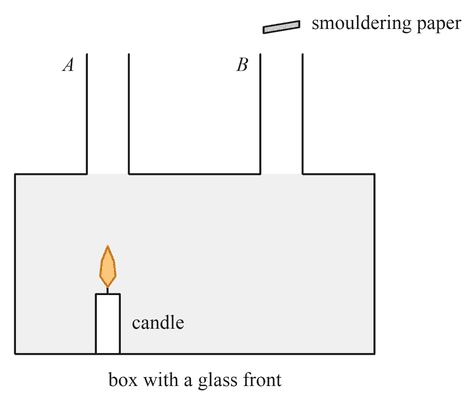
(a) Describe the path that the smoke takes.
(b) Explain why the air moves in this way.
(c) The candle is now moved so that it stands under chimney , and the smouldering paper is still held just above . What happens to the smoke now? Explain.
- 303 marks
Question 30
During a hard workout, litres of blood flow through the skin every minute. The blood arrives from the warm body core at and leaves the skin at . Take the density of blood as and its specific heat capacity as . (Hypothetical data.)
(a) Find the mass of blood that flows through the skin each second.
(b) Find the heat that the blood carries to the skin each second.
(c) Explain why this way of carrying heat is called forced convection.
- 311 mark
Question 31
For thermal radiation of a certain wavelength, a thin plastic sheet has a reflecting power of and a transmitting power of . (Hypothetical data.) At the same temperature and wavelength, the emissivity of a surface equals its absorptive power (Kirchhoff's law). What fraction of a black body's emission at that wavelength does the sheet give out?
- 322 marks
Question 32
A thermometer hangs in a room whose walls and air are at . A large block of ice is placed a short distance from the thermometer, without touching it, and the reading falls slightly. A student says that the ice sends out ‘cold rays’ which cool the thermometer. Use Prevost's theory of heat exchanges to give the correct explanation.
- 333 marks
Question 33
A small metal plate of emissivity hangs inside a large evacuated enclosure with black walls. Treat the plate as a grey body: its absorptive power is for radiation from the walls at any temperature. Take . (Hypothetical data.)
(a) The plate and the walls are both at . Find the power the plate gives out per square metre, and the power it absorbs per square metre from the walls.
(b) The walls are now quickly heated to . Just after this, while the plate is still at , find the net power that the plate gains per square metre.
(c) What happens to the plate's temperature after that, according to Prevost's theory?
- 341 mark
Question 34
A hollow metal cube is filled with hot water at . Its four side faces are finished differently: is matt black paint, is matt white paint, is dull (unpolished) aluminium and is polished aluminium. Each face in turn is turned to face a thermopile away (face is shown facing it), and the deflection of a galvanometer joined to the thermopile is noted. (Hypothetical data.)
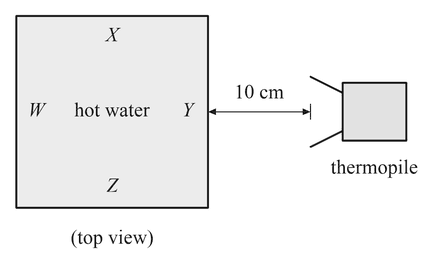
Face Deflection (divisions) 48 45 12 3 Which conclusion do these readings support?
- 353 marks
Question 35
On a clear, still winter night the air temperature stays at about . In the morning, frost has formed on the roof of a car parked in the open, but not on the roof of an identical car parked under a carport (a roof with no walls). Use Prevost's theory of heat exchanges to explain:
(a) why the roof of the car in the open became colder than the air around it;
(b) why the roof of the car under the carport did not.
- 361 mark
Question 36
A space-station module must get rid of of waste heat by radiation. A flat radiator panel faces deep space in the shade, so it absorbs almost no radiation, and only its outer face radiates. The panel is kept at and its surface has emissivity . (Hypothetical data.) Take . What area of panel is needed?
- 373 marks
Question 37
A small metal plate of area , coated with a dark paint, is heated electrically inside an evacuated chamber. The chamber walls are cooled with liquid nitrogen to , so the radiation the plate absorbs from them can be ignored. The power radiated by the plate is measured at four temperatures. (Hypothetical data.)
(K) 500 600 700 800 (W) 1.35 2.79 5.17 8.83 (a) Show that the readings obey .
(b) Find the emissivity of the paint. Take .
- 383 marks
Question 38
In a simple model, a thermal camera works out the temperature of a surface from the power per unit area that it receives from that surface, using Stefan's law with an emissivity that the user sets. A technician leaves the setting at , which is close to the value for skin and most paints, and points the camera at a polished metal pipe whose emissivity is only . The pipe is really at . Ignore any radiation that the pipe reflects from its surroundings. (Hypothetical data.) Take .
(a) Find the power per unit area that the pipe gives out.
(b) Find the temperature that the camera displays.
(c) Suggest how the technician could get a correct reading.
- 391 mark
Question 39
A closed wooden box is painted matt white on the inside, and a small hole is drilled in one side. Seen from outside in daylight, the hole looks darker than a patch of lamp black painted on the box beside it. Why?
- 403 marks
Question 40
The heating rod of an electric room heater is long and in diameter. When it is switched on, it glows at . Its surface has emissivity , and the room acts as a black enclosure at . The heater takes from the mains. Ignore the area of the rod's two ends. (Hypothetical data.) Take .
(a) Find the curved surface area of the rod.
(b) Find the net power that the rod loses by radiation.
(c) What percentage of the electrical power leaves the rod as radiation? How does the rest leave the rod?
- 413 marks
Question 41
A copper calorimeter of mass holds of water (mass ) and is left to cool in a room; it takes to cool from to . It is then emptied, dried and filled to the same level with of glycerine (mass ), which takes to cool through the same range in the same room. Take the specific heat capacity of copper as and of water as . (Hypothetical data.)
(a) Explain why the calorimeter loses heat at the same average rate in the two experiments.
(b) Find the specific heat capacity of glycerine.
- 421 mark
Question 42
A beaker of hot water cools in a room at , and its temperature (in ) is recorded at regular times . If Newton's law of cooling holds, which graph will be a straight line?
- 431 mark
Question 43
A pan of soup cools in a kitchen at . When the soup is at , its temperature is falling at per minute. Assuming that Newton's law of cooling holds, how fast is its temperature falling when it has cooled to ?
- 443 marks
Question 44
A small blackened body is surrounded by walls at . The net power it loses by radiation per unit area is , where is its temperature. Take . (Hypothetical data.)
(a) Find this loss per square metre when the body is at .
(b) A student assumes Newton's law of cooling (loss proportional to the excess temperature ) and uses the result of (a) to predict the loss per square metre at (). Find the student's prediction.
(c) Find the true loss per square metre at , and say what the comparison shows about when Newton's law of cooling can be used.
- 453 marks
Question 45
A teapot full of tea has a total heat capacity of and stands in a room at . When the tea is at , its temperature is falling at per minute. The teapot is then put on a warming plate that supplies heat to it at a steady . Assume that Newton's law of cooling holds over this range. (Hypothetical data.)
(a) Find the rate at which the teapot loses heat when the tea is at .
(b) Find the steady temperature at which the tea settles on the warming plate.
(c) What power should the plate supply to keep the tea at ?
- 461 mark
Question 46
The spectral radiancy of a black body is the power it emits per unit area of its surface per unit interval of wavelength, so that the total power per unit area is the area under the graph of against . The figure shows one thin strip of this area, of width .

Which gives the SI unit of and the unit of the area under the graph?
- 473 marks
Question 47
Thermal cameras are made for two wavelength bands in which the air is fairly transparent: a long-wave band from to and a mid-wave band from to . Treat each surface below as a black body, and take Wien's constant .
(a) Find the wavelength of maximum emission from human skin at .
(b) Find the wavelength of maximum emission from a car's exhaust pipe at .
(c) Which band suits each of these targets? Why can an ordinary camera not photograph a person in a completely dark room?
- 481 mark
Question 48
The Sun's surface is at about and the Earth's surface at about ; take Wien's constant . Gases such as carbon dioxide and water vapour keep the Earth's surface warmer than it would otherwise be. Which statement explains this greenhouse effect?
- 494 marks
Question 49
Wien's fifth power law says that the greatest spectral radiancy of a black body is proportional to . A black body is heated from to . The figure shows its – graph at . Take Wien's constant .
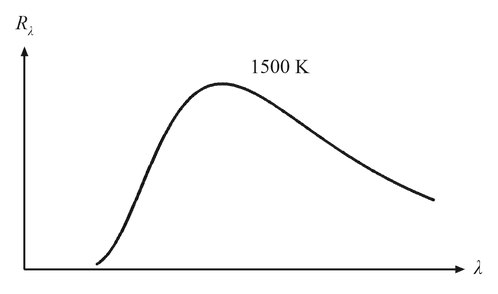
(a) Find the wavelength of maximum emission at each temperature.
(b) By what factor does the height of the peak of the – graph increase?
(c) By what factor does the total power radiated per unit area increase?
(d) The answers to (b) and (c) are different. Use the shape of the graphs to explain why.
- 501 mark
Question 50
A low-pressure sodium street lamp gives out yellow light of wavelength . A student puts this wavelength into Wien's displacement law, with , and gets a temperature of about for the glowing gas in the lamp. Why is this method wrong here?
- 512 marks
Question 51
Stainless steel cooking pans are preferred with an extra copper bottom. Why?
- 521 mark
Question 52
At what common temperature, would a block of wood and a block of metal feel equally cold or equally hot when touched?
- 532 marks
Question 53
Two metal rods 1 and 2 of the same length have same temperature difference between their ends. Their thermal conductivities are and and cross-sectional areas and respectively. What is the required condition for the same rate of heat conduction in them?
- 541 mark
Question 54
A thermal conductor is heated at one end. What is the theoretical value of its thermal conductivity in order that the other end also attains the same temperature?
- 552 marks
Question 55
Pieces of copper and glass are heated to the same temperature. Why does the piece of copper feel hotter on touching?
- 562 marks
Question 56
Thermal conductivity of air is less than that of felt, but felt is a better heat insulator in comparison to air. Why?
- 572 marks
Question 57
Woollen clothes are worn in winter, why?
- 582 marks
Question 58
Two shirts are warmer than a single shirt of double the thickness. Why?
- 592 marks
Question 59
‘The Earth without its atmosphere would be inhospitably cold’. Why?
- 602 marks
Question 60
“A solid sphere of copper of radius and a hollow sphere of the same material of inner radius and outer radius are heated to the same temperature and allowed to cool in the same environment. Which of them starts cooling faster?”
- 612 marks
Question 61
“A body with large reflectivity is a poor emitter”. Why?
- 622 marks
Question 62
What is the difference between radiation and thermal radiation?
- 632 marks
Question 63
“Water pipes are painted with aluminium paint”. Why?
- 641 mark
Question 64
Is it necessary that all black-coloured bodies to be regarded as perfectly black bodies?
- 652 marks
Question 65
Why do animals curl into ball during winter?
- 662 marks
Question 66
A car is left in sunlight on a hot day with all the windows closed. After sometime, it is found that the inside of the car is considerably warmer than the air outside. Why?
- 672 marks
Question 67
“Air is a bad conductor of heat, but still we do not feel warm without clothes”. Why?
- 681 mark
Question 68
If the temperature of a black body is raised from 300 K to 600 K, by what factor the rate of emission shall increase?
- 693 marks
Question 69
Two beakers, identical in all respects, but made of different materials, are filled with equal amounts of ice at 0 °C. The ice in one beaker melts in one minute whereas that in the other beaker melts in five minutes. Find the ratio of the thermal conductivities of the material of the two beakers.
- 703 marks
Question 70
Two rods and of same area of cross-section are joined together end to end. The free end of the rod is kept in melting ice at 300 K and free end of rod at 400 K. The rods are of the same length. The conductivity of is 3 times that of . Calculate the temperature of the junction of the rods.
- 713 marks
Question 71
Two identical metal rods and are joined end to end. The free end of is kept at 27 °C and the free end of at 37 °C. Calculate the temperature of the interface. Thermal conductivity of , that of .
- 723 marks
Question 72
Two plates of equal area are placed in contact with each other. The thickness of the plates are 2.0 cm and 3.0 cm respectively. The outer face of first plate is at −25 °C and that of second plate is at +25 °C. The conductivities of the plates are in the ratio 2 : 3. Calculate the temperature of the common surface of the plates.
- 733 marks
Question 73
The ratio of the thermal conductivities of two different materials is 1 : 2. The thermal resistance of the rods of these materials having the same thickness are equal. Find the ratio of the length of the rods.
- 743 marks
Question 74
Calculate the amount of radiant energy from a black body at a temperature of (i) 27 °C (ii) 2727 °C. .
- 753 marks
Question 75
Calculate the energy radiated per minute by a black body of surface area , maintained at 127 °C. .
- 763 marks
Question 76
A black body having an area of for its radiating surface radiates energy of 16.42 J in 15 minutes. What is the temperature of the body?
- 773 marks
Question 77
Calculate the maximum amount of heat which may be lost per second by radiation from a sphere of 10 cm in diameter and at a temperature of 227 °C when placed in an enclosure at a temperature of 27 °C. .
- 783 marks
Question 78
Calculate the energy radiated per minute from a filament of an incandescent lamp at 3000 K if the surface area is and its relative emittance is 0.425.
- 793 marks
Question 79
The energy radiated per hour from the surface of a filament 0.5 cm long and of radius 0.32 cm of an incandescent lamp at a certain temperature is J. If the relative emittance of the surface is 0.8, calculate the temperature of the filament.
- 803 marks
Question 80
Calculate the power of an incandescent lamp whose filament has a surface area of and is at a temperature of 3645 K. Emissivity of the surface is 0.4 and .
- 813 marks
Question 81
A black body of mass 0.010 g is kept in a black enclosure of temperature 27 °C. The temperature of the body is 127 °C and the area of the emitting surface is . If its specific heat capacity is , find the rate of cooling of the body. .
- 823 marks
Question 82
Considering the Sun as a perfect sphere of radius , calculate the energy radiated by it one minute. Take the temperature of the Sun as 5800 K and S.I. unit.
- 833 marks
Question 83
A sphere of radius 5 cm at 1027 °C is suspended in a vacuum in an enclosure at 127 °C. Assuming the sphere to be a black body, calculate the rate of loss of heat.
- 843 marks
Question 84
The surface temperature of a hot body is 1227 °C. Find the wavelength at which it radiates maximum energy. Given Wien's constant cm K.
- 853 marks
Question 85
Calculate the surface temperature of the Moon. Given that mm where is the wavelength of the maximum intensity of emission. Wien's constant cm K.
- 863 marks
Question 86
The operating temperature of an indirectly heated filament of a vacuum tube is around 1050 K. At what wavelength will it radiate maximum? Given cm K.
- 873 marks
Question 87
Calculate the temperature at which a body may appear (i) deep red (7900 Å) and (ii) blue (5000 Å).
- 883 marks
Question 88
The maximum temperature reached during an atomic explosion was of the order of K. Calculate the wavelength of maximum energy cm K.
- 893 marks
Question 89
If wavelengths of maximum intensity of radiations emitted by the Sun and the Moon are m and m respectively. Calculate the ratio of their temperatures.
- 901 mark
Question 90
A metal plate 4 mm thick has a temperature difference of between its faces. It transmits 200 kcal/h through an area of . Thermal conductivity of the material is
- 911 mark
Question 91
The two ends of a rod of length and a uniform cross-sectional area are kept at two temperature and . The rate of heat transfer, , through the rod in a steady state is given by
- 921 mark
Question 92
In which case, the thermal conductivity increases from left to right.
- 931 mark
Question 93
Heat current is the maximum in which of the following? (Rods are of identical dimension.)

- 941 mark
Question 94
Which of the following circular rods (given radius and length ) each made of the same material as whose ends are maintained at the same temperature will conduct the most heat?
- 951 mark
Question 95
Two rods and are equal lengths. Their ends are kept between the same temperature and their area of cross-sections are and and thermal conductivities and . The rate of heat transmission in the two rods will be equal, if
- 961 mark
Question 96
The coefficient of thermal conductivity depends upon
- 971 mark
Question 97
Consider a compound slab consisting of two different materials having equal thickness and thermal conductivities and respectively. The equivalent thermal conductivity of the slab is
- 981 mark
Question 98
Two identical bodies are made of a material for which the heat capacity increases with temperature. One of these is at , while the other one is at . If the two bodies are brought into contact, then assuming no heat loss, the final common temperature is
- 991 mark
Question 99
A cylindrical rod having temperature and at its ends. The rate of flow of heat is cal/s. If all the linear dimensions are doubled keeping temperature constant, then rate of flow of heat will be
- 1001 mark
Question 100
A body of length 1 m having cross sectional area has heat flow through it at the rate of 6000 Joule/s. Then find the temperature difference if .
- 1011 mark
Question 101
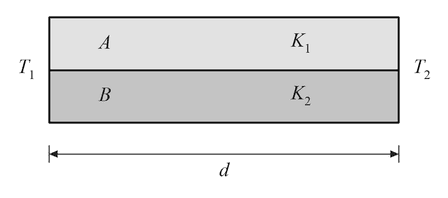
A slab, as shown in the figure, consists of two parallel layers of two different material of same thickness having thermal conductivities and . The equivalent conductivity of the combination is
- 1021 mark
Question 102
The freezer in a refrigerator is located at the top section so that
- 1031 mark
Question 103
It is hotter for the same distance over the top of a fire than it is in the side of it, mainly because
- 1041 mark
Question 104
In which of the following process, convection does not take place primarily?
- 1051 mark
Question 105
In heat transfer, which method is based on gravitation?
- 1061 mark
Question 106
A hot and a cold body are kept in vacuum separated from each other. Which of the following cause decrease in temperature of the hot body?
- 1071 mark
Question 107
Infrared radiation is detected by
- 1081 mark
Question 108
The Earth radiates in the infrared region of the spectrum. The spectrum is correctly given by
- 1091 mark
Question 109
We consider the radiation emitted by the human body. Which of the following statements is true?
- 1101 mark
Question 110
In which of the following heat travels in a straight line with the speed of light?
- 1111 mark
Question 111
For a perfectly black body, its absorptive power is
- 1121 mark
Question 112
Which of the following law states that "good absorbers of heat are good emitters"?
- 1131 mark
Question 113
The thermal radiation from a hot body travels with a velocity of
- 1141 mark
Question 114
An ideal black body at room temperature is thrown into a furnace. It is observed that
- 1151 mark
Question 115
Three objects coloured black, gray and white can withstand hostile conditions up to . These objects are thrown into a furnace where each of them attains a temperature of . Which object will glow brightest?
- 1161 mark
Question 116
If wavelengths of maximum intensity of radiations emitted by the Sun and the Moon are and respectively, the ratio of their temperatures is
- 1171 mark
Question 117
If black wire of platinum is heated, then its colour first appears red, then yellow and finally white. It can be understood on the basis of
- 1181 mark
Question 118
Flash light equipped with a new set of batteries, produces bright white light. As the batteries wear out
- 1191 mark
Question 119
A black body is at a temperature of 5760 K. The energy of radiation emitted by the body at wavelength 250 nm is , at wavelength 500 nm is and that at 1000 nm is . Wien's constant, . Which of the following is correct?
- 1201 mark
Question 120
A black body has maximum wavelength at temperature 2000 K. Its corresponding wavelength at temperature 3000 K will be
- 1211 mark
Question 121
If the radius of star is and it acts as a black body, what would be the temperature of the star, in which the rate of energy production is ? ( stands for Stefan's constant)
- 1221 mark
Question 122
Parallel rays of light of intensity are incident on a spherical black body kept in surroundings of temperature 300 K. Take Stefan–Boltzmann constant and assume that the energy exchange with the surroundings is only through radiation. The final steady state temperature of the black body is close to
- 1231 mark
Question 123
Energy is being emitted from the surface of black body at temperature at the rate of . Temperature of the black body at which the rate of energy emission is will be
- 1241 mark
Question 124
If the temperature of the Sun were to be increased from to and its radius from to , then the ratio of the radiant energy received on the Earth to what it was previously will be
- 1251 mark
Question 125
Assuming the Sun to have a spherical outer surface of radius radiating like a black body at temperature , the power received by a unit surface, (normal to the incident rays) at a distance from the centre of the Sun is (where is the Stefan's constant)
- 1261 mark
Question 126
A body of area is heated to a temperature 1000 K. The amount of energy radiated by the body in 1 s is (Stefan's constant )
- 1271 mark
Question 127
A spherical black body with a radius of 12 cm radiates 450 watt power at 500 K. If the radius were halved and the temperature doubled, the power radiated in watt would be
- 1281 mark
Question 128
Two black metallic spheres of radius 4 m, at 2000 K and 1 m at 4000 K will have ratio of energy radiation as
- 1291 mark
Question 129
The energy spectrum of a black body exhibits a maximum around a wavelength . The temperature of the black body is now changed such that the energy is maximum around a wavelength . The power radiated by the black body will now increase by a factor of
- 1301 mark
Question 130
Two beakers and are filled to the brim with water at . When is heated and is cooled, the water
- 1311 mark
Question 131
A sphere, a cube and a thin circular plate, all made of the same material and having the same mass, are initially heated to a temperature of . When left in air at room temperature, the following cools fastest
- 1321 mark
Question 132
A slab of stone of area and thickness 0.1 m is exposed on the lower surface to steam at . A block of ice at rests on the upper surface of the slab. In one hour, 4.8 kg of ice is melted. The thermal conductivity of slab is (given latent heat of fusion of ice )
- 1331 mark
Question 133
A heat source of is connected to another heat reservoir at by a copper slab which is 1 m thick. Given that the thermal conductivity of copper is , the energy flux through it in the steady state is
- 1341 mark
Question 134
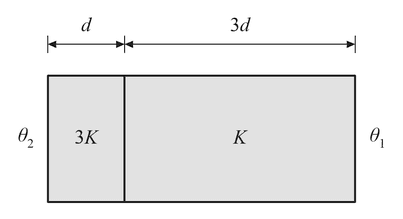
Two materials having coefficients of thermal conductivity '' and '' and thickness '' and '', respectively, are joined to form a slab as shown in the given figure. The temperatures of the outer surfaces are '' and '' respectively, . The temperature at the interface is
- 1351 mark
Question 135
The unit of thermal conductivity is
- 1361 mark
Question 136
A metallic sphere cools from to in 300 s. If atmospheric temperature around is , then the sphere's temperature after the next 5 minutes will be close to
- 1371 mark
Question 137
A cup of coffee cools from to in minutes, when the room temperature is . The time taken by a similar cup of coffee to cool from to at a room temperature same at is
- 1381 mark
Question 138
Two identical metal wires of thermal conductivities and respectively are connected in series. The effective thermal conductivity of the combination is
- 1391 mark
Question 139
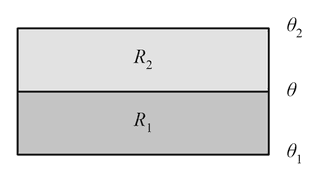
The temperature at the junction of two insulating sheets, having thermal resistances and as well as top and bottom temperatures and (as shown in the given figure) is given by
- 1401 mark
Question 140
A bowl filled with very hot soup cools from to in 2 minutes when the room temperature is . How long will it take to cool from to ?
- 1411 mark
Question 141
Assertion: For higher temperature, the peak emission wavelength of a black body shifts to lower wavelengths.
Reason: Peak emission wavelength of a blackbody is proportional to the fourth power of temperature.
- 1421 mark
Question 142
Assertion: Perspiration from human body helps in cooling the body.
Reason: A thin layer of water on the skin enhances its emissivity.
- 1431 mark
Question 143
Assertion: While measuring the thermal conductivity of liquid experimentally, the upper layer is kept hot and the lower layer is kept cold.
Reason: This avoids heating of liquid by convection.
- 1441 mark
Question 144
Initially a black body at absolute temperature is kept inside a closed chamber at absolute temperature . Now the chamber is slightly opened to allow sun rays to enter. It is observed that temperatures and remain constant. Which of the following statements is/are true?
(a) The rate of emission of energy from the black body remains the same.
(b) The rate of emission of energy from the black body increases.
(c) The rate of absorption of energy by the black body increases.
(d) The energy radiated by the black body equals the energy absorbed by it.
- 1451 mark
Question 145
A human body has a surface area of approximately . The normal body temperature is 10 K above the surrounding temperature . Take the room temperature to be . For , the value of (where is the Stefan–Boltzmann constant). Which of the following options is/are correct?
(a) The amount of energy radiated by the body in 1 second is close to 60 joule.
(b) If the surrounding temperature reduces by a small amount , then to maintain the same body temperature, the same (living) human being needs to radiate more energy per unit time.
(c) Reducing the exposed surface area of the body (e.g. by curling up) allows humans to maintain the same body temperature while reducing the energy lost by radiation.
(d) If the body temperature rises significantly, then the peak in the spectrum of electromagnetic radiation emitted by the body would shift to the longer wavelengths.
- 1461 mark
Question 146
A metal rod of length has its one end in ice at and the other end in water at . If a point on the rod is maintained at , then it is found that equal amounts of water and ice evaporate and melt per unit time. The latent heat of evaporation of water is 540 cal/g and latent heat of melting of ice is 80 cal/g. If the point is at a distance of from the ice end , find the value of . [Neglect any heat loss to the surrounding.]
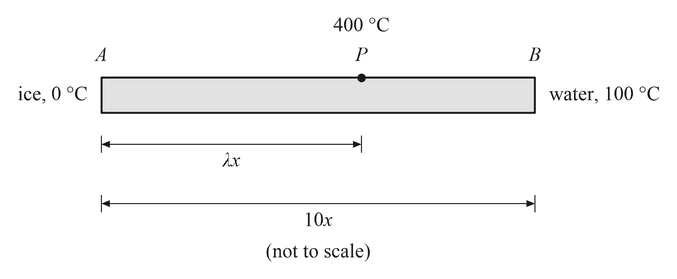
- 1471 mark
Question 147
Two plates and of thermal conductivity and are joined together as shown in the given figure to form a compound plate. The thickness of the plates are 4.0 cm and 2.5 cm respectively and the area of cross-section is for each plate. The equivalent thermal conductivity of the compound plate is , then the value of is ______.

- 1481 mark
Question 148
A body cools from to in 6 minutes. If the temperature of surroundings is , then after the next 6 minutes the temperature will be ______ .