
Heat from a desktop processor passes, in turn, through a layer of thermal paste, a copper base plate and a finned heat sink into the air inside the computer case, as shown in the figure. The processor gives out . The paste is thick with thermal conductivity , and the copper base is thick with thermal conductivity ; both have a face of . The thermal resistance of the heat sink, from its base to the air, is , and the air is at . (Hypothetical data.)
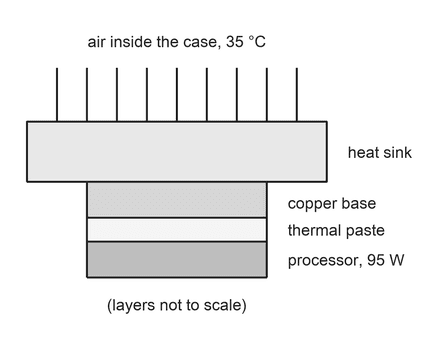
(a) Find the thermal resistances of the paste layer and of the copper base.
(b) Find the temperature of the top surface of the processor in the steady state.
(c) If the paste were left out, so that a layer of air thick (thermal conductivity ) filled the gap instead, what would this temperature become?