
Opening your dashboard
Class 11 Physics Chapter 17 Heat Transfer: Competency-Based Questions (CBQ)
52 questions on Chapter 17, each worked through on its own page with the AI tutor. Class 11 Physics, ICSE 2026-27.
52 questions
1–4 marks · Mixed difficulty
- 13 marks
Question 1
Competency: Application
A school science club builds a solar box cooker, as shown in the figure. Its walls are double, with glass wool packed between two metal sheets, and the inside of the box and the outside of the cooking pot are painted dull black. A sheet of glass forms the lid. At noon, sunlight of intensity falls normally on the lid, which measures . About 40 % of the energy reaching the lid ends up in the water in the pot. (Hypothetical data.)
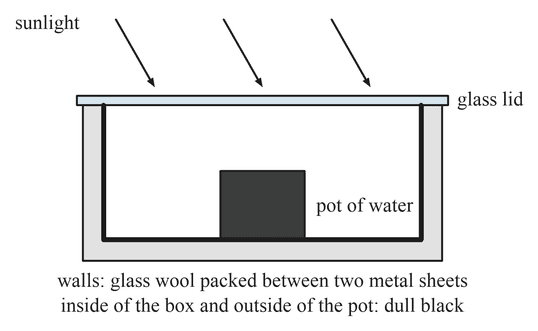
(a) By which mode does energy from the Sun reach the pot? Why are the inside of the box and the pot painted dull black?
(b) Which modes of heat loss do the glass wool and the closed glass lid each reduce? Explain briefly.
(c) The pot holds of water at . Taking the specific heat capacity of water as , estimate how long the cooker takes to heat the water to , if the 40 % share stays the same.
- 21 mark
Question 2
Competency: Application
Firefighters who must go close to a very large fire, such as a burning oil tank, wear proximity suits. Each suit has a shiny, aluminium-coated outer layer over several thick insulating layers. Close to such a fire, most of the heat reaching a firefighter comes as radiation from the flames, not from the air around. The shiny outer layer is there mainly to
- 33 marks
Question 3
Competency: Analysis & Evaluation
A student joins a copper rod and a rod of an unknown metal X end to end. The two rods have the same diameter, , and each is long. The joined rods are lagged along their whole length. The free end of the copper rod is kept in steam and the free end of rod X in melting ice, as shown in the figure.
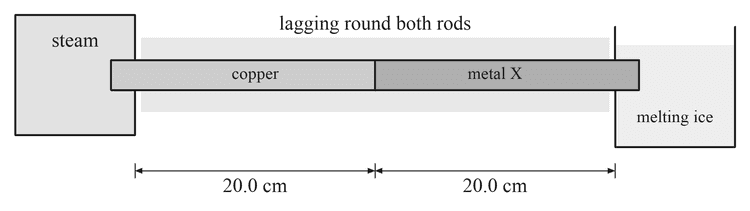
In the steady state, temperature sensors along the rods read:
Distance from the steam end (cm) 0.0 10.0 20.0 (joint) 30.0 40.0 Temperature () 100.0 89.0 78.0 39.0 0.0 Thermal conductivities (): copper 400, aluminium 205, brass 110, iron 80, lead 35. (Hypothetical data.)
(a) Find the temperature gradient in each rod.
(b) Use your answers to find the thermal conductivity of metal X, and identify the metal from the list.
(c) Find the rate at which heat flows along the rods.
- 41 mark
Question 4
Competency: Analysis & Evaluation
In a canteen, boiling water is poured into two tumblers made of the same kind of ordinary glass. One tumbler has thin walls and the other has much thicker walls.
Assertion (A): The thick-walled tumbler is more likely to crack than the thin-walled one.
Reason (R): Glass is a poor conductor of heat, so the inner surface of a thick wall heats up and expands well before its outer surface does, and the large temperature difference across the wall strains the glass.
- 53 marks
Question 5
Competency: Application
On a Himalayan expedition, two climbers shelter for the night in a snow cave dug into a deep snowdrift. The walls and roof of packed snow are thick and have thermal conductivity . Treat them as a flat slab of area whose outer surface stays at . Each climber, resting, gives out heat at about ; assume that all this heat leaves by conduction through the snow. The inner surface of the snow must not rise above , or it starts to melt and drip. (Hypothetical data.)
(a) Find the temperature of the inner surface of the snow in the steady state.
(b) Find the greatest rate at which heat can flow out through the snow without the inner surface rising above .
(c) The climbers want to run a small stove inside for warmth. What is the largest extra steady power the stove could add without the snow starting to melt? What would happen if they ran a stove for a long time?
- 63 marks
Question 6
Competency: Analysis & Evaluation
In a classic demonstration, rods of copper, aluminium and steel, all of the same length and diameter, are coated with a thin layer of wax and fixed through the side of a tank of boiling water, as shown in the figure. Heat flows along each rod, and some of it is lost to the air from the rod's sides. After a long time the wax has melted along of the copper rod, of the aluminium rod and of the steel rod. For rods of the same size and surface, losing heat to the same surroundings, the length along which the wax melts in the steady state is proportional to , where is the thermal conductivity of the rod. Take for copper. (Hypothetical data.)
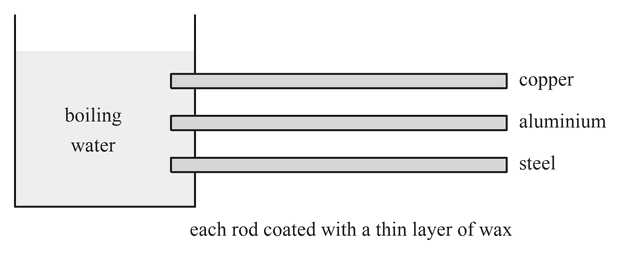
(a) Why must the rods have the same size and the same coating?
(b) Find the thermal conductivities of aluminium and steel.
(c) Why are the lengths read only after a long time, when the wax has stopped melting any farther along the rods?
- 74 marks
Question 7
Competency: Analysis & Evaluation
On a winter night in a hill-station hotel, the air in a room is at and the air outside is at . The window is a single sheet of glass thick, of thermal conductivity . Heat crossing the window must also pass through a thin layer of almost still air on each face of the glass. For each square metre of window, the thermal resistance of this air layer is on the room side and on the outside. Water vapour in the room air condenses on any surface colder than (the dew point of the room air). (Hypothetical data.)
(a) Find the thermal resistance of the glass itself, for each square metre of window.
(b) Find the rate of heat flow through each square metre of the window, and the temperature of the inner surface of the glass. Will the window mist up?
(c) The hotel fits double glazing: two such sheets of glass with a sealed air gap between them, whose thermal resistance is for each square metre. Find the new temperature of the inner surface of the glass. Will the window mist up now?
- 81 mark
Question 8
Competency: Analysis & Evaluation
The door of a refrigerator is a sandwich of three flat layers: an outer steel sheet thick (), a layer of polyurethane foam thick () and an inner plastic liner thick (). The temperatures of the outer and inner faces of the door stay the same. (Hypothetical data.) Which single change would cut the heat flowing in through the door the most?
- 91 mark
Question 9
Competency: Analysis & Evaluation
The outer wall of a classroom is made of brick, with a wooden door set in it. Heat leaves the room through the brick part of the wall and through the door side by side. The inner faces of the brick and of the door are at the same temperature, and so are their outer faces.
Assertion (A): Of the brick part and the door, the one with the greater thermal resistance carries the greater heat current.
Reason (R): For two parts side by side (in parallel), the temperature difference across each is the same, so the heat current through each is inversely proportional to its thermal resistance.
- 103 marks
Question 10
Competency: Analysis & Evaluation
A student uses Searle's apparatus, shown in the figure, to find the thermal conductivity of a brass rod of diameter . The thermometers and in the rod are apart, and in the steady state they read and . From the readings of and and the rate of flow of the water through the coil, the student correctly finds that the water carries heat away from the rod at .
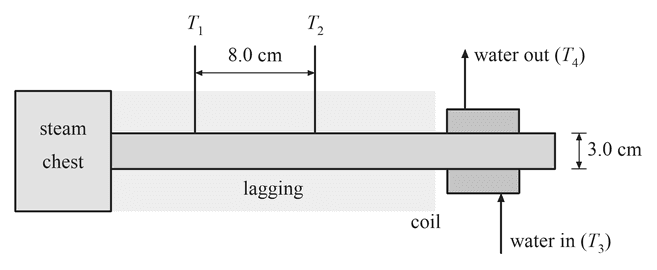
The student then takes the area of cross-section of the rod to be , where is its diameter, and gets . The student concludes that the rod cannot be brass, since brass has a thermal conductivity of about . (Hypothetical data.)
(a) Find the correct value of the thermal conductivity of the rod.
(b) Explain the student's mistake, and show that it accounts for the student's value exactly.
(c) The student had checked that the unit of the answer came out as . Explain why this check could not catch the mistake, and suggest a check that would have caught it.
- 111 mark
Question 11
Competency: Analysis & Evaluation
In Searle's experiment a student records the readings of and , the distance between them, the diameter of the rod, the temperatures of the water entering and leaving the coil, and the mass of water that flows through the coil in a measured time. The student does not record the temperature of the steam in the steam chest.
Assertion (A): The student can still find the thermal conductivity of the rod.
Reason (R): The steam keeps the hot end of the rod at a steady temperature, which is needed for the readings to settle into a steady state.
- 121 mark
Question 12
Competency: Application
A salt-gradient solar pond is a pond 2 to 3 metres deep with a dark bottom, in which the water is made much saltier near the bottom than near the top. In sunshine, the water near the bottom becomes as hot as about , while the water at the surface stays close to the temperature of the air, and the hot water can be drawn off for heating. The hot water at the bottom stays there, instead of rising to the surface, mainly because
- 131 mark
Question 13
Competency: Analysis & Evaluation
Astronauts on board the International Space Station, which is in free fall around the Earth, have studied how candles and other small flames burn.
Assertion (A): On the space station a candle flame is nearly spherical, not the tall, pointed shape seen on the Earth.
Reason (R): In the free fall of orbit, the hot gases round the flame are not pushed upward by buoyancy, so natural convection almost stops.
- 143 marks
Question 14
Competency: Analysis & Evaluation
On many winter mornings in Delhi, smoke and dust hang in a thick layer close to the ground. A school weather club measures the air temperature just above the ground and higher, using a sensor on a tethered balloon, at 7 a.m. on a still winter morning and again at 2 p.m. on the same sunny day:
Time At 2 m At 100 m 7 a.m. 2 p.m. Smoke from a small fire near the ground is watched at both times. (Hypothetical data.)
(a) At 2 p.m. the smoky air near the ground rises and spreads upward. Explain why, using the readings.
(b) At 7 a.m. the smoke spreads out sideways in a layer close to the ground. Explain why.
(c) On a sunny day the smoky layer usually clears by about noon. Explain how, naming the modes of heat transfer involved.
- 151 mark
Question 15
Competency: Analysis & Evaluation
Two identical copper spheres at , one polished and the other coated with lamp black, are hung by fine threads inside an evacuated oven whose walls are kept at . Heat reaches the spheres only by radiation.
Assertion (A): The polished sphere warms up faster than the blackened sphere.
Reason (R): A surface that is a poor absorber of thermal radiation is also a poor emitter of it.
- 161 mark
Question 16
Competency: Analysis & Evaluation
During a health check at a school gate, a teacher measures foreheads with a non-contact infrared thermometer. It works out a temperature from the thermal radiation of wavelengths to that reaches it from the surface it is pointed at. A child is sitting in a car with its windows closed, so the teacher points the thermometer at the child's forehead through the closed glass window. It reads about , far below a normal skin temperature. The best explanation is that
- 173 marks
Question 17
Competency: Application
A lunar lander measures the temperature of the Moon's surface. Sunlight reaching the Moon has an intensity of about , and the Moon has no atmosphere. Treat a small patch of the dusty surface as a black body that absorbs all the sunlight falling on it and loses heat only by radiation from its upper surface; the lunar dust is so poor a conductor that heat conducted into the ground can be ignored. Take . (Hypothetical data.)
(a) Find the steady temperature of a patch when the Sun is directly overhead.
(b) At a lunar latitude of about , the noon Sun stands only about above the horizon, so each square metre of level ground there receives only about times as much sunlight. Find the steady temperature of a patch there at noon.
(c) During the long lunar night a patch cools to about . Find the power it still radiates per square metre, and explain why the Moon's night side gets far colder than the Earth does at night.
- 181 mark
Question 18
Competency: Analysis & Evaluation
A student heats a small black body so that its temperature doubles on the Celsius scale, from to , and compares the total power it emits at the two temperatures.
Assertion (A): The total power it emits rises by a factor of only about , not .
Reason (R): The power emitted by a black body is proportional to the fourth power of its temperature in degrees Celsius.
- 191 mark
Question 19
Competency: Application
Two stars, X and Y, have spectra of exactly the same shape, with the same wavelength of maximum emission, so their surfaces are at the same temperature. Measurements show that star X gives out 100 times as much power as star Y. Treating both stars as spherical black bodies, the ratio of the radius of X to the radius of Y is
- 203 marks
Question 20
Competency: Analysis & Evaluation
Rohan pours of hot coffee at into a mug in a room at . He also has of cold milk at from the refrigerator, and he wants his drink to be as cool as possible after 10 minutes. He can either (i) add the milk at once and wait 10 minutes, or (ii) wait 10 minutes and then add the milk. By Newton's law of cooling, the excess of the drink's temperature over the room temperature falls by the same fraction in every equal interval of time; take it to fall to of its value in 10 minutes in either case. Take the specific heat capacities of milk and coffee to be equal, ignore the heat taken by the mug, and assume that the milk stays at until it is added. (Hypothetical data.)
(a) Find the temperature of the drink after 10 minutes with plan (i).
(b) Find the temperature of the drink just after the milk is added with plan (ii).
(c) Which plan gives the cooler drink? Use Newton's law of cooling to explain why.
- 211 mark
Question 21
Competency: Analysis & Evaluation
A steel tumbler of hot milk is left to cool in a room at . A student records its temperature every minute, works out the rate of fall of temperature at several moments, and plots this rate against the excess temperature . During the experiment the excess temperature stays below about .
Assertion (A): The plotted points lie close to a straight line through the origin.
Reason (R): By Newton's law of cooling, the rate of fall of temperature of a body is proportional to its absolute temperature.
- 221 mark
Question 22
Competency: Application
A rubber hot-water bag is filled at and placed under a blanket in a room at . The excess of its temperature over the room temperature is found to halve every 40 minutes, as Newton's law of cooling predicts. (Hypothetical data.) About how long after filling will the bag have cooled to ?
- 233 marks
Question 23
Competency: Application
Radio telescopes and satellites detect a faint glow of radiation coming almost equally from every direction in the sky. It is called the cosmic microwave background, and its spectrum matches that of a black body at extremely closely. Astronomers explain it as radiation given out when the young universe had cooled to about ; since then, as the universe has expanded, every wavelength in this radiation has been stretched by the same factor. Take Wien's constant and .
(a) Find the wavelength of maximum emission of this radiation today, and name the region of the electromagnetic spectrum it lies in.
(b) Find the wavelength of maximum emission when the radiation was given out, and hence the factor by which its wavelengths have been stretched.
(c) Find the power per square metre radiated by a black body at . Compare it with that radiated by a black body at room temperature, , and say why the detectors that measure this radiation are cooled to very low temperatures.
- 241 mark
Question 24
Competency: Analysis & Evaluation
A student compares the curves of spectral radiancy against wavelength for one black body, first at and then at .
Assertion (A): At every wavelength the body emits more power per unit area per unit wavelength interval at than at , so the two curves never cross.
Reason (R): The wavelength at which is greatest is shorter at the higher temperature.
- 251 mark
Question 25
Competency: Application
The tungsten filament of an ordinary incandescent bulb glows at about . Treated as a black body at this temperature, it gives out only about 5 % of its radiation as visible light (wavelengths from about 400 nm to 700 nm). Take Wien's constant . The main reason for this small share is that
- 263 marks
Question 26
An iron plate area, thick has its opposite faces maintained at 373 K and 223 K respectively. How much heat flows through the plate per second? Thermal conductivity of iron .
- 273 marks
Question 27
Calculate the rate of flow of heat through a metal sheet 0.02 m thick and area with its two sides at 273 K and 293 K respectively. Given .
- 283 marks
Question 28
Steam at 373 K is passed through a tube of radius 0.5 m and length 3 m. If the thickness of the tube is 2 mm and in C.G.S. units, find the rate of loss of heat in . Room temperature is 9 °C.
- 293 marks
Question 29
A cylindrical metallic rod 0.5 m long conducts heat at the rate of when its ends are kept at 400 °C and 0 °C respectively. Coefficient of thermal conductivity of metal is . What is the diameter of rod?
- 303 marks
Question 30
The glass windows of a room have a total area of and glass thickness is 3 mm. Calculate the rate at which heat escapes from the room per minute by conduction when the inside of the windows is at a temperature 15 °C and the outside temperature is −10 °C. Thermal conductivity .
- 313 marks
Question 31
Heat is flowing through two cylindrical rods of the same material. The diameters of the rods are in the ratio 1 : 2 and their lengths are in the ratio 2 : 1. If the temperature difference between their ends is the same, then find the ratio of amounts of heat conducted through them per unit time.
- 323 marks
Question 32
One face of a cube of side 0.2 m is in contact with ice and the opposite face is in contact with steam. If all other sides are well lagged, calculate the mass of ice that melts during one hour. Thermal conductivity of the metal . L.H. of fusion of ice .
- 333 marks
Question 33
The opposite faces of a cubical block of iron of cross-section are kept in contact with steam and melting ice. Calculate the amount of ice melted at the end of 5 minutes. Given .
- 343 marks
Question 34
A copper rod of length 60 cm long and 8 mm in radius is taken and its one end is kept in boiling water and the other end in ice at 0 °C. If 72 g of ice melts in one hour, what is the thermal conductivity of copper? Latent heat of fusion of ice .
- 353 marks
Question 35
One side of an iron plate one metre square is kept at 100 °C and the other side is at 0 °C. The thickness of the plate is 1 cm. If all the heat conducted across the plate in one minute is used in melting ice, calculate the amount of ice so melted. Thermal conductivity of iron in C.G.S. unit and L.H. of fusion of ice cal/g.
- 363 marks
Question 36
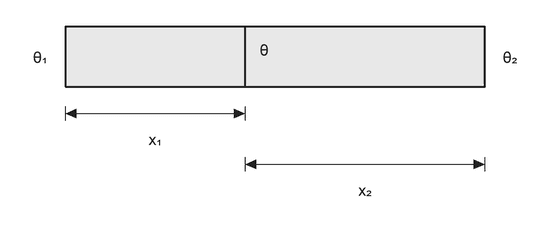
Show that in a compound slab, the temperature gradient in each position is inversely proportional to the thermal conductivity.
- 373 marks
Question 37
A slab consists of two parallel layers of iron and brass 10 cm and 10.9 cm thick and of thermal conductivities and respectively. The area of opposite faces are each and are at temperatures 373 K and 273 K. Find heat conducted per second across the slab and also the temperature of the interface.
- 383 marks
Question 38
An ice box is built of wood of thickness 1.75 cm. The box has an inner lining of cork 2 cm thick. If the difference in temperature between the interior of the box and outside is 12 °C, calculate the temperature of the interface between wood and cork. Thermal conductivity of wood and cork are respectively 0.25 and 0.05 in S.I. unit.
- 393 marks
Question 39
Two identical sheets of metal are welded end to end as shown in Fig. (a). 20 J of heat flows through it in 4 min. If the sheets are welded as shown in Fig. (b), find the time taken for the same amount of heat to flow through the sheets.

- 403 marks
Question 40
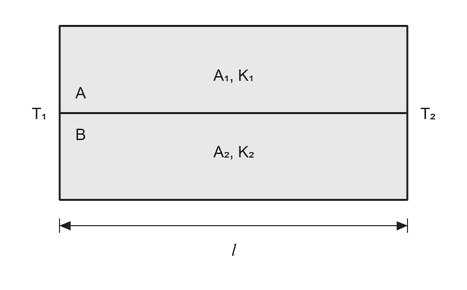
Calculate the thermal conductivity of the composite rod shown in the given figure. The two rods and are made of two different materials of thermal conductivities and and are welded together.
- 413 marks
Question 41
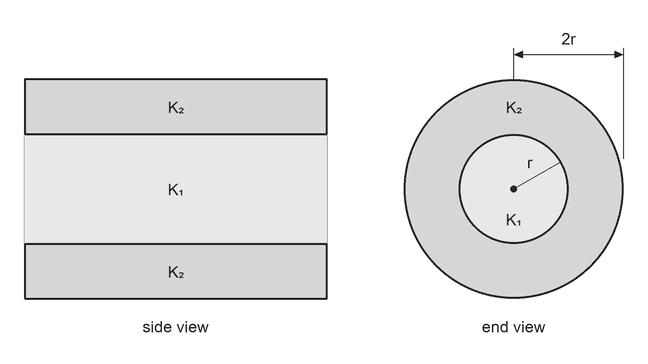
A cylinder of radius made of a material of thermal conductivity is surrounded by a cylindrical shell of inner radius and outer radius made of a material of thermal conductivity . The two ends of the combined system are maintained at two different temperatures. There is no loss of heat across the cylindrical surface and the system is in steady state. Show that the effective thermal conductivity of the system is .
- 423 marks
Question 42
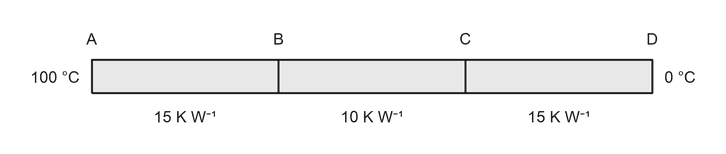
Three rods , and are connected as shown in the given figure. They are of the same length and area of cross-section. The thermal resistance of is , is and is . If the free ends are maintained at 100 °C and 0 °C, calculate the rate of heat flowing through the combination.
- 433 marks
Question 43
Four rods are joined and their free ends are maintained at 100 °C and 30 °C as shown in the given figure. What is the temperature of the junction ? The thermal resistances of rods and are each and those of rods and are each.
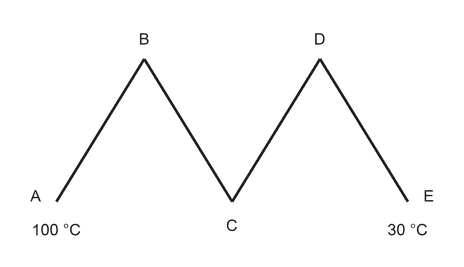
- 443 marks
Question 44
A thin brass rectangular sheet of sides 10 cm and 5 cm is heated in a furnace to 500 °C and taken out. How much electric power is needed to maintain the sheet at this temperature? Its emissivity is 0.25.
- 453 marks
Question 45
The temperature of an electric bulb changes from 2000 K to 3000 K due to a.c. voltage fluctuations. Calculate the percentage rise in electric power consumed.
- 463 marks
Question 46
If each square cm of the Sun's surface radiates energy at the rate of , calculate the temperature of the Sun's surface in degree celsius, assuming Stefan's law applies to the radiation. (Stefan's constant )
- 473 marks
Question 47
Two stars radiate maximum energy at wavelength and respectively. What is the ratio of their temperatures?
- 483 marks
Question 48
The temperature of a furnace is 2324 °C and the intensity is maximum in its radiation spectrum nearly at 12000 Å. If the intensity in the spectrum of a star is maximum nearly at 4800 Å, calculate the surface temperature of the star.
- 493 marks
Question 49
A black body emits radiations of maximum intensity at a wavelength of 5000 Å when the temperature of the body is 1227 °C. If the temperature of the body is increased by 1000 °C, calculate the wavelength corresponding to the maximum intensity.
- 503 marks
Question 50
Two black bodies and emit radiations with peak intensities at wavelengths 4000 Å and 8000 Å respectively. Compare the total energy emitted per unit area per second by the two bodies.
- 513 marks
Question 51
A body cools from 60 °C to 50 °C, the temperature of the surroundings being 25 °C. What will be its temperature after another 6 minutes?
- 524 marks
Question 52
A body initially at 80 °C cools to 64 °C in 5 minutes and to 52 °C in 10 minutes. What will be the temperature after 15 minutes and what is the temperature of the surroundings?