
Competency: Analysis & Evaluation
A student uses Searle's apparatus, shown in the figure, to find the thermal conductivity of a brass rod of diameter . The thermometers and in the rod are apart, and in the steady state they read and . From the readings of and and the rate of flow of the water through the coil, the student correctly finds that the water carries heat away from the rod at .
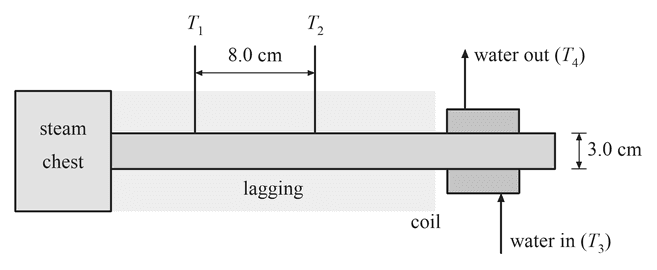
The student then takes the area of cross-section of the rod to be , where is its diameter, and gets . The student concludes that the rod cannot be brass, since brass has a thermal conductivity of about . (Hypothetical data.)
(a) Find the correct value of the thermal conductivity of the rod.
(b) Explain the student's mistake, and show that it accounts for the student's value exactly.
(c) The student had checked that the unit of the answer came out as . Explain why this check could not catch the mistake, and suggest a check that would have caught it.