
Opening your dashboard
Class 11 Physics Chapter 15: Surface Tension Solutions
58 textbook questions with step-by-step answers, free to read, for ISC 2026-27.
Get talked through Ch 15, not just shown the answer
Reading a finished solution is not the same as being able to do it. The AI tutor takes one question at a time and works it with you, in your own words, until you can.
- Ask it out loud, in your own words
- It gives you the next step, not the answer
- Stuck on part (ii)? Start there
58 questions with solutions
1–5 marks · Mixed difficulty
The first 52 solutions are on this page. This chapter is a long one, so the rest open on their own page to keep this one quick to load.
- 11 mark
Question 1
A iron needle slowly placed on the surface of water floats on it because
Solve with AIAnswer
(A) when inside water, it will displace water more than its weight
(B) the density of the material of the needle is less than that of water
- Correct
(C) of its surface tension
(D) of its shape
Answer: (C) Of its surface tension
Concept: The surface of a liquid behaves like a stretched membrane because of surface tension. A light object placed gently on it makes a small dent, and the surface tension along the edges of the dent pulls upward on it.
Step 1 — See what holds the needle up. The needle presses the water surface down into a shallow groove. The surface on each side pulls along itself, at an angle above the horizontal, so these pulls have upward components. Together they balance the weight of the needle.
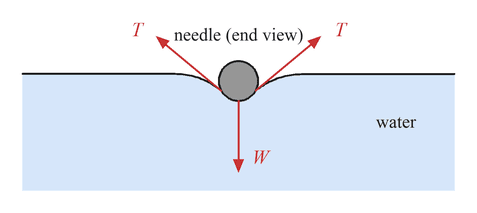
Step 2 — Name the cause. The pulls in the figure are forces of surface tension, so the needle floats because of the surface tension of water (the "its" in the option refers to the water).
- (A) Iron is about 7.9 times as dense as water, so a needle fully inside water displaces water weighing only about one-eighth of its own weight; that is why it sinks once it breaks through the surface.
- (B) Iron (about ) is far denser than water (), so buoyancy alone could never hold the needle up.
- (D) A long, thin shape does help, because it gives a long line of contact for a small weight; but the shape only works through the surface tension, and the same needle sinks if it is pushed under the surface.
Therefore, the answer is (C): the needle floats because of the surface tension of the water.
- 21 mark
Question 2
A needle can float on clear water but sinks when some detergent is added to it. This happens because
Solve with AIAnswer
(A) addition of detergent increases the density of water
(B) addition of detergent reduces the density of water
- Correct
(C) addition of detergent reduces the surface tension of water
(D) addition of detergent increases the surface tension of water
Answer: (C) Addition of detergent reduces the surface tension of water
Concept: A needle floats on clean water because the upward components of the surface-tension forces along the dent it makes balance its weight. These forces are proportional to the surface tension of the water.
Step 1 — See what the detergent changes. A detergent lowers the surface tension of water a great deal, so the upward pull of the surface on the needle becomes smaller.
Step 2 — Conclude. When this pull becomes less than the weight of the needle, the needle breaks through the surface and sinks.
- (A) A little detergent hardly changes the density of water, and a denser liquid would push up more, not less, so this could not make the needle sink.
- (B) The density barely changes, and buoyancy is not what held the needle up in the first place; iron is far denser than water either way.
- (D) Detergents lower the surface tension of water; a larger surface tension would hold the needle up more firmly.
Therefore, the answer is (C): the detergent reduces the surface tension of water.
- 31 mark
Question 3
The work done to blow a soap bubble of radius (surface tension )
Solve with AIAnswer
(A)
(B)
(C)
- Correct
(D)
Answer: (D)
Concept: The work done in forming a liquid surface at constant temperature equals surface tension × increase in surface area. A soap bubble is a thin film, so it has two surfaces, an outer one and an inner one.
Step 1 — Find the area of one surface. Each surface of a bubble of radius is a sphere of area .
Step 2 — Add the two surfaces. The total new surface area is
Step 3 — Find the work done. The work done is the surface tension times this area:
- (A) This counts only one surface of the film; a liquid drop has one surface, but a bubble has two.
- (B) This uses , the area of a flat circle of radius , instead of the surface area of a sphere.
- (C) This uses , the area of a hemisphere, which is only a quarter of the total area of the two surfaces.
Therefore, the work done is , option (D).
- 41 mark
Question 4
A drop of oil is placed on the surface of water. Which of the following statement is correct?
Solve with AIAnswer
(A) it will remain on it as a sphere
- Correct
(B) it will spread as a thin layer
(C) it will partly be as spherical droplets and partly as thin film
(D) it will float as a distorted drop on the water surface
Answer: (B) It will spread as a thin layer
Concept: At the edge of an oil drop on water, three surfaces meet: water–air, oil–air and oil–water. The water–air surface pulls the edge outward, while the other two pull it inward. A liquid spreads when the outward pull is the larger.
Step 1 — Compare the pulls. The surface tension of water (about ) is much larger than that of common oils (about ). For an oil such as olive oil, the outward pull of the water surface is larger than the inward pulls of the oil–air and oil–water surfaces together.
Step 2 — Find the result. The edge of the drop keeps being pulled outward, so the oil spreads into a thin layer over the water.
- (A) A free drop is spherical only when its own surface tension is the only force on it; here the water surface pulls its edge outward all round.
- (C) The unbalanced outward pull acts all round the edge, so the whole drop spreads; it does not stay partly as droplets.
- (D) This is not what happens to an ordinary spreading oil such as olive oil, which flattens into a thin layer rather than staying as a drop.
Note: A few oils, such as liquid paraffin, have so little attraction for water that they do stay on it as flattened lens-shaped drops; the expected answer, as the book states, is the common case of an oil that spreads.
Therefore, the answer is (B): the oil drop spreads as a thin layer on the water.
- 51 mark
Question 5
At critical temperature, the surface tension of a liquid
Solve with AIAnswer
- Correct
(A) is zero
(B) is infinity
(C) is the same as that at any other temperature
(D) cannot be determined
Answer: (A) Is zero
Concept: The surface tension of a liquid decreases as its temperature rises. At the critical temperature the liquid and its vapour become identical, so there is no surface separating them.
Step 1 — Follow the trend. As the temperature rises, the cohesive forces become weaker and the surface tension falls steadily.
Step 2 — Apply it at the critical temperature. At the critical temperature there is no longer a liquid surface at all, so there is nothing to have a surface tension: its value has fallen to zero.
- (B) Surface tension falls as the temperature rises, so it cannot grow to an infinite value at the highest temperature at which a surface exists.
- (C) Surface tension depends on temperature; it is largest at low temperatures and falls as the temperature rises.
- (D) It can be stated: with no surface between liquid and vapour, the surface tension is zero.
Therefore, at the critical temperature the surface tension of a liquid is zero, option (A).
- 61 mark
Question 6
Two spherical soap bubbles of radii and in vacuum coalesce under isothermal conditions. The resulting bubble has a radius such that
Solve with AIAnswer
(A)
(B)
- Correct
(C)
(D)
Answer: (C)
Concept: The air inside a soap bubble of radius is at an excess pressure over the outside. In vacuum the outside pressure is zero, so the air inside is at pressure . At constant temperature (Boyle's law), when the two lots of air are joined, the sum of stays the same.
Step 1 — Write for one bubble. A bubble of radius has
Step 2 — Apply Boyle's law to the joined bubbles. The air of both bubbles ends up in one bubble of radius , so
Step 3 — Simplify. We cancel from every term:
Check: The surface area of the new bubble, , equals the total area of the two old bubbles, so in vacuum the surface energy does not change either.
- (A) The average of the radii fails the test of two equal bubbles of radius : their average is just , but the air of two bubbles needs a radius of .
- (B) Read as , it gives for two equal bubbles, a bubble smaller than either of the two; as literally printed, is just . Neither satisfies .
- (D) Adding the radii gives for two equal bubbles, which is larger than the required .
Therefore, the radius of the new bubble is , option (C).
- 71 mark
Question 7
Energy needed in breaking a drop of radius into drops of radius , is
where is surface tension and is atmospheric pressure.
Solve with AIAnswer
- Correct
(A)
(B)
(C)
(D)
Answer: (A)
Concept: At constant temperature, the energy needed to make new liquid surface is surface tension × increase in surface area. A drop has one surface.
Step 1 — Find the area before. The big drop of radius has surface area .
Step 2 — Find the area after. Each small drop has area , so the drops together have area . (Since the volume is unchanged, , so is smaller than and the total area grows.)
Step 3 — Find the energy. The increase in area is , so the energy needed is
- (B) This uses , the factor in the volume of a sphere, instead of , the factor in its surface area, so it gives only one-third of the correct energy.
- (C) This counts the area of the big drop times instead of once; for eight drops of half the radius it gives , while the true energy is only .
- (D) Pressure × area is a force, not an energy, so atmospheric pressure cannot replace surface tension here; the bracket also has the wrong sign, since the area increases.
Therefore, the energy needed is , option (A).
- 81 mark
Question 8
Soap helps in cleaning the clothes because
Solve with AIAnswer
- Correct
(A) it reduces the surface tension of solution
(B) it gives strength to solution
(C) it absorbs the dirt
(D) chemical of soap cleans
Answer: (A) It reduces the surface tension of solution
Concept: A liquid with a lower surface tension wets a surface more easily and gets into narrow spaces more easily.
Step 1 — See what soap does to water. Soap lowers the surface tension of water. The soap solution therefore wets the cloth well and gets into the fine gaps between its threads, where the dirt is.
Step 2 — See how the dirt leaves. Soap molecules have one end that is attracted to water and another that is attracted to oil and grease. They surround the oily dirt and hold it in the water, so it is washed away when the cloth is rinsed.
- (B) "Strength" is not a property that soap gives to water; soap weakens the surface tension instead.
- (C) Soap does not soak up dirt like a sponge; it loosens oily dirt and holds it in the water so that rinsing carries it away.
- (D) This is too vague to be the reason: the soap's chemicals do the work, but they do it by lowering the surface tension and holding the grease in the water, which option (A) names.
Therefore, the answer is (A): soap cleans clothes because it reduces the surface tension of the solution.
- 91 mark
Question 9
When two capillary tubes of different diameters are dipped vertically, the rise of the liquid is
Solve with AIAnswer
(A) same in both the tubes
(B) more in tube of larger diameter
(C) less in tube of smaller diameter
- Correct
(D) more in the tube of smaller diameter
Answer: (D) More in the tube of smaller diameter
Concept: The height to which a liquid rises in a capillary tube is given by the capillary-rise formula.
Here is the surface tension, the angle of contact, the radius of the tube, the density of the liquid and the acceleration due to gravity.
Step 1 — Find how depends on the tube. For the same liquid, , , and are the same in both tubes, so the height depends only on the radius:
Step 2 — Compare the tubes. The tube of smaller diameter has the smaller radius, so the liquid rises higher in it.
- (A) The rise depends on the radius of the tube, so it cannot be the same in tubes of different diameters.
- (B) A larger diameter means a larger and so a smaller rise; this has the dependence the wrong way round.
- (C) This is the reverse of the truth: the narrower tube gives the greater rise.
Therefore, the liquid rises more in the tube of smaller diameter, option (D).
- 101 mark
Question 10
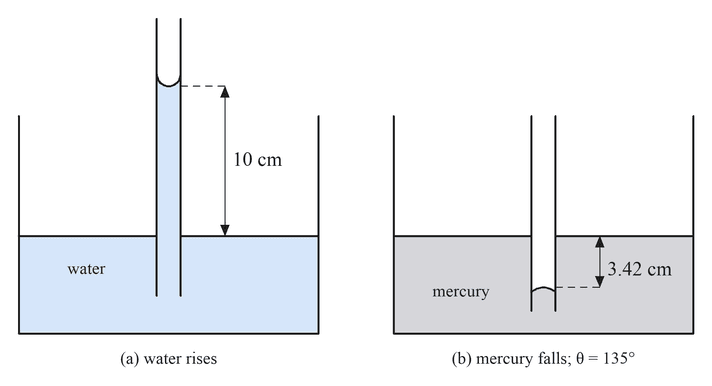
Water rises to a height of 10 cm in a capillary tube and mercury falls to a depth of 3.42 cm in the same capillary tube. If the density of mercury is 13.6 g/cc and the angle of contact is , the ratio of surface tension for water and mercury is
 Solve with AI
Answer
(A) 1:0.5
(B) 1:3
- Correct
(C) 1:6.5
(D) 1.5:1
Answer: (C) 1:6.5
Concept: From the formula for capillary rise, , the surface tension is
For mercury, is a fall (negative) and is negative, so comes out positive.
Step 1 — Write for water. We take the angle of contact of water with clean glass as (the stem gives for mercury only), and the density of water as . With :
Step 2 — Write for mercury. We use , and :
Step 3 — Take the ratio. The radius and cancel:
So , and the nearest option is 1 : 6.5.
- (A) This ratio is what we get if mercury's density is left out: , and .
- (B) This ratio comes from multiplying by instead of dividing by it: , and .
- (D) This would make water's surface tension larger than mercury's, but holding mercury, 13.6 times denser, 3.42 cm below its level needs a much larger surface tension than holding water 10 cm up.
Note: The exact ratio is , which rounds to . The printed option is this value cut short to one decimal place, and it is the nearest of the four options.
Therefore, the ratio of the surface tensions of water and mercury is about 1 : 6.5, option (C).
- 111 mark
Question 11
A square wire frame of size is dipped in a liquid. On taking out, a membrane is formed. If the surface tension of the liquid is , the force acting on the frame will be
 Solve with AI
Answer
(A)
(B)
- Correct
(C)
(D)
Answer: (C)
Concept: Surface tension is the force per unit length acting along any line on a liquid surface. A film (membrane) has two surfaces, front and back, and each pulls on the wire it touches.
Step 1 — Find the length of wire in contact with one surface. The film touches all four sides of the square frame, so the length of contact for one surface is
Step 2 — Count both surfaces. Both surfaces of the membrane pull on the frame along this length, so the total length is
Step 3 — Find the force. The force is the surface tension times this length:
- (A) This is the pull of the two surfaces on just one side of the frame.
- (B) This counts all four sides but only one surface of the membrane.
- (D) No count gives this: four sides with two surfaces each make 8 lengths , not 10.
Therefore, the force on the frame is , option (C).
- 121 mark
Question 12
In a surface tension experiment with a capillary tube water rises upto 0.1 m. If the same experiment is repeated on an artificial satellite, which is revolving around the Earth, water will rise in the capillary tube upto a height of
Solve with AIAnswer
(A) 0.1 m
(B) 0.2 m
(C) 0.98 m
- Correct
(D) full length of capillary tube
Answer: (D) Full length of capillary tube
Concept: On the Earth, water rises in a capillary tube until the weight of the raised column balances the upward pull of surface tension, which gives the height . Inside an orbiting satellite everything is in free fall, so the water has no effective weight.
Step 1 — See what stops the rise on the Earth. The 0.1 m column stops rising because its weight balances the surface-tension pull.
Step 2 — Apply it in the satellite. In the satellite there is no weight to balance the pull, so nothing stops the water. It rises to the top of the tube, whatever the tube's length. (It does not overflow: at the top the meniscus simply adjusts its curvature.)
- (A) The height of 0.1 m is set by the weight of the column on the Earth; that weight is absent in the satellite.
- (B) Doubling the height has no basis; with no weight at all there is no particular height at which the rise stops.
- (C) This is , as if the height grew with ; in fact is proportional to , so it has no finite value when .
Therefore, the water rises to the full length of the capillary tube, option (D).
- 131 mark
Question 13
Two unequal soap bubbles are formed one on each side of a tube closed in the middle by a tap. What happens when the tap is opened to put the two bubbles in communication?
 Solve with AI
Answer
(A) no air passes in any direction as the pressures are the same on two sides of the tap
(B) larger bubble shrinks and smaller bubble increases in size till they become equal in size
- Correct
(C) smaller bubble gradually collapses and the bigger one increases in size
(D) none of these
Answer: (C) Smaller bubble gradually collapses and the bigger one increases in size
Concept: The pressure inside a soap bubble of radius is greater than the outside pressure by the excess pressure given below, because the bubble film has two surfaces.
So the smaller the bubble, the greater the pressure inside it.
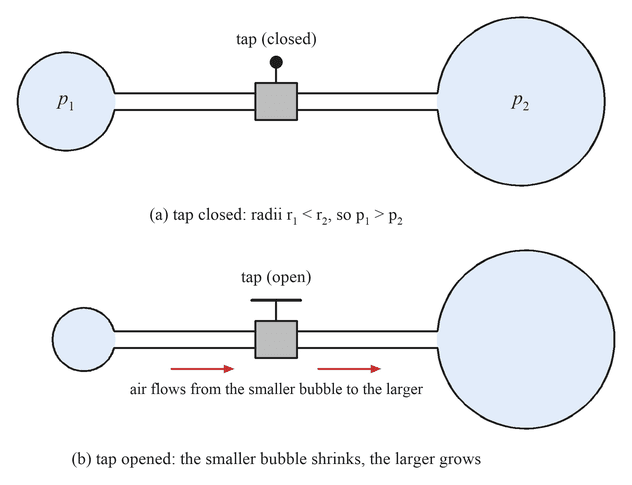
Step 1 — Compare the pressures. The smaller bubble has the smaller radius, so the pressure inside it is the higher.
Step 2 — See which way the air flows. When the tap is opened, air flows from the higher pressure to the lower, that is, from the smaller bubble into the larger one.
Step 3 — Follow what happens next. As the smaller bubble loses air, its radius becomes smaller still, so its pressure rises even more; the larger bubble grows, so its pressure falls. The flow therefore goes on: the smaller bubble collapses and the larger one grows.
- (A) The pressures are not the same: the excess pressure is larger inside the smaller bubble.
- (B) This has the flow the wrong way round; air moves out of the smaller bubble, where the pressure is higher, so the bubbles never become equal.
- (D) Option (C) describes exactly what happens, so "none of these" is wrong.
Note: The small bubble shrinks until only a shallow cap of film is left across the end of its tube, curved like the large bubble.
Therefore, the smaller bubble gradually collapses and the bigger one grows, option (C).
- 141 mark
Question 14
The radii of two soap bubbles are and . They meet to produce a double bubble. The radius of their common interface is
 Solve with AI
Answer
(A)
(B)
- Correct
(C)
(D)
Answer: (C) (a radius of size )
Concept: The pressure inside a soap bubble of radius exceeds the pressure outside it by . The common film between the two bubbles is also a soap film, so the pressure difference across it is , where is its radius of curvature.
Step 1 — Write the pressures inside the bubbles. We call the outside pressure and add each bubble's excess pressure to it:
Since , the pressure in the smaller bubble is the larger, so the common film bulges into the larger bubble.
Step 2 — Find the pressure difference across the common film. We subtract the two pressures, so that cancels:
Step 3 — Equate it to . The common film is a soap film of radius , so this pressure difference must equal :
Step 4 — Match it with the options. This has the same form as option (C), , except for the order of the terms in the denominator. As printed, (C) is negative because ; its size is the radius we found.
- (A) This uses the sum of the radii instead of their difference; for and it gives , smaller than both bubbles, while the common film must be flatter than either bubble (radius 6).
- (B) The average radius, 2.5 for and , does not satisfy the pressure balance, which needs a radius of 6.
- (D) The difference of the radii, 1 for and , is again not the radius 6 that the pressure balance requires.
Note: The denominator of option (C) should read ; as printed it gives a negative number whose size is the correct radius.
Therefore, the radius of the common interface is , option (C).
- 151 mark
Question 15
Two capillary tubes of radii 0.2 cm and 0.4 cm are dipped in the same liquid. The ratio of heights through which liquid will rise in the tube is
Solve with AIAnswer
(A) 1:2
- Correct
(B) 2:1
(C) 1:4
(D) 4:1
Answer: (B) 2:1
Concept: The height of capillary rise is . For the same liquid (same , , ) and the same , the height is inversely proportional to the radius:
Step 1 — Write the ratio of the heights. For tubes of radii and :
Step 2 — Substitute the radii. We put in the two radii given in the question:
So ; the liquid rises twice as high in the narrower tube.
- (A) This takes the height as proportional to the radius, which turns the ratio upside down.
- (C) This takes the height as proportional to , which is the wrong dependence and in the wrong direction.
- (D) This takes the height as proportional to ; the rise depends on only.
Therefore, the heights are in the ratio 2 : 1, option (B).
- 161 mark
Question 16
“Water can be sprayed easily when soap is added to it.” Why?
Solve with AIWritten solution
Solution:
Concept: Spraying breaks water into a very large number of tiny drops, which creates a large new surface area. The work needed equals surface tension × increase in area.
Step 1 — See what soap changes. Soap lowers the surface tension of water.
Step 2 — Apply it to spraying. With a smaller surface tension, less work is needed to create the large area of the spray, so the water breaks up into fine drops more easily.
Therefore, soapy water is sprayed easily because soap decreases the surface tension of water, so less work is needed to make the large surface area of the spray.
- 171 mark
Question 17
What is the effect of temperature on angle of contact?
Solve with AIWritten solution
Solution:
Concept: The angle of contact depends on the balance between the adhesive force (liquid–solid) and the cohesive force (liquid–liquid). Cohesion weakens as the temperature rises.
Step 1 — State the effect. As the temperature rises, the cohesive forces in the liquid become weaker, so the liquid wets the solid more easily.
Step 2 — Give the result. For a liquid such as water on glass, the angle of contact therefore usually decreases with rise in temperature.
Therefore, the angle of contact usually decreases as the temperature increases.
- 181 mark
Question 18
“When wax is coated on clothes, they become waterproof.” Why?
Solve with AIWritten solution
Solution:
Concept: Water rises into the fine gaps (capillaries) between the threads of a cloth only when it wets the threads, that is, when the angle of contact is less than .
Step 1 — See what wax does. Water does not wet wax: the angle of contact between water and wax is obtuse. When the threads are coated with wax, the gaps between them stop acting as capillaries that draw water in; instead water is pushed back from them.
Step 2 — See the result. Rain therefore stays on the cloth as drops that roll off and does not soak through.
Therefore, waxed clothes become waterproof because wax makes the angle of contact obtuse, so the pores of the cloth no longer draw water in by capillary action.
- 191 mark
Question 19
“Mercury does not wet glass.” Why?
Solve with AIWritten solution
Solution:
Concept: A liquid wets a solid when the adhesive force between the liquid and the solid is greater than the cohesive force between the liquid's own molecules.
Step 1 — Compare the forces for mercury. The cohesive force among mercury molecules is greater than the adhesive force between mercury and glass molecules.
Step 2 — See the result. Mercury pulls itself together into drops instead of spreading over the glass, and its angle of contact with glass is obtuse.
Therefore, mercury does not wet glass because the cohesive force among mercury molecules is greater than the adhesive force between mercury and glass.
- 201 mark
Question 20
What happens to the pressure inside a soap bubble when air is blown into it?
Solve with AIWritten solution
Solution:
Concept: A soap bubble of radius has two surfaces, so the excess pressure inside it is given by the formula below.
So the excess pressure is inversely proportional to the radius.
Step 1 — See what blowing does. Blowing air into the bubble makes it bigger, so its radius increases.
Step 2 — Find the effect on the pressure. Since , a larger radius gives a smaller excess pressure.
Therefore, the excess pressure inside the bubble decreases as air is blown in, because the radius increases and .
- 211 mark
Question 21
“In summer cotton dresses should be preferred.” Why?
Solve with AIWritten solution
Solution:
Concept: Water rises through very fine pores by capillary action, and evaporation of water cools the surface it leaves.
Step 1 — See what cotton does with sweat. The fine pores between the fibres of cotton act as capillaries, so they soak up the sweat from the skin and spread it through the cloth.
Step 2 — See how this cools the body. The sweat spread over the large area of the cloth evaporates quickly, taking latent heat from the body.
Therefore, cotton dresses are preferred in summer because the fine pores of cotton act as capillaries that absorb sweat, which then evaporates and keeps the body cool.
- 221 mark
Question 22
If a capillary tube is dipped in a state of weightlessness how will the rise of water in it be different to that observed in normal conditions?
Solve with AIWritten solution
Solution:
Concept: In normal conditions water rises in a capillary tube until the weight of the raised column balances the upward pull of surface tension, so .
Step 1 — Apply it in weightlessness. In a state of weightlessness the water column has no weight (), so there is no downward force to balance the pull of surface tension.
Step 2 — State the result. The water goes on rising until it reaches the other (top) end of the tube, whatever the length of the tube. It does not overflow; the meniscus at the top simply changes its curvature.
Therefore, in weightlessness water rises right to the top of the capillary tube, whatever its length, instead of stopping at a definite height .
- 231 mark
Question 23
“Soldering becomes easy due to the addition of flux”. Why?
Solve with AIWritten solution
Solution:
Concept: Molten solder flows over a metal surface and bonds to it only if it wets the metal, that is, if the adhesion between solder and metal is strong enough compared with the solder's own surface tension.
Step 1 — See what the flux does. The flux reduces the surface tension of the molten tin (solder). It also removes the thin layer of oxide on the metals and keeps air away, so the molten solder touches clean metal.
Step 2 — See the result. The molten solder now wets the metal and spreads easily into the joint instead of rolling up into drops, which makes soldering easy.
Therefore, flux makes soldering easy because it reduces the surface tension of the molten tin and cleans the metal surface, so the solder spreads over the joint.
- 241 mark
Question 24
A water–alcohol mixture is prepared such that its density is exactly equal to the density of some oil. What would be the shape of a drop of that oil in the given mixture and why?
Solve with AIWritten solution
Solution:
Concept: When gravity has no net effect on a drop, its shape is decided only by surface tension, which gives it the least surface area for its volume, that is, a sphere.
Step 1 — Find the net effect of gravity. The densities of the oil and the mixture are equal, so the weight of the oil drop is exactly balanced by the upthrust of the mixture on it.
Step 2 — Find the shape. Only the surface (interfacial) tension shapes the drop, so it takes the shape of least surface area.
Therefore, the oil drop is spherical, because its weight is balanced by the upthrust and only surface tension decides its shape.
- 251 mark
Question 25
What will happen to the rise of liquid in a capillary tube if its top end is closed?
Solve with AIWritten solution
Solution:
Concept: For liquid to rise in a tube, the air above it must be able to move out of its way.
Step 1 — See what the closed end does. With the top end closed, the air trapped in the tube cannot escape. As soon as the liquid starts to rise, it compresses this air and raises its pressure.
Step 2 — See the result. The extra pressure of the trapped air pushes back on the liquid. The liquid can rise only by the tiny amount that compresses the air enough to balance the capillary pull, so it practically does not rise.
Therefore, the liquid practically does not rise in a capillary tube closed at the top, because the trapped air cannot be displaced; strictly, it rises only very slightly, until the compressed air stops it.
- 261 mark
Question 26
“A drop of oil placed on the surface of water spreads out. But a drop of water placed on oil contracts to a spherical shape”. Why?
Solve with AIWritten solution
Solution:
Concept: A liquid spreads on another when the adhesive force between the two liquids is greater than its own cohesive force; it gathers into a drop when its cohesion is the stronger.
Step 1 — Look at oil on water. The adhesive force between oil and water molecules is greater than the cohesive force among oil molecules. The water surface, with its large surface tension, pulls the edge of the oil drop outward, so the oil spreads.
Step 2 — Look at water on oil. The cohesive force among water molecules is greater than the adhesive force between water and oil. The water pulls itself together, and its surface tension gives it the least surface area, a nearly spherical drop.
Therefore, oil spreads on water because adhesion beats the cohesion of oil, while water contracts into a drop on oil because the cohesion of water beats the adhesion.
- 271 mark
Question 27
What will be the shape of a bigger drop of mercury on a glass plate (a) on the surface of the Earth and (b) at the centre of the Earth?
Solve with AIWritten solution
Solution:
Concept: The shape of a drop is set by two effects: surface tension, which tries to make it spherical, and gravity, which tries to flatten it so that its centre of gravity is as low as possible.
Step 1 — Part (a). On the surface of the Earth, gravity acts on the drop. For a bigger drop the effect of gravity is large, so the drop is flattened into an elliptical (squashed, pancake-like) shape.
Step 2 — Part (b). At the centre of the Earth, , so the drop has no weight. Only surface tension acts, and it makes the drop spherical.
Therefore, the drop is (a) elliptical (flattened) on the surface of the Earth and (b) spherical at the centre of the Earth, where .
- 281 mark
Question 28
When droplets of mercury are brought in contact, they immediately combine to form a bigger drop. Why? Is the temperature of the bigger drop the same, or more, or less than the temperature of the droplets?
Solve with AIWritten solution
Solution:
Concept: Surface energy equals surface tension × surface area. A system tends to move to the state of least energy, and energy released at constant total energy appears as heat.
Step 1 — See why they combine. The cohesive force among mercury molecules is large. When the droplets touch, they merge, because one bigger drop has less total surface area, and hence less surface energy, than the separate droplets.
Step 2 — Find the temperature. The decrease in surface energy is released as heat, which warms the mercury.
Therefore, the droplets combine because of the strong cohesive force (one drop has less surface area and energy), and the bigger drop is at a higher temperature than the droplets, because the surface energy released becomes heat.
- 292 marks
Question 29
“A steel needle placed on water surface floats”. Why?
Solve with AIWritten solution
Solution:
Concept: Because of surface tension, the free surface of a liquid behaves like a stretched elastic membrane: it pulls along itself with a force per unit length.
Step 1 — See what the needle does to the surface. A dry steel needle placed gently on water does not break the surface. Its weight presses the surface down, making a shallow groove (depression) at the point of contact.
Step 2 — See the forces that hold it up. On each side of the groove, the surface pulls on the needle along the surface, at an angle above the horizontal. The upward (vertical) components of these surface-tension forces, acting along the whole length of the needle, balance its weight .
Therefore, the needle floats because the water surface, pressed into a depression, pulls upward on it by surface tension, and this upward pull balances the needle's weight.
- 302 marks
Question 30
“Small liquid drops are spherical, but large ones are elliptical.” Why?
Solve with AIWritten solution
Solution:
Concept: A liquid drop takes the shape for which its total potential energy is least. Two energies compete: the surface energy, which is least for a sphere, and the gravitational potential energy, which is least when the drop is flattened so that its centre of gravity is low.
Step 1 — Compare how the two energies grow with size. For a drop of size , the surface energy is proportional to the area, that is, to . The gravitational potential energy is proportional to the mass times the height of the centre of gravity, that is, to .
Step 2 — Small drops. For a small drop, is tiny compared with , so the gravitational energy is small compared with the surface energy. Surface tension wins and makes the drop spherical, the shape with the least surface area for a given volume.
Step 3 — Large drops. For a large drop, the gravitational energy dominates. To make it least, the drop sinks and spreads so that its centre of gravity is as low as possible, and it becomes flattened (elliptical).
Therefore, small drops are spherical because surface tension dominates over gravity for them, while large drops are flattened (elliptical) because their gravitational potential energy dominates.
- 312 marks
Question 31
Distinguish between cohesive and adhesive forces.
Solve with AIWritten solution
Solution:
Concept: Both are attractive forces between molecules; they differ in which molecules attract each other.
Step 1 — Cohesive force. The force of attraction between molecules of the same substance is called the cohesive force; for example, the attraction between one water molecule and another. It is the cause of surface tension and holds a liquid drop together.
Step 2 — Adhesive force. The force of attraction between molecules of different substances is called the adhesive force; for example, the attraction between water molecules and glass molecules. It makes water stick to glass and wet it.
Step 3 — Their effect together. When adhesion is stronger than cohesion (water on glass), the liquid wets the solid; when cohesion is stronger (mercury on glass), it does not.
Therefore, cohesive force acts between molecules of the same substance, while adhesive force acts between molecules of different substances.
- 322 marks
Question 32
Explain the terms (i) molecular range and (ii) sphere of influence.
Solve with AIWritten solution
Solution:
Concept: The attraction between two molecules falls off very rapidly with distance, so it is felt only up to a very small distance.
Step 1 — Molecular range (part i). The maximum distance up to which the cohesive force between two molecules can act is called the molecular range. It is very small, of the order of (a few molecular diameters).
Step 2 — Sphere of influence (part ii). A sphere drawn around a molecule as centre, with a radius equal to the molecular range, is called the sphere of influence of that molecule. The molecule is attracted only by the molecules inside this sphere.

Step 3 — Read the figure. In the figure, is the molecular range. Molecule A, deep inside, has its whole sphere of influence in the liquid, so it is pulled equally in all directions. Molecules B and C, near and on the surface, have part of their spheres outside the liquid, so they feel a resultant pull into the liquid.
Therefore, the molecular range is the greatest distance (about ) up to which a molecule attracts others, and the sphere of influence is the sphere of that radius drawn around the molecule.
- 332 marks
Question 33
Define surface tension and surface energy. How are they related?
Solve with AIWritten solution
Solution:
Concept: A liquid surface behaves like a stretched membrane. Making more surface needs work, because molecules must be brought up from inside against the inward pull of the liquid.
Step 1 — Define surface tension. Surface tension of a liquid is the force per unit length acting at right angles to an imaginary line drawn on the liquid surface, in the plane of the surface. Its SI unit is .
Step 2 — Define surface energy. Surface energy is the extra potential energy per unit area of the surface film, equal to the work done in increasing the area of the surface by one unit at constant temperature. Its SI unit is .
Step 3 — Find the relation. Take a soap film on a U-shaped frame with a sliding wire AB of length . The film has two surfaces, so the force needed to hold the wire is .
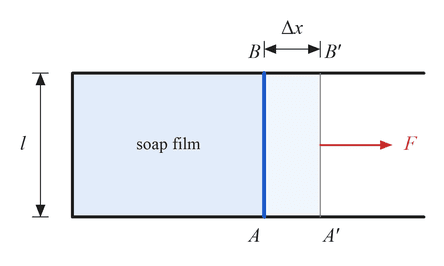
Moving the wire out by at constant temperature needs this work:
At the same time, the area of the film's two surfaces grows by:
So the work done per unit area of new surface is:
Therefore, surface tension is the force per unit length and surface energy is the work per unit area of new surface, and at constant temperature the surface energy is numerically equal to the surface tension.
- 342 marks
Question 34
Define angle of contact. Name the factors on which the angle of contact depends.
Solve with AIWritten solution
Solution:
Concept: Where a liquid surface meets a solid, the surface is curved, and the angle at which it meets the solid shows how well the liquid wets the solid.
Step 1 — Define the angle of contact. The angle of contact is the angle between the tangent to the liquid surface at the point of contact and the solid surface inside the liquid. It is acute for liquids that wet the solid (water on clean glass, nearly ) and obtuse for liquids that do not (mercury on glass, about to ).
Step 2 — Name the factors. The angle of contact depends on:
- the nature of the liquid and of the solid in contact (that is, on the relative strength of adhesion and cohesion);
- the cleanliness of the solid surface and impurities in the liquid;
- the medium above the free surface of the liquid (air, another liquid);
- the temperature of the liquid.
Therefore, the angle of contact is the angle inside the liquid between the solid surface and the tangent to the liquid surface at the point of contact; it depends on the nature of the liquid and solid, impurities and cleanliness, the medium above the liquid, and the temperature.
- 352 marks
Question 35
“The shape of water meniscus is concave, whereas the shape of mercury meniscus is convex.” Why?
Solve with AIWritten solution
Solution:
Concept: The shape of a liquid meniscus depends on the relative strengths of the forces of cohesion and adhesion. At the point of contact, a liquid molecule feels an adhesive force towards the wall and a cohesive force into the liquid. A liquid surface always sets itself at right angles to the resultant force on its molecules.
Step 1 — Water in glass. For water, the force of adhesion is greater than the force of cohesion, so the resultant points out of the liquid towards the glass. The surface, at right angles to , rises along the wall, and the meniscus is concave.
Step 2 — Mercury in glass. For mercury, the force of cohesion is larger than the force of adhesion, so the resultant points into the liquid. The surface, at right angles to , curves down at the wall, and the meniscus is convex.

Therefore, the water meniscus is concave because adhesion with glass is stronger than the cohesion of water, while the mercury meniscus is convex because the cohesion of mercury is stronger than its adhesion with glass.
- 362 marks
Question 36
Draw labelled diagram to show angle of contact between (i) water and glass, and (ii) mercury and glass.
Solve with AIWritten solution
Solution:
Concept: The angle of contact is measured inside the liquid, between the solid surface and the tangent to the liquid surface at the point of contact.
Step 1 — Water and glass (part i). Water wets glass, so its surface rises along the glass and is concave. The tangent at the point of contact makes an acute angle with the glass below it. (For pure water and very clean glass the angle is nearly ; it is drawn larger here so that it can be seen.)
Step 2 — Mercury and glass (part ii). Mercury does not wet glass, so its surface is pushed down at the glass and is convex. The tangent at the point of contact makes an obtuse angle, about to , with the glass below it.
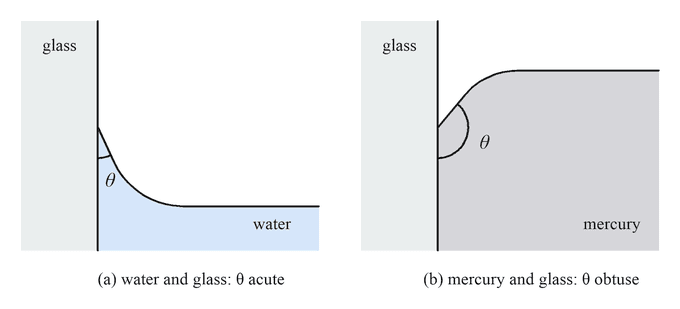
Therefore, the angle of contact between water and glass is acute (concave surface), and between mercury and glass it is obtuse (convex surface), as shown in the labelled diagrams.
- 372 marks
Question 37
“Oil rises in lamp wick”. Why?
Solve with AIWritten solution
Solution:
Concept: A liquid that wets a solid rises in very narrow tubes or gaps in it by capillary action.
Step 1 — Look at the wick. A cotton wick is made of fibres with very fine gaps between them. These gaps act as capillary tubes.
Step 2 — See what the oil does. Oil wets cotton, so it rises through these fine capillaries up to the burning end of the wick, where it burns.
Therefore, oil rises in a lamp wick due to capillarity: the fine gaps between the cotton fibres act as capillary tubes.
- 382 marks
Question 38
“Water stick to the walls of a glass tube, but mercury does not.” Why?
Solve with AIWritten solution
Solution:
Concept: A liquid sticks to (wets) a solid when the adhesive force between the liquid and solid molecules is greater than the cohesive force between the liquid's own molecules.
Step 1 — Water and glass. The force of adhesion between glass molecules and water molecules is greater than the force of cohesion among water molecules. So water clings to the glass and wets it.
Step 2 — Mercury and glass. In the case of mercury, the cohesive force among mercury molecules is larger than the force of adhesion between mercury and glass. So mercury pulls away from the glass instead of sticking to it.
Therefore, water sticks to glass because adhesion is stronger than its cohesion, while mercury does not because its cohesion is stronger than its adhesion to glass.
- 392 marks
Question 39
If the capillary tube dipped in water is of insufficient length , will water overflow?
Solve with AIWritten solution
Solution:
Concept: The height of capillary rise is . Since is the radius of the meniscus, this can be written in the form below.
So the product is a constant for a given liquid.
Step 1 — See what happens at the top. In a tube of length (less than ) above the water, the water rises to the top of the tube and then can rise no further.
Step 2 — See how the meniscus adjusts. At the top, the meniscus becomes flatter: its radius of curvature increases to a new value , fixed by the same constant product:
Since , is greater than . With this flatter meniscus, the upward pull of surface tension just balances the weight of the shorter column, so there is no unbalanced force to push water out.
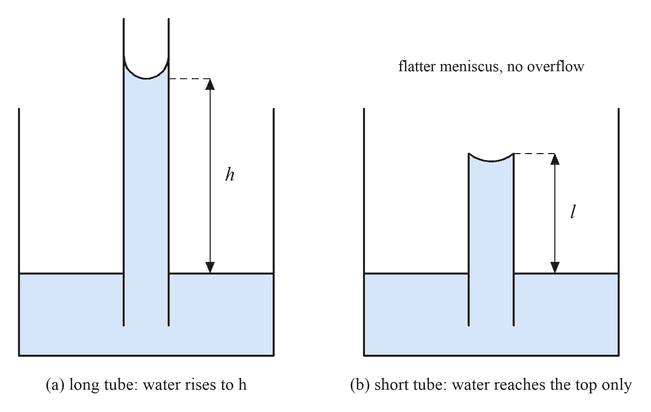
Therefore, no, the water will not overflow; it rises to the top of the tube and the meniscus becomes flatter, with radius .
- 402 marks
Question 40
“Camphor particles do not dance about in water contaminated with oil.” Why?
Solve with AIWritten solution
Solution:
Concept: Camphor particles dance on clean water because, where camphor dissolves, it lowers the surface tension, so the pulls of the surface around a particle are unequal.
Step 1 — See what oil does to the water. A layer of oil contamination reduces the surface tension of the water surface, below that of the camphor solution.
Step 2 — See the effect on the camphor. Dissolving camphor can now no longer lower the surface tension further on one side of a particle; the pulls on all sides are equal, so there is no resultant force on the particle.
Therefore, camphor particles do not dance on oily water, because the contamination has already reduced the surface tension of the water below that of the camphor solution, so dissolving camphor causes no unbalanced pull.
- 412 marks
Question 41
“On cold water, oil spreads, but on hot water, it remains in the form of drops.” Why?
Solve with AIWritten solution
Solution:
Concept: An oil drop spreads on water when the outward pull of the water surface at the edge of the drop (the surface tension of water) is larger than the inward pulls of the oil's own surfaces. Surface tension decreases as the temperature rises.
Step 1 — Cold water. The surface tension of cold water is high, larger than the pulls of the oil's surfaces, so the edge of the oil drop is pulled outward and the oil spreads.
Step 2 — Hot water. The surface tension of hot water is less than that of cold water. For an oil whose surface pulls lie between these two values, the outward pull of hot water is no longer the larger one, so the oil does not spread and stays as drops.
Therefore, oil spreads on cold water but stays as drops on hot water, because the surface tension of hot water is less than that of cold water.
- 422 marks
Question 42
Give practical applications of studying the excess pressure inside bubbles and drops.
Solve with AIWritten solution
Solution:
Concept: The pressure inside a curved liquid surface exceeds the outside pressure: by inside a drop or an air bubble in a liquid, and by inside a soap bubble. Smaller bubbles need larger pressures.
Step 1 — Making foams. It is used in the manufacture of polystyrene foam and other expanded (foamed) plastics, foam rubber and similar materials, where gas bubbles of a controlled size are blown inside the material.
Step 2 — Other uses. It also explains why a tiny gas bubble needs a high pressure to form, which matters in boiling and in the formation of bubbles in liquids, and why small and large bubbles joined together do not share air equally, which matters in the lungs (the surfactant in the air sacs lowers their surface tension so that small sacs do not empty into large ones).
Therefore, the study of excess pressure is used in making polystyrene and other expanded (foamed) plastics and foams, and it explains bubble formation in boiling liquids and the working of the air sacs in the lungs.
- 432 marks
Question 43
What are the characteristics of detergent solutions?
Solve with AIWritten solution
Solution:
Concept: A detergent is a substance whose long molecules have one end attracted to water and the other end attracted to oil and grease.
Step 1 — Low surface tension. A detergent decreases the surface tension of the liquid (say, water) in which it is dissolved.
Step 2 — Good wetting. Because its surface tension is low, the solution spreads more easily: the area of contact with the cloth or dish is increased, and the solution gets into fine pores and gaps.
Step 3 — Holding grease. The detergent molecules surround drops of oil and grease and keep them in the water, so the dirt is carried away when the article is rinsed. The cleaning ability of the liquid is thus increased.
Therefore, a detergent solution has a low surface tension, wets and spreads over surfaces easily, and holds oily dirt in the water, so it cleans much better than water alone.
- 442 marks
Question 44
Name the factors affecting the surface tension of a liquid.
Solve with AIWritten solution
Solution:
Concept: Surface tension comes from the cohesive forces between the molecules at the surface, so anything that changes these forces changes it.
Step 1 — Temperature. For most liquids, surface tension decreases as the temperature rises, and it becomes zero at the critical temperature.
Step 2 — Impurities. Impurities on the surface, such as oil, grease or dust, lower the surface tension.
Step 3 — Dissolved substances. A dissolved substance can raise or lower the surface tension: very soluble salts such as common salt raise it slightly, while soap, detergents and alcohol lower it.
Therefore, the surface tension of a liquid depends on (i) its temperature, (ii) the presence of impurities and (iii) the presence of any dissolved substance in it.
- 452 marks
Question 45
If a capillary tube is dipped in a state of weightlessness, how will the rise of water in it be different to that observed in normal conditions?
Solve with AIWritten solution
Solution:
Concept: In normal conditions water rises in a capillary tube until the weight of the raised column balances the upward pull of surface tension, which fixes the height .
Step 1 — Apply it in weightlessness. In a state of weightlessness the weight of water is zero (), so there is no downward force to balance the upward pull of surface tension.
Step 2 — State the result. Nothing stops the rise, so the water rises to the other end of the capillary tube, irrespective of the length of the tube. It does not overflow; at the top the meniscus only changes its curvature.
Therefore, in weightlessness the water rises to the other end of the capillary tube, whatever its length, instead of stopping at a definite height as it does on the Earth.
- 462 marks
Question 46
A drop of oil placed on the surface of water spreads out. But a drop of water placed on oil contracts into a spherical shape. Explain both phenomena.
Solve with AIWritten solution
Solution:
Concept: A liquid spreads on another when the adhesive force between the two is greater than its own cohesive force; it contracts into a drop when its own cohesion is the stronger.
Step 1 — Oil on water. In the first case, the force of adhesion between water molecules and oil molecules is larger than the cohesive force between the oil molecules. The water surface, with its large surface tension, pulls the edge of the oil drop outward all round, so the oil spreads out.
Step 2 — Water on oil. In the second case, the cohesive force of water molecules is larger than the adhesive force between water and oil. The water pulls itself together, and its surface tension gives it the least surface area, so it contracts into a nearly spherical drop.
Therefore, oil spreads on water because adhesion exceeds the cohesion of oil, while water contracts into a drop on oil because the cohesion of water exceeds the adhesion.
- 472 marks
Question 47
When droplets of mercury are brought in contact, they immediately combine to form a bigger drop. Why? Is the temperature of the bigger drop the same, or more, or less than the temperature of the droplets?
Solve with AIWritten solution
Solution:
Concept: Surface energy = surface tension × surface area. For a fixed volume, one big drop has less surface area than many small droplets.
Step 1 — See why they combine. The cohesive force among mercury molecules is strong. When the droplets touch, they merge into one bigger drop, which has less total surface area and so less surface energy; the system moves to the state of lower energy.
Step 2 — Find the change in temperature. The decrease in surface energy is not lost; it is released as heat inside the mercury.
Step 3 — State the result. This heat raises the temperature, so the bigger drop is warmer than the droplets were.
Therefore, the droplets combine because of strong cohesive forces (the merged drop has less surface energy), and the temperature of the bigger drop is greater than that of the droplets, because of the decrease in surface energy.
- 482 marks
Question 48
A water–alcohol mixture is prepared such that its density is exactly equal to the density of some oil. What would be the shape of drop of that oil in the given mixture and why?
Solve with AIWritten solution
Solution:
Concept: A free drop on which surface tension is the only force takes the shape of least surface area, a sphere.
Step 1 — Find the effect of gravity. The oil drop and the mixture have the same density, so the weight of the oil drop is balanced by the upthrust of the mixture on it. Gravity therefore has no net effect on its shape.
Step 2 — Find the shape. The surface tension (between the oil and the mixture) dominates, and it makes the surface area as small as possible for the volume of the drop.
Therefore, the shape of the oil drop will be spherical, because surface tension dominates once the weight of the drop is balanced by the upthrust of the mixture.
- 493 marks
Question 49
Define surface tension. Explain surface tension based on molecular theory.
Solve with AIWritten solution
Solution:
Concept: Surface tension arises because molecules at the surface of a liquid are pulled inward by the molecules below them, while molecules deep inside are pulled equally in all directions.
Step 1 — Define surface tension. Surface tension is the property of a liquid by which its free surface behaves like a stretched membrane and tries to have the least possible area. It is measured as the force per unit length acting at right angles to an imaginary line drawn on the surface, in the plane of the surface:
Its SI unit is .
Step 2 — Recall the molecular range. A molecule attracts other molecules only up to a very small distance, the molecular range (about ). The sphere of this radius around a molecule is its sphere of influence.
Step 3 — A molecule deep inside (A). Its whole sphere of influence lies in the liquid, so it is attracted equally in all directions. The resultant force on it is zero.
Step 4 — Molecules near and on the surface (B and C). Part of their sphere of influence lies above the surface, where there are (almost) no liquid molecules. The pull from below is not balanced, so each feels a resultant force into the liquid. It is largest for a molecule on the surface itself (C).
Step 5 — Explain surface tension. To bring a molecule from inside up to the surface, work must be done against this inward pull, so surface molecules have extra potential energy. A system tends to the state of least potential energy, so the liquid keeps the number of molecules in its surface, that is, its surface area, as small as possible. The surface therefore behaves like a stretched membrane under tension, and this is surface tension.
Therefore, surface tension is the force per unit length along a line on the liquid surface, and it arises because surface molecules feel an unbalanced inward pull, which makes the surface contract like a stretched membrane.
- 503 marks
Question 50
Define surface energy. Show that surface energy is numerically equal to surface tension.
Solve with AIWritten solution
Solution:
Concept: Molecules at the surface of a liquid have more potential energy than those inside, because work is needed to bring a molecule to the surface against the inward pull of the liquid.
Step 1 — Define surface energy. The surface energy of a liquid is the extra potential energy per unit area of its surface film. It equals the work done in increasing the area of the surface by one unit, at constant temperature. Its SI unit is .
Step 2 — Set up the arrangement. Take a rectangular frame of wire with a sliding wire AB of length on it, and form a soap film on it. The film has two surfaces, each pulling the wire inward with a force , so the total inward force is
Step 3 — Find the work done. To pull the wire out slowly through a small distance (to A′B′), an equal outward force is needed. The work done is
Step 4 — Find the increase in area. Both surfaces of the film grow, each by , so the total increase in area is
Step 5 — Find the work per unit area. At constant temperature this work is stored as surface energy, so the surface energy per unit area is
Therefore, surface energy is the work done per unit area in increasing the surface at constant temperature, and it is numerically equal to the surface tension (in and , which are the same unit).
- 513 marks
Question 51
Define angle of contact. Name the factors on which it depends. Explain the shape of liquid meniscus in a tube.
Solve with AIWritten solution
Solution:
Concept: The angle of contact shows how well a liquid wets a solid; it depends on the relative strengths of adhesion (liquid–solid) and cohesion (liquid–liquid).
Step 1 — Define the angle of contact. The angle of contact is the angle, measured inside the liquid, between the tangent to the liquid surface at the point of contact and the solid surface. It is acute when the liquid wets the solid (water on glass) and obtuse when it does not (mercury on glass, about to ).
Step 2 — Name the factors. The angle of contact depends on the nature of the liquid and of the solid, the cleanliness of the solid surface and impurities in the liquid, the medium above the liquid, and the temperature.
Step 3 — Find the forces at the wall. Consider a liquid molecule at the point of contact with the wall of the tube. It feels the adhesive force of the wall, at right angles to the wall, and the cohesive force of the liquid, directed into the liquid. A liquid surface sets itself at right angles to the resultant force on its molecules.
Step 4 — Explain the concave meniscus. For water in glass, adhesion is the stronger, so points out of the liquid towards the wall. The surface, at right angles to , rises along the wall, and the meniscus is concave (angle of contact acute).
Step 5 — Explain the convex meniscus. For mercury in glass, cohesion is the stronger, so points into the liquid. The surface, at right angles to , curves down at the wall, and the meniscus is convex (angle of contact obtuse).
Therefore, the angle of contact is the angle inside the liquid between the solid surface and the tangent to the liquid surface; it depends on the liquid and solid, impurities, the medium above and the temperature; and the meniscus is concave when adhesion is stronger (water) and convex when cohesion is stronger (mercury), because the surface sets at right angles to the resultant force.
- 523 marks
Question 52
Derive an expression for the excess pressure inside (i) a liquid drop and (ii) a liquid bubble.
Solve with AIWritten solution
Solution:
Concept: Because a curved liquid surface is under tension, the pressure on its concave side is greater than on its convex side. The excess pressure can be found by equating the work done by it in a small expansion to the increase in surface energy.

Step 1 — Set up part (i), a liquid drop. Let a drop of radius have pressure inside and outside, so the excess pressure is . A drop has one surface, with surface tension .
Step 2 — Find the work done by the excess pressure. Let the radius grow slightly from to . The excess pressure acts on the area and moves it out through , so the work done is
Step 3 — Find the increase in surface energy. The increase in surface area is
The term in is negligible because is very small, so it is dropped. The increase in surface energy is therefore .
Step 4 — Equate the two. The work done by the excess pressure is stored as the extra surface energy, so:
Step 5 — Part (ii), a liquid (soap) bubble. A bubble is a thin film with two surfaces, inner and outer, of almost the same radius . When it grows, both surfaces grow, so the increase in surface energy is
Step 6 — Equate again. As before, the work done by the excess pressure equals the increase in surface energy:
Therefore, the excess pressure is (i) inside a liquid drop and (ii) inside a liquid bubble, which has two surfaces.
- 533 marks
Question 53
What is capillarity? Derive an expression for capillary rise.
- 543 marks
Question 54
Mention four applications of capillarity. Explain the various factors affecting surface tension.
- 555 marks
Question 55
(i) Give two experiments to illustrate the phenomenon of surface tension.
(ii) Explain surface tension on the basis of molecular theory.
(iii) How is surface tension related to surface energy?
- 565 marks
Question 56
(i) Derive Laplace law for a spherical membrane.
(ii) Describe an experiment to demonstrate the excess pressure inside a bubble.
- 575 marks
Question 57
(i) What do you understand by the term surface tension of a liquid?
(ii) What is the force of surface tension on a light ring of radius floating on a liquid of surface tension ?
(iii) When a capillary tube is dipped in a liquid, it rises in the tube to a height above the outside level. What would happen if the tube were dipped such that its length outside the liquid is less than ? Explain your answer briefly.
- 585 marks
Question 58
Describe the method of determination of surface tension of a liquid by capillary rise. Derive the formula used.
What Class 11 Physics Ch 15 covers
The sections of the chapter, in the order the book takes them. Every question above comes from one of these.
- 01Surface Tension and Molecular Theory
- 02Cohesive and Adhesive Forces
- 03Surface Energy
- 04Shape of Liquid Drops and Angle of Contact
- 05Excess Pressure Across a Curved Surface
- 06Capillarity
More ways to study this chapter
The same chapter asked three other ways. Practise it, revise it, and see what the board has set on Ch 15 before.
Class 11 Physics Ch 15 questions students ask
How many questions are there in Class 11 Physics Ch 15?
58 questions. Every one is solved step by step on this page.
Are these Class 11 Physics solutions free?
Yes. Every question and its full working is free to read, with no account needed.
Can I download the Class 11 Physics Ch 15 solutions as a PDF?
There is no PDF to download. Every solution is on this page instead, which means it is searchable, always the current syllabus, and readable on a phone. Use your browser's print option if you want it on paper.