
Question 555 marksMedium
(i) Give two experiments to illustrate the phenomenon of surface tension.
(ii) Explain surface tension on the basis of molecular theory.
(iii) How is surface tension related to surface energy?
Confirming your payment
Sign up now and get 250 free tokens.
Surface Tension · Question 55 of 58
(i) Give two experiments to illustrate the phenomenon of surface tension.
(ii) Explain surface tension on the basis of molecular theory.
(iii) How is surface tension related to surface energy?
Solution:
Concept: Surface tension makes a liquid surface behave like a stretched membrane that tries to contract to the least possible area.
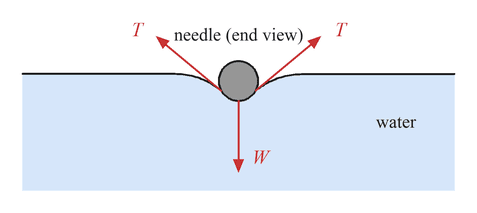
Step 1 — Part (i), first experiment: a floating needle. A dry steel needle placed gently on the surface of water floats, although steel is far denser than water. The needle presses the surface into a shallow groove, and the surface tension on both sides pulls on it with upward components that balance its weight.
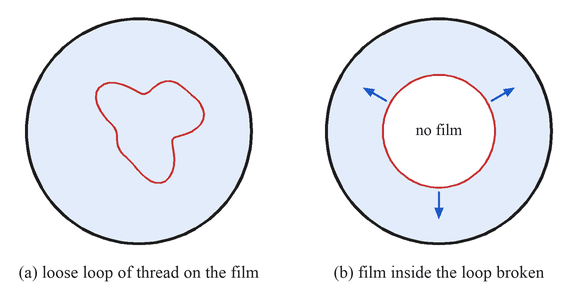
Step 2 — Part (i), second experiment: a loop of thread on a soap film. A ring of wire is dipped in soap solution so that a film forms on it, and a loose loop of thread is laid on the film. The loop lies in an irregular shape. When the film inside the loop is pricked, the thread is at once pulled out into a perfect circle. The film outside pulls the thread outward equally all round, at right angles to it, and contracts to its least area; the circle gives the largest area inside the loop and so the least film outside.
Step 3 — Part (ii), molecular theory. A molecule attracts others only within its sphere of influence, a sphere whose radius is the molecular range (about ). A molecule deep inside the liquid (A) is pulled equally in all directions. A molecule near or on the surface (B, C) has part of its sphere outside the liquid, so it feels a resultant pull inward.

Work must be done against this inward pull to bring a molecule to the surface, so the surface molecules have extra potential energy. To make its potential energy least, the liquid keeps its surface area as small as possible, so the surface behaves like a stretched membrane. This is surface tension.
Step 4 — Part (iii), relation with surface energy. Take a soap film on a frame with a sliding wire AB of length . The film has two surfaces, so the force on the wire is .
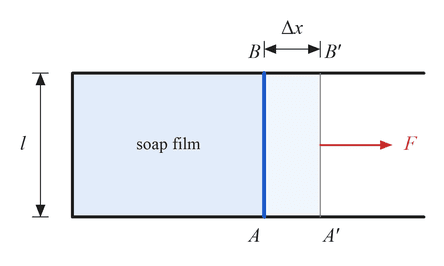
Moving the wire out through at constant temperature needs this work:
The increase in area of the two surfaces is:
So the work done per unit area of new surface, which is the surface energy, is:
Therefore, (i) a floating needle and a loop of thread pulled into a circle on a soap film show surface tension; (ii) it arises from the unbalanced inward pull on surface molecules; and (iii) at constant temperature the surface energy per unit area is numerically equal to the surface tension.