
Question 565 marksHard
(i) Derive Laplace law for a spherical membrane.
(ii) Describe an experiment to demonstrate the excess pressure inside a bubble.
Confirming your payment
Sign up now and get 250 free tokens.
Surface Tension · Question 56 of 58
(i) Derive Laplace law for a spherical membrane.
(ii) Describe an experiment to demonstrate the excess pressure inside a bubble.
Solution:
Concept: The pressure on the concave (inner) side of a curved membrane under tension is greater than on its convex side. Laplace's law gives this excess pressure in terms of the tension and the radius of curvature.
Step 1 — Part (i), set up the membrane. Consider a spherical membrane (a single surface) of radius and surface tension , with pressure inside and outside. Imagine it cut into two halves by a plane through its centre O, and look at the forces on the right half.

Step 2 — Find the push of the excess pressure. The resultant of the pressure forces on the right half is the excess pressure times the area of the flat circular face:
It pushes the right half to the right, away from the left half.
Step 3 — Find the pull of surface tension. Along the rim, a circle of length , the left half pulls on the right half with force per unit length, to the left:
Step 4 — Balance the forces. The half is in equilibrium, so
This is Laplace's law for a spherical membrane. For a soap bubble, which has two surfaces, the pull along the rim is doubled and the excess pressure is .
Step 5 — Part (ii), the apparatus. A narrow tube has a tap in its middle. With the tap closed, a small soap bubble is blown on one end of the tube and a larger one on the other end.
Step 6 — Part (ii), what is seen. When the tap is opened, so that the air in the two bubbles is connected, the smaller bubble shrinks and the larger one grows.
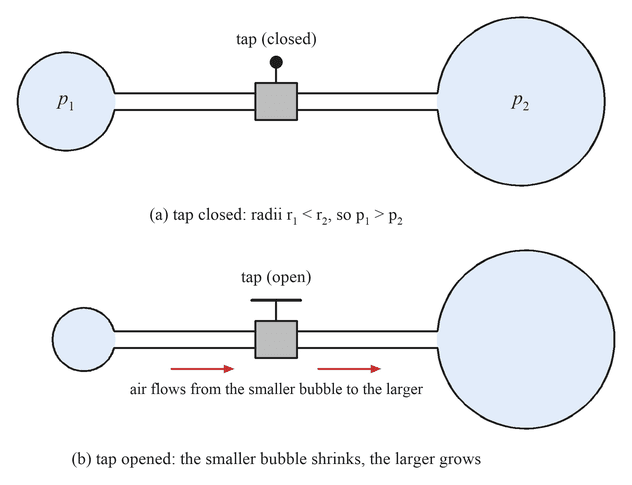
Step 7 — Part (ii), the conclusion. Air flows from higher pressure to lower pressure, so the pressure inside the smaller bubble must be the higher. This shows that there is an excess pressure inside a bubble and that it is greater for a smaller radius, as predicts.
Therefore, (i) the excess pressure across a spherical membrane is (Laplace's law; for a soap bubble with two surfaces), and (ii) when two unequal bubbles are connected, air flows from the smaller into the larger, showing the greater excess pressure inside the smaller bubble.