Solution:
Concept: Surface tension γ is a force per unit length acting along every line in the liquid surface; the total force on a solid edge is γ times the length of the line along which the liquid touches it.
Step 1 — Part (i), meaning of surface tension. Surface tension is the property of a liquid by which its free surface behaves like a stretched elastic membrane and tends to have the least possible area. It is measured by the force per unit length acting at right angles to an imaginary line drawn on the liquid surface, in the plane of the surface:
γ=lF
Its SI unit is N m−1.
Step 2 — Part (ii), find the line of contact. A light ring of thin wire resting on a liquid surface is touched by the liquid along two circles: its outer edge and its inner edge, each of length 2πr.
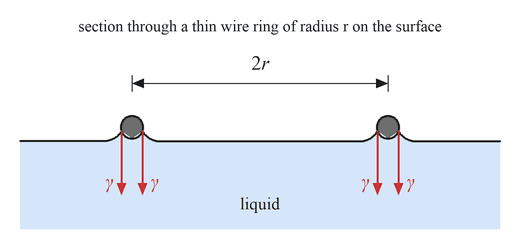
The total length of contact is
L=2πr+2πr
L=4πr
Step 3 — Part (ii), find the force. The force of surface tension is γ times this length:
F=γ×4πr
F=4πrγ
This is the downward pull that has to be overcome to lift the ring off the surface (the ring being light, its weight is neglected).
Step 4 — Part (iii), what happens at the top. The liquid rises up to the top of the tube and stops there; it does not overflow. Its meniscus becomes flatter, with a larger radius of curvature.
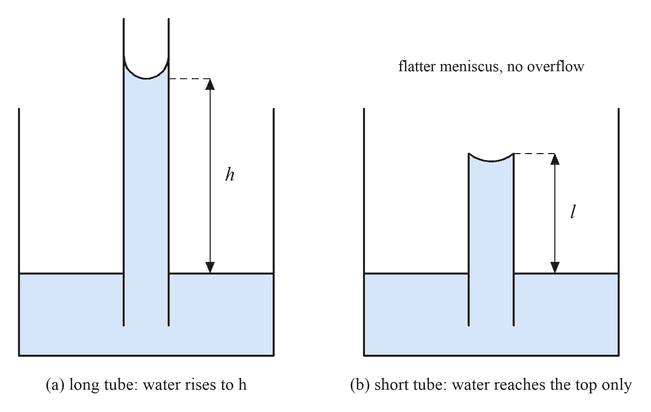
Step 5 — Part (iii), why. The height of rise satisfies hR=ρg2γ, where R is the radius of the meniscus, so the product hR is constant. If the length of tube outside is l<h, the meniscus at the top adjusts its radius so that lR′=hR, which gives:
R′=lhR
This is larger than R, because l<h. With this flatter meniscus, the upward force of surface tension just supports the shorter column, so no force is left over to push the liquid out.
Therefore, (i) surface tension is the force per unit length along a line on the liquid surface; (ii) the force on the ring is 4πrγ; and (iii) in a tube shorter than h, the liquid rises only to the top and its meniscus becomes flatter, so the liquid does not overflow.
