
Question 585 marksHard
Describe the method of determination of surface tension of a liquid by capillary rise. Derive the formula used.
Confirming your payment
Sign up now and get 250 free tokens.
Surface Tension · Question 58 of 58
Describe the method of determination of surface tension of a liquid by capillary rise. Derive the formula used.
Solution:
Concept: A liquid that wets a capillary tube rises in it until the upward pull of surface tension along the line of contact balances the weight of the raised column. Measuring the height of rise and the radius of the tube therefore gives the surface tension.
Step 1 — Derive the formula: the forces. Let a tube of radius be dipped in a liquid of density , surface tension and angle of contact , and let the liquid rise to a height . Along the line of contact (length ), the wall pulls the liquid with force per unit length at angle to the wall. The vertical components add up to , while the horizontal components cancel.
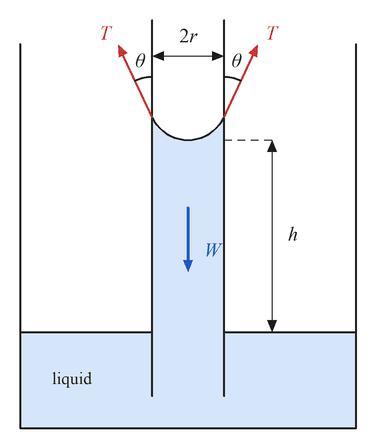
Step 2 — Derive the formula: the balance. The weight of the raised column (neglecting the meniscus) is . In equilibrium:
For water in clean glass, and , so
Step 3 — Set up the apparatus. A clean, dry capillary tube of uniform bore is clamped vertically with its lower end dipping in the liquid in a beaker. A pin is fixed beside the tube with its tip just touching the liquid surface in the beaker. A travelling microscope, which slides on a vertical scale with a vernier, is set up in front of the tube.

Step 4 — Measure the height . The microscope is focused on the bottom of the meniscus in the tube and its reading is noted. The beaker is then removed carefully, the microscope is lowered and focused on the tip of the pin, and the reading is noted again. The difference of the two readings is the height of the liquid column above the outside level.
Step 5 — Measure the radius . The tube is cut at the place where the meniscus stood, and the microscope is focused horizontally on the bore. The readings of the two ends of a diameter are taken, in two perpendicular directions, and the mean diameter gives the radius .
Step 6 — Calculate. Knowing , , , and , the surface tension is found from
Watch out: The liquid in the meniscus above its lowest point also has weight. For a hemispherical meniscus this extra volume equals a column of height , so a more accurate result for water is .
Therefore, the surface tension is found by measuring the capillary rise with a travelling microscope and the radius of the bore, and using , which comes from balancing the vertical pull of surface tension against the weight of the raised column.