
Opening your dashboard
Class 11 Physics Chapter 15 Surface Tension: Competency-Based Questions (CBQ)
46 questions on Chapter 15, each worked through on its own page with the AI tutor. Class 11 Physics, ICSE 2026-27.
46 questions
1–4 marks · Mixed difficulty
- 11 mark
Question 1
Competency: Analysis & Evaluation
A student notices that glycerine pours far more slowly than water. The student says: "Glycerine is so thick that its surface tension must be much larger than that of water." The teacher gives the student these values at :
Liquid Surface tension () Viscosity () Water Glycerine Which comment on the student's statement is correct?
- 21 mark
Question 2
Competency: Analysis & Evaluation
Two students write these statements in their notes on surface tension.
Assertion (A): Surface tension acts at right angles to the free surface of a liquid, pulling the surface into the liquid.
Reason (R): A molecule in the surface layer has fewer liquid molecules on its air side, so the resultant cohesive force on it points into the liquid.
- 31 mark
Question 3
Competency: Application
A boundary between two liquids that do not mix also behaves like a stretched membrane, and the force per unit length along it is called its interfacial tension. A data book gives these values at : the surface tension of water (water–air) is , that of hexane (hexane–air) is , and the interfacial tension of the hexane–water boundary is . According to the molecular theory, why is the tension of the hexane–water boundary smaller than the surface tension of water?
- 44 marks
Question 4
Competency: Application
A school weather club measures rainfall with a simple rain gauge: rain falls into a funnel whose circular rim is across and runs down into a collecting bottle, as shown. The funnel is dry at the start of each shower. After one shower the club pours the collected water into a measuring cylinder and reads . Rainfall is reported as the depth of water that would stand on flat ground, which is the volume caught divided by the area of the rim. A thin film of water always stays stuck to the inside of the funnel; for this funnel its area is about and its average thickness about . (Hypothetical data.)
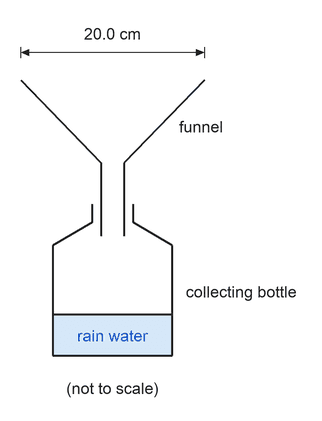
(a) Find the rainfall reported from the collected.
(b) Find the volume of water held back in the film and the true rainfall. By what percentage does the gauge under-read?
(c) Explain, using cohesive and adhesive forces, why the film stays on the funnel, and why a funnel coated with a water-repellent material such as PTFE would hold back much less water. Show also why the film matters far more after a very light shower that gives only .
- 51 mark
Question 5
Competency: Analysis & Evaluation
A cook pours a little water on a clean glass plate and on a frying pan with a non-stick PTFE coating.
Assertion (A): On the clean glass plate the water spreads out, but on the PTFE-coated pan it gathers into rounded drops.
Reason (R): Contact with the PTFE coating increases the surface tension of the water.
- 61 mark
Question 6
Competency: Analysis & Evaluation
Aboard a space station in orbit, where everything floats, an astronaut wrings out a wet face cloth. Instead of dripping away, the squeezed-out water forms a wobbling layer that clings all round the cloth and over the astronaut's hands. The air inside the station is kept at about normal room temperature and pressure. Which explanation is correct?
- 73 marks
Question 7
Competency: Application
At a science fair, children make giant soap bubbles. A loop of rope across is dipped in bubble solution and drawn slowly through the air, pulling out a tube of soap film long that ends in a rounded end, as shown. Treat the tube as a cylinder of radius and the rounded end as a hemisphere of the same radius. The surface tension of the solution is ; ignore the small extra pressure of the air inside. (Hypothetical data.)
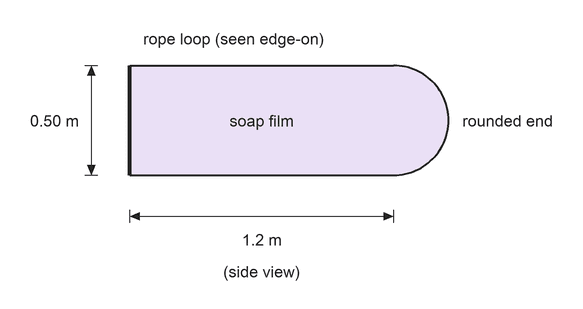
(a) Find the total area of soap surface in the tube and its end.
(b) Find the least work that must be done to make this film.
(c) A helper says: "We add glycerine because it raises the surface tension, and that is what makes the bubbles last longer." With glycerine added, the surface tension of the solution is measured as . Find the least work needed now, and comment on the helper's claim.
- 81 mark
Question 8
Competency: Analysis & Evaluation
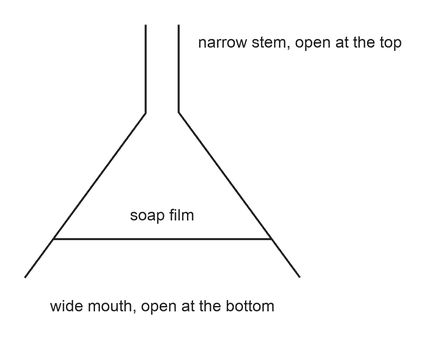
A glass funnel is dipped mouth first into soap solution, so that a flat soap film stretches across it just inside its wide mouth. The funnel is then held with its narrow stem pointing straight up, as shown; both the stem and the mouth are open to the air. What happens to the film, and why?
- 91 mark
Question 9
Competency: Analysis & Evaluation
A data book lists the surface tension of water at as , and its surface energy (the work needed per square metre to make new surface at constant temperature) as .
Assertion (A): The surface energy per unit area of a liquid, at constant temperature, is numerically equal to its surface tension.
Reason (R): The units and are the same, since .
- 103 marks
Question 10
Competency: Application
A car's windscreen is treated on the outside with a water-repellent coating, on which water has an angle of contact of about . The inside of the windscreen is treated with an anti-fog coating, on which water has an angle of contact of about . On ordinary untreated windscreen glass, which always carries a thin film of grime, the angle of contact of water is about (on perfectly clean glass it is close to ). (Hypothetical data.)
(a) On which of these three surfaces does water wet the glass? State the rule you use.
(b) Explain, in terms of cohesive and adhesive forces, why raindrops on the outside of the windscreen stay as nearly round beads, which the moving air blows off when the car is driven.
(c) On a cold morning, moisture from the passengers' breath condenses on the inside of the windscreen. Explain why the anti-fog coating keeps the view clear, even though it does not stop the water from condensing on the glass.
- 111 mark
Question 11
Competency: Analysis & Evaluation
After a shower, visitors to a pond notice raindrops on the lotus leaves: they sit as shining, almost perfect spheres and roll off at the slightest tilt, carrying dust with them.
Assertion (A): Raindrops on a lotus leaf stay almost perfectly spherical and roll off easily.
Reason (R): The angle of contact of water on a lotus leaf is very large, about , because its waxy, finely bumpy surface attracts water only weakly.
- 121 mark
Question 12
Competency: Application
In the laboratory a student reads the level of water in a narrow glass burette and the level of mercury in the bore of a glass thermometer. The figure shows both surfaces, greatly magnified. Line 1 is level with the edges of the water surface, where it meets the glass, and line 2 with its lowest point. Line 3 is level with the highest point of the mercury surface and line 4 with its edges. Which lines should the student read, and why?

- 134 marks
Question 13
Competency: Application
Mercury porosimetry is used to find the sizes of the tiny pores in materials such as rock, cement and catalysts. The sample is first emptied of air and is then surrounded by mercury, whose pressure is raised step by step. Mercury does not wet the sample (angle of contact ), so it enters a pore only when its pressure is high enough to push its convex surface into the pore, as shown. Model each pore as a narrow cylindrical tube of radius . Take the surface tension of mercury as and . (Hypothetical data.)

(a) Show that the mercury surface at the mouth of a pore is part of a sphere of radius , and hence that mercury enters the pore only when its pressure exceeds .
(b) Find this pressure, in atmospheres, for a pore of radius .
(c) The instrument can reach a pressure of . Find the radius of the narrowest pore it can fill, and explain why water could not be used in place of mercury in this method.
- 143 marks
Question 14
Competency: Analysis & Evaluation
In a classroom demonstration, a glass tall is filled to the brim with water, a piece of fine nylon mesh is stretched over its mouth and held by a rubber band, and the glass is turned upside down and held still, as shown. The water does not pour out, although each hole in the mesh is about across. Take the surface tension of water as , its density as and . (Hypothetical data.)
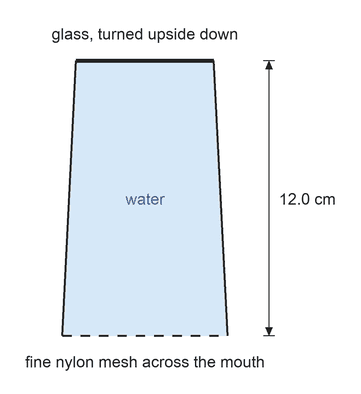
(a) A water surface stretched across a hole of radius can hold back a pressure difference of at most , when it bulges into a hemisphere. Find this greatest pressure difference for one hole of the mesh.
(b) A student says that surface tension in the holes holds up the whole weight of the water. Find the pressure difference across the mesh that this would need, and use it to decide what really holds the water up.
(c) Explain what job the curved water surfaces in the holes do, and why the demonstration fails with a coarse net whose holes are across.
- 151 mark
Question 15
Competency: Analysis & Evaluation
In a fish tank, an air pump releases small bubbles about across at the bottom, and they rise to the surface. Take the surface tension of water as , its density as and .
Assertion (A): Air bubbles about across, rising through the water, are very nearly spherical.
Reason (R): For such a small bubble, the excess pressure due to surface tension, , is much larger than the difference in water pressure between its top and its bottom.
- 164 marks
Question 16
Competency: Analysis & Evaluation
Two clean, flat glass plates, each wide, stand upright in a dish of water with of each plate above the water surface. They touch along one upright edge, and a thin wire thick keeps their other upright edges apart, so the gap between them grows steadily from zero at the touching edge to at the wire, away, as shown. Water rises between the plates, and it rises highest near the touching edge. For two parallel plates a distance apart, water (angle of contact zero) rises to a height ; treat each narrow upright strip of the wedge as such a pair of plates. Take , and . (Hypothetical data.)
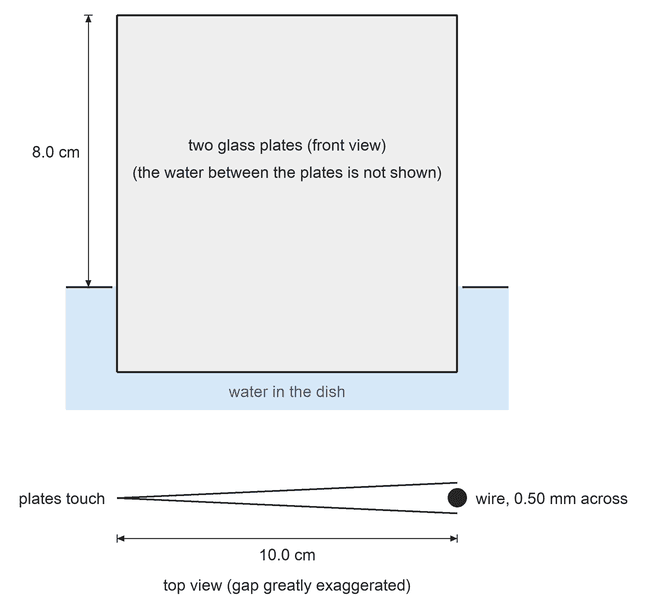
(a) Find the gap and the height of the water at distances , and from the touching edge.
(b) Show that is the same all along the plates, find its value, and name the curve formed by the top edge of the water.
(c) Within what distance of the touching edge does the water reach the top of the plates?
- 173 marks
Question 17
Competency: Application
After rain, water is held in the narrow spaces between soil grains. Model each space as a narrow upright tube of radius , fully wetted by water (angle of contact zero), with a concave water surface open to the air above. The water just below such a surface is at a lower pressure than the air; this pressure deficit measures how tightly the soil holds the water. A plant's roots can draw water out of a space only if the deficit there is less than about ; when all the remaining water is held more tightly than this, the plant wilts. Take the surface tension of water as . (Hypothetical data.)
(a) Explain why the water just below the concave surface is at a lower pressure than the air above it, and write the pressure deficit in terms of and .
(b) Find the radius of the narrowest space from which the roots can still draw water.
(c) Find the pressure deficit in a space of radius and compare it with the roots' limit. As the soil dries after rain, which spaces lose their water first, the wider or the narrower ones?
- 181 mark
Question 18
Competency: Analysis & Evaluation
The same clean glass capillary tube is dipped first in water and then in mercury.
Assertion (A): Water rises in the tube above the outside level, but mercury stands below the outside level.
Reason (R): Mercury is about times as dense as water.
- 191 mark
Question 19
Competency: Analysis & Evaluation
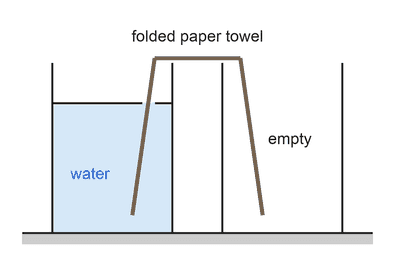
In a "walking water" activity, a cup full of coloured water and an empty cup stand side by side. A folded strip of paper towel is laid with one end in the water, over the rims of both cups, and the other end in the empty cup, as shown. Coloured water creeps up the strip and soon starts dripping into the empty cup. If the cups are left for several hours,
- 204 marks
Question 20
Competency: Analysis & Evaluation
A student measures the capillary rise of water in five glass capillary tubes of different radii , all at the same temperature. (Hypothetical data.)
Tube A B C D E (mm) 0.20 0.25 0.32 0.40 0.50 (cm) 7.34 5.89 3.95 3.68 2.93 Take the density of water as , and the angle of contact as zero.
(a) Explain why a graph of against should be a straight line through the origin, and say what its slope gives.
(b) Plot the graph, find the slope of the best straight line through the origin, and hence find the surface tension of water.
(c) One tube does not fit the line. Name it, find by what percentage its rise falls short, and suggest a likely reason.
- 211 mark
Question 21
Competency: Analysis & Evaluation
In the capillary rise method, two clean capillary tubes of different bores are dipped in the same beaker of water, and the surface tension is worked out separately from each tube.
Assertion (A): The two tubes should give the same value of the surface tension of water.
Reason (R): The water rises to the same height in both tubes, because the rise depends only on the liquid.
- 221 mark
Question 22
Competency: Application
In the capillary rise experiment, before taking the travelling-microscope reading on the meniscus, a student uses a rubber bulb to draw the water a few centimetres up the capillary tube above its final level, then lets it fall back and settle. The teacher says that this step makes the result more reliable. Why?
- 234 marks
Question 23
Competency: Application
In froth flotation, crushed ore is stirred with water in a tank while air is bubbled through it. In one plant, grains of galena (lead sulphide, density ) are separated from grains of quartz rock (density ). A chemical called a collector is added: it coats only the galena grains and makes their surfaces water-repellent, while the quartz grains stay fully wetted. A frother is also added, and the surface tension of the water in the tank is . Galena grains stick to the air bubbles and are carried up into a froth that is skimmed off, while the quartz sinks. Take and the density of water as . (Hypothetical data.)
(a) Galena is nearly three times as dense as quartz, yet the galena rises and the quartz sinks. Explain, using the angle of contact, why this separation does not depend on density.
(b) A galena grain of radius hangs from a bubble. The water surface of the bubble can pull on the grain, along their circle of contact, with a force of at most about . Compare this with the grain's weight minus the upthrust of the water on it.
(c) Find the radius of a galena grain for which the two forces in (b) are equal, and explain why the ore must be crushed to a fine powder before flotation.
- 241 mark
Question 24
Competency: Analysis & Evaluation
Wildlife rescuers clean seabirds caught in an oil spill by washing their feathers in a mild detergent solution. Afterwards the birds are kept out of open water for some days, until preening has restored the waterproofing of their feathers.
Assertion (A): A bird whose feathers still hold detergent floats higher in water than a bird with clean, waterproof feathers.
Reason (R): Detergent dissolved in water makes the force per unit length along the water's surface smaller.
- 251 mark
Question 25
Competency: Application
In a simple laboratory test, a pinch of fine, dry sulphur powder is sprinkled on the surface of two urine samples. On a normal sample the powder stays floating; on a sample that contains bile salts it sinks within a few seconds. Sulphur (density about ) is denser than urine. The powder sinks in the second sample because the bile salts
- 264 marks
Question 26
A thin, smooth stream of water falling from a tap breaks up into drops. Model a short piece of the stream as a cylinder of radius and length that pulls itself into one spherical drop of the same volume. Ignore the flat ends of the piece, since they were joined to the neighbouring pieces.
(i) Show that the drop has a smaller surface area than the curved surface of the cylinder only if .
(ii) In a stream of radius , a piece long forms one drop. Find the radius of the drop and the surface energy released ().
- 273 marks
Question 27
Calculate the work done in blowing a soap bubble of radius 0.1 m surface tension being 0.03 N m⁻¹. What additional work will be performed in further blowing it so that its radius is doubled?
- 283 marks
Question 28
A spherical mercury drop of m radius is sprayed into million drops of the same size. Calculate the energy used in doing so. Given surface tension of mercury .
- 293 marks
Question 29
Calculate the amount of energy evolved when 8 droplets of water (surface tension of water ) of radius 1/2 mm each combine into one.
- 303 marks
Question 30
Calculate the loss of energy when 27 drops of water each of radius 0.6 mm coalesce to form a single drop.
- 313 marks
Question 31
If a number of small droplets of water each of radius coalesce to form a single drop of radius , show that the rise in temperature is given by
where is the surface tension of water, is its density and is its specific heat capacity.
- 323 marks
Question 32
What is the difference of pressure between the inside and outside of a spherical drop of water of radius 1 mm? Surface tension of water .
- 333 marks
Question 33
Find the difference of pressure between inside and outside of a soap bubble of 5 mm in diameter. Surface tension of soap solution is .
- 343 marks
Question 34
A spherical air bubble is formed in water at a depth of 1.2 m from the surface. The diameter of the bubble is 0.6 mm and surface tension of water is . Calculate the pressure inside. Atmospheric pressure m of water.
- 353 marks
Question 35
A small hollow sphere having a small hole in it is immersed in water to a depth of 50 cm, before any water penetrates into it. Calculate the radius of the hole, if the surface tension of water is .
- 363 marks
Question 36
The pressure inside a soap bubble of radius 1 cm balances a 1.5 mm column of oil of density 800 kg m⁻³. Find the surface tension of the soap solution.
- 373 marks
Question 37
A capillary tube of radius 0.6 mm is dipped vertically in a liquid of surface tension 0.04 N m⁻¹ and relative density 0.8. Calculate the height of capillary rise if the angle of contact is 15°.
- 383 marks
Question 38
A capillary tube whose inner radius is 0.5 mm is dipped in water (). What is the weight of the water raised? Angle of contact .
- 393 marks
Question 39
The tube of a mercury barometer is 4.5 mm in diameter. What error does surface tension introduce in the reading? Given angle of contact of mercury and glass is 140°. Surface tension of mercury and density 13.6 g/cc.
- 403 marks
Question 40
Water rises in a capillary tube to a height 4 cm. If the tube is inclined at an angle of 45° with the vertical, find the position of the water in the tube.
- 414 marks
Question 41
Find the height to which water will rise in a capillary tube of radius 0.3 mm. . What will happen if the tube is raised till the upper end is 3 cm above the water surface?
- 423 marks
Question 42
Mercury in a capillary tube is depressed by 1.32 cm. Find the diameter of the tube, if the angle of contact of mercury with glass is 140° and density of mercury is 13.6 g cm⁻³ and surface tension .
- 433 marks
Question 43
Mercury in a capillary tube is depressed by 1.16 cm. The diameter of the capillary tube is 1 mm. Calculate the angle of contact of mercury with the glass if the surface tension of mercury is and its density is .
- 443 marks
Question 44
Two narrow tubes of diameter 3.0 mm and 6.0 mm are joined together to form a U-shaped tube open at both ends. If the U-tube contains water, what is the difference in its level in the two limbs of the tube? Surface tension of water at the temperature of the experiment is . Take the angle of contact to be zero and density of water to be .
- 453 marks
Question 45
Water rises to a height of 9 cm in a certain capillary tube. In the same tube, the level of mercury surface is depressed by 3 cm. Compute the ratio of surface tension of water and mercury. Density of mercury . Angle of contact of water is zero and that for mercury is 135°.
- 463 marks
Question 46
A thin tube of internal diameter 1.0 mm is dipped in a beaker of water. Calculate the height of the water level in the tube. Given surface tension of water N/m. Density of water .