
Competency: Analysis & Evaluation
Two clean, flat glass plates, each wide, stand upright in a dish of water with of each plate above the water surface. They touch along one upright edge, and a thin wire thick keeps their other upright edges apart, so the gap between them grows steadily from zero at the touching edge to at the wire, away, as shown. Water rises between the plates, and it rises highest near the touching edge. For two parallel plates a distance apart, water (angle of contact zero) rises to a height ; treat each narrow upright strip of the wedge as such a pair of plates. Take , and . (Hypothetical data.)
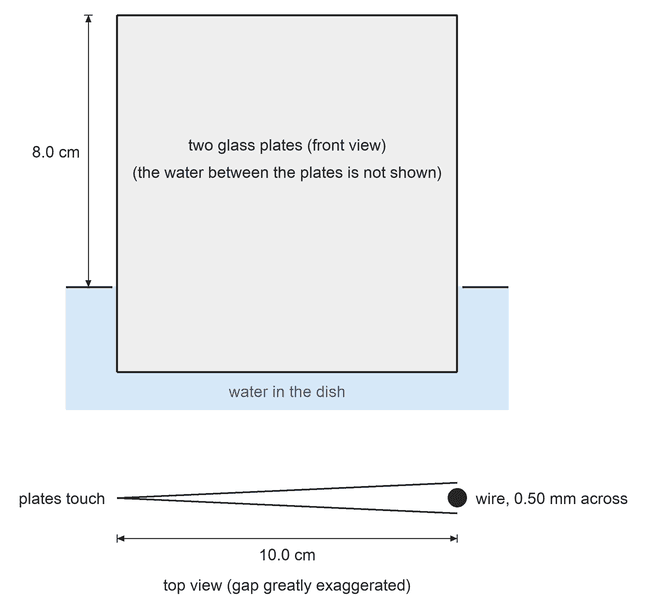
(a) Find the gap and the height of the water at distances , and from the touching edge.
(b) Show that is the same all along the plates, find its value, and name the curve formed by the top edge of the water.
(c) Within what distance of the touching edge does the water reach the top of the plates?