
Competency: Analysis & Evaluation
In a classroom demonstration, a glass tall is filled to the brim with water, a piece of fine nylon mesh is stretched over its mouth and held by a rubber band, and the glass is turned upside down and held still, as shown. The water does not pour out, although each hole in the mesh is about across. Take the surface tension of water as , its density as and . (Hypothetical data.)
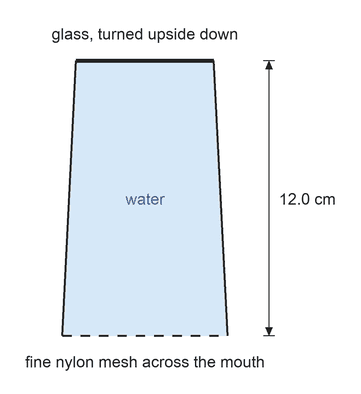
(a) A water surface stretched across a hole of radius can hold back a pressure difference of at most , when it bulges into a hemisphere. Find this greatest pressure difference for one hole of the mesh.
(b) A student says that surface tension in the holes holds up the whole weight of the water. Find the pressure difference across the mesh that this would need, and use it to decide what really holds the water up.
(c) Explain what job the curved water surfaces in the holes do, and why the demonstration fails with a coarse net whose holes are across.