
Opening your dashboard
Class 11 Physics Chapter 15 Surface Tension: Practice Questions
117 questions on Chapter 15, each worked through on its own page with the AI tutor. Class 11 Physics, ICSE 2026-27.
117 questions
1–4 marks · Mixed difficulty
- 11 mark
Question 1
An imaginary straight line long is drawn on the flat surface of water at rest. The surface tension of water is . With what force does the water surface on one side of the line pull on the surface on the other side?
- 21 mark
Question 2
According to the molecular theory, why does the free surface of a liquid tend to shrink to the smallest possible area?
- 33 marks
Question 3
A wire ring holds a soap film. A loop of thread long lies loosely on the film. The film inside the loop is touched with a hot needle and breaks, and the thread is pulled out into a circle, as shown. The surface tension of the soap solution is . (Hypothetical data.)
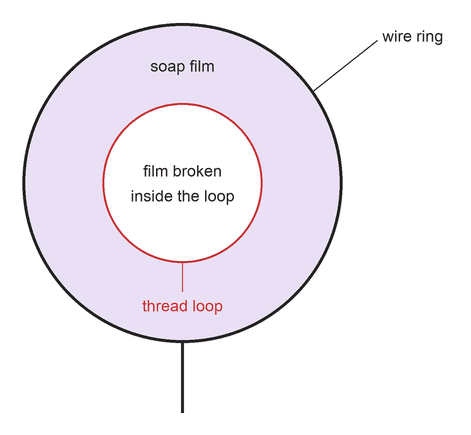
(i) Find the radius of the circle formed by the thread.
(ii) Find the tension in the thread.
- 43 marks
Question 4
A steel needle long and of mass is placed gently on clean water, where it floats in a shallow dimple. Along each of its two long edges the water surface pulls on it with a force , where is the length of the needle. Each pull is directed along the water surface, which there makes an angle with the horizontal, as shown. Take the surface tension of water as and , and neglect the upthrust of the water and the short ends of the needle. (Hypothetical data.)
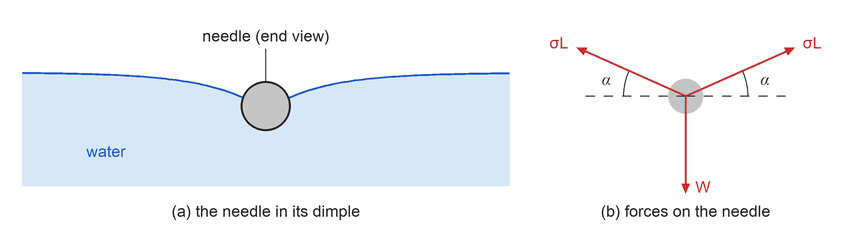
(i) Find the angle .
(ii) What is the greatest mass that a needle of the same length could have and still be held up in this way?
- 53 marks
Question 5
For very short ripples on deep water (a few millimetres long), gravity can be neglected, and the speed of a ripple of wavelength is given by the formula below, in which is the surface tension and the density of the liquid.
(i) Using the dimensional formula of surface tension, show that the right-hand side has the dimensions of speed.
(ii) Find the speed of ripples of wavelength on water (, ).
(iii) How does the speed change if the wavelength is halved?
- 61 mark
Question 6
Which of the following is NOT a correct S.I. unit of surface tension?
- 71 mark
Question 7
Cohesive forces (between molecules of the same substance) and adhesive forces (between molecules of different substances) are both
- 81 mark
Question 8
A drop of pure water is placed on each of three clean, flat surfaces P, Q and R. The angles of contact are on P, on Q and on R. (Hypothetical data.) Arrange the surfaces in decreasing order of the adhesive force between water and the surface.
- 92 marks
Question 9
A student writes with a fountain pen, whose ink is mostly water, on a polythene bag. Instead of a smooth line, the ink gathers into small separate beads. On paper the same ink spreads into a smooth line. Explain both observations in terms of cohesive and adhesive forces, and say why markers made for writing on polythene use an alcohol-based ink.
- 103 marks
Question 10
Take the molecular range of water to be (). (Hypothetical data.) Water has density and molar mass ; take .
(i) About how many water molecules lie inside the sphere of influence of a molecule deep inside the water?
(ii) Molecule A lies below the free surface. What fraction of its sphere of influence lies above the surface, in the air? (The volume of a cap of height cut from a sphere of radius is .)
(iii) Molecule B lies below the surface. Which of A and B feels a net force due to cohesion, and in which direction?
- 112 marks
Question 11
Damp sand can be shaped into a sandcastle with steep walls, but dry sand, and sand lying completely under water, just slump. Explain this using cohesive and adhesive forces and surface tension.
- 121 mark
Question 12
The surface tension of mercury is . How much work must be done, at constant temperature, to create of new mercury surface?
- 133 marks
Question 13
An ultrasonic humidifier turns water into a fine mist of droplets, each of radius , at a rate of per hour. The surface tension of water is . (Hypothetical data.)
(i) Show that the surface energy needed to turn a volume of water into droplets of radius is . (The surface of the water left in the tank can be ignored.)
(ii) Find the least power the humidifier must supply to create the new surface.
(iii) The humidifier draws . What percentage of this power goes into surface energy?
- 141 mark
Question 14
A soap film is formed on a rectangular wire frame with one movable side. The movable side is pulled out slowly at constant temperature. The graph shows the work done against the increase in the area of the frame. (Hypothetical data.)
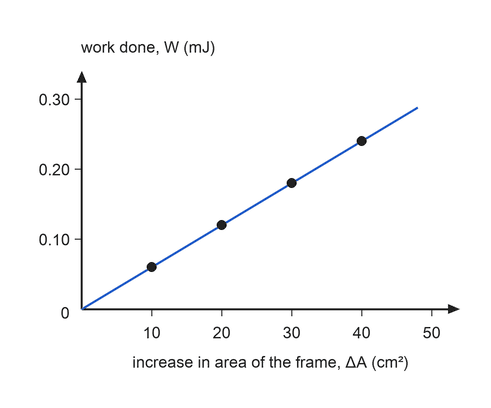
The surface tension of the soap solution is
- 153 marks
Question 15
Use these data for water: surface tension , density , molar mass , and latent heat of vaporisation .
(i) Estimate the volume taken up by one water molecule, and hence the area it occupies in the surface (take this area as the square of the cube root of the volume).
(ii) Estimate the extra energy of one molecule in the surface.
(iii) Compare this with the energy needed to remove one molecule from the liquid completely (to evaporate it), and explain the result using the molecular theory.
- 161 mark
Question 16
An air bubble of radius is trapped inside water (), and a soap bubble of the same radius floats in air (). Which bubble has more surface energy, and by what factor?
- 173 marks
Question 17
When a soap film bursts, a hole opens and its edge races outward, sweeping up the film. Consider a film of thickness made of soap solution of surface tension and density . (Hypothetical data.)
(i) A small area of the film disappears as the hole grows. Write down the surface energy it had and its mass.
(ii) If all this surface energy became kinetic energy of the film's material, show that the speed would be , where is the thickness, and find this speed.
(iii) How would this speed change for a film four times thinner?
- 183 marks
Question 18
Small drops of mercury on a glass plate are almost perfect spheres, but large ones spread into flat puddles. A rough test compares the surface energy of a drop of radius , , with the gravitational potential energy it could lose by flattening, which is of the order of (its weight times its radius). For mercury take and , with .
(i) Show that the two energies are equal when , and find this radius.
(ii) For a mercury drop of radius , find the ratio of the gravitational energy to the surface energy, and state the shape of the drop.
- 191 mark
Question 19
A drop of liquid rests on a horizontal solid surface. At the edge P of the drop, the tangent to the liquid surface is drawn, and the angles and are marked as shown.
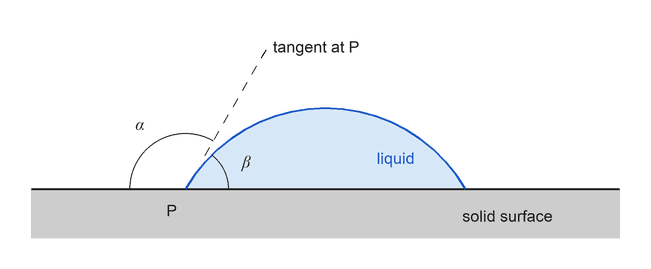
Which angle is the angle of contact, and what does it tell us about this liquid and this surface?
- 203 marks
Question 20
A small drop of a liquid rests on a flat horizontal surface. It is so small that gravity hardly affects its shape, so its surface is part of a sphere. Its circular base is across and its greatest height is , as shown. (Hypothetical data.)
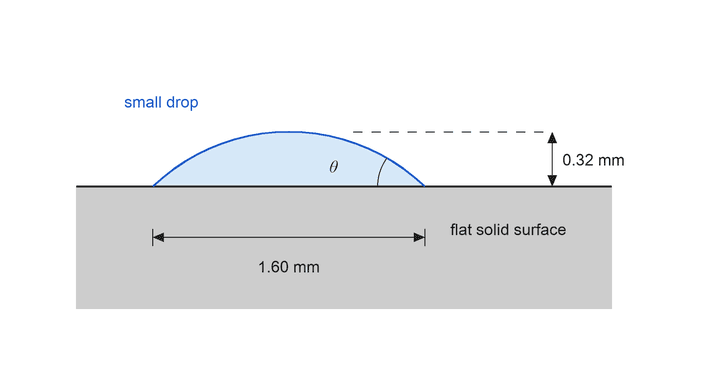
(i) Find the radius of curvature of the drop's surface.
(ii) Find the angle of contact .
(iii) Does the liquid wet the surface?
- 211 mark
Question 21
A tiny drop of liquid of volume rests on a horizontal surface with which the liquid has an angle of contact of exactly . The drop is small enough for its surface to be part of a sphere. The radius of the circle in which the drop touches the surface is about
- 223 marks
Question 22
Imagine of water set free in weightless conditions in the shape of a cube. Surface tension pulls it into a sphere. (Hypothetical data.) Take the surface tension of water as .
(i) Find the surface area of the cube and of the sphere.
(ii) Find the surface energy released.
(iii) Why does the water become a sphere rather than any other shape?
- 233 marks
Question 23
A thin, clean glass plate wide is held vertically with its lower edge dipping into a liquid. The liquid surface meets each face of the plate along a horizontal line long, as shown. The thickness of the plate is negligible.
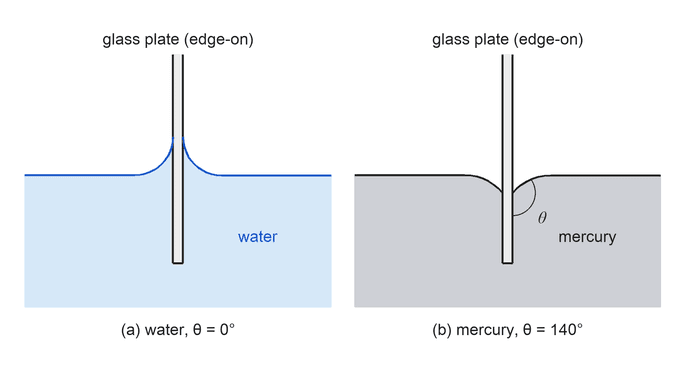
(i) In water (, angle of contact ), find the size and direction of the vertical force of surface tension on the plate.
(ii) Repeat part (i) for mercury (, angle of contact ).
(iii) Explain why the two forces are in opposite directions.
- 242 marks
Question 24
A narrow tube made of paraffin wax is dipped vertically into water. The angle of contact of water with paraffin wax is about .
(i) Sketch the shape of the water surface inside the tube, marking the angle of contact.
(ii) Explain this shape in terms of cohesive and adhesive forces.
- 251 mark
Question 25
A soap bubble of radius is blown in air. An air bubble of the same radius is formed just below the surface of the same soap solution in a beaker. The ratio of the excess pressure inside the soap bubble to the excess pressure inside the air bubble is
- 263 marks
Question 26
In the maximum bubble pressure method, air is pushed slowly down a vertical glass tube of internal radius whose lower end is below the surface of water, as shown. A bubble grows at the end of the tube; a gauge shows that the pressure of the air in the tube rises to a maximum and then falls as the bubble grows further and breaks away. The greatest gauge pressure (pressure above atmospheric) is . Take the density of water as and . (Hypothetical data.)

(a) Explain why the air pressure is greatest when the bubble is a hemisphere whose radius equals the radius of the tube.
(b) Find the surface tension of water.
- 271 mark
Question 27
Drops of different radii are formed from the same liquid at the same temperature, and the excess pressure inside each drop is found. Which graph will be a straight line passing through the origin?
- 283 marks
Question 28
A soap bubble is blown on a wet, flat glass plate so that it forms a hemisphere of radius , as shown. The surface tension of the soap solution is . (Hypothetical data.)
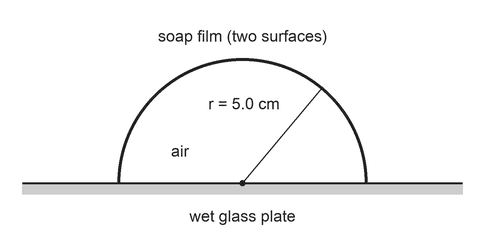
(a) Find the excess pressure of the air inside the bubble.
(b) Find the total upward force that this excess pressure exerts on the dome of soap film.
(c) Show that the pull of the film along the rim, where the dome meets the plate, balances this force.
- 291 mark
Question 29
A clean glass capillary tube of internal radius stands vertically in water, and the water inside rises with a hemispherical meniscus (angle of contact zero). Taking , the pressure in the water just below the meniscus is
- 303 marks
Question 30
Before water can boil, bubbles of steam must form inside it. Consider a tiny bubble of radius that contains only water vapour, just below the free surface of water at in an open pan (ignore the depth of water above it). At this temperature the surface tension of water is about ; atmospheric pressure is .
(a) Find the excess pressure that the vapour inside the bubble must have to stop the bubble from collapsing.
(b) Find the total pressure the vapour must have. The vapour pressure of water reaches this value only at about . What does this tell you about boiling very clean water in a very smooth container?
(c) Explain why bubbles form easily at about at scratches on a pan or on boiling chips, which hold tiny pockets of air many times wider than .
- 311 mark
Question 31
Water stands at a height in a clean glass capillary tube that is dipped vertically in a beaker of water. In equilibrium, the height does not depend on
- 324 marks
Question 32
A clean glass capillary tube of internal radius is dipped vertically into water. Take , angle of contact zero, density of water and .
(a) Find the height to which the water rises.
(b) The upward pull of surface tension, , acts at the top of the column while the water rises through the height . Find the work it does.
(c) Find the gravitational potential energy gained by the raised water.
(d) Compare your answers to (b) and (c), and say what becomes of the difference.
- 334 marks
Question 33
Two clean, flat glass plates are held vertically and parallel, a small distance apart, with their lower edges dipping in water, as shown in the edge-on view. The plates have width into the page, and water rises between them to a height above the outside level. Take the angle of contact as zero, and neglect the effects at the two side edges of the plates and the small amount of water in the curved surface.
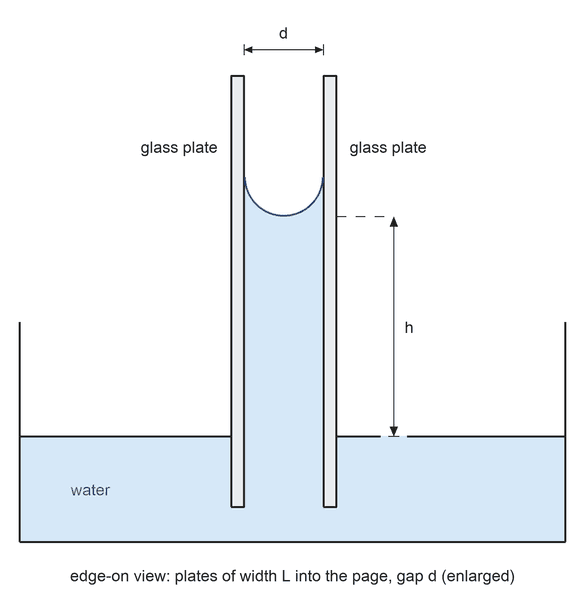
(a) By balancing the forces on the raised water, show that .
(b) Find for , taking , and .
(c) Compare this with the rise in a capillary tube whose internal diameter is also , and explain the difference.
- 341 mark
Question 34
To collect a blood sample, a nurse touches one end of a thin, clean glass capillary tube, held horizontal, to a drop of blood on a patient's fingertip. Blood runs into the tube and fills it along its whole length. This happens mainly because
- 351 mark
Question 35
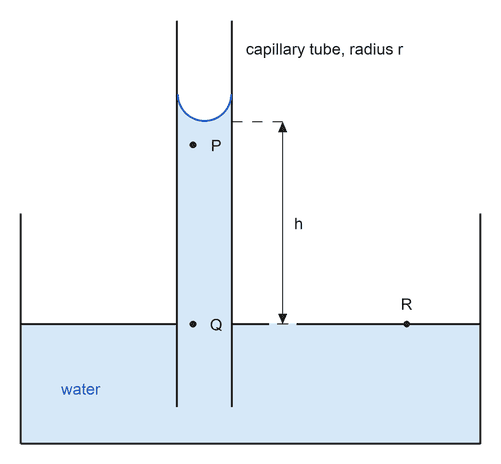
Water has risen to a height in a clean capillary tube of radius that stands in a beaker. Point is in the water just below the meniscus, point is inside the tube at the level of the water surface in the beaker, and point is on the free surface in the beaker, as shown. Which statement is correct?
- 362 marks
Question 36
A short thread of water is placed inside a horizontal glass tube that tapers gently from a wide end to a narrow end, as shown. Water wets the glass, so both ends of the thread have concave menisci.
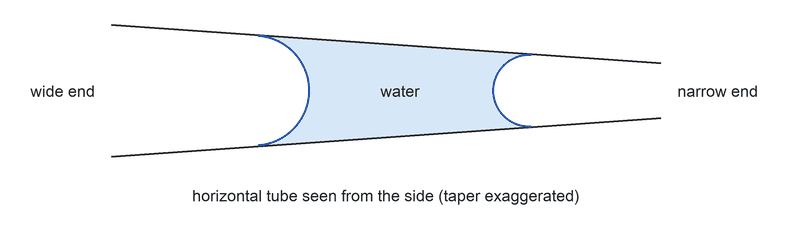
(a) Using the pressure difference across a curved surface, explain which way the water thread moves.
(b) Which way would a thread of mercury, which does not wet glass, move in the same tube? Give a reason.
- 374 marks
Question 37
In the capillary rise experiment, a student uses two clean capillary tubes in a beaker of water. For each tube the student takes the travelling-microscope reading with the horizontal cross-wire touching the bottom of the meniscus, and the reading on the tip of the needle , which just touches the water surface in the beaker. Each tube is then broken at the level of the meniscus, and its bore is measured in two perpendicular directions. The density of water is , , and the angle of contact is zero. (Hypothetical data.)
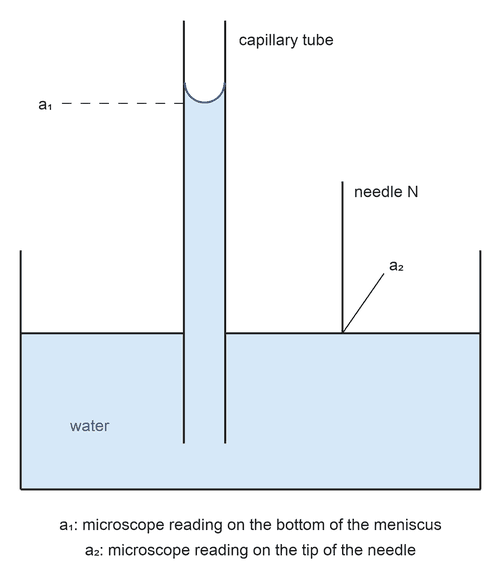
Tube (cm) (cm) Bore, first direction (mm) Bore, second direction (mm) 1 8.236 2.482 0.520 0.500 2 6.149 2.483 0.802 0.798 (a) Find the capillary rise and the mean radius of each tube.
(b) Using , find the surface tension from each tube, and the mean value.
- 382 marks
Question 38
In the capillary rise method, the height is measured from the outside water level to the lowest point of the meniscus, but some water is also held in the curved meniscus above this point. Treating the meniscus as a hemisphere of radius (the radius of the bore, angle of contact zero), show that this extra water is equal to a column of height , and hence that .
- 391 mark
Question 39
In the capillary rise method, a needle fixed beside the capillary tube is adjusted until its tip just touches the water surface in the beaker, and the travelling microscope is then focused on the needle tip. The needle is used because
- 402 marks
Question 40
In a capillary rise experiment, the bore diameter is measured as with a possible error of , and the capillary rise as with a possible error of . The surface tension is found from , taking and as exact. (Hypothetical data.)
(a) Find the maximum percentage error in .
(b) Which measurement needs the most care? Explain.
- 412 marks
Question 41
In the capillary rise method, the capillary tube is broken at the level of the meniscus before its bore is measured, and the bore is measured in two perpendicular directions and the mean is taken. Give the reason for each of these two steps.
- 421 mark
Question 42
A student's capillary tube was slightly greasy, so the angle of contact of water with it was instead of zero. The student calculated the surface tension from the measured rise using , which assumes zero angle of contact. The student's value of is
- 433 marks
Question 43
The surface tension of water at several temperatures is given below (values rounded).
Temperature () 0 20 40 60 80 100 () 75.6 72.8 69.6 66.2 62.6 58.9 The variation is often written as , where is the value at and is the temperature in .
(a) Find using the values at and .
(b) Use this value of to predict at , and compare with the table.
(c) At what temperature would this formula make zero? The surface tension of water actually becomes zero at its critical temperature, about . What does this tell you about the formula?
- 443 marks
Question 44
Water at rises in a clean glass capillary tube. At the surface tension of water is and its density is ; at they are and . Take , the angle of contact as zero at both temperatures, and neglect the expansion of the glass.
(a) Find the radius of the tube.
(b) Find the height to which water at rises in the same tube.
(c) Which change, in surface tension or in density, has the larger effect on the rise? Does the change in density raise or lower the column?
- 451 mark
Question 45
Which one of the following raises the surface tension of water slightly?
- 463 marks
Question 46
The tiny air sacs (alveoli) of the lungs are lined with a thin layer of watery liquid, so each sac has a single liquid–air surface on its inside. Model an alveolus as a sphere of radius . (Hypothetical data.)
(a) If the lining had a surface tension of , find the excess pressure needed inside the alveolus to keep it open.
(b) Cells in the lungs release a surfactant that lowers the surface tension of the lining to about . Find the new excess pressure.
(c) Use your answers to explain why babies born very early, whose lungs do not yet make enough surfactant, find breathing hard.
- 473 marks
Question 47
Water travels up a tree through very narrow tubes in its wood (xylem vessels). Take a vessel of radius whose walls are fully wetted by water (angle of contact zero). Take , the density of water and .
(a) How high could capillarity alone raise water in this vessel?
(b) A tree is tall. What radius would a tube need for capillarity alone to lift water to its top?
(c) What do your answers show about how water reaches the tops of tall trees?
- 481 mark
Question 48
Mosquito larvae living in still water hang from the underside of the water surface, held by the surface film while they take in air through a breathing tube that reaches the air. Health workers sometimes spread a thin film of oil on such water to kill the larvae. In terms of surface tension, the oil works because it
- 493 marks
Question 49
In some sandy soils the grains become coated with waxy material from decaying plants, so the soil repels water. The gaps between the grains act like capillary tubes of radius . Water () meets the coated grains at an angle of contact of . Groundskeepers therefore water such soil with a solution of a wetting agent (), which meets the grains at an angle of contact of . Take the density of both liquids as and . (Hypothetical data.)
(a) Find the capillary rise of plain water in such a gap, and explain what its sign means.
(b) Find the capillary rise of the wetting-agent solution.
(c) The wetting agent lowers the surface tension, yet the liquid now enters the gaps. Explain.
- 502 marks
Question 50
Which earthen pot keep water cooler, a new one or an old used one?
- 511 mark
Question 51
Why is there a split in the nib of a pen?
- 522 marks
Question 52
A steel blade floats on the surface of pure water. When detergent is added it sinks; why?
- 531 mark
Question 53
Why is sand drier than clay?
- 542 marks
Question 54
The ends of glass tube become round on heating. Why?
- 552 marks
Question 55
Explain how raincoats become waterproof.
- 562 marks
Question 56
When a chalk piece is immersed in water, bubbles are emitted; why?
- 572 marks
Question 57
The pressure given by a mercury barometer is always less than actual pressure. Why?
- 582 marks
Question 58
“The angle of contact of mercury with glass is obtuse; while the water with glass is acute.” Why?
- 592 marks
Question 59
Water on a clean glass surface, tends to spread out, while mercury on the same surface, tends to form drops. Why?
- 602 marks
Question 60
Surface tension of a liquid is independent of the area of surface. Why?
- 612 marks
Question 61
A drop of liquid under no external force, is always spherical in shape. Why?
- 621 mark
Question 62
What is the effect of temperature on surface tension?
- 632 marks
Question 63
Particles of camphor move around on the surface of water. Why?
- 643 marks
Question 64
A wire ring of diameter 0.03 m is dipped in a liquid and pulled out gently. If a force of 0.1 N is required to break the film, then what is the surface tension of the liquid?
- 653 marks
Question 65
A square frame of side is dipped in liquid soap. When it is taken out of the liquid, a soap film is formed on it. If the surface tension of soap solution is , then what is the force acting on the frame?
- 663 marks
Question 66
A wooden stick 2 m long is floating on the surface of water. The surface tension of water is 0.07 N/m. By putting soap solution on one side of the stick, the surface tension is reduced to 0.06 N/m. Calculate the net force on the stick.
- 673 marks
Question 67
A wire 0.1 m long is placed horizontally on the surface of water and is gently pulled up with a force of N to keep the wire in equilibrium. Calculate the surface tension of water.
- 683 marks
Question 68
Calculate the force required to take away a flat circular plate of radius 0.02 m from the surface of water. The surface tension of water is 0.07 N m⁻¹.
- 693 marks
Question 69
A ring of internal and external diameters m and m is supported horizontally from the pan of a physical balance such that it comes in contact with a liquid. An extra force of 40 N is required to pull it away from the liquid. Determine the surface tension of the liquid.
- 703 marks
Question 70
There is a soap film on a rectangular frame of wire of area . If the area of the frame is increased to , find the work done in the process. Given surface tension of soap films .
- 713 marks
Question 71
Assume that 64 water droplets combine to form a large drop. Determine the ratio of the total surface energy of 64 droplets to that of large drop. Given, surface tension of water .
- 723 marks
Question 72
The work done in blowing a soap bubble of volume is . What is the work done in blowing a soap bubble of volume ?
- 733 marks
Question 73
The work done in blowing a bubble of radius is . What is the work done in making a bubble of radius ? Given both the bubble are to be made with the same solution.
- 743 marks
Question 74
A film of water is formed between two straight parallel wires each 0.1 m long and at a separation of m. Calculate the work required to increase m distance between wires. Surface tension of water .
- 753 marks
Question 75
What should be the diameter of a soap bubble in order that the excess pressure inside it is ? Surface tension .
- 763 marks
Question 76
What is the pressure inside a drop of mercury of radius 3.00 mm at room temperature? Surface tension of mercury at that temperature (20°C) is . The atmospheric pressure is Pa.
- 773 marks
Question 77
Calculate the pressure inside air bubble of diameter 0.2 mm situated just below the surface of water. Surface tension of water is .
- 783 marks
Question 78
Find the difference in excess pressure on the inside and outside of a rain drop, if its diameter changes from 1.003 cm to 1.002 cm by evaporation. Surface tension of water is .
- 793 marks
Question 79
An air bubble of radius 0.6 mm may remain in equilibrium at a depth in water. If the surface tension of water is N/m, then calculate the depth.
- 803 marks
Question 80
Calculate the height of liquid column required to balance the excess pressure inside a soap bubble of radius m. The density of liquid is 900 kg m⁻³ and the surface tension of soap solution is .
- 813 marks
Question 81
When a capillary tube is dipped vertically in alcohol, alcohol rises by 0.02 m above the outer level. Calculate the surface tension of alcohol, given density of alcohol is 790 kg m⁻³.
- 823 marks
Question 82
Calculate the radius of the capillary tube if, when it is dipped vertically into a beaker of water, the water stands 35 cm higher in the capillary tube than in the beaker. Surface tension of water is .
- 833 marks
Question 83
Water rises to a height of 4 cm in a certain capillary tube. Find the height to which water will rise in another tube whose radius is one-half of the first tube.
- 841 mark
Question 84
The property utilised in the manufacture of lead shots is
- 851 mark
Question 85
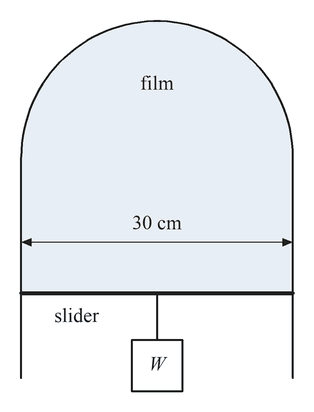
A thin liquid film formed between a -shaped wire and a light slider supports a weight of . The length of the slider is 30 cm and its weight is negligible. The surface tension of the liquid film is
- 861 mark
Question 86
The force required to separate two glass plates of area with a film of water 0.05 mm thick between them, is (surface tension of water is )
- 871 mark
Question 87
A certain number of spherical drops of a liquid of radius coalesce to form a single drop of radius and volume . If is the surface tension of the liquid, then
- 881 mark
Question 88
If is the surface tension of soap solution, the amount of work done in blowing a soap bubble from a diameter to is
- 891 mark
Question 89
What is ratio of surface energy of 1 small drop and 1 large drop, if 1000 small drops combined to form 1 large drop
- 901 mark
Question 90
What is the shape when a non-wetting liquid is placed in a capillary tube?
(A) Concave upward
(B) Convex upward
(C) Concave downward
(D) Convex downward
- 911 mark
Question 91
A liquid rises in a capillary tube if the angle of contact is
- 921 mark
Question 92
The wettability of a surface by a liquid depends primarily on
- 931 mark
Question 93
Three liquids of densities , and with , having the same value of surface tension , rise to the same height in three identical capillaries. The angles of contact , and obey
- 941 mark
Question 94
The excess pressure inside one soap bubble is three times that inside a second soap bubble, then the ratio of their surface areas is
- 951 mark
Question 95
The pressure at depth below the surface of a liquid of density open to the atmosphere is
- 961 mark
Question 96
The air pressure inside a soap bubble of radius exceeds the outside air pressure by 10 Pa. By how much will the pressure inside a bubble of radius exceed the outside air pressure?
- 971 mark
Question 97
A soap bubble in vacuum has a radius of 3 cm and another soap bubble in vacuum has a radius of 4 cm. If the two bubbles coalesce under isothermal condition, then the radius of the new bubble is
- 981 mark
Question 98
A capillary tube (A) is dipped in water. Another identical tube (B) is dipped in a soap–water solution. Which of the following shows the relative nature of the liquid columns in the two tubes?
- 991 mark
Question 99
Water rises to a height in a capillary tube. If the length of tube above the surface of water is made less than , then
- 1001 mark
Question 100
In a capillary tube experiment, a vertical 30 cm long capillary tube is dipped in water. The water rises up to a height of 10 cm due to capillary action. If this experiment is conducted in a freely falling elevator, the length of the water column becomes
- 1011 mark
Question 101
A 20 cm long capillary tube is dipped vertically in water and the liquid rises up to 10 cm. If the entire system is kept in a freely falling platform, the length of water column in the tube will be
- 1021 mark
Question 102
The lower end of a glass capillary tube is dipped in water. Water rises to a height of 8 cm. The tube is then broken at a height of 6 cm. The height of water column and angle of contact will be
- 1031 mark
Question 103
Two capillary tubes of radii 0.2 cm and 0.4 cm are dipped in the same liquid. The ratio of heights through which liquid will rise in the tubes is
- 1041 mark
Question 104
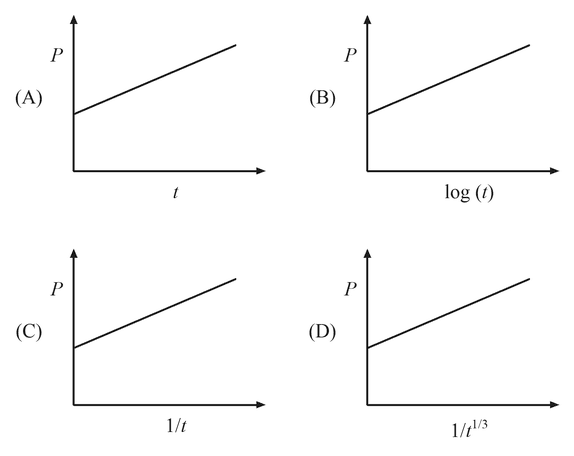
A soap bubble, blown by a mechanical pump at the mouth of a tube, increases in volume, with time, at a constant rate. The graph that correctly depicts the time dependence of pressure inside the bubble is given by
- 1051 mark
Question 105
If is the mass of water that rises in a capillary tube of radius , then mass of water which will rise in a capillary tube of radius is
- 1061 mark
Question 106
A soap bubble, having radius of 1 mm, is blown from a detergent solution having a surface tension of . The pressure inside the bubble equals at a point below the free surface of water in a container. Taking , density of water , the value of is
- 1071 mark
Question 107
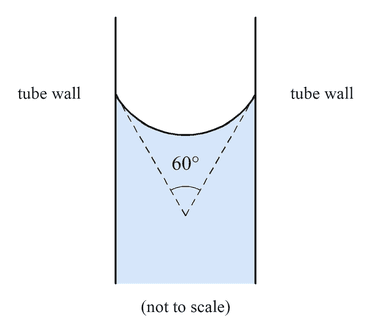
A capillary tube made of glass of radius 0.15 mm is dipped vertically in a beaker filled with methylene iodide (surface tension , density ) which rises to height in the tube. It is observed that the two tangents drawn from liquid-glass interfaces (from opp. sides of the capillary) make an angle of with one another. Then is close to ()
- 1081 mark
Question 108
Pressure inside two soap bubbles are 1.01 and 1.02 atmosphere, respectively. The ratio of their volumes is
- 1091 mark
Question 109
A capillary tube of radius is immersed in water and water rises in it to a height . The mass of the water in the capillary is 5 g. Another capillary tube of radius is immersed in water. The mass of water that will rise in this tube is
- 1101 mark
Question 110
When two soap bubbles of radii and coalesce, the radius of curvature of common surface is
- 1111 mark
Question 111
Two spherical soap bubbles of radii and in vacuum combine under isothermal conditions. The resulting bubble has a radius equal to
- 1121 mark
Question 112
Given below are two statements: One is Assertion A and the other is labelled as Reason R.
Assertion A: Clothes containing oil or grease stains cannot be cleaned by water wash.
Reason R: Because the angle of contact between the oil/grease and water is obtuse.
In the light of the above statements, choose the correct answer from the options given below.
- 1131 mark
Question 113
A water drop of radius 1 cm is broken into 729 equal droplets. If surface tension of water is 75 dyne/cm, then the gain in surface energy upto first decimal place will be: (Given )
- 1141 mark
Question 114
A mercury drop of radius is broken into 125 equal size droplets. Surface tension of mercury is . The gain in surface energy is
- 1151 mark
Question 115
If 1000 droplets of water of surface tension , having the same radius 1 mm each, combine to form a single drop, in the process the released surface energy is (take )
- 1161 mark
Question 116
Surface tension of a soap bubble is . Work done to increase the radius of the soap bubble from 3.5 cm to 7 cm will be [take ]
- 1171 mark
Question 117
A spherical drop of liquid splits into 1000 identical spherical drops. If is the surface energy of the original drop and is the total surface energy of the resulting drops, then (ignoring evaporation) . Then the value of is ______.