
Question 374 marksMedium
In the capillary rise experiment, a student uses two clean capillary tubes in a beaker of water. For each tube the student takes the travelling-microscope reading with the horizontal cross-wire touching the bottom of the meniscus, and the reading on the tip of the needle , which just touches the water surface in the beaker. Each tube is then broken at the level of the meniscus, and its bore is measured in two perpendicular directions. The density of water is , , and the angle of contact is zero. (Hypothetical data.)
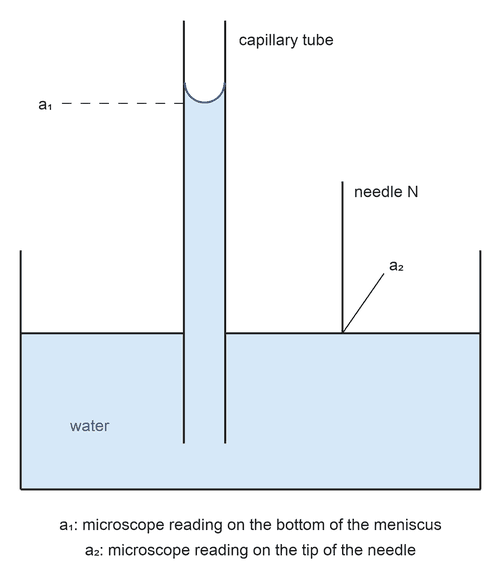
| Tube | (cm) | (cm) | Bore, first direction (mm) | Bore, second direction (mm) |
|---|---|---|---|---|
| 1 | 8.236 | 2.482 | 0.520 | 0.500 |
| 2 | 6.149 | 2.483 | 0.802 | 0.798 |
(a) Find the capillary rise and the mean radius of each tube.
(b) Using , find the surface tension from each tube, and the mean value.