
Question 533 marksMedium
What is capillarity? Derive an expression for capillary rise.
Confirming your payment
Sign up now and get 250 free tokens.
Surface Tension · Question 53 of 58
What is capillarity? Derive an expression for capillary rise.
Solution:
Concept: Where a liquid meets the wall of a narrow tube, surface tension acts all along the line of contact. For a liquid that wets the tube, this pull has an upward component on the liquid, which lifts a column of liquid until its weight balances the pull.
Step 1 — Define capillarity. The rise or fall of a liquid in a tube of very fine bore (a capillary tube) compared with the level outside is called capillarity. Water rises in a glass capillary; mercury falls in it.
Step 2 — Set up the forces. Let a capillary tube of radius be dipped in a liquid of density and surface tension , with angle of contact . The liquid rises to a height . Along the line of contact, of length , the wall pulls on the liquid with force per unit length, directed at angle to the wall.
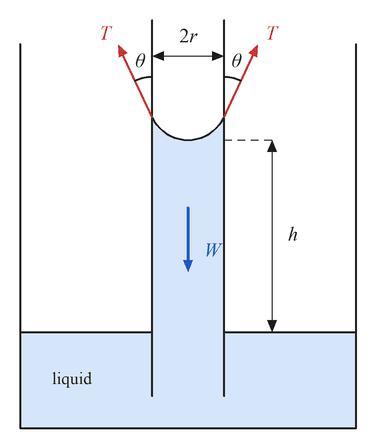
Step 3 — Find the upward force. The horizontal components of these pulls cancel round the circle. The vertical components add up to
Step 4 — Find the weight of the raised column. Neglecting the small volume of liquid in the meniscus, the raised column is a cylinder of radius and height , so its weight is
Step 5 — Balance the forces. In equilibrium the upward force equals the weight:
Step 6 — Read the result. The rise is inversely proportional to the radius, so it is larger in a narrower tube. If (mercury in glass), is negative and is negative: the liquid is depressed.
Therefore, capillarity is the rise or fall of a liquid in a fine tube, and the height of capillary rise is .