
Question 503 marksMedium
Define surface energy. Show that surface energy is numerically equal to surface tension.
Confirming your payment
Sign up now and get 250 free tokens.
Surface Tension · Question 50 of 58
Define surface energy. Show that surface energy is numerically equal to surface tension.
Solution:
Concept: Molecules at the surface of a liquid have more potential energy than those inside, because work is needed to bring a molecule to the surface against the inward pull of the liquid.
Step 1 — Define surface energy. The surface energy of a liquid is the extra potential energy per unit area of its surface film. It equals the work done in increasing the area of the surface by one unit, at constant temperature. Its SI unit is .
Step 2 — Set up the arrangement. Take a rectangular frame of wire with a sliding wire AB of length on it, and form a soap film on it. The film has two surfaces, each pulling the wire inward with a force , so the total inward force is
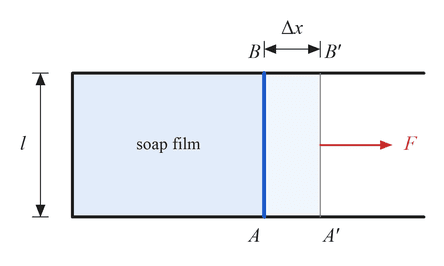
Step 3 — Find the work done. To pull the wire out slowly through a small distance (to A′B′), an equal outward force is needed. The work done is
Step 4 — Find the increase in area. Both surfaces of the film grow, each by , so the total increase in area is
Step 5 — Find the work per unit area. At constant temperature this work is stored as surface energy, so the surface energy per unit area is
Therefore, surface energy is the work done per unit area in increasing the surface at constant temperature, and it is numerically equal to the surface tension (in and , which are the same unit).