
Question 513 marksMedium
Define angle of contact. Name the factors on which it depends. Explain the shape of liquid meniscus in a tube.
Confirming your payment
Sign up now and get 250 free tokens.
Surface Tension · Question 51 of 58
Define angle of contact. Name the factors on which it depends. Explain the shape of liquid meniscus in a tube.
Solution:
Concept: The angle of contact shows how well a liquid wets a solid; it depends on the relative strengths of adhesion (liquid–solid) and cohesion (liquid–liquid).
Step 1 — Define the angle of contact. The angle of contact is the angle, measured inside the liquid, between the tangent to the liquid surface at the point of contact and the solid surface. It is acute when the liquid wets the solid (water on glass) and obtuse when it does not (mercury on glass, about to ).
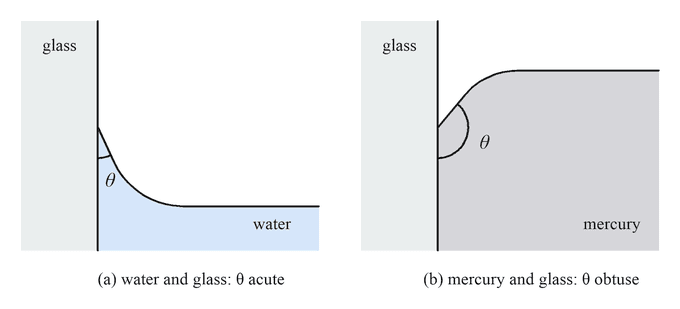
Step 2 — Name the factors. The angle of contact depends on the nature of the liquid and of the solid, the cleanliness of the solid surface and impurities in the liquid, the medium above the liquid, and the temperature.
Step 3 — Find the forces at the wall. Consider a liquid molecule at the point of contact with the wall of the tube. It feels the adhesive force of the wall, at right angles to the wall, and the cohesive force of the liquid, directed into the liquid. A liquid surface sets itself at right angles to the resultant force on its molecules.

Step 4 — Explain the concave meniscus. For water in glass, adhesion is the stronger, so points out of the liquid towards the wall. The surface, at right angles to , rises along the wall, and the meniscus is concave (angle of contact acute).
Step 5 — Explain the convex meniscus. For mercury in glass, cohesion is the stronger, so points into the liquid. The surface, at right angles to , curves down at the wall, and the meniscus is convex (angle of contact obtuse).
Therefore, the angle of contact is the angle inside the liquid between the solid surface and the tangent to the liquid surface; it depends on the liquid and solid, impurities, the medium above and the temperature; and the meniscus is concave when adhesion is stronger (water) and convex when cohesion is stronger (mercury), because the surface sets at right angles to the resultant force.