
Question 11 markMCQEasy
A iron needle slowly placed on the surface of water floats on it because
Confirming your payment
Sign up now and get 250 free tokens.
Surface Tension · Question 1 of 58
A iron needle slowly placed on the surface of water floats on it because
(A) when inside water, it will displace water more than its weight
(B) the density of the material of the needle is less than that of water
(C) of its surface tension
(D) of its shape
Answer: (C) Of its surface tension
Concept: The surface of a liquid behaves like a stretched membrane because of surface tension. A light object placed gently on it makes a small dent, and the surface tension along the edges of the dent pulls upward on it.
Step 1 — See what holds the needle up. The needle presses the water surface down into a shallow groove. The surface on each side pulls along itself, at an angle above the horizontal, so these pulls have upward components. Together they balance the weight of the needle.
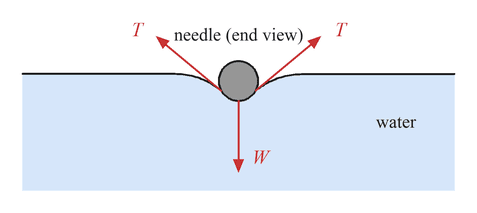
Step 2 — Name the cause. The pulls in the figure are forces of surface tension, so the needle floats because of the surface tension of water (the "its" in the option refers to the water).
Therefore, the answer is (C): the needle floats because of the surface tension of the water.