
Opening your dashboard
Class 10 Biology Chapter 12: The Endocrine System Solutions
54 textbook questions with step-by-step answers, free to read, for ICSE 2026-27.
Get talked through Ch 12, not just shown the answer
Reading a finished solution is not the same as being able to do it. The AI tutor takes one question at a time and works it with you, in your own words, until you can.
- Ask it out loud, in your own words
- It gives you the next step, not the answer
- Stuck on part (ii)? Start there
54 questions with solutions
1–13 marks · Mixed difficulty
- 15 marks
Question 1
Fill in the blanks by selecting the appropriate alternative from those given in brackets.
(i) Regulation of activities inside the body are brought about by .......... and .......... systems. (nervous/digestive/endocrine)
(ii) Hormones are secreted directly into the .......... . (organs/lymph/blood)
(iii) Chemically, some hormones are .........., some steroids, some .......... . (proteins/amines/carbohydrates)
(iv) Both .......... or deficiency of hormones lead to serious consequences. (excess/absence)
(v) Hormones produced in one species usually show .......... influence in other species. (similar/different)
Solve with AIWritten solution
Solution:
Concept: Body activities are regulated by two systems, the nervous system and the endocrine system. The endocrine system works through hormones, chemical regulators poured directly into the blood.
Step 1 — Blank (i): the two regulating systems.
Regulation inside the body is brought about partly by nerves and partly by hormones. The digestive system is one of the systems being regulated, not a regulator.
Answer: nervous and endocrine.
Step 2 — Blank (ii): where hormones go.
Endocrine glands have no ducts, so their secretion passes straight into the blood flowing through them.
Answer: blood.
Step 3 — Blank (iii): chemical nature.
Insulin is a protein, adrenaline is an amine and testosterone is a steroid. No hormone is a carbohydrate.
Answer: some are proteins, some steroids, some amines.
Step 4 — Blank (iv): excess or deficiency.
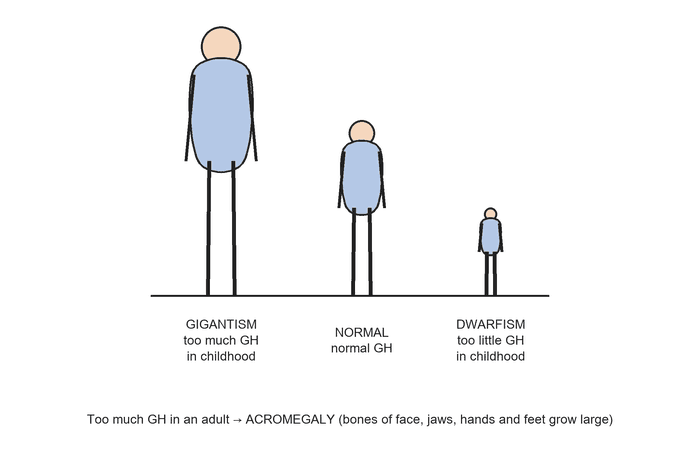
Too much (hypersecretion) and too little (hyposecretion) of a hormone both upset the body. For example, too much growth hormone in childhood gives gigantism and too little gives dwarfism.
Answer: excess.
Step 5 — Blank (v): effect in other species.
Hormones are chemicals, and the same chemical acts in much the same way in related animals; this is why insulin taken from animals could be used to treat diabetic patients.
Answer: similar.
Watch out: In (iv), 'absence' is wrong because the sentence already says 'deficiency'; the missing partner of deficiency is excess.
Therefore, the blanks are (i) nervous, endocrine; (ii) blood; (iii) proteins, amines; (iv) excess; (v) similar.
- 23 marks
Question 2
Give the characteristics of hormones pertaining to
(i) Site of action
(ii) Chemical nature
(iii) Manner of transportation.
Solve with AIWritten solution
Solution:
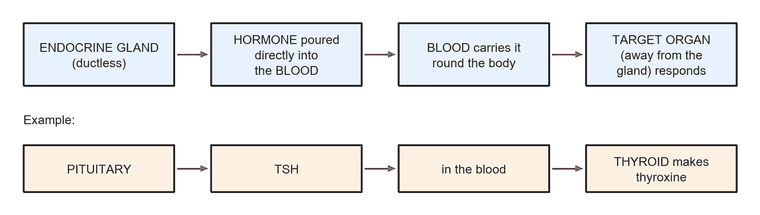
Concept: A hormone is a secretion of a ductless (endocrine) gland that is poured directly into the blood and acts on target organs or cells of the same body.
Step 1 — Site of action.
Hormones reach every part of the body in the blood, but only certain target organs or cells, usually away from the gland, respond to them. So a hormone acts at a distance from where it is made.
Step 2 — Chemical nature.
Chemically, hormones are of three kinds:
Kind Example Solubility Peptides (proteins) insulin water-soluble Amines (from amino acids) adrenaline water-soluble Steroids (from cholesterol) testosterone lipid-soluble Step 3 — Manner of transportation.
An endocrine gland has no duct. Its hormone passes directly into the blood flowing through the gland, and the blood carries it to all parts of the body.
Watch out: Hormones are not carried through ducts; that is how enzymes of exocrine glands travel.
Therefore, hormones act on distant target organs, are proteins (peptides), amines or steroids, and are carried by the blood.
- 31 mark
Question 3
Mention the three types of cells of the islets of Langerhans and the name of the hormone they secrete.
Solve with AIWritten solution
Solution:
Concept: The islets of Langerhans are groups of hormone-secreting cells scattered in the pancreas. Each of their three kinds of cells makes its own hormone.
Step 1 — List the three kinds of islet cells and their hormones.
Cells of the islet Hormone secreted Beta (β) cells Insulin Alpha (α) cells Glucagon Delta (δ) cells Somatostatin 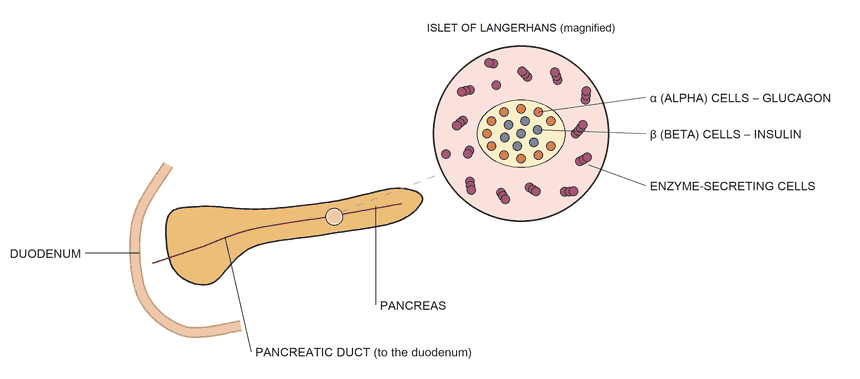
Step 2 — What the hormones do.
Insulin lowers the blood sugar level and glucagon raises it, so the two keep blood sugar steady. Somatostatin holds back the secretion of both insulin and glucagon.
Watch out: There are no 'gamma' cells in the islets; the three kinds are alpha, beta and delta.
Therefore, beta cells secrete insulin, alpha cells secrete glucagon and delta cells secrete somatostatin.
- 42 marks
Question 4
Mention the two principal ways in which insulin acts :
Solve with AIWritten solution
Solution:
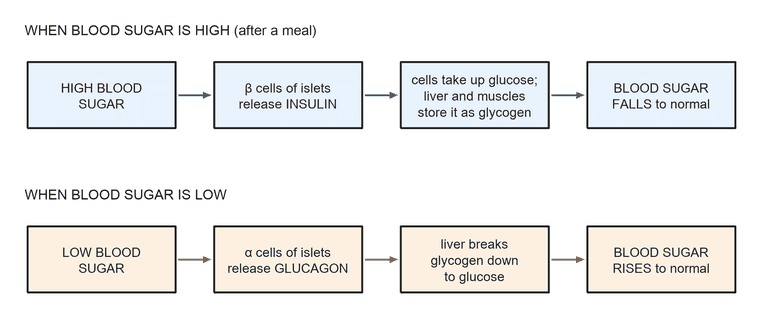
Concept: Insulin, from the beta cells of the islets of Langerhans, checks a rise in the blood sugar level, for example after a meal.
Step 1 — First way: glucose is used by the cells.
Insulin makes the body cells take up glucose from the blood and use it (oxidise it) for energy. Glucose leaves the blood, so the blood sugar level falls.
Step 2 — Second way: extra glucose is stored as glycogen.
Insulin also makes the liver and muscles take up the extra glucose and store it as glycogen. This removes the surplus from the blood.
Watch out: Insulin does not itself turn glucose into glycogen; it makes the cells absorb glucose, and the cells use it or store it as glycogen.
Therefore, insulin acts by promoting glucose utilisation by the body cells and by the deposition of extra glucose as glycogen in the liver and muscles.
- 52 marks
Question 5
Name the following conditions :
(i) Passage of much glucose in urine
(ii) Overdose of insulin makes the diabetic patient unconscious
Solve with AIWritten solution
Solution:
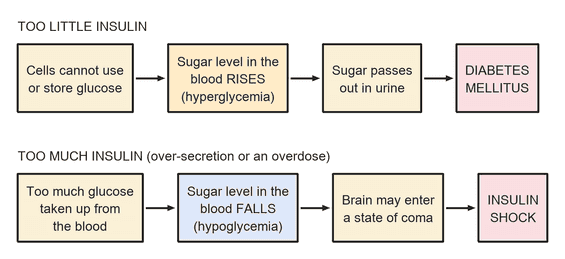
Concept: Too little insulin lets the blood sugar level rise; too much insulin makes it fall too low.
Step 1 — Condition (i): much glucose in urine.
When too little insulin is secreted, glucose stays in the blood (hyperglycemia). The kidneys cannot take all of it back, so a great deal of urine loaded with sugar is passed. 'Mellitus' means honey, referring to this sugar.
Answer: diabetes mellitus.
Step 2 — Condition (ii): overdose of insulin.
An overdose of insulin drives too much glucose out of the blood (hypoglycemia). The brain depends on blood glucose, so the patient may become unconscious. A quick bite of sugar or sweet biscuits helps.
Answer: insulin shock.
Watch out: Insulin shock is caused by too much insulin, the opposite of diabetes mellitus.
Therefore, (i) is diabetes mellitus and (ii) is insulin shock (hypoglycemia).
- 61 mark
Question 6
List any three symptoms of diabetes mellitus.
Solve with AIWritten solution
Solution:
Concept: In diabetes mellitus too little insulin is secreted, so glucose stays in the blood and spills into the urine.
Step 1 — Sugar in blood and urine.
Without enough insulin the cells cannot take up glucose, so the blood sugar level stays high (hyperglycemia) and a large amount of urine loaded with sugar is passed.
Step 2 — Thirst.
So much water leaves the body with this urine that the person feels very thirsty.
Step 3 — Loss of weight.
The cells cannot use glucose, so the body breaks down its fat and protein for energy and the person loses weight and grows weak. In some cases eyesight is lost.
Watch out: Write symptoms, not the cause: 'deficiency of insulin' is the cause, not a symptom.
Therefore, three symptoms are high blood sugar with much sugary urine, excessive thirst and loss of weight.
- 71 mark
Question 7
Name the two categories of hormones secreted by adrenal cortex.
Solve with AIWritten solution
Solution:
Concept: The hormones of the adrenal cortex (the outer part of the adrenal gland) are called cortical hormones or corticoids.
Step 1 — Name the two categories.
The two main categories are mineralocorticoids and glucocorticoids.
Step 2 — Say what each does.
Mineralocorticoids regulate mineral metabolism, especially of and ions. Glucocorticoids regulate carbohydrate, protein and fat metabolism.
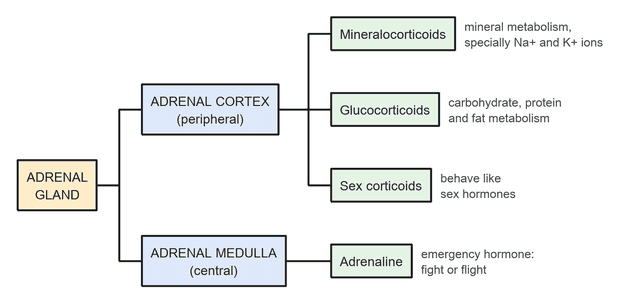
The cortex also secretes sex corticoids, which behave like sex hormones.
Watch out: Adrenaline is not a cortical hormone; it comes from the adrenal medulla.
Therefore, the two categories are mineralocorticoids and glucocorticoids.
- 81 mark
Question 8
List any two effects of adrenaline.
Solve with AIWritten solution
Solution:
Concept: Adrenaline, from the adrenal medulla, is the emergency hormone: it prepares the body to face danger ('fight') or run from it ('flight').
Step 1 — Effect on the heart.
Adrenaline makes the heart beat faster, so the blood pressure rises and blood reaches the muscles quickly.
Step 2 — Effect on blood sugar.
It makes the liver change glycogen into glucose, so more glucose is released into the blood as fuel for the muscles.
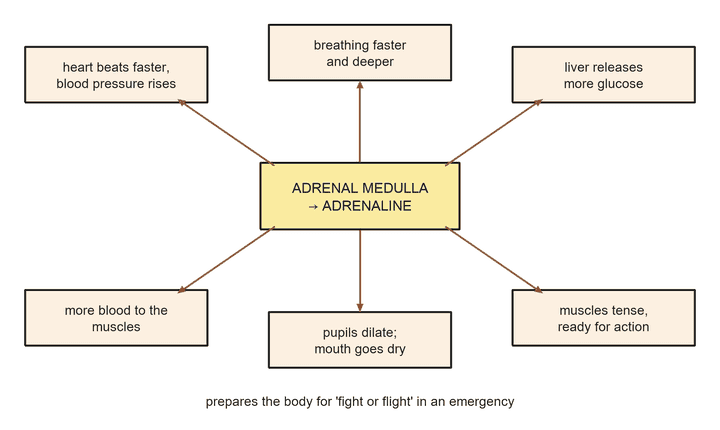
Other effects: more blood to the muscles and less to the skin and gut, faster and deeper breathing, dilated pupils.
Therefore, two effects of adrenaline are a faster heart beat (with higher blood pressure) and more glucose released into the blood.
- 97 marks
Question 9
Fill in the blanks with the correct alternative :
(i) Thyroid is located close to .......... (larynx/kidney)
(ii) Cretinism is caused due to .......... of thyroxin. (undersecretion/oversecretion)
(iii) Oversecretion of thyroxin causes .......... goitre. (simple/exophthalmic)
(iv) The condition showing swelling in face and hands and sluggishness due to hypothyroidism is called .......... (cretinism/myxoedema)
(v) The hormone concerned with facing dangers is .......... . (thyroxine/cortisone/adrenalin)
(vi) Cortex and medulla are the two regions of .......... .......... (thyroid/adrenal)
(vii) One of the effects of increased secretion of adrenaline is .......... . (Dry mouth/slowing of heart beat/arterioles of the digestive system dilate)
Solve with AIWritten solution
Solution:
Concept: Blanks (i) to (iv) are about the thyroid and the disorders of thyroxine; blanks (v) to (vii) are about the adrenal gland and adrenaline.
Step 1 — Blank (i): position of the thyroid.
The thyroid lies in front of the neck, just below the larynx (voice box).
Answer: larynx.
Step 2 — Blank (ii): cause of cretinism.
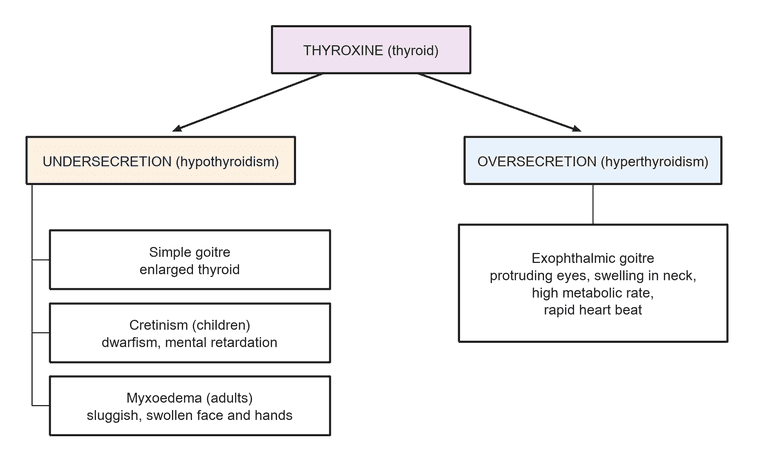
Cretinism is a form of hypothyroidism in children: too little thyroxine stunts growth and mental development.
Answer: undersecretion.
Step 3 — Blank (iii): oversecretion.
Too much thyroxine makes the eyes bulge out with a swelling in the neck. Simple goitre is due to lack of iodine (too little thyroxine).
Answer: exophthalmic goitre.
Step 4 — Blank (iv): swollen face, sluggish adult.
Hypothyroidism in an adult gives a swollen face and hands and sluggishness; cretinism is the childhood form.
Answer: myxoedema.
Step 5 — Blank (v): hormone for facing danger.
Adrenaline prepares the body for 'fight or flight'.
Answer: adrenalin.
Step 6 — Blank (vi): gland with cortex and medulla.
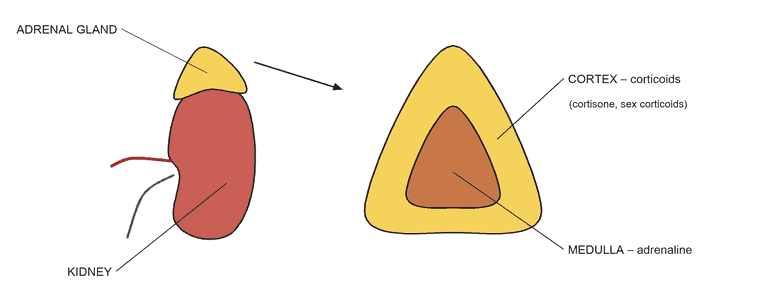
Each adrenal gland has an outer cortex and an inner medulla.
Answer: adrenal gland.
Step 7 — Blank (vii): effect of extra adrenaline.
Adrenaline narrows the arterioles of the digestive system, so less blood and saliva reach the mouth and it feels dry. The heart beats faster, not slower, and these arterioles narrow, they do not widen.
Answer: Dry mouth.
Watch out: Do not mix up the two thyroid disorders of hyposecretion: cretinism is in children, myxoedema in adults.
Therefore, the blanks are larynx, undersecretion, exophthalmic, myxoedema, adrenalin, adrenal, dry mouth.
- 104 marks
Question 10
Mention if the following statements are true (T) or false (F). If false, rewrite the correct word (not words) striking out the single wrong one.
(i) Pituitary is of the size of a lemon.
(ii) Pituitary has three lobes — anterior, posterior and intermediate.
(iii) Oversecretion of growth hormone in adult causes gigantism.
(iv) Vasopressin secreted by anterior lobe controls reabsorption of water form kidney tubules.
Solve with AIWritten solution
Solution:
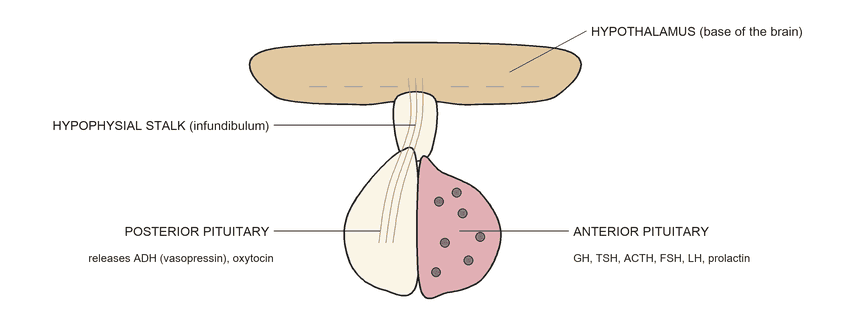
Concept: The pituitary is a pea-sized gland hanging from the base of the brain below the hypothalamus. Its anterior and posterior lobes secrete different hormones.
Step 1 — Statement (i): size.
The pituitary is tiny, about the size of a pea and only about half a gram in weight, not the size of a lemon.
False. Pituitary is of the size of a
lemonpea.Step 2 — Statement (ii): lobes.
The pituitary has an anterior lobe, a posterior lobe and an intermediate lobe. In humans the intermediate lobe is very small, so the gland is usually described with two distinct lobes.
True.
Step 3 — Statement (iii): too much growth hormone in an adult.
In an adult the long bones can no longer lengthen, so extra growth hormone enlarges the bones of the face (jaws), hands and feet. Gigantism happens only when the oversecretion is in childhood.
False. Oversecretion of growth hormone in adult causes
gigantismacromegaly.Step 4 — Statement (iv): source of vasopressin.
Vasopressin (ADH) and oxytocin are released from the posterior lobe.
False. Vasopressin secreted by
anteriorposterior lobe controls reabsorption of water from kidney tubules.Watch out: Change only the single wrong word, as the question asks.
Therefore, (i) F (pea), (ii) T, (iii) F (acromegaly), (iv) F (posterior).
- 114 marks
Question 11
Write the full forms of :
(i) TSH
(ii) LH
(iii) ACTH
(iv) ADH
Solve with AIWritten solution
Solution:
Concept: TSH, LH and ACTH come from the anterior pituitary and ADH from the posterior pituitary. Each full name tells what the hormone does.
Step 1 — TSH.
Thyroid Stimulating Hormone: it makes the thyroid secrete thyroxine.
Step 2 — LH.
Luteinizing Hormone: it brings about ovulation and the corpus luteum in females, and the secretion of testosterone in males.
Step 3 — ACTH.
Adrenocorticotropic Hormone: it controls the adrenal cortex.
Step 4 — ADH.
Antidiuretic Hormone (vasopressin): it increases the reabsorption of water from the kidney tubules, so less urine is formed ('anti-diuretic' means against much urine).

Therefore, TSH = Thyroid Stimulating Hormone, LH = Luteinizing Hormone, ACTH = Adrenocorticotropic Hormone, ADH = Antidiuretic Hormone.
- 122 marks
Question 12
What causes the following ?
(i) Acromegaly
(ii) Diabetes insipidus
Solve with AIWritten solution
Solution:
Concept: Both are disorders of pituitary hormones: acromegaly is due to too much growth hormone, diabetes insipidus to too little ADH.
Step 1 — Acromegaly.
It is caused by oversecretion of growth hormone in an adult. The long bones can no longer lengthen, so the bones of the face (especially the jaws), hands and feet grow too large; the nose and lips become thick.
Step 2 — Diabetes insipidus.
It is caused by deficiency of ADH (vasopressin) from the posterior pituitary. With little ADH, less water is reabsorbed in the kidney tubules, so a large volume of dilute urine (without sugar) is passed and the person is always thirsty.
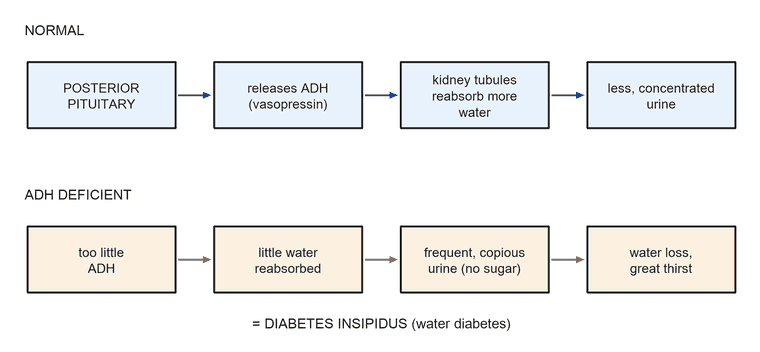
Watch out: Diabetes insipidus is not caused by insulin; its urine has no sugar.
Therefore, acromegaly is caused by excess growth hormone in an adult, and diabetes insipidus by deficiency of ADH (vasopressin).
- 131 mark
Question 13
Which of the following is not an endocrine gland?
Solve with AIAnswer
(A) Adrenal gland
(B) Pituitary gland
(C) Thyroid gland
- Correct
(D) Sebaceous gland
Answer: (D) Sebaceous gland
Concept: An endocrine gland is ductless: its hormone goes straight into the blood. A gland whose secretion leaves through a duct is an exocrine gland.
Step 1 — Check each gland for a duct.
The adrenal, pituitary and thyroid glands have no ducts and secrete hormones into the blood.
Step 2 — Find the duct gland.
The sebaceous gland of the skin sends its oily sebum through a duct onto the skin and secretes no hormone, so it is an exocrine gland.

Watch out: A gland in the skin is not endocrine just because it is small; what matters is whether it has a duct.
Why the other options are wrong:
- (A) Adrenal gland: the adrenal gland is ductless and secretes adrenaline and the cortical hormones into the blood.
- (B) Pituitary gland: the pituitary is ductless, the 'master' endocrine gland.
- (C) Thyroid gland: the thyroid is ductless and secretes thyroxine into the blood.
Therefore, the sebaceous gland is not an endocrine gland, option (D).
- 141 mark
Question 14
Which of the following hormones stimulates milk secretion ?
Solve with AIAnswer
- Correct
(A) Prolactin
(B) Oxytocin
(C) Progesterone
(D) Calcitonin
Answer: (A) Prolactin
Concept: Prolactin, from the anterior pituitary, makes the mammary glands form and secrete milk (lactation).
Step 1 — Separate milk secretion from milk ejection.
Making milk in the breast is milk secretion; pushing out the milk already made is milk ejection.
Step 2 — Match the hormone.
Milk formation and secretion is controlled by prolactin.
Watch out: Oxytocin also concerns milk, but only its ejection (let-down), not its secretion.
Why the other options are wrong:
- (B) Oxytocin: oxytocin, from the posterior pituitary, ejects milk already formed and contracts the uterus.
- (C) Progesterone: progesterone, from the corpus luteum, prepares and maintains the uterus for pregnancy.
- (D) Calcitonin: calcitonin, from the thyroid, moves calcium from the blood into the bones.
Therefore, the hormone that stimulates milk secretion is prolactin, option (A).
- 151 mark
Question 15
Oxytocin stimulates the contraction of :
Solve with AIAnswer
(A) Ovary
(B) Ureter
- Correct
(C) Uterus
(D) Breast
Answer: (C) Uterus
Concept: Oxytocin, released by the posterior pituitary, makes the smooth muscle of the uterus contract strongly during childbirth ('oxytocin' means quick birth).
Step 1 — Recall the target.
Oxytocin acts on the muscular wall of the uterus at the end of pregnancy.
Step 2 — Result.
The strong contractions push the baby out, so oxytocin brings about childbirth.
Watch out: Oxytocin also acts on the breast, but only to eject milk; the organ it makes contract in labour is the uterus.
Why the other options are wrong:
- (A) Ovary: the ovary is controlled by FSH and LH; oxytocin does not make it contract.
- (B) Ureter: the ureter carries urine and is not a target of oxytocin.
- (D) Breast: in the breast oxytocin only squeezes out milk already formed; the contraction asked about is of the uterus.
Therefore, oxytocin stimulates the contraction of the uterus, option (C).
- 161 mark
Question 16
Hypersecretion of growth hormone causes :
Solve with AIAnswer
(A) Gigantism and Dwarfism
(B) Acromegaly and Dwarfism
- Correct
(C) Gigantism and Acromegaly
(D) Dwarfism and Virilism
Answer: (C) Gigantism and Acromegaly
Concept: Hypersecretion means too much. Too much growth hormone causes a different disorder in a child and in an adult.
Step 1 — In childhood.
The long bones can still lengthen, so they grow beyond normal and the child becomes a giant: gigantism.
Step 2 — In an adult.
The long bones have stopped growing, so the bones of the face, hands and feet enlarge: acromegaly.
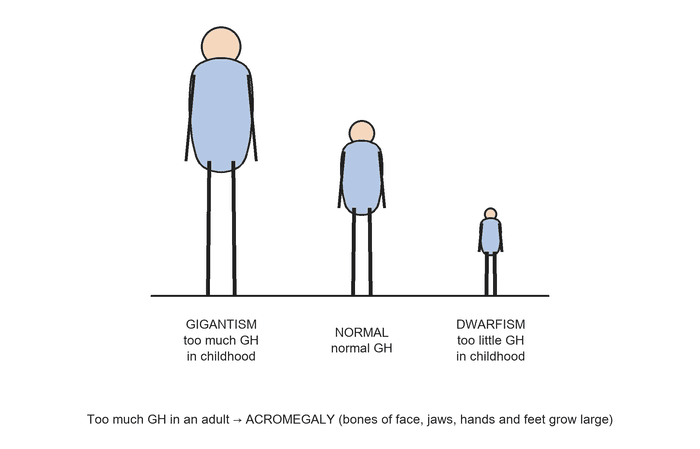
Watch out: Dwarfism is due to too little growth hormone, so any option with dwarfism is wrong.
Why the other options are wrong:
- (A) Gigantism and Dwarfism: gigantism is right, but dwarfism comes from deficiency of growth hormone.
- (B) Acromegaly and Dwarfism: acromegaly is right, but dwarfism comes from deficiency, not excess.
- (D) Dwarfism and Virilism: dwarfism is due to deficiency of growth hormone, and virilism to overactivity of the adrenal cortex.
Therefore, hypersecretion of growth hormone causes gigantism and acromegaly, option (C).
- 171 mark
Question 17
A gland which secretes enzymes and hormones both is :
Solve with AIAnswer
(A) Adrenal
- Correct
(B) Pancreas
(C) Thyroid
(D) Pituitary
Answer: (B) Pancreas
Concept: A gland that secretes both enzymes (through a duct) and hormones (into the blood) is a mixed, exo-endocrine gland.
Step 1 — Duct part of the pancreas.
Its enzyme-secreting cells pour pancreatic juice through the pancreatic duct into the duodenum for digestion.
Step 2 — Ductless part of the pancreas.
Its islets of Langerhans secrete insulin and glucagon directly into the blood.

Why the other options are wrong:
- (A) Adrenal: the adrenal secretes only hormones (adrenaline and cortical hormones).
- (C) Thyroid: the thyroid secretes only hormones (thyroxine and calcitonin).
- (D) Pituitary: the pituitary secretes only hormones.
Therefore, the pancreas secretes both enzymes and hormones, option (B).
- 181 mark
Question 18
Insulin is secreted by :
Solve with AIAnswer
- Correct
(A) β-cells of Pancreas
(B) δ-cells of Pancreas
(C) α-cells of Pancreas
(D) γ-cells of Pancreas
Answer: (A) β-cells of Pancreas
Concept: The islets of Langerhans have three kinds of cells, each with its own hormone. Insulin comes from the beta (β) cells.
Step 1 — Match cells to hormones.
Beta cells make insulin, alpha cells make glucagon and delta cells make somatostatin.
Step 2 — Pick insulin's source.
So insulin is secreted by the β-cells.
Watch out: Alpha comes first in the alphabet, but insulin is made by beta cells; alpha cells make glucagon.
Why the other options are wrong:
- (B) δ-cells of Pancreas: δ-cells secrete somatostatin.
- (C) α-cells of Pancreas: α-cells secrete glucagon.
- (D) γ-cells of Pancreas: the islets have no γ-cells; the three kinds are alpha, beta and delta.
Therefore, insulin is secreted by the β-cells of the pancreas, option (A).
- 191 mark
Question 19
Islets of Langerhans are located in the :
Solve with AIAnswer
(A) Kidneys
(B) Liver
(C) Throat
- Correct
(D) Pancreas
Answer: (D) Pancreas
Concept: The islets of Langerhans are small groups of hormone-secreting cells scattered through the pancreas ('islets' means little islands).
Step 1 — Locate the islets.
They lie among the enzyme-secreting cells of the pancreas, in the loop of the duodenum.

Step 2 — Their hormones.
They secrete insulin, glucagon and somatostatin into the blood.
Watch out: The liver is where insulin and glucagon act, not where they are made.
Why the other options are wrong:
- (A) Kidneys: the kidneys carry the adrenal glands on top; they have no islets.
- (B) Liver: the liver stores and releases glycogen under insulin and glucagon, but has no islets.
- (C) Throat: the throat region holds the thyroid, not the islets.
Therefore, the islets of Langerhans are located in the pancreas, option (D).
- 201 mark
Question 20
Exophthalmic goitre is caused due to the overactivity of
Solve with AIAnswer
(A) thymus
- Correct
(B) thyroid
(C) parathyroid
(D) adrenal cortex.
Answer: (B) thyroid
Concept: Overactivity of the thyroid means too much thyroxine (hyperthyroidism). It causes exophthalmic goitre ('exo' = out, 'ophthalmos' = eye).
Step 1 — Link the disorder to its gland.
A goitre is an enlargement of the thyroid, so the gland involved is the thyroid.
Step 2 — Signs.
Too much thyroxine gives protruding eyes, a swelling in the neck, a high metabolic rate and a rapid heart beat.

Watch out: Simple goitre is due to too little thyroxine (iodine lack); exophthalmic goitre is due to too much.
Why the other options are wrong:
- (A) thymus: the thymus is a different gland; goitre is an enlargement of the thyroid.
- (C) parathyroid: the parathyroids control calcium; exophthalmic goitre is not their disorder.
- (D) adrenal cortex: overactivity of the adrenal cortex causes Cushing's syndrome or virilism.
Therefore, exophthalmic goitre is caused by overactivity of the thyroid, option (B).
- 211 mark
Question 21
The hormone which causes stimulation of sympathetic nervous system is :
Solve with AIAnswer
(A) Thyroxine
(B) Insulin
(C) Prolactin
- Correct
(D) Adrenaline
Answer: (D) Adrenaline
Concept: Adrenaline, from the adrenal medulla, has the same effects as the sympathetic nervous system and stimulates it, preparing the body for an emergency.
Step 1 — Recall the sympathetic effects.
The sympathetic system speeds the heart, dilates the pupils and raises blood sugar.
Step 2 — Find the hormone with the same effects.
Adrenaline produces exactly these effects.

Why the other options are wrong:
- (A) Thyroxine: thyroxine regulates basal metabolism.
- (B) Insulin: insulin lowers the blood sugar level.
- (C) Prolactin: prolactin promotes milk formation and secretion.
Therefore, the hormone that stimulates the sympathetic nervous system is adrenaline, option (D).
- 221 mark
Question 22
The hormone which stimulates the breakdown of glycogen in the liver to glucose is :
Solve with AIAnswer
- Correct
(A) Glucagon
(B) Somatostatin
(C) Insulin
(D) None of these
Answer: (A) Glucagon
Concept: Glucagon, from the alpha cells of the islets of Langerhans, makes the liver break glycogen down to glucose, so the blood sugar rises.
Step 1 — When it acts.
When blood sugar falls, the alpha cells release glucagon.
Step 2 — What it does.
In the liver, glucagon changes stored glycogen into glucose, which enters the blood.

Watch out: Insulin does the opposite of glucagon: it makes the liver store glucose as glycogen.
Why the other options are wrong:
- (B) Somatostatin: somatostatin holds back the secretion of insulin and glucagon.
- (C) Insulin: insulin makes the liver and muscles store glucose as glycogen, the reverse process.
- (D) None of these: glucagon does this job, so 'none of these' is wrong.
Therefore, the hormone that breaks down liver glycogen to glucose is glucagon, option (A).
- 231 mark
Question 23
John tried to match the hormones with the disorders caused due to their hyposecretion. He tabulated the pairs as follows :
Hormones Disorders caused due to hyposecretion P Diabetes mellitus Q Diabetes insipidus Identify the correct pairs of hormones.
Solve with AIAnswer
- Correct
(A) P - Insulin, Q - Vasopressin
(B) P - Prolactin, Q - Insulin
(C) P - Insulin, Q - Glucagon
(D) P - Thyroxine, Q - Adrenaline
Answer: (A) P - Insulin, Q - Vasopressin
Concept: Hyposecretion means too little. Both disorders are called diabetes because much urine is passed, but they are due to different hormones.
Step 1 — Identify P.
Deficiency of insulin causes diabetes mellitus; the urine contains sugar.
Step 2 — Identify Q.
Deficiency of vasopressin (ADH) causes diabetes insipidus; much dilute urine without sugar is passed.
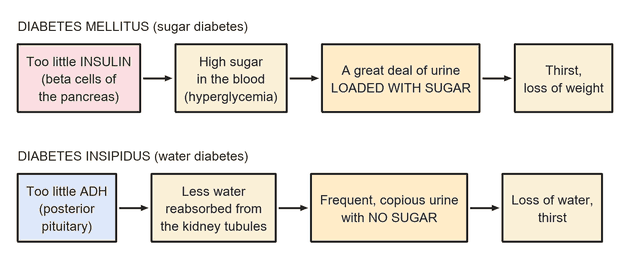
Watch out: Diabetes insipidus has nothing to do with insulin or glucagon; it is a water-balance disorder.
Why the other options are wrong:
- (B) P - Prolactin, Q - Insulin: prolactin is for milk secretion, and insulin deficiency causes diabetes mellitus, not insipidus.
- (C) P - Insulin, Q - Glucagon: P is right, but glucagon deficiency does not cause diabetes insipidus.
- (D) P - Thyroxine, Q - Adrenaline: lack of thyroxine causes goitre, cretinism or myxoedema, and adrenaline is the emergency hormone.
Therefore, P is insulin and Q is vasopressin, option (A).
- 241 mark
Question 24
The following questions are Assertion-Reason based questions. Choose the answer based on the codes given below.
(1) A is True and R is False
(2) A is False and R is True
(3) Both A and R are True
(4) Both A and R are False
Assertion (A): Hormones are the secretions from some glandular parts of the body which regulate certain physiological processes by chemical means.
Reason (R): Hormones are directly poured into the target organs which are usually very close to the source/ gland secreting the hormones.
Solve with AIAnswer
- Correct
(A) (1) A is True and R is False
(B) (2) A is False and R is True
(C) (3) Both A and R are True
(D) (4) Both A and R are False
Answer: (A) (1) A is True and R is False
Concept: Hormones are poured directly into the blood and act on target organs or cells usually away from the gland.
Step 1 — Judge the Assertion.
The Assertion is true. A hormone is a secretion of a glandular part of the body, and it regulates body processes chemically.
Step 2 — Judge the Reason.
The Reason is false. Hormones are poured into the blood, not into the target organ, and the targets are usually far from the gland. For example, TSH from the pituitary below the brain acts on the thyroid in the neck.
Step 3 — Choose the code.
A is true and R is false, so the code is (1).

Watch out: The words 'very close to the source' make R false; hormones act at a distance.
Why the other options are wrong:
- (B) (2) A is False and R is True: the Assertion is true, not false.
- (C) (3) Both A and R are True: the Reason is false.
- (D) (4) Both A and R are False: the Assertion is true.
Therefore, the answer is option (A): A is true and R is false.
- 251 mark
Question 25
The following questions are Assertion-Reason based questions. Choose the answer based on the codes given below.
(1) A is True and R is False
(2) A is False and R is True
(3) Both A and R are True
(4) Both A and R are False
Assertion (A): Adrenal medulla secretes glucocorticoids which regulate glucose levels of the blood.
Reason (R): Glucocorticoids, a kind of cortisone, stimulate the deposition of extra glucose in blood as glycogen in the liver and muscles. The roles of insulin and glucocorticoids are the same.
Solve with AIAnswer
(A) (1) A is True and R is False
(B) (2) A is False and R is True
(C) (3) Both A and R are True
- Correct
(D) (4) Both A and R are False
Answer: (D) (4) Both A and R are False
Concept: Glucocorticoids are hormones of the adrenal cortex; they raise blood glucose, the opposite of insulin.
Step 1 — Judge the Assertion.
The Assertion is false. The adrenal medulla secretes adrenaline; glucocorticoids come from the adrenal cortex.
Step 2 — Judge the Reason.
The Reason is false. Storing extra glucose as glycogen in the liver and muscles is the action of insulin. Cortical hormones raise blood glucose, so their role is the opposite of insulin's, not the same.
Step 3 — Choose the code.
Both A and R are false, so the code is (4).
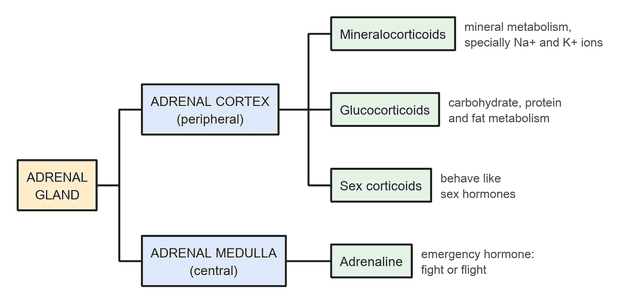
Watch out: Medulla and cortex are easily swapped: medulla makes adrenaline, cortex makes the corticoids.
Why the other options are wrong:
- (A) (1) A is True and R is False: the Assertion is false.
- (B) (2) A is False and R is True: the Reason is false.
- (C) (3) Both A and R are True: neither statement is true.
Therefore, the answer is option (D): both A and R are false.
- 261 mark
Question 26
The following questions are Assertion-Reason based questions. Choose the answer based on the codes given below.
(1) A is True and R is False
(2) A is False and R is True
(3) Both A and R are True
(4) Both A and R are False
Assertion (A): Oversecretion of insulin causes hyperglycemia or diabetes mellitus.
Reason (R): Oversecretion of insulin can lead to hypoglycemia by casuing excessive uptake of glucose from the blood into the cells, which in turn can lead to increased insulin resistance and ultimately result in hyperglycemia or diabetes mellitus.
Solve with AIAnswer
(A) (1) A is True and R is False
- Correct
(B) (2) A is False and R is True
(C) (3) Both A and R are True
(D) (4) Both A and R are False
Answer: (B) (2) A is False and R is True
Concept: Too much insulin gives low blood sugar (hypoglycemia); diabetes mellitus is due to too little insulin.
Step 1 — Judge the Assertion.
The Assertion is false. Too much insulin lowers blood sugar (hypoglycemia). Diabetes mellitus (hyperglycemia) is due to too little insulin.
Step 2 — Judge the Reason.
The Reason is true. Excess insulin drives glucose from the blood into the cells, lowering blood sugar. Over a long time, constantly high insulin can make cells respond less to it (insulin resistance), which may in the end raise blood sugar. The book's key treats this statement as true.
Step 3 — Choose the code.
A is false and R is true, so the code is (2).

Watch out: The immediate effect of excess insulin is hypoglycemia, not diabetes.
Why the other options are wrong:
- (A) (1) A is True and R is False: the Assertion is false, not true.
- (C) (3) Both A and R are True: the Assertion is false.
- (D) (4) Both A and R are False: the Reason is taken as true.
Therefore, the answer is option (B): A is false and R is true.
- 271 mark
Question 27
The following questions are Assertion-Reason based questions. Choose the answer based on the codes given below.
(1) A is True and R is False
(2) A is False and R is True
(3) Both A and R are True
(4) Both A and R are False
Assertion (A): Cretinism is a condition which affects adults causing dwarfism and mental retardation.
Reason (R): Cretinism is a kind of hypothyroidism. This disease occurs due to the defective development, or early atrophy (degeneration), of the thyroid.
Solve with AIAnswer
(A) (1) A is True and R is False
- Correct
(B) (2) A is False and R is True
(C) (3) Both A and R are True
(D) (4) Both A and R are False
Answer: (B) (2) A is False and R is True
Concept: Cretinism is hypothyroidism in children; in adults hypothyroidism causes myxoedema.
Step 1 — Judge the Assertion.
The Assertion is false. Cretinism causes dwarfism and mental retardation, but in children, not adults. In adults, too little thyroxine causes myxoedema.
Step 2 — Judge the Reason.
The Reason is true. Cretinism is a form of hypothyroidism, due to defective development or early degeneration (atrophy) of the thyroid.
Step 3 — Choose the code.
A is false and R is true, so the code is (2).
Watch out: Cretinism (children) and myxoedema (adults) are both hypothyroidism; only the age differs.
Why the other options are wrong:
- (A) (1) A is True and R is False: the Assertion is false, not true.
- (C) (3) Both A and R are True: the Assertion is false.
- (D) (4) Both A and R are False: the Reason is a correct statement.
Therefore, the answer is option (B): A is false and R is true.
- 286 marks
Question 28
Name the following:
(a) The hormone produced by adrenal medulla.
(b) The condition caused by the oversecretion of insulin.
(c) The hormone secreted by β (beta) cells of the islets of Langerhans.
(d) The interconnection between the two lobes of thyroid gland (technical term).
(e) The hormone whose undersecretion causes more urine formation.
(f) The hormone which stimulates the entire sympathetic nervous system.
Solve with AIWritten solution
Solution:
Concept: Each clue points to one hormone, condition or part of the four endocrine glands in the syllabus.
Step 1 — Part (a).
The adrenal medulla, the central part of the adrenal gland, secretes adrenaline.
Step 2 — Part (b).
Too much insulin removes too much glucose from the blood, giving hypoglycemia (insulin shock); the brain may go into a coma if it lasts.
Step 3 — Part (c).
Beta cells secrete insulin, which checks the rise of blood sugar.
Step 4 — Part (d).
The two lobes of the thyroid are joined by a narrow band called the isthmus.
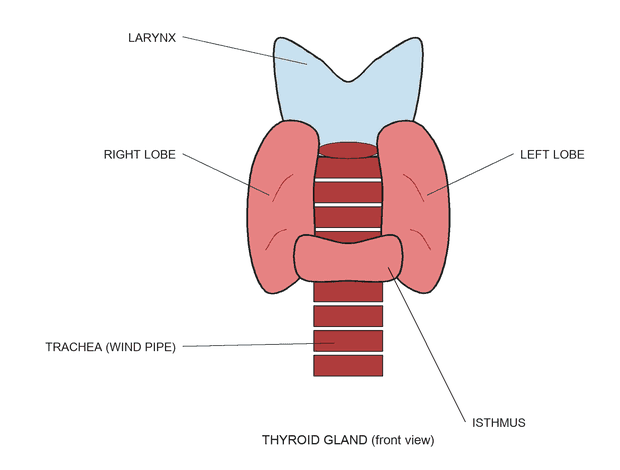
Step 5 — Part (e).
ADH (vasopressin) makes the kidney tubules reabsorb water. When it is deficient, less water is reabsorbed and much urine is formed (diabetes insipidus).
Step 6 — Part (f).
Adrenaline stimulates the whole sympathetic nervous system in an emergency.
Watch out: (b) asks for the condition, not the hormone: answer hypoglycemia, not insulin.
Therefore, (a) adrenaline, (b) hypoglycemia, (c) insulin, (d) isthmus, (e) ADH (vasopressin), (f) adrenaline.
- 291 mark
Question 29
What would a child suffer from if there was hyposecretion from his thyroid ?
Solve with AIWritten solution
Solution:
Concept: Hyposecretion from the thyroid means too little thyroxine (hypothyroidism). Thyroxine is needed for normal growth and mental development of a child.
Step 1 — Effect on a child.
Without enough thyroxine the child's body and brain do not develop properly, giving dwarfism (stunted growth) and mental retardation.
Step 2 — Name the disorder.
This condition is called cretinism. It is due to defective development or early degeneration of the thyroid.

Watch out: The same deficiency in an adult is myxoedema, not cretinism.
Therefore, the child would suffer from cretinism.
- 305 marks
Question 30
Choose the odd one out from each series and write the category of the remaining terms :
(a) Simple goitre, Cretinism, Pellagra, Myxoedema
(b) Alpha cells, Beta cells, Gamma cells, Delta cells
(c) Somatotropin, Prolactin, Oxytocin, Luteinizing hormone
(d) Thyroid, Pituitary, Prostate, Parathyroid
(e) Thyroxine, Insulin, Thiamine, Glucagon
Solve with AIWritten solution
Solution:
Concept: In each series three terms share a category; the term that does not fit is the odd one.
Step 1 — Series (a).
Simple goitre, cretinism and myxoedema are all due to too little thyroxine. Pellagra is a vitamin (niacin) deficiency disease.
Odd one: Pellagra; rest: disorders of the thyroid (hypothyroidism).
Step 2 — Series (b).
Alpha, beta and delta cells secrete glucagon, insulin and somatostatin. The islets have no gamma cells.
Odd one: Gamma cells; rest: hormone-secreting cells of the islets of Langerhans.
Step 3 — Series (c).
Somatotropin (growth hormone), prolactin and LH come from the anterior pituitary; oxytocin is released by the posterior pituitary.
Odd one: Oxytocin; rest: hormones of the anterior pituitary.
Step 4 — Series (d).
Thyroid, pituitary and parathyroid are ductless glands; the prostate is a gland of the male reproductive system and secretes no hormone.
Odd one: Prostate; rest: endocrine (ductless) glands.
Step 5 — Series (e).
Thyroxine, insulin and glucagon are hormones; thiamine is vitamin .
Odd one: Thiamine; rest: hormones.
Watch out: Give the category of the remaining three as well as the odd one; both are asked.
Therefore, the odd ones are pellagra, gamma cells, oxytocin, prostate and thiamine.
- 315 marks
Question 31
Write full forms of the following abbreviations :
(a) ACTH
(b) TSH
(c) ADH
(d) LH
(e) FSH
Solve with AIWritten solution
Solution:
Concept: All five are pituitary hormones. ADH comes from the posterior lobe; the other four from the anterior lobe.
Step 1 — ACTH.
Adrenocorticotropic Hormone: controls the adrenal cortex.
Step 2 — TSH.
Thyroid Stimulating Hormone: makes the thyroid secrete thyroxine.
Step 3 — ADH.
Antidiuretic Hormone (vasopressin): increases water reabsorption in the kidney tubules.
Step 4 — LH.
Luteinizing Hormone: ovulation and corpus luteum in females, testosterone secretion in males.
Step 5 — FSH.
Follicle Stimulating Hormone: egg formation in females and sperm formation in males.

Therefore, ACTH = Adrenocorticotropic Hormone, TSH = Thyroid Stimulating Hormone, ADH = Antidiuretic Hormone, LH = Luteinizing Hormone, FSH = Follicle Stimulating Hormone.
- 325 marks
Question 32
Identify the odd one in each of the following and mention what the rest are :
(a) Larynx; glucagon; testosterone; prolactin ..........
(b) Adrenaline; penicillin; insulin; thyroxin ..........
(c) Stomach; ileum; liver; adrenaline ..........
(d) TSH; GH; ADH; insulin ..........
(e) Iodine, cretinism, goitre, myxoedema ..........
Solve with AIWritten solution
Solution:
Concept: Find the term that does not belong, then name the group formed by the other three.
Step 1 — Group (a).
Glucagon (pancreas), testosterone (testes) and prolactin (anterior pituitary) are hormones; the larynx is an organ, the voice box.
Odd one: Larynx; rest: hormones.
Step 2 — Group (b).
Adrenaline, insulin and thyroxin are hormones; penicillin is an antibiotic.
Odd one: Penicillin; rest: hormones.
Step 3 — Group (c).
Stomach, ileum and liver are organs of the digestive system; adrenaline is a hormone.
Odd one: Adrenaline; rest: organs of the digestive system.
Step 4 — Group (d).
TSH and GH (anterior lobe) and ADH (posterior lobe) are pituitary hormones; insulin comes from the pancreas.
Odd one: Insulin; rest: hormones of the pituitary gland.
Step 5 — Group (e).
Cretinism, goitre and myxoedema are thyroid disorders; iodine is the element needed to make thyroxine.
Odd one: Iodine; rest: disorders of the thyroid gland.
Therefore, the odd ones are larynx, penicillin, adrenaline, insulin and iodine.
- 335 marks
Question 33
Match the terms given in column A with those in column B.
Column A Column B (a) Adrenaline (i) Hypoglycemia (b) Adrenal virilism (ii) Hyperglycemia (c) Addison's disease (iii) Mental retardation (d) Acromegaly (iv) Eyes are protruded (e) Cushing's syndrome (v) Excessive growth of bones in face (vi) Emergency hormone (vii) Masculine characters Solve with AIWritten solution
Solution:
Concept: Link each term to its key feature. Column B has seven items for five terms, so two are left over.
Step 1 — (a) Adrenaline.
It prepares the body for 'fight or flight', so it is the (vi) emergency hormone.
Step 2 — (b) Adrenal virilism.
Overgrowth of the adrenal cortex in a woman produces male features such as a beard and a deep voice: (vii) masculine characters.
Step 3 — (c) Addison's disease.
Too little cortisone from the adrenal cortex; low blood sugar is one of its signs: (i) hypoglycemia.
Step 4 — (d) Acromegaly.
Too much growth hormone in an adult enlarges the bones of the face, hands and feet: (v) excessive growth of bones in face.
Step 5 — (e) Cushing's syndrome.
Too much cortisone from the adrenal cortex; high blood sugar is one of its signs: (ii) hyperglycemia.

Left over: (iii) mental retardation (a feature of cretinism) and (iv) protruding eyes (exophthalmic goitre).
Watch out: Addison's (too little cortisone) and Cushing's (too much cortisone) have opposite effects on blood sugar.
Therefore, (a)–(vi), (b)–(vii), (c)–(i), (d)–(v), (e)–(ii).
- 344 marks
Question 34
Given below are group of terms. In each group the first pair indicates the relationship between the two terms. Suggest the suitable word(s) for the fourth place.
(a) Beta cells : Insulin :: Alpha cells : ..........
(b) Children : Cretinism :: Adults : ..........
(c) Undersecretion : Dwarfism :: Oversecretion : ..........
(d) Diabetes mellitus : Insulin :: Diabetes insipidus : ..........
Solve with AIWritten solution
Solution:
Concept: Work out how the first pair is related, then apply the same relationship to the second pair.
Step 1 — Group (a).
Relationship: islet cell and the hormone it secretes. Beta cells make insulin, so alpha cells make glucagon.
Step 2 — Group (b).
Relationship: age group and the disorder from too little thyroxine. Children get cretinism, so adults get myxoedema.
Step 3 — Group (c).
Relationship: amount of growth hormone in childhood and its result. Too little gives dwarfism, so too much gives gigantism.
Step 4 — Group (d).
Relationship: disorder and the hormone whose lack causes it. Diabetes mellitus is lack of insulin, so diabetes insipidus is lack of ADH (vasopressin).
Watch out: In (c) the first pair is about childhood, so the answer is gigantism, not acromegaly (adults).
Therefore, the words are glucagon, myxoedema, gigantism and ADH (vasopressin).
- 355 marks
Question 35
Mention the name of diseases based on the clues/ symptoms given below :
(a) Urine is loaded with sugar.
(b) Swelling in the neck.
(c) Dwarfism and mental retardation in children.
(d) Eyes are protruded.
(e) Excessive growth of bones in the face, hands and feet.
Solve with AIWritten solution
Solution:
Concept: Each symptom is the mark of one disorder caused by too little or too much of a hormone.
Step 1 — Clue (a).
Too little insulin leaves much sugar in the blood, which spills into the urine: diabetes mellitus.
Step 2 — Clue (b).
Lack of iodine in food means too little thyroxine, so the thyroid enlarges as a neck swelling: simple goitre.
Step 3 — Clue (c).
Too little thyroxine in children: cretinism.
Step 4 — Clue (d).
Too much thyroxine (hyperthyroidism) makes the eyes protrude: exophthalmic goitre.
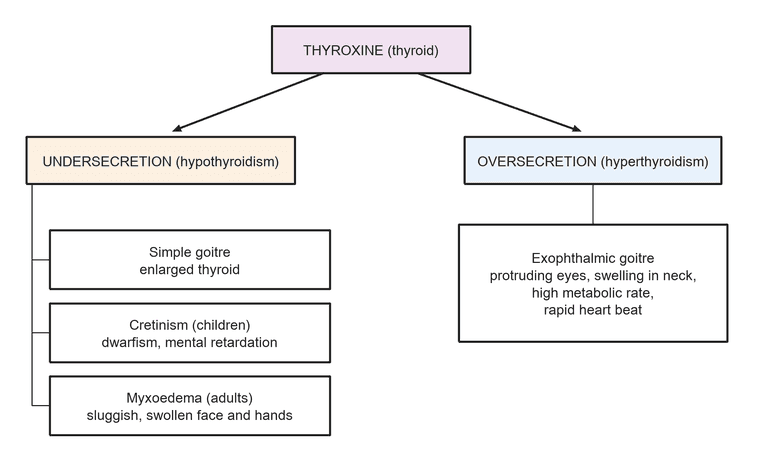
Step 5 — Clue (e).
Too much growth hormone in an adult: acromegaly.
Watch out: Both goitres swell the neck; protruding eyes point to exophthalmic goitre, a swelling alone to simple goitre.
Therefore, (a) diabetes mellitus, (b) simple goitre, (c) cretinism, (d) exophthalmic goitre, (e) acromegaly.
- 368 marks
Question 36
Write the exact location of each of the following glands:
(a) Thyroid
(b) Adrenal
(c) Pancreas
(d) Pituitary
Solve with AIWritten solution
Solution:
Concept: These are the four endocrine glands in the syllabus; each has a fixed position in the body.
Step 1 — Thyroid.
In front of the neck, just below the larynx. Its two lobes lie on either side of the trachea and are joined by the isthmus.
Step 2 — Adrenal.
Like a cap on top of each kidney ('ad' = near, 'renal' = kidney), so there are two adrenal glands.
Step 3 — Pancreas.
In the abdomen, in the loop of the duodenum, just below the stomach. Its islets of Langerhans are scattered all through it.
Step 4 — Pituitary.
A pea-sized projection hanging from the base of the brain, below the hypothalamus.
Watch out: The adrenal sits on the kidney but is a separate gland; it is not part of the kidney.
Therefore, thyroid: front of the neck below the larynx; adrenal: on top of each kidney; pancreas: in the loop of the duodenum; pituitary: at the base of the brain below the hypothalamus.
- 378 marks
Question 37
Name the following :
(a) Three hormones secreted from the Islets of Langerhans of pancreas.
(b) Two types of cortical hormones.
(c) Six hormones secreted from anterior pituitary.
(d) Two hormones secreted from posterior pituitary.
(e) The emergency hormone.
(f) Diseases caused due to hypothyroidism.
(g) Symptoms of cretinism.
(h) Abnormalities caused due to hypersecretion of growth hormone.
Solve with AIWritten solution
Solution:
Concept: The answers come from the four endocrine glands in the syllabus: pancreas, adrenal, pituitary and thyroid.
Step 1 — Part (a).
The islets secrete insulin (beta cells), glucagon (alpha cells) and somatostatin (delta cells).
Step 2 — Part (b).
The two types of cortical hormones are mineralocorticoids (mineral metabolism) and glucocorticoids (carbohydrate, protein and fat metabolism).
Step 3 — Part (c).
The anterior pituitary secretes growth hormone, TSH, ACTH, FSH, LH and prolactin.
Step 4 — Part (d).
The posterior pituitary releases ADH (vasopressin) and oxytocin.
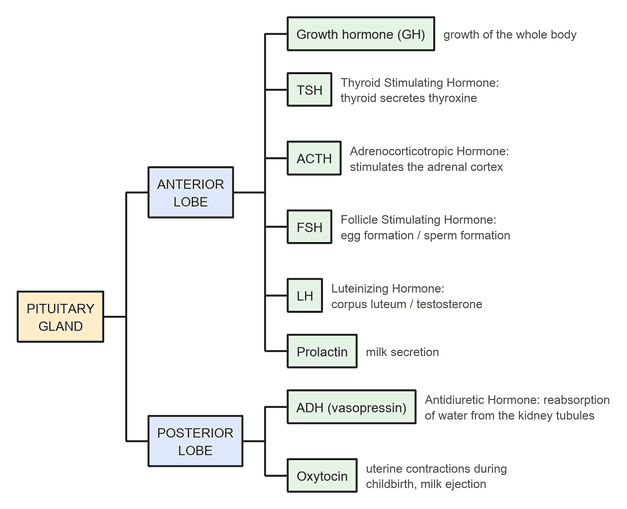
Step 5 — Part (e).
The emergency hormone is adrenaline.
Step 6 — Part (f).
Hypothyroidism causes simple goitre, cretinism and myxoedema.
Step 7 — Part (g).
Cretinism shows dwarfism (stunted growth) and mental retardation.
Step 8 — Part (h).
Too much growth hormone causes gigantism in children and acromegaly in adults.
Watch out: Exophthalmic goitre is not a disease of hypothyroidism; it is due to too much thyroxine.
Therefore, the answers are as listed in parts (a) to (h) above.
- 385 marks
Question 38
Write the main function of each of the following hormones.
Hormones Functions (a) Thyroxine .......... (b) Adrenaline .......... (c) Insulin .......... (d) Glucagon .......... (e) Vasopressin .......... Solve with AIWritten solution
Solution:
Concept: Each hormone has one main action on its target organ.
Step 1 — Thyroxine.
Regulates the basal metabolism, the rate of oxidation in the cells at rest (and so growth and mental development).
Step 2 — Adrenaline.
Prepares the body for an emergency ('fight or flight'): faster heart beat, more glucose and more blood to the muscles.
Step 3 — Insulin.
Lowers blood sugar by making cells take up glucose and store the extra as glycogen.
Step 4 — Glucagon.
Raises blood sugar by making the liver change glycogen into glucose.

Step 5 — Vasopressin.
Increases the reabsorption of water from the kidney tubules, so less urine is formed.
Watch out: Insulin and glucagon have opposite actions; do not swap them.
Therefore, thyroxine regulates basal metabolism, adrenaline prepares for emergency, insulin lowers and glucagon raises blood sugar, and vasopressin increases water reabsorption in the kidneys.
- 395 marks
Question 39
Name the hormones responsible for the given functions.
Functions Hormones (a) Contraction of uterine muscles during child birth .......... (b) Maintenance of corpus luteum .......... (c) Milk formation and secretion .......... (d) Development of external sex characters in males. .......... (e) Stimulation of sympathetic nervous system .......... Solve with AIWritten solution
Solution:
Concept: Read each function and recall the hormone whose main action it is.
Step 1 — Function (a).
Oxytocin, from the posterior pituitary, makes the uterus contract strongly during childbirth.
Step 2 — Function (b).
Luteinizing hormone (LH) brings about ovulation and keeps the corpus luteum going, so that it secretes progesterone.
Step 3 — Function (c).
Prolactin, from the anterior pituitary, makes the breasts form and secrete milk.
Step 4 — Function (d).
The sex corticoids of the adrenal cortex behave like sex hormones; in males they act with testosterone from the testes, which is the main hormone for male sex characters.
Step 5 — Function (e).
Adrenaline stimulates the sympathetic nervous system.
Watch out: Milk formation is prolactin; oxytocin only ejects milk.
Therefore, (a) oxytocin, (b) LH, (c) prolactin, (d) sex corticoids (with testosterone), (e) adrenaline.
- 402 marks
Question 40
If you stand to make your maiden speech before a large audience, your mouth dries up and heart rate increases. What brings about these changes?
Solve with AIWritten solution
Solution:
Concept: A maiden speech before a large audience is emotional stress, and stress makes the adrenal medulla release extra adrenaline, the emergency hormone.
Step 1 — Cause.
Nerves of the autonomic nervous system stimulate the adrenal medulla, which pours adrenaline into the blood.
Step 2 — Effect on the mouth.
Adrenaline narrows the arterioles of the digestive system. Less blood reaches the salivary glands, less saliva is made, and the mouth dries up. The blood saved goes to the muscles.
Step 3 — Effect on the heart.
Adrenaline makes the heart beat faster, sending more oxygen and glucose to the muscles; this is felt as a thumping heart.

Watch out: The changes are caused by a hormone, adrenaline, not by thyroxine or insulin.
Therefore, these changes are brought about by adrenaline secreted by the adrenal medulla.
- 4113 marks
Question 41
Given below is a table designed to give the names of the glands, the hormones produced, their chief functions, the effects of oversecretion and undersecretion in respect of thyroid, pituitary and pancreas. Fill up the blanks 1-13.
S.No. Source Gland Cells Hormone produced Chief function Effect of oversecretion Effect of undersecretion 1. (1) .......... Thyroxine (2) .......... (3) .......... (4) .......... 2. Beta cells of Islets of Langerhans (5) .......... Promotes glucose utilisation by the body cells (6) .......... (7) .......... 3. (8) .......... Growth Hormone (9) .......... (10) .......... Dwarfism 4. (11) .......... Vasopressin Increases reabsorption of water from kidney tubules (12) .......... (13) .......... Solve with AIWritten solution
Solution:
Concept: For each hormone recall its source, its chief function, and the effect of too much and too little of it.
Step 1 — Row 1: thyroxine.
(1) Thyroid gland; (2) regulates basal metabolism; (3) too much: exophthalmic goitre; (4) too little: simple goitre / cretinism (children) / myxoedema (adults).
Step 2 — Row 2: beta cells.
(5) Insulin; (6) too much: hypoglycemia (low blood sugar); (7) too little: diabetes mellitus.
Step 3 — Row 3: growth hormone.
(8) Anterior pituitary; (9) promotes growth of the body, especially of the bones; (10) too much: gigantism (children) / acromegaly (adults).
Step 4 — Row 4: vasopressin.
(11) Posterior pituitary; (12) too much: rise in blood pressure (vasopressin narrows the blood vessels); (13) too little: diabetes insipidus.
Step 5 — Completed table.
S.No. Source Hormone Chief function Oversecretion Undersecretion 1. Thyroid gland Thyroxine Regulates basal metabolism Exophthalmic goitre Simple goitre / cretinism / myxoedema 2. Beta cells of islets Insulin Glucose utilisation Hypoglycemia Diabetes mellitus 3. Anterior pituitary Growth hormone Growth of the body Gigantism / acromegaly Dwarfism 4. Posterior pituitary Vasopressin Water reabsorption Rise in blood pressure Diabetes insipidus Watch out: Vasopressin is released by the posterior lobe, growth hormone by the anterior lobe.
Therefore, the blanks 1–13 are filled as in the completed table above.
- 427 marks
Question 42
Complete the following table by filling in the blanks numbered 1 to 7.
Gland Hormone secreted Effect on body (1) .......... (2) .......... Regulates basal metabolism Pancreas ("beta" cells) (3) .......... Controls blood sugar (4) .......... (5) .......... Increases heart beat (6) .......... Thyroid stimulating hormone (7) .......... Solve with AIWritten solution
Solution:
Concept: Each row links a gland, its hormone and the effect of that hormone. Start from the entry that is given.
Step 1 — Row 1.
The hormone that regulates basal metabolism is thyroxine: (1) Thyroid, (2) Thyroxine.
Step 2 — Row 2.
Beta cells control blood sugar through (3) Insulin.
Step 3 — Row 3.
The hormone that increases the heart beat is adrenaline: (4) Adrenal (medulla), (5) Adrenaline.
Step 4 — Row 4.
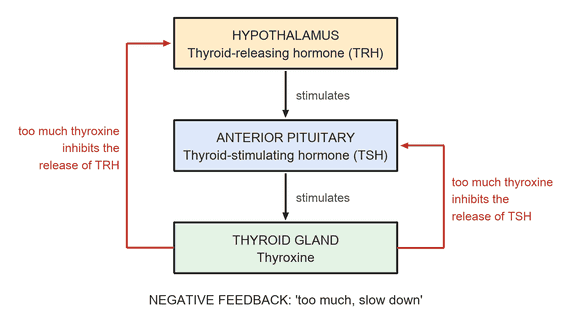
TSH comes from (6) the anterior pituitary and (7) stimulates the thyroid to secrete thyroxine. When thyroxine in the blood becomes too high, it holds back TSH release (negative feedback).
Step 5 — Completed table.
Gland Hormone secreted Effect on body Thyroid Thyroxine Regulates basal metabolism Pancreas (beta cells) Insulin Controls blood sugar Adrenal (medulla) Adrenaline Increases heart beat Anterior pituitary Thyroid stimulating hormone Stimulates the thyroid to secrete thyroxine Therefore, the blanks are (1) thyroid, (2) thyroxine, (3) insulin, (4) adrenal medulla, (5) adrenaline, (6) anterior pituitary, (7) stimulates the thyroid to secrete thyroxine.
- 438 marks
Question 43
Complete the following table by filling in the blank spaces numbered 1 to 8.
Gland Secretions Effect on body (1) .......... Oestrogen (2) .......... Alpha cells of Islets of Langerhans (3) .......... (4) .......... (5) .......... (6) .......... Protruding eyes (7) .......... (8) .......... Gigantism Solve with AIWritten solution
Solution:
Concept: Each row links a gland, its secretion and the effect. Protruding eyes and gigantism are effects of too much of a hormone.
Step 1 — Row 1.
Oestrogen is made by the (1) ovary; it brings about (2) the female secondary sexual characters and growth of the reproductive organs.
Step 2 — Row 2.
Alpha cells secrete (3) glucagon, which (4) raises blood sugar by changing liver glycogen to glucose.
Step 3 — Row 3.
Protruding eyes are the sign of exophthalmic goitre: (5) thyroid, (6) thyroxine (in excess).
Step 4 — Row 4.
Gigantism is due to too much growth hormone in childhood: (7) anterior pituitary, (8) growth hormone (in excess).
Step 5 — Completed table.
Gland Secretions Effect on body Ovary Oestrogen Female secondary sexual characters Alpha cells of islets Glucagon Raises blood sugar Thyroid Thyroxine (in excess) Protruding eyes Anterior pituitary Growth hormone (in excess) Gigantism Watch out: Rows 3 and 4 describe disorders, so say 'in excess' with the hormone.
Therefore, the blanks are ovary, female sex characters, glucagon, raises blood sugar, thyroid, thyroxine, anterior pituitary, growth hormone.
- 446 marks
Question 44
Define the following terms :
(a) Endocrine system
(b) Hormones
(c) Myxoedema
Solve with AIWritten solution
Solution:
Concept: A definition says what the thing is and what it does, in one or two exact lines.
Step 1 — Endocrine system.
The system of ductless (endocrine) glands which secrete hormones and together bring about the chemical coordination of the body. The glands work together and control one another, so they form one system.
Step 2 — Hormones.
Secretions of ductless glands poured directly into the blood, which act on target organs or cells, usually away from their source, and regulate body activities. Example: TSH from the pituitary acts on the thyroid in the neck.

Step 3 — Myxoedema.
A condition in adults due to too little thyroxine (hypothyroidism), in which the person becomes sluggish, with swelling of the face and hands.
Watch out: Myxoedema is the adult form; the same deficiency in children is cretinism.
Therefore, the three terms are defined as above.
- 4510 marks
Question 45
Distinguish between the following pairs :
(a) Exocrine and endocrine glands (secretory substance and example)
(b) Enzymes and hormones (mode of transport and target organ)
(c) Nervous control and hormonal control (transmission and effect)
(d) Diabetes mellitus and diabetes insipidus (cause and symptoms)
(e) Addison's disease and cushing's syndrome (cause and sugar level)
Solve with AIWritten solution
Solution:
Concept: Compare each pair only on the basis given in brackets, one row for each basis.
Step 1 — Exocrine and endocrine glands.
Basis Exocrine glands Endocrine glands Secretory substance Enzymes / other secretions through ducts Hormones poured directly into the blood Example Salivary gland, sweat gland Thyroid, pituitary 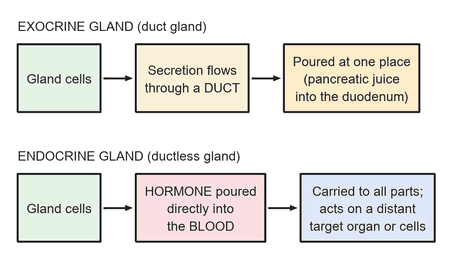
Step 2 — Enzymes and hormones.
Basis Enzymes Hormones Mode of transport Carried through ducts (or act inside cells) Carried by the blood Target organ Act at or near where they are poured Act on distant target organs Step 3 — Nervous control and hormonal control.
Basis Nervous control Hormonal control Transmission Electro-chemical, along nerve fibres Chemical, through the blood Effect Rapid, short-lived, local Usually slow, widespread, often long-lasting 
Step 4 — Diabetes mellitus and diabetes insipidus.
Basis Diabetes mellitus Diabetes insipidus Cause Deficiency of insulin Deficiency of ADH (vasopressin) Symptoms High blood sugar; sugar in urine; thirst, loss of weight Much dilute urine without sugar; thirst 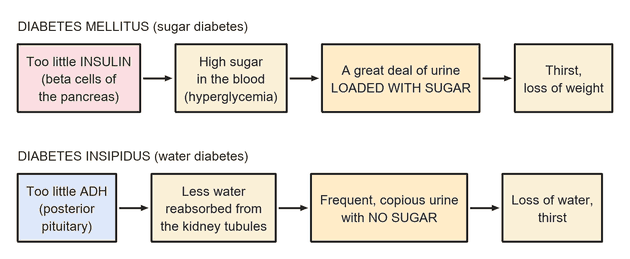
Step 5 — Addison's disease and Cushing's syndrome.
Basis Addison's disease Cushing's syndrome Cause Too little cortisone (adrenal cortex) Too much cortisone (adrenal cortex) Sugar level Hypoglycemia (low) Hyperglycemia (high) 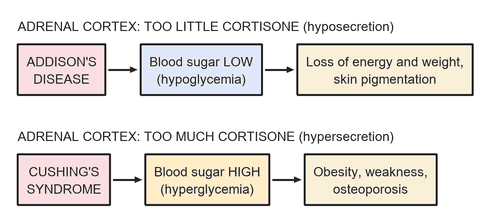
Watch out: Keep to the basis in brackets; extra points on other bases earn no marks.
Therefore, the five pairs differ as shown in the tables above.
- 468 marks
Question 46
Give reason.
(a) Adrenaline is often described as the emergency hormone.
(b) Pituitary is popularly called as the master gland.
(c) People living in the low Himalayan hilly regions often suffer from goitre.
(d) Simple goitre can be prevented by using iodised salt in food.
Solve with AIWritten solution
Solution:
Concept: Each reason follows from what the gland or hormone does, so go from the cause to the effect.
Step 1 — Reason (a): emergency hormone.
Cause: at times of danger, fear, anger or stress the adrenal medulla releases extra adrenaline.
Effect: the heart beats faster, breathing quickens, more glucose and more blood reach the muscles, so the body is ready to 'fight or flight'. Hence it is called the emergency hormone.
Step 2 — Reason (b): master gland.
Cause: the pituitary secretes tropic hormones: TSH (thyroid), ACTH (adrenal cortex), FSH and LH (testes and ovaries).
Effect: through these it controls most other endocrine glands, so it is called the master gland.

Step 3 — Reason (c): goitre in hilly regions.
Cause: the soil and water of these regions lack iodine, so the food grown there lacks iodine.
Effect: the thyroid cannot make enough thyroxine and enlarges, giving simple goitre.

Step 4 — Reason (d): iodised salt.
Cause: iodine is needed to make thyroxine, and iodised salt supplies it.
Effect: the thyroid makes enough thyroxine and does not enlarge, so simple goitre is prevented.
Watch out: Simple goitre comes from lack of iodine in food, not from too much thyroxine.
Therefore, the reasons are as explained in Steps 1 to 4.
- 474 marks
Question 47
Identify the gland with the help of following clues :
(a) The gland is like a cap on top of each kidney.
(b) The gland is both a duct gland as well as a ductless gland.
(c) A bilobed (butterfly-shaped) gland.
(d) The gland is located in mid-brain below the hypothalamus.
Solve with AIWritten solution
Solution:
Concept: Each clue gives the position, shape or nature of one of the four endocrine glands in the syllabus.
Step 1 — Clue (a).
A cap on top of each kidney is the adrenal gland ('ad' = near, 'renal' = kidney).
Step 2 — Clue (b).
The pancreas is a duct gland (pancreatic juice into the duodenum) and a ductless gland (islets secrete insulin and glucagon into the blood).
Step 3 — Clue (c).
The bilobed, butterfly-shaped gland in the neck is the thyroid gland.
Step 4 — Clue (d).
The pea-sized gland hanging below the hypothalamus is the pituitary gland.
Therefore, (a) adrenal, (b) pancreas, (c) thyroid, (d) pituitary.
- 4810 marks
Question 48
Study the diagram given below and then answer the questions that follow :

(a) Name the cells of the pancreas that produce (1) glucagon (2) insulin.
(b) State the main function of (1) glucagon and (2) insulin.
(c) Why is the pancreas referred to as an exo-endocrine gland?
(d) Why is insulin not given orally but is injected into the body?
(e) What is the technical term for the cells of the pancreas that produce endocrine hormones?
(f) Where in the body is the pancreas located?
Solve with AIWritten solution
Solution:
Concept: Glucagon and insulin from the islets of Langerhans act on the liver in opposite ways to keep blood sugar normal.

Step 1 — Part (a): the cells.
(1) Glucagon is made by the alpha (α) cells and (2) insulin by the beta (β) cells of the islets of Langerhans.
Step 2 — Part (b): functions.
(1) Glucagon changes liver glycogen into glucose, raising blood sugar when it is low. (2) Insulin makes cells take up glucose and store the extra as glycogen in the liver and muscles, lowering blood sugar after a meal.
Step 3 — Part (c): exo-endocrine.
It is exocrine because it pours pancreatic juice (enzymes) through a duct into the duodenum, and endocrine because its islets secrete insulin and glucagon straight into the blood.
Step 4 — Part (d): why insulin is injected.
Cause: insulin is a protein.
Effect: taken by mouth it would be digested by the protein-digesting enzymes of the gut and destroyed before reaching the blood, so it is injected.
Step 5 — Part (e): technical term.
The hormone-secreting cells are the islets of Langerhans ('islets' = little islands).
Step 6 — Part (f): location.
In the abdomen, just below the stomach, in the loop of the duodenum.
Watch out: Insulin lowers and glucagon raises blood sugar; keep the two arrows in the figure apart.
Therefore, the answers to (a)–(f) are as given in Steps 1 to 6.
- 495 marks
Question 49
Given below is a portion from the human body showing some important structure in ventral (front) view.
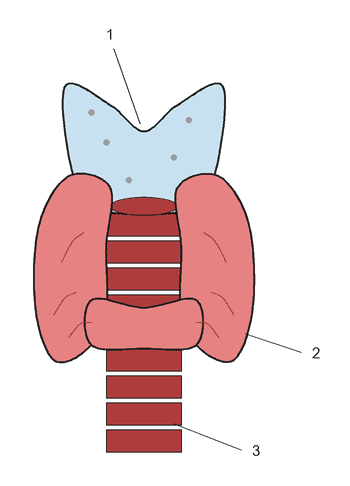
(a) Where is this portion located in the body ?
(b) Name the structures numbered 1-3.
(c) State one main function of each of the structures named above.
(d) Is there any duct to carry the secretions from the structure numbered 2? If so, give its name.
Solve with AIWritten solution
Solution:
Concept: The figure shows the thyroid gland lying on the trachea just below the larynx.
Step 1 — Part (a): location.
This portion is in the neck, in front of the trachea, just below the larynx.
Step 2 — Part (b): the parts.
1 – Larynx; 2 – Thyroid gland (two lobes joined by the isthmus); 3 – Trachea (wind pipe).

Step 3 — Part (c): functions.
The larynx produces the voice (sound box). The thyroid secretes thyroxine, which regulates basal metabolism. The trachea carries air to and from the lungs.
Step 4 — Part (d): duct.
No. The thyroid is a ductless (endocrine) gland; thyroxine passes directly into the blood.
Watch out: Part 2 is the whole thyroid gland, not just one lobe.
Therefore, (a) the neck; (b) 1 larynx, 2 thyroid, 3 trachea; (c) voice, thyroxine, air passage; (d) no, the thyroid has no duct.
- 504 marks
Question 50
Given below is an outline diagram of human body showing position of certain organs.
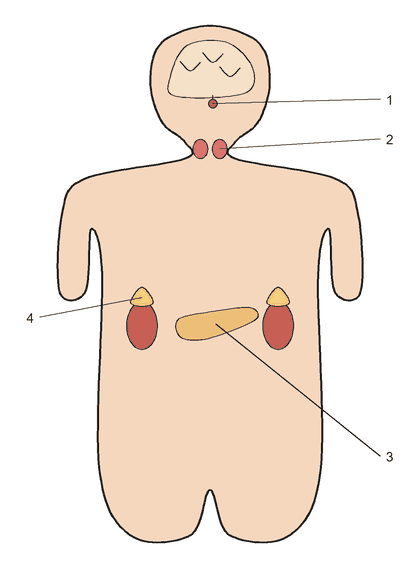
(a) Name the parts numbered 1 to 4.
(b) What is common to all these parts in regard to the nature of their functions ?
(c) Name the nutrient element which is essential for the normal working of part 2.
Solve with AIWritten solution
Solution:
Concept: The four numbered parts are the four endocrine glands in the syllabus.
Step 1 — Part (a): name the parts.
1 – Pituitary gland (below the brain); 2 – Thyroid gland (neck); 3 – Pancreas (abdomen); 4 – Adrenal gland (cap on the kidney).
Step 2 — Part (b): what is common.
All are endocrine (ductless) glands: they secrete hormones directly into the blood, which regulate body activities by chemical coordination.
Step 3 — Part (c): nutrient for part 2.
Iodine is needed to make thyroxine; without it the thyroid enlarges (simple goitre).
Therefore, 1 is the pituitary, 2 the thyroid, 3 the pancreas and 4 the adrenal gland; all are ductless glands, and iodine is needed by the thyroid.
- 516 marks
Question 51
The diagram given below shows an endocrine gland in the human body. Study the diagram and answer the following questions :
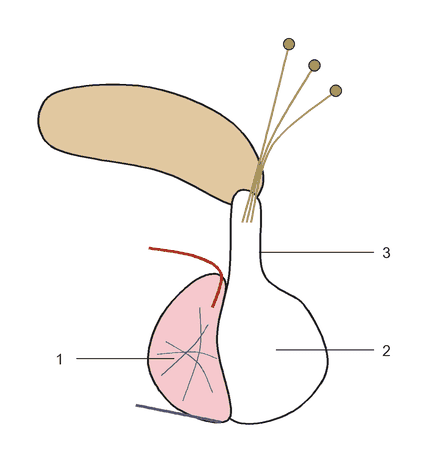
(a) Identify the gland. Write its specific location in the human body.
(b) Label the guidelines 1, 2 and 3 shown in the figure.
(c) Name any two secretions from part 1 and two from part 2.
(d) The deficiency of which hormone causes Diabetes insipidus ? How is this condition different from Diabetes mellitus with respect to the abnormal substances present in the of urine.
Solve with AIWritten solution
Solution:
Concept: The pea-sized gland hanging from the base of the brain is the pituitary.
Step 1 — Part (a): the gland.
Pituitary gland, hanging from the base of the brain below the hypothalamus by a stalk.
Step 2 — Part (b): the labels.
1 – Anterior lobe; 2 – Posterior lobe; 3 – Pituitary (hypophysial) stalk.

Step 3 — Part (c): secretions.
Part 1: any two of growth hormone, TSH, ACTH, FSH, LH, prolactin. Part 2: ADH (vasopressin) and oxytocin.
Step 4 — Part (d): diabetes insipidus.
Deficiency of ADH (vasopressin) causes it. Its urine is large in volume but has no sugar, whereas in diabetes mellitus (lack of insulin) the urine contains sugar (glucose).

Watch out: 'insipidus' means tasteless (no sugar) and 'mellitus' means honey (sugar present).
Therefore, (a) pituitary; (b) 1 anterior lobe, 2 posterior lobe, 3 stalk; (c) as listed; (d) ADH, and its urine has no sugar.
- 523 marks
Question 52
Human height is mainly controlled by genetic factors but hormonal secretion is also equally important in regulating the height. Study the figures given below and answer the questions that follow :
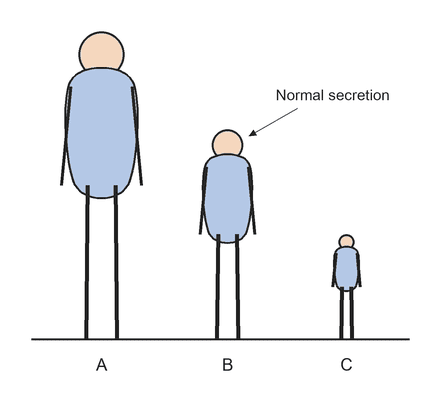
(a) Which of the above figures (A/B/C) is suffering from hyposecretion of the growth hormone ?
(b) Name the disorder shown in figure A.
(c) Mention the gland which secretes 'Growth Hormone'.
Solve with AIWritten solution
Solution:
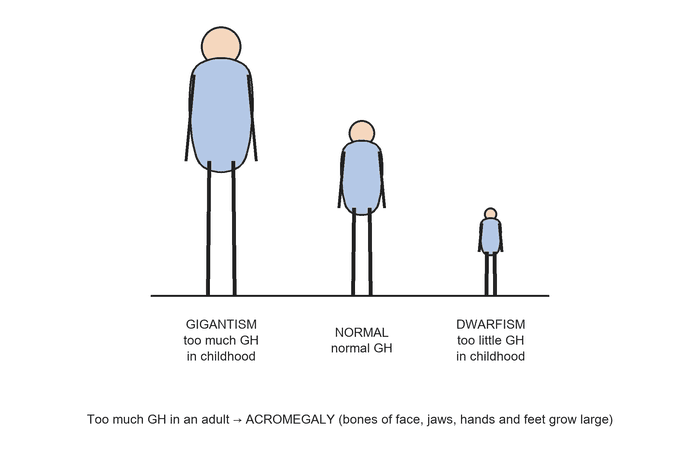
Concept: Too little growth hormone in childhood gives a dwarf; too much gives a giant.
Step 1 — Part (a).
C is much shorter than the normal person B, so C has hyposecretion of growth hormone (dwarfism).
Step 2 — Part (b).
A is much taller than B: the long bones have grown beyond normal, so A shows gigantism.
Step 3 — Part (c).
Growth hormone is secreted by the anterior lobe of the pituitary gland.
Watch out: Gigantism is from childhood oversecretion; in an adult the result would be acromegaly.
Therefore, (a) C, (b) gigantism, (c) anterior pituitary.
- 533 marks
Question 53
Compare the hormonal response with the nervous response with respect to their speed, transmission and the general nature of changes brought about.
Solve with AIWritten solution
Solution:
Concept: Nerves give quick, local, short-lived responses; hormones give slower, widespread and often long-lasting ones.
Step 1 — Compare on the three bases.
Basis Hormonal response Nervous response Speed Usually slow Immediate, rapid Transmission Chemical, through the blood Electro-chemical along nerve fibres (chemical across synapses) Nature of changes Widespread, often long-lasting; can affect growth and metabolism Local, short-lived; cannot affect growth 
Step 2 — An example of each.
Pulling the hand away from a hot object is a nervous response: it is over in a moment. Growth under growth hormone is a hormonal response: slow, and lasting for years.
Therefore, hormonal responses are slow, chemical and widespread, while nervous responses are rapid, electro-chemical and local.
- 543 marks
Question 54
Mention three important differences between the action of hormones and that of nerves in the regulatory mechanism of our body.
Solve with AIWritten solution
Solution:
Concept: The differences come from how the message travels: hormones go chemically in the blood, nerve impulses go electro-chemically along nerve fibres.
Step 1 — Tabulate the differences.
Action of hormones Action of nerves Slow in action Rapid in action Affect different organs (widespread) Affect only a particular muscle or gland Effect may be long-lasting; can affect growth Effect short-lived; cannot affect growth Cannot be modified by learning Can be modified to some extent by learning Step 2 — Why they differ.
A hormone is carried by the blood to the whole body, so it acts slowly and widely. A nerve impulse travels along one nerve fibre to one muscle or gland, so it acts at once and locally.
Watch out: Any three rows earn full marks; each must compare the same point for both.
Therefore, hormones act slowly, widely and for long; nerves act rapidly, locally and briefly.
What Class 10 Biology Ch 12 covers
The sections of the chapter, in the order the book takes them. Every question above comes from one of these.
- 01Need for the Regulation of Body Activities
- 02General Properties of Hormones
- 03Endocrine Glands
- 04Adrenal Glands
- 05Pancreas
- 06Thyroid
More ways to study this chapter
The same chapter asked three other ways. Practise it, revise it, and see what the board has set on Ch 12 before.
- Competency-Based Questions (CBQ)Case study questions: a situation, and the part of the chapter that answers it.40questionsOpen
- Previous Year QuestionsQuestions that have actually appeared in board papers, each tagged with its year.56questionsOpen
- Practice QuestionsExtra questions per chapter, for when one attempt at a method is not enough.42questionsOpen
Ch 12 in past ICSE papers
The same chapter as the board has actually asked it. These are worded differently from the textbook exercise, which is the point of reading them.
- 11 mark
Board paper question 1
Choose the correct answer from the four options given below:
Gigantism and Acromegaly are due to:
Solve with AIAnswer
(A) Hyposecretion of Thyroxine.
(B) Hyposecretion of Growth hormone
(C) Hypersecretion of Thyroxine
- Correct
(D) Hypersecretion of Growth hormone
Answer: (D) Hypersecretion of Growth hormone
Concept: Growth hormone (GH, somatotropin) from the anterior pituitary controls the growth of the body, especially of the bones. Too much or too little of it changes height, and the effect depends on whether the fault starts in childhood or in adult life.
Step 1 — Gigantism.
Gigantism happens when the anterior pituitary makes too much growth hormone in childhood. The long bones are still growing, so they lengthen far beyond normal and the child grows into a giant.
Step 2 — Acromegaly.
Acromegaly happens when too much growth hormone starts in an adult. The long bones can no longer lengthen, so instead the bones of the face (especially the jaws), the hands and the feet grow large.
Step 3 — Find the common cause.
Both disorders come from the same fault, hypersecretion of growth hormone; they differ only in the age at which it starts.

Watch out: Gigantism and acromegaly are both caused by too MUCH growth hormone; too little growth hormone gives dwarfism.
Why the other options are wrong:
- (A) Hyposecretion of Thyroxine: Too little thyroxine causes simple goitre, cretinism (in children) or myxoedema (in adults), not overgrowth of the bones.
- (B) Hyposecretion of Growth hormone: Too little growth hormone in childhood causes dwarfism, the opposite of gigantism.
- (C) Hypersecretion of Thyroxine: Too much thyroxine causes exophthalmic goitre, with bulging eyes and a high metabolic rate, not giant growth.
Therefore, gigantism and acromegaly are due to hypersecretion of growth hormone, option (D).
- 21 mark
Board paper question 2
In each set of terms given below, there is an odd one and cannot be grouped in the same category to which the other three belong. Identify the odd term in each set and name the category to which the remaining three belong.
Example: Ovary, Fallopian tube, Ureter, Uterus. Odd term: Ureter Category: Parts of female reproductive system.
Cortisone, Somatotropin, Adrenocorticotropic hormone, Vasopressin.
Solve with AIWritten solution
Solution:
Concept: In an odd-one-out item, find what three of the terms share (the category), and then name the one term that does not share it. The pituitary has two lobes. The anterior lobe makes growth hormone, prolactin and the tropic hormones (TSH, ACTH, FSH, LH). The posterior lobe releases ADH (vasopressin) and oxytocin, which are made in the hypothalamus and stored in the posterior lobe.
Step 1 — Find where each hormone comes from.
We place each of the four hormones in its gland.
- Somatotropin (growth hormone) is made by the anterior pituitary.
- Adrenocorticotropic hormone (ACTH) is made by the anterior pituitary.
- Vasopressin (ADH) is released by the posterior pituitary.
- Cortisone (today called cortisol) is made by the adrenal cortex.
Step 2 — Name the category.
Three of the hormones come from the pituitary gland, one lobe or the other, so the category is hormones of the pituitary gland.
Step 3 — Pick the odd term.
Cortisone alone is made outside the pituitary, in the adrenal cortex. The pituitary only controls it, through ACTH, which tells the adrenal cortex to secrete it.
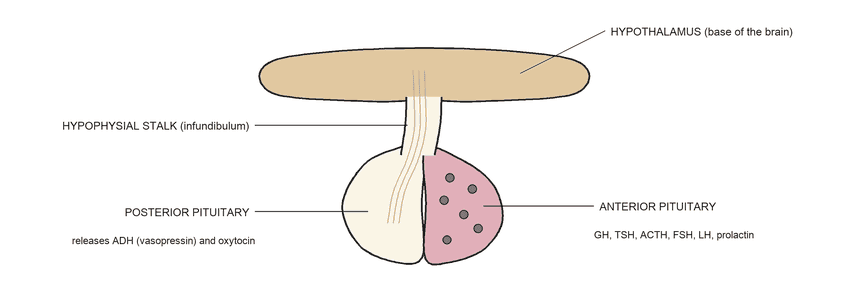
Watch out: ACTH and cortisone are linked (ACTH stimulates cortisone release), but ACTH is the pituitary hormone and cortisone is the adrenal one.
Therefore, the odd term is Cortisone; the category of the other three is hormones of the pituitary gland.
- 35 marks
Board paper question 3
Complete the following paragraph by filling in the blanks (i) to (v) with appropriate words:
The amount of urine output is under the regulation of a hormone called (i) ............... secreted by the (ii) ............... lobe of the pituitary gland. If this hormone secretion is reduced, there is an increased production of urine. This disorder is called (iii) ............... Sometimes excess glucose is passed with urine due to hyposecretion of another hormone called (iv) ............... leading to the cause of a disease called (v)................
Solve with AIWritten solution
Solution:
Concept: Two different hormones are linked with the word diabetes (passing a large amount of urine). ADH (antidiuretic hormone, vasopressin) is made in the hypothalamus and released by the posterior pituitary. It makes the kidney tubules take back (reabsorb) more water from the urine being formed, so less, more concentrated urine is passed. Insulin from the beta cells of the pancreas lowers the blood sugar.
Step 1 — Blank (i): the hormone controlling urine output.
The hormone that controls how much water leaves in the urine is antidiuretic hormone (ADH), also called vasopressin. It makes the kidney tubules reabsorb more water, so less urine is formed.
Step 2 — Blank (ii): the lobe that releases it.
ADH is released into the blood by the posterior lobe of the pituitary gland (it is made in the hypothalamus and stored there).
Step 3 — Blank (iii): the disorder when ADH is reduced.
With too little ADH, less water is reabsorbed, so a large amount of dilute urine with no sugar is passed and the person is always thirsty. This is diabetes insipidus.
Step 4 — Blank (iv): the hormone whose lack puts glucose in urine.
Glucose appears in the urine when there is too little insulin, the hormone of the beta cells of the islets of Langerhans that lowers blood sugar.
Step 5 — Blank (v): the disease.
Without enough insulin the blood sugar stays high (hyperglycaemia) and the extra glucose is passed out in the urine. This disease is diabetes mellitus.
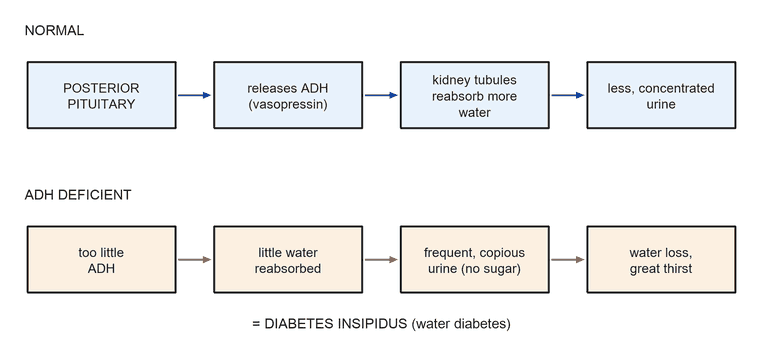
Watch out: Insipidus (ADH, no sugar in urine) and mellitus (insulin, sugar in urine) are easy to swap; 'mellitus' means honey-sweet.
Therefore, (i) antidiuretic hormone (ADH or vasopressin), (ii) posterior, (iii) diabetes insipidus, (iv) insulin, (v) diabetes mellitus.
- 41 mark
Board paper question 4
State the exact location of the following structures:
Thyroid gland
Solve with AIWritten solution
Solution:
Concept: "Exact location" means naming the body region and the organs the structure lies next to. The thyroid gland in the neck makes thyroxine, which contains iodine. Thyroxine sets the basal metabolic rate (how fast the cells release energy at rest) and is needed for normal growth and mental development.
Step 1 — Name the body region.
The thyroid gland lies in the neck, in front of the wind pipe, just below the larynx (voice box).
Step 2 — Describe how it sits.
It is a bilobed, butterfly-shaped gland. Its two lobes lie on either side of the trachea (wind pipe) and are joined across the front of the trachea by a narrow band, the isthmus.
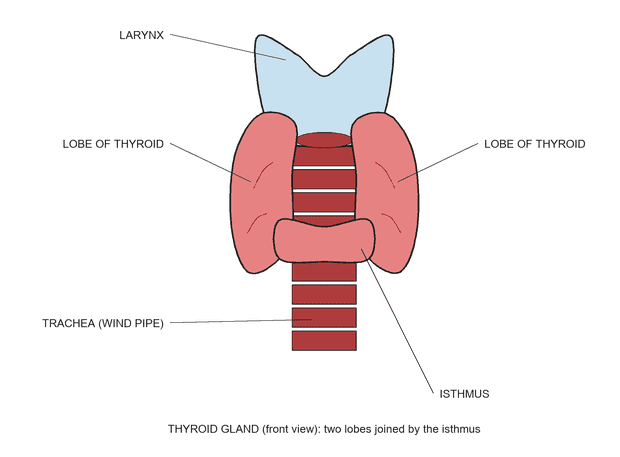
Watch out: The thyroid is in the neck below the larynx, not in the brain (that is the pituitary) or on the kidneys (the adrenals).
Therefore, the thyroid gland lies in the front of the neck just below the larynx, its two lobes on either side of the trachea joined by the isthmus.
- 55 marks
Board paper question 5
Given in the box below are a set of 14 biological terms. Of these, 12 can be paired into 6 matching pairs. Out of the six pairs, one has been done for you as an example.
Example: endosmosis – Turgid cell.
Identify the remaining five matching pairs :
Cushing's syndrome, Turgid cell, Iris, Free of rod and cone cells, Colour of eyes, Hypoglycemia, Active transport, Acrosome, Addison's disease, Blind spot, Hyperglycemia, Spermatozoa, Endosmosis, Clotting of blood. Solve with AIWritten solution
Solution:
Concept: Each matching pair is a term and the feature, cause or part that goes with it. Fourteen terms make six pairs (twelve terms), so two terms are left without a partner.
Step 1 — Pair Cushing's syndrome.
Cushing's syndrome is caused by too much cortisol (the book's cortisone) from the adrenal cortex; cortisol raises the blood sugar, so one of its signs is hyperglycaemia. Pair: Cushing's syndrome – Hyperglycemia.
Step 2 — Pair Addison's disease.
Addison's disease is caused by too little of the adrenal cortex hormones, so the blood sugar can fall too low. Pair: Addison's disease – Hypoglycemia.
Step 3 — Pair the iris.
The pigment in the iris gives the eye its colour. Pair: Iris – Colour of eyes.
Step 4 — Pair the blind spot.
The blind spot is where the optic nerve leaves the eyeball; it has no rods or cones, so no image forms there. Pair: Blind spot – Free of rod and cone cells.
Step 5 — Pair the acrosome.
The acrosome is the cap on the head of a sperm (spermatozoon); its enzymes help the sperm to get through the coverings of the egg. Pair: Acrosome – Spermatozoa.
Step 6 — Check the count.
The example and these five pairs use twelve of the fourteen terms. The two left over are Active transport and Clotting of blood, which have no partner in the box.
Watch out: Hyper- means too much and hypo- means too little; Cushing's (too much cortical hormone) goes with hyperglycemia, Addison's (too little) with hypoglycemia.
Therefore, the five pairs are Cushing's syndrome – Hyperglycemia, Addison's disease – Hypoglycemia, Iris – Colour of eyes, Blind spot – Free of rod and cone cells, and Acrosome – Spermatozoa.
- 65 marks
Board paper question 6
Given below is the outline of the human body showing the important glands:
(i) Name the glands marked 1 to 4.
(ii) Name the hormone secreted by part 2. Give one important function of this hormone.
(iii) Name the endocrine part of the part numbered 3.
(iv) Why is the part labelled 1 called the master gland? Which part of the forebrain controls the gland labelled 1?
(v) Name the gland that secretes the 'emergency hormone'.
Solve with AIWritten solution
Solution:
Concept: Read each gland from its position in the outline: the pituitary hangs below the brain, the thyroid is in the neck, the adrenals sit like caps on the kidneys and the pancreas lies across the abdomen below the stomach.
Step 1 — Part (i): name the glands 1 to 4.
We read each number from its position.
- 1 – Pituitary gland (the small gland below the brain)
- 2 – Thyroid gland (in the neck)
- 3 – Pancreas (the long gland across the abdomen)
- 4 – Adrenal gland (the cap on the kidney)
Step 2 — Part (ii): hormone of part 2 and one function.
Part 2, the thyroid, secretes thyroxine. One important function: it regulates the basal metabolic rate, the rate at which the cells release energy (and heat) at rest. It is also needed for normal growth and mental development.
Step 3 — Part (iii): endocrine part of gland 3.
The endocrine part of the pancreas is the islets of Langerhans, small groups of hormone-making cells scattered through it. The rest of the pancreas makes pancreatic juice, which leaves through a duct.
Step 4 — Part (iv): why gland 1 is the master gland.
The pituitary is called the master gland because its anterior lobe makes tropic hormones that control several other endocrine glands: TSH controls the thyroid, ACTH the adrenal cortex, and FSH and LH the testes and ovaries. It is itself controlled by the hypothalamus, the part of the forebrain from which it hangs.
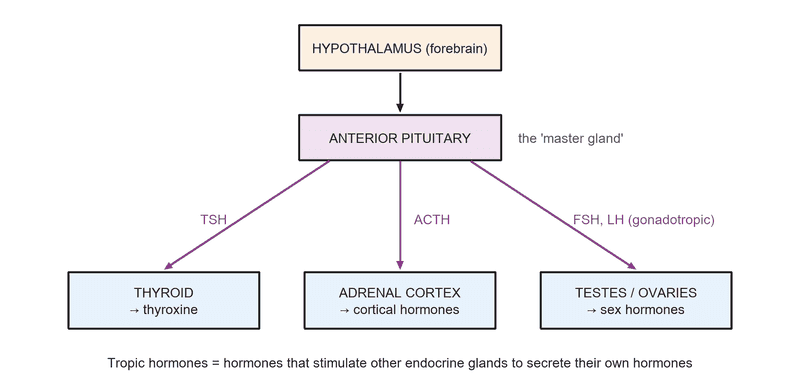
Step 5 — Part (v): gland of the emergency hormone.
The adrenal gland secretes the emergency hormone, adrenaline, from its inner part, the medulla. Adrenaline prepares the body to fight or run away.
Watch out: The master gland is the pituitary, but it is not the top controller; the hypothalamus of the forebrain controls it.
Therefore, (i) 1 pituitary, 2 thyroid, 3 pancreas, 4 adrenal gland; (ii) thyroxine, which regulates basal metabolism; (iii) islets of Langerhans; (iv) its tropic hormones control other glands, and the hypothalamus controls it; (v) the adrenal gland (medulla).
All 56 board paper questions for this chapter, solved the same way.
Class 10 Biology Ch 12 questions students ask
How many questions are there in Class 10 Biology Ch 12?
54 questions. Every one is solved step by step on this page.
Are these Class 10 Biology solutions free?
Yes. Every question and its full working is free to read, with no account needed.
Can I download the Class 10 Biology Ch 12 solutions as a PDF?
There is no PDF to download. Every solution is on this page instead, which means it is searchable, always the current syllabus, and readable on a phone. Use your browser's print option if you want it on paper.