Solution:
Concept: Compare each pair only on the basis given in brackets, one row for each basis.
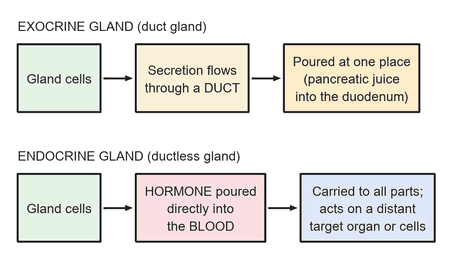
Step 1 — Exocrine and endocrine glands.
| Basis | Exocrine glands | Endocrine glands |
|---|
| Secretory substance | Enzymes / other secretions through ducts | Hormones poured directly into the blood |
| Example | Salivary gland, sweat gland | Thyroid, pituitary |
Step 2 — Enzymes and hormones.
| Basis | Enzymes | Hormones |
|---|
| Mode of transport | Carried through ducts (or act inside cells) | Carried by the blood |
| Target organ | Act at or near where they are poured | Act on distant target organs |
Step 3 — Nervous control and hormonal control.
| Basis | Nervous control | Hormonal control |
|---|
| Transmission | Electro-chemical, along nerve fibres | Chemical, through the blood |
| Effect | Rapid, short-lived, local | Usually slow, widespread, often long-lasting |

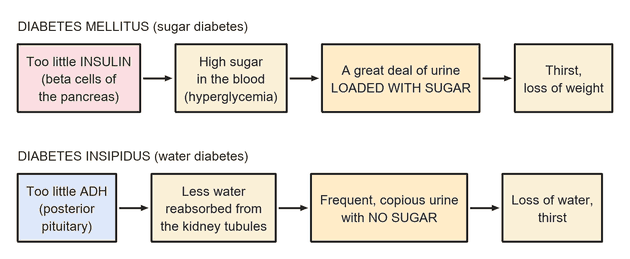
Step 4 — Diabetes mellitus and diabetes insipidus.
| Basis | Diabetes mellitus | Diabetes insipidus |
|---|
| Cause | Deficiency of insulin | Deficiency of ADH (vasopressin) |
| Symptoms | High blood sugar; sugar in urine; thirst, loss of weight | Much dilute urine without sugar; thirst |
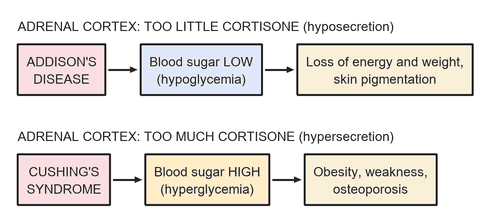
Step 5 — Addison's disease and Cushing's syndrome.
| Basis | Addison's disease | Cushing's syndrome |
|---|
| Cause | Too little cortisone (adrenal cortex) | Too much cortisone (adrenal cortex) |
| Sugar level | Hypoglycemia (low) | Hyperglycemia (high) |
Watch out: Keep to the basis in brackets; extra points on other bases earn no marks.
Therefore, the five pairs differ as shown in the tables above.
