
Opening your dashboard
Class 10 Biology Chapter 12 The Endocrine System: Practice Questions
42 questions on Chapter 12, each worked through on its own page with the AI tutor. Class 10 Biology, ICSE 2026-27.
42 questions
1–5 marks · Mixed difficulty
- 11 mark
Question 1
Bloom's level: Remember
Pick the false statement about hormones :
- 21 mark
Question 2
Bloom's level: Remember
Cortisone, the best-known hormone that suppresses inflammation, is secreted by the :
- 31 mark
Question 3
Bloom's level: Remember
The tropic hormone of the anterior pituitary that regulates the activity of the adrenal cortex is :
- 41 mark
Question 4
Bloom's level: Understand
Which statement correctly describes hormonal control when compared with nervous control?
- 51 mark
Question 5
Bloom's level: Understand
Endocrine glands are also called ductless glands because :
- 61 mark
Question 6
Bloom's level: Apply
A patient taking thyroxine tablets is accidentally given far too high a dose for several weeks. Which set of changes is most likely?
- 71 mark
Question 7
Bloom's level: Apply
A diabetic patient takes his usual insulin injection but then misses his lunch. An hour later he is sweating, shaky and confused. The best immediate help is to :
- 81 mark
Question 8
Bloom's level: Apply
If a patient's anterior pituitary had to be removed by surgery, which glands would be most directly affected because they lose their stimulating hormones?
- 91 mark
Question 9
Bloom's level: Analyse
The thyroxine level in a person's blood rises above normal. According to the feedback mechanism, what happens next?
- 101 mark
Question 10
Bloom's level: Understand
Assertion (A): Hormones are effective even though they are produced in very small quantities.
Reason (R): Hormones are biologically very active; adrenaline, for example, acts even at a concentration of 1 part in 300 000 000 parts.
- 111 mark
Question 11
Bloom's level: Analyse
Assertion (A): A frightened person often gets a dry mouth.
Reason (R): Adrenaline stimulates the liver to convert glycogen into glucose.
- 121 mark
Question 12
Bloom's level: Evaluate
Assertion (A): Insulin lowers the sugar level in the blood.
Reason (R): Insulin itself converts glucose into glycogen.
- 131 mark
Question 13
Bloom's level: Remember
Name two organs whose main job is not hormone production, but which also produce certain hormones.
- 142 marks
Question 14
Bloom's level: Understand
Hormones are carried by the blood to every part of the body, yet each hormone acts only on certain organs. Explain this with the help of the term target organ and one example.
- 152 marks
Question 15
Bloom's level: Understand
The word hormone comes from a Greek word meaning "to excite" or "to put into action". Explain how this meaning suits what hormones do, with one example.
- 162 marks
Question 16
Bloom's level: Apply
Adrenaline is active even at a concentration of 1 part in parts. A person's blood has a mass of about kg. Find the smallest mass of adrenaline (in milligrams) that would be active in this blood.
- 172 marks
Question 17
Bloom's level: Apply
Two ten-year-old children are both much shorter than others of their age. Child P also shows mental retardation, while child Q is mentally normal and has the body proportions of a younger child. Identify the likely condition of each child, and the gland and hormone at fault.
- 182 marks
Question 18
Bloom's level: Apply
Sort the following secretions into hormones and non-hormonal secretions, and state the basis of your grouping :
insulin, saliva, thyroxine, bile, adrenaline, pancreatic juice
- 192 marks
Question 19
Bloom's level: Analyse
Two people, X and Y, each drink the same glucose solution after an overnight fast. Their blood sugar (in mg per 100 mL of blood) is measured :
Time after drink 0 h 1 h 2 h 3 h X 90 140 110 92 Y 120 260 240 210 (a) Find the rise in blood sugar of each person in the first hour. Who is likely to be diabetic ?
(b) Which hormone is most likely lacking in this person, and what does that hormone normally do?
- 202 marks
Question 20
Bloom's level: Evaluate
Kunal writes : "Adrenaline and the sympathetic nervous system work against each other, so that the body does not over-react in an emergency." Evaluate his statement.
- 211 mark
Question 21
Bloom's level: Apply
A patient's report reads : "Hyposecretion of vasopressin." Name the disorder he is likely to have and the part of the gland at fault.
- 222 marks
Question 22
Bloom's level: Understand
Explain why the activities of the body must take place at a proper time and in a correct sequence, using the example of digestive juices. Name the two systems that regulate this.
- 234 marks
Question 23
Bloom's level: Apply
Case: On a night trek, Tanvi hears the deep growl of a leopard close by. Her heart starts thumping, she pants, her face turns pale, and she runs back to the camp faster than she has ever run.
(a) Name the hormone mainly responsible and the exact part of the gland that secretes it.
(b) Explain the biological advantage of each of these : (i) thumping heart, (ii) panting, (iii) pale face.
(c) Where did the extra energy for her fast run come from ?
- 244 marks
Question 24
Bloom's level: Analyse
Case: A health team surveyed 400 adults in each of two villages :
Village Location Adults with a visible swelling in the neck A Hilly region, far from the sea 30 B Coastal plain 4 (a) Calculate the percentage of affected adults in each village. How many times more common is the condition in Village A?
(b) Name the condition and explain why it is more common in Village A.
(c) Suggest one simple public-health measure for Village A and explain how it works.
- 253 marks
Question 25
Bloom's level: Apply
During a long and difficult childbirth, a doctor gives the mother an injection of a hormone to strengthen the contractions of the uterus.
(a) Name the hormone and the lobe of the pituitary from which it is normally released.
(b) State one other role of the same hormone after the baby is born.
(c) In normal labour, each contraction of the uterus leads to a still stronger contraction until delivery. Is this negative or positive feedback? Explain.
- 264 marks
Question 26
Bloom's level: Evaluate
Case: Mohan, who has diabetes mellitus, says three things at a family party :
- Statement 1 : "I take insulin every day, so I am cured now."
- Statement 2 : "Since I take insulin, I can eat as many sweets as I like."
- Statement 3 : "If I feel shaky and sweaty after my injection, I should take another dose."
(a) Evaluate Statement 1.
(b) Evaluate Statement 2.
(c) Evaluate Statement 3 and state what he should actually do.
- 274 marks
Question 27
Bloom's level: Analyse
Study these hormones : insulin, glucagon, adrenaline, cortical hormones (from the adrenal cortex).
(a) Classify them into those that raise the blood sugar level and those that lower it.
(b) Which hormone of the raising group acts mainly in an emergency, and which acts mainly when the blood sugar falls during fasting ?
(c) Predict what would happen to the blood sugar level after meals if insulin were absent but all the others worked normally. Give the reason.
- 283 marks
Question 28
Bloom's level: Understand
(a) What is meant by negative feedback in the control of hormone secretion?
(b) Using the hypothalamus, the anterior pituitary and the thyroid, explain what happens when the thyroxine level in the blood falls below normal.
(c) Why are most feedback mechanisms in the body of the negative type?
- 295 marks
Question 29
Bloom's level: Create
Construct a flow chart that summarises how the endocrine glands of this chapter are linked.
(a) Start with the hypothalamus and the pituitary, and show the three glands stimulated by anterior-pituitary tropic hormones (name each tropic hormone on the arrow).
(b) Add the two hormones of the posterior pituitary and their targets, and the two glands of the syllabus that are not controlled by pituitary tropic hormones, with their main hormones.
(c) Mark one negative feedback loop on your chart.
- 305 marks
Question 30
Bloom's level: Create
Design a labelled cycle diagram (in words or arrows) to show how the pancreas keeps the blood sugar level steady over one day.
(a) Show what happens after a meal, naming the cells, the hormone and its two actions.
(b) Show what happens during a long gap between meals, naming the cells, the hormone and its action.
(c) Add a note to your cycle showing where it breaks down in diabetes mellitus, and one symptom that results.
- 311 mark
Question 31
In which one of the following is the hormone correctly paired with its source ?
- 321 mark
Question 32
Which one of the following is not an effect of adrenaline on the body ?
- 331 mark
Question 33
Assertion (A): Simple goitre is common among the people living in hilly regions.
Reason (R): The soil of hilly regions, and hence the food grown there, is deficient in iodine, which is the active ingredient in the production of thyroxine.
- 342 marks
Question 34
Chemically, hormones are of three kinds.
(i) To which chemical kind does each of these hormones belong — insulin, adrenaline and testosterone ?
(ii) Which one of these three hormones is lipid-soluble ? From which substance is it derived ?
- 352 marks
Question 35
The increase in the height of a child over the years is regulated by hormones and not by nerves.
(i) State two ways in which the effect of hormonal control differs from that of nervous control, which make hormones suitable for this.
(ii) Which of the two kinds of control — hormonal or nervous — can be modified to some extent by learning from previous experience ?
- 362 marks
Question 36
Undersecretion of thyroxine harms a child and an adult in different ways.
(i) Name the condition it produces in a child, and state two of its features.
(ii) Name the condition it produces in an adult, and state two of its features.
- 372 marks
Question 37
(i) What is meant by a tropic hormone ?
(ii) Name the tropic hormone of the anterior pituitary that regulates the activity of the adrenal cortex, and the one that stimulates egg formation in females and sperm formation in males.
- 384 marks
Question 38
The figure shows an endocrine gland that sits like a cap on the top of a kidney. A section of this gland is drawn enlarged, with its two regions numbered 1 and 2.
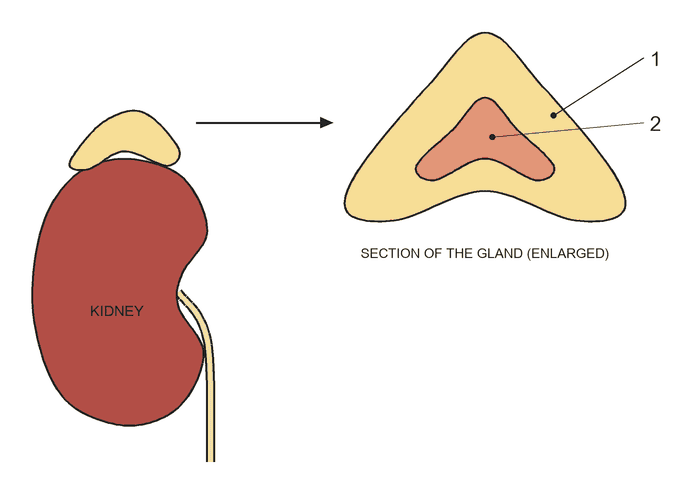
(i) Identify the gland, and its regions 1 and 2.
(ii) Name the hormone secreted by region 2. What stimulates this region to release extra hormone into the blood at a time of emotional stress ?
(iii) Name the best known hormone of region 1. Name the disease caused by its hyposecretion and the one caused by its hypersecretion.
- 393 marks
Question 39
The pancreas is described as both a duct gland and a ductless gland.
(i) Justify this description, naming what the pancreas secretes in each role and where each secretion is poured.
(ii) Name the groups of hormone-secreting cells of the pancreas. Which of their cells secrete insulin, and which secrete glucagon ?
(iii) A student writes, “Insulin converts glucose into glycogen.” Why is this statement wrong ? Write what insulin actually does.
- 404 marks
Question 40
The flow chart shows how the level of thyroxine in the blood is controlled. X and Y are two hormones. The dashed arrows show the effect of a high level of thyroxine.

(i) Name the hormones X and Y.
(ii) What happens along the two dashed arrows when the level of thyroxine in the blood exceeds the normal ? Name this kind of control.
(iii) Give one example from the human body of the opposite kind of control, and say why it is called so.
- 411 mark
Question 41
Class 10 Sample Paper 1 · Section A
Name the following:
A hormone that regulates the basal metabolic rate.
- 422 marks
Question 42
Class 10 Sample Paper 2 · Section B
Which hormone imbalance is responsible for each of the following diseases?
(i) Diabetes mellitus
(ii) Goitre
(iii) Cretinism
(iv) Adrenal virilism