
Opening your dashboard
Class 10 Biology Chapter 12 The Endocrine System: Competency-Based Questions (CBQ)
40 questions on Chapter 12, each worked through on its own page with the AI tutor. Class 10 Biology, ICSE 2026-27.
40 questions
1–5 marks · Mixed difficulty
- 11 mark
Question 1
Cognitive domain: Application
For many years, insulin obtained from the pancreas of cattle and pigs was injected into human diabetic patients, and it lowered their blood sugar. Which general property of hormones made this treatment possible ?
- 21 mark
Question 2
Cognitive domain: Analysis
The table gives the findings for four persons at a health check-up.
Person Blood sugar Glucose in urine Volume of urine passed Thirst P High Present Very large Marked Q Normal Absent Very large Marked R Low Absent Normal Normal S Normal Absent Normal Normal Whose findings point to the deficiency of a hormone released from the posterior lobe of the pituitary ?
- 31 mark
Question 3
Cognitive domain: Application
Mrs. D'Souza has been losing weight and energy for some months. She feels the cold badly and catches infections easily. A relative says she must have diabetes mellitus, but her blood sugar is found to be below normal. Which cause fits all these findings ?
- 41 mark
Question 4
Cognitive domain: Analysis
Mr. Rai has lived for years on food grown in soil that is deficient in iodine. His blood report reads :
Hormone Level in blood Thyroxine Below normal Thyroid stimulating hormone (TSH) Above normal Which explanation accounts for both the readings ?
- 51 mark
Question 5
Cognitive domain: Understanding
Assertion (A): The secretion of an endocrine gland can act on an organ lying far away from the gland, although the gland has no duct.
Reason (R): Hormones are poured directly into the blood, which carries them to all parts of the body.
- 61 mark
Question 6
Cognitive domain: Analysis
Assertion (A): During childbirth, one contraction of the uterus gives a message to contract further, and this continues till the delivery is completed.
Reason (R): Most of the feedback mechanisms in our body are of the negative type, which restore the normal state.
- 71 mark
Question 7
Cognitive domain: Application
Dev had his dinner at 8 p.m. and ate nothing more until 8 a.m. the next day. When his blood was tested in the morning, his blood sugar was still close to the normal level.
During the night, the hormone ______ secreted by the alpha cells of his pancreas stimulated his liver to break down stored ______ into glucose.
- 81 mark
Question 8
Cognitive domain: Application
In Arun, the anterior pituitary began to oversecrete growth hormone when he was 8 years old. In his uncle, the same oversecretion began suddenly at the age of 40.
Arun is likely to develop ______, whereas his uncle is likely to develop ______.
- 91 mark
Question 9
Cognitive domain: Understanding
Riya pulls her hand away from a hot pan within a fraction of a second. Over the same year she also grows taller by cm.
The quick withdrawal of her hand is under nervous control, but her increase in height is under ______ control, because only this kind of control can affect ______.
- 102 marks
Question 10
Cognitive domain: Understanding
In a patient, the duct of the pancreas was found to be completely blocked, so that no pancreatic juice could reach the duodenum. The digestion of his food was affected, but his blood sugar remained normal.
Explain, from the structure of the pancreas, why the two functions were not affected alike.
- 112 marks
Question 11
Cognitive domain: Application
Two sisters had their thyroid glands tested. Anita always feels warm, is restless and her heart beats fast even when she sits quietly. Sunita is sluggish, and her face and hands look swollen.
Using the main function of thyroxine, explain the condition of each sister.
- 122 marks
Question 12
Cognitive domain: Evaluation
An advertisement on the internet says : "Our growth hormone course will add 10 cm to the height of any adult."
Judge this claim, using what your chapter says about growth hormone in adults.
- 135 marks
Question 13
Cognitive domain: Analysis
Case: The blood sugar level of a healthy young man was read every hour for eight hours. He ate a meal at the start, rested till the fifth hour, and then went cycling without eating anything more. P, Q, R and S mark four parts of the graph.
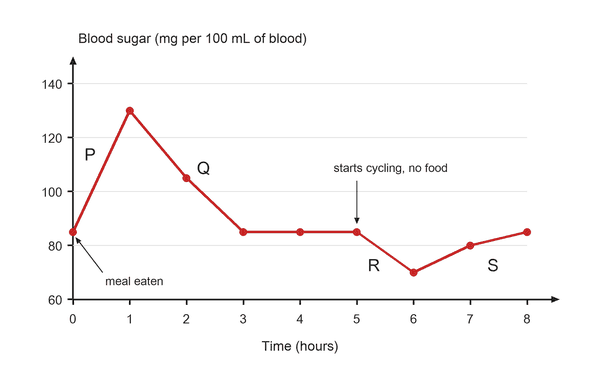
(a) From the graph, state by how much his blood sugar rose in part P, how many hours after the meal it was back at its starting value, and the lowest value reached. Why did it rise in part P ?
(b) Name the hormone that brought the level down in part Q and the cells that secrete it. State the two ways in which it acts.
(c) In part S the level rose although he had eaten nothing. Explain how.
(d) Predict two ways in which this graph would look different for a person whose pancreas secretes too little insulin.
- 144 marks
Question 14
Cognitive domain: Evaluation
Case: To explain hormonal control to her class, Zara compares it with a radio broadcast. Her friend Kabir says a telephone call is the better comparison.
Feature Radio broadcast Telephone call How the message travels Sent out to the whole town Along a wire to one telephone only Who acts on the message Only the radio sets tuned to that station Only the person who is called Speed Immediate Immediate (a) Decide which of the two is the better comparison for hormonal control. Justify your choice with two points of similarity.
(b) Point out one feature of hormonal control that the comparison you chose shows wrongly.
(c) Kabir adds : "Nerves are much faster than hormones, so the body would manage well with nerves alone." Judge this statement, giving two things that hormones do and nerves cannot.
(d) Which of the two kinds of control in the body can be modified by learning from previous experience ?
- 155 marks
Question 15
Cognitive domain: Creativity
Case: Students of a school in the plains are going on an NSS camp to a village in the hills. Many people there have a swelling in the neck, and most families cook with locally bought salt that is not iodised. The students must design one poster for the village health centre.
(a) Write a short heading or slogan for the poster, and name the condition it deals with.
(b) Plan three simple pictures or boxes for the poster that together explain why this condition is common in the village. Say what each will show.
(c) State the one clear action the poster should ask every family to take, and the reason to be printed with it.
(d) Suggest how the students could find out, two years later, whether the poster has helped.
- 161 mark
Question 16
CISCE Competency-Focused Practice Questions (2024) · Cognitive domain: Application & Analysis
An exo-endocrine gland in the human body is:
- 171 mark
Question 17
CISCE Competency-Focused Practice Questions (2024) · Cognitive domain: Understanding
A squirrel is in a scary situation. The secreted adrenaline prepares the body to meet the situation. Which of the following is NOT TRUE for this situation?
- 181 mark
Question 18
CISCE Competency-Focused Practice Questions (2024) · Cognitive domain: Application
Surya’s father was diagnosed with Diabetes mellitus. The doctor advised him to limit certain foods. Which are the foods he should avoid eating?
P - Sweets
Q - Leafy vegetables
R - Bananas
S - Pulses
- 192 marks
Question 19
CISCE Competency-Focused Practice Questions (2024) · Cognitive domain: Understanding
What is Adrenal Virilism?
- 202 marks
Question 20
CISCE Competency-Focused Practice Questions (2024) · Cognitive domain: Application
State the effect of Adrenaline on:
(a) Pupils of eyes
(b) Heartbeat
- 213 marks
Question 21
CISCE Competency-Focused Practice Questions (2024) · Cognitive domain: Understanding & Analysis
Rohit’s father has increased thirst and hunger with frequent urination. He also gets fatigued very often. His doctor advised him to get a blood sugar profile done.
(a) Name the disease based on the symptoms given above.
(b) Name the hormone whose deficiency causes this disorder.
(c) What is the technical term for high blood sugar level?
- 221 mark
Question 22
Cognitive domain: Application
On a hot day Ravi played football for two hours and drank no water. In the evening he passed only a small amount of dark yellow urine. Which change in his body explains the small amount of urine ?
- 231 mark
Question 23
Cognitive domain: Analysis
Mr. Thomas, aged , has put on a great deal of weight. He feels weak and tires easily, his bones are thin and brittle, his body keeps extra salt and water, and his blood sugar is above normal. His doctor finds that all this is due to a disorder of the adrenal cortex.
Which option names the disorder and gives its correct cause ?
- 241 mark
Question 24
Cognitive domain: Analysis
In a laboratory study of the pancreas, two groups of healthy rats were treated so that, in group P, all the beta cells of the islets of Langerhans were destroyed, and in group Q, all the alpha cells were destroyed. No other cells were harmed. Both groups were then kept without food for hours. (Hypothetical data.)
Which option correctly predicts the blood sugar of the two groups at the end of the fast ?
- 251 mark
Question 25
Cognitive domain: Understanding
Assertion (A): Myxoedema is seen in adults, whereas cretinism affects children.
Reason (R): Both myxoedema and cretinism are caused by undersecretion of thyroxine.
- 261 mark
Question 26
Cognitive domain: Understanding
Assertion (A): Insulin and glucagon have opposite effects on the blood sugar, and the body needs both of them to keep it steady.
Reason (R): Both insulin and glucagon lower the blood sugar level.
- 271 mark
Question 27
Cognitive domain: Evaluation
The bar chart shows the level of thyroxine in the blood of four persons, P, Q, R and S. The shaded band is the normal range. The table gives the doctor's notes. (Hypothetical data.)
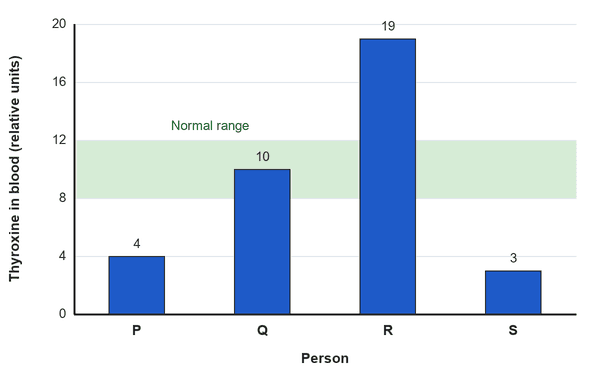
Person Age Doctor's notes P years Sluggish; face and hands look swollen Q years No complaint R years Swelling in the neck; protruding eyes; fast heart beat; restless S years Much shorter than other children of the same age; slow mental development Which conclusion is best supported by the chart and the table ?
- 281 mark
Question 28
Cognitive domain: Analysis
Seema has just had a baby. Tests show that the cells of her breasts are making milk normally, but when the baby sucks, the milk does not flow out. The doctor finds that one hormone is in short supply.
Which hormone is it, and which part of which gland releases it ?
- 291 mark
Question 29
Cognitive domain: Analysis
A patient has a tumour in the anterior pituitary that goes on secreting TSH whatever the level of thyroxine in the blood. The hypothalamus and the thyroid gland are normal.
Which row correctly gives the levels of TSH, thyroxine and thyroid-releasing hormone (TRH) in the patient's blood ?
- 302 marks
Question 30
Cognitive domain: Application
Kavya, a girl with diabetes mellitus, has to inject insulin every day. She says: "It is too much trouble. I will take one very big dose once a week instead."
Give two reasons why her plan is a bad one.
- 312 marks
Question 31
Cognitive domain: Creativity
Many students mix up diabetes mellitus and diabetes insipidus.
Compose a memory aid of two lines, a rhyme, a slogan or a short jingle, that keeps the two disorders apart. Then state the two facts about each disorder that your lines carry, one about the urine and one about the hormone.
- 322 marks
Question 32
Cognitive domain: Understanding
Many names of disorders in this chapter are built from word roots. Use the roots to explain the following.
(a) Hypoglycaemia (hypo : below, glyc : sugar, emia : blood). Name the hormone whose overdose can cause it in a diabetic patient.
(b) Exophthalmic goitre (exo : outward, ophthalmos : eye). State the fault of the thyroid gland that causes it.
- 332 marks
Question 33
Cognitive domain: Analysis
After a road accident, Mr. Joseph lost a large amount of blood before he reached the hospital. His blood pressure was low, and for some hours he passed very little urine. His blood showed a high level of antidiuretic hormone (ADH).
(a) State how ADH acts on the blood vessels, and how this helps his low blood pressure.
(b) State how ADH acts on the kidneys, and why passing very little urine is useful to him at this time.
- 343 marks
Question 34
Cognitive domain: Evaluation
A student made this table to revise the hormones. Three of its entries are wrong.
Hormone Gland and part Main action Adrenaline Adrenal cortex Prepares the body to meet an emergency Glucagon Beta cells of the pancreas Raises the blood sugar by breaking down glycogen in the liver Oxytocin Anterior pituitary Causes contraction of the uterus during childbirth TSH Anterior pituitary Stimulates the thyroid to secrete thyroxine ADH Posterior pituitary Increases the reabsorption of water from the kidney tubules Find the three wrong entries and write each one correctly.
- 353 marks
Question 35
Cognitive domain: Application
Three patients attend an adrenal clinic. Each has a disorder of the adrenal cortex. (Hypothetical cases.)
Patient Findings P A boy of years who shows signs of sexual maturity far too early Q A man whose blood tests show a disturbed balance of sodium and potassium ions R A woman whose body handles carbohydrates, proteins and fats abnormally For each patient, name the group of cortical hormones that is most likely involved, and state in a few words the normal work of that group.
- 363 marks
Question 36
Cognitive domain: Analysis
The growth chart shows the heights of three children, A, B and C, measured from the age of years to years. One child grew normally, one has a disorder in which the pituitary secretes too little growth hormone, and one has a disorder in which it secretes too much. The heights at , and years are marked on the chart. (Hypothetical data.)

(a) Say which child grew normally. Name the condition of B and the condition of C.
(b) Find how much taller C was than A at years, and how much shorter B was than A at years.
(c) Find the gain in height of A and of C between the ages of and years. What do the two gains show about the effect of too much growth hormone on the long bones of a child ?
- 373 marks
Question 37
Cognitive domain: Analysis
A patient with a long-standing painful inflammation is given cortisone tablets for many months. Cortisone from the adrenal cortex is controlled by ACTH from the anterior pituitary in the same kind of feedback as thyroxine and TSH: a high level of cortisone inhibits the release of ACTH.
(a) Predict what happens to the level of ACTH in the patient's blood, and why.
(b) Predict what happens to the activity of the patient's own adrenal cortex, and why.
(c) What would happen to the level of ACTH in a person whose adrenal cortex has been removed by surgery ? Give a reason.
- 385 marks
Question 38
Cognitive domain: Analysis
Case: During a surprise fire drill at school, the pulse and the breathing of a -year-old girl were noted a minute before the alarm and again during the rush to the playground. The share of the blood pumped by her heart that went to different parts of the body was also noted. (Hypothetical data.)
Reading Before the alarm During the rush Heart beats per minute Breaths per minute Share of the blood to the muscles Share of the blood to the digestive system Share of the blood to the skin (a) By how many beats per minute did her heart rate rise, and what is this rise as a percentage of the rate before the alarm, to the nearest whole number ?
(b) Name the hormone that brought about these changes and the part of the gland that released it. What stimulated that part of the gland ?
(c) By how many percentage points did the share of the blood to the muscles rise, and how many of these points came from the digestive system and the skin together ? Explain how adrenaline brings about this shift of blood, and how the shift helps her to run.
- 395 marks
Question 39
Cognitive domain: Evaluation
Case: A school in a hill village has students. Many students had a swelling in the neck, and from January the headmaster made sure that iodised salt was used in the mid-day meal. At the end of each year the school nurse counted the students with a visible swelling in the neck. (Hypothetical data.)
Year Students with a swelling in the neck (a) Find the percentage of the students with a swelling in and in , and the percentage fall in the number of such students between these two years.
(b) A teacher says: "There are still 15 students with a swelling, so the iodised salt has failed." Evaluate this statement using the data.
(c) Suggest two things the school could do to bring the number down further, giving a reason for each.
- 404 marks
Question 40
Cognitive domain: Creativity
Case: Dr. Mehta runs a health helpline. For each caller below she must frame one question, or ask for one test result, that would separate the two disorders she suspects. (Hypothetical callers.)
- Caller 1: a man who is very thirsty and passes a large amount of urine. She suspects diabetes mellitus or diabetes insipidus.
- Caller 2: a woman with a swelling in the front of her neck. She suspects simple goitre or exophthalmic goitre.
- Caller 3: a man who is always tired and sluggish. She suspects myxoedema or Addison's disease.
(a) For caller , write the question or the test, and say which result points to each disorder, with the hormone that is lacking.
(b) For caller , write the question and say which answer points to each disorder, with the fault of the thyroid.
(c) For caller , write the question and say which answer points to each disorder, with the hormone that is lacking.