Solution:
Concept: The answers come from the four endocrine glands in the syllabus: pancreas, adrenal, pituitary and thyroid.
Step 1 — Part (a).
The islets secrete insulin (beta cells), glucagon (alpha cells) and somatostatin (delta cells).
Step 2 — Part (b).
The two types of cortical hormones are mineralocorticoids (mineral metabolism) and glucocorticoids (carbohydrate, protein and fat metabolism).
Step 3 — Part (c).
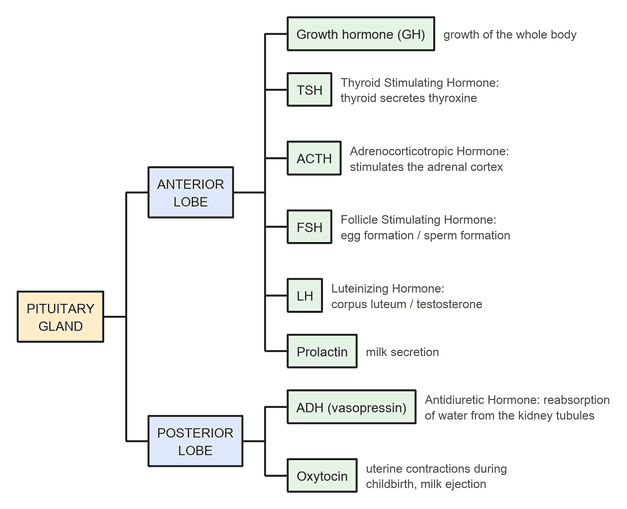
The anterior pituitary secretes growth hormone, TSH, ACTH, FSH, LH and prolactin.
Step 4 — Part (d).
The posterior pituitary releases ADH (vasopressin) and oxytocin.
Step 5 — Part (e).
The emergency hormone is adrenaline.
Step 6 — Part (f).
Hypothyroidism causes simple goitre, cretinism and myxoedema.
Step 7 — Part (g).
Cretinism shows dwarfism (stunted growth) and mental retardation.
Step 8 — Part (h).
Too much growth hormone causes gigantism in children and acromegaly in adults.
Watch out: Exophthalmic goitre is not a disease of hypothyroidism; it is due to too much thyroxine.
Therefore, the answers are as listed in parts (a) to (h) above.
