Solution:
Concept: Blanks (i) to (iv) are about the thyroid and the disorders of thyroxine; blanks (v) to (vii) are about the adrenal gland and adrenaline.
Step 1 — Blank (i): position of the thyroid.
The thyroid lies in front of the neck, just below the larynx (voice box).
Answer: larynx.
Step 2 — Blank (ii): cause of cretinism.
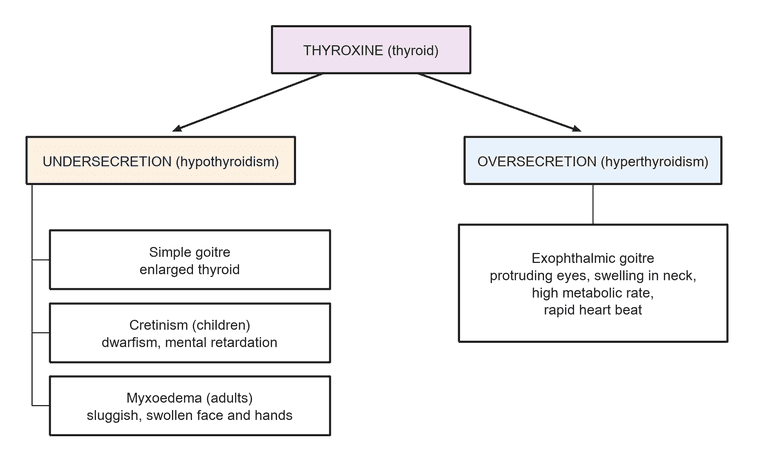
Cretinism is a form of hypothyroidism in children: too little thyroxine stunts growth and mental development.
Answer: undersecretion.
Step 3 — Blank (iii): oversecretion.
Too much thyroxine makes the eyes bulge out with a swelling in the neck. Simple goitre is due to lack of iodine (too little thyroxine).
Answer: exophthalmic goitre.
Step 4 — Blank (iv): swollen face, sluggish adult.
Hypothyroidism in an adult gives a swollen face and hands and sluggishness; cretinism is the childhood form.
Answer: myxoedema.
Step 5 — Blank (v): hormone for facing danger.
Adrenaline prepares the body for 'fight or flight'.
Answer: adrenalin.
Step 6 — Blank (vi): gland with cortex and medulla.
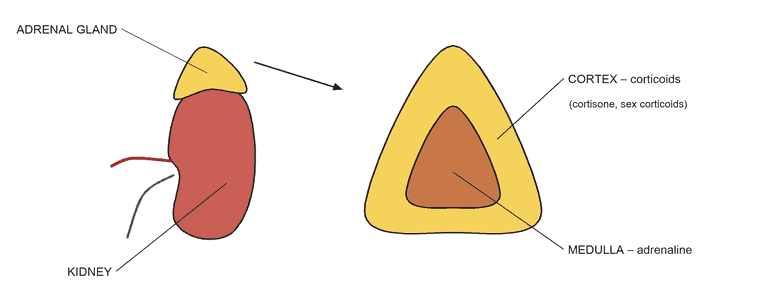
Each adrenal gland has an outer cortex and an inner medulla.
Answer: adrenal gland.
Step 7 — Blank (vii): effect of extra adrenaline.
Adrenaline narrows the arterioles of the digestive system, so less blood and saliva reach the mouth and it feels dry. The heart beats faster, not slower, and these arterioles narrow, they do not widen.
Answer: Dry mouth.
Watch out: Do not mix up the two thyroid disorders of hyposecretion: cretinism is in children, myxoedema in adults.
Therefore, the blanks are larynx, undersecretion, exophthalmic, myxoedema, adrenalin, adrenal, dry mouth.
