
Opening your dashboard
Class 9 Maths Chapter 15: Construction of Polygons Solutions
47 textbook questions with step-by-step answers, free to read, for ICSE 2026-27.
Get talked through Ch 15, not just shown the answer
Reading a finished solution is not the same as being able to do it. The AI tutor takes one question at a time and works it with you, in your own words, until you can.
- Ask it out loud, in your own words
- It gives you the next step, not the answer
- Stuck on part (ii)? Start there
47 questions with solutions
1–3 marks · Mixed difficulty
- 11 mark
Question 1
A quadrilateral can be constructed, if its :
Solve with AIAnswer
(A) three sides and one angle are known
- Correct
(B) four sides and one angle are known
(C) two sides and two angles are known
(D) four sides are known
Answer: (B) four sides and one angle are known
Concept: A quadrilateral is fixed (can be constructed in only one shape) when five suitable measurements are known, such as four sides and one angle, or four sides and one diagonal.
Step 1 — Count what fixes a quadrilateral.
A diagonal splits a quadrilateral into two triangles that share it. Each triangle needs three measurements, and the shared diagonal is counted once, so a quadrilateral needs five independent measurements.
Step 2 — Count each option.
Four sides and one angle give 4 + 1 = 5 measurements, which is enough: the angle and its two sides fix one triangle, and the other two sides fix the second.
Watch out: Four sides alone are not enough. A frame of four rods joined at the corners can still be pushed out of shape.
Why the other options are wrong:
- (A) three sides and one angle are known: Three sides and one angle are only four measurements, so the fourth side can take any length.
- (C) two sides and two angles are known: Two sides and two angles are only four measurements, so the shape is not fixed.
- (D) four sides are known: Four sides with no angle or diagonal let the quadrilateral flex, like a hinged frame.
Therefore, a quadrilateral can be constructed when four sides and one angle are known, option (B).
- 21 mark
Question 2
A parallelogram can be constructed, if its :
Solve with AIAnswer
(A) all the four sides are known
(B) opposite sides are known
(C) opposite angles are known
- Correct
(D) two adjacent sides and contained angle are known
Answer: (D) two adjacent sides and contained angle are known
Concept: A parallelogram is fixed when we know enough to draw one of its triangles; the opposite sides then follow, because they are equal and parallel.
Step 1 — Recall the properties used.
In a parallelogram the opposite sides are equal and parallel, so knowing two adjacent sides gives all four sides.
Step 2 — Fix the shape.
Two adjacent sides and the angle between them fix one triangle, for example triangle ABD from AB, AD and angle A. The fourth vertex C is then found by drawing CD equal and parallel to AB.
Watch out: Knowing two adjacent sides is not enough; the angle between them is also needed.
Why the other options are wrong:
- (A) all the four sides are known: Four sides are only two different lengths; without an angle the parallelogram can lean by any amount.
- (B) opposite sides are known: One pair of opposite sides gives only one length, so the other side and the angle are unknown.
- (C) opposite angles are known: Angles alone fix no length, so the parallelogram can be drawn in any size.
Therefore, a parallelogram can be constructed when two adjacent sides and the included angle are known, option (D).
- 31 mark
Question 3
A parallelogram can be constructed, if its :
Solve with AIAnswer
- Correct
(A) two diagonals and included angle are given
(B) two diagonals and one angle are given
(C) two diagonals are given
(D) one side and one diagonal are given
Answer: (A) two diagonals and included angle are given
Concept: The diagonals of a parallelogram bisect each other, so the two diagonals together with the angle between them fix all four vertices.
Step 1 — Use the property of the diagonals.
The diagonals of a parallelogram bisect each other. So if AC and BD are known, the four half-diagonals are known too.
Step 2 — Fix the shape.
Draw AC and mark its mid-point O. Through O draw the second diagonal at the given angle to AC and cut off half of BD on each side of O. Joining the four ends gives the parallelogram, so the two diagonals and the angle between them fix it.
Watch out: The two diagonals alone are not enough; the angle between them must be given too.
Note: Option (B) is not impossible in principle (see its bullet), but only (A) is the standard construction of this chapter, so the printed answer (A) is kept.
Why the other options are wrong:
- (B) two diagonals and one angle are given: Here the angle is an angle of the parallelogram, not the angle between the diagonals, so the direct construction (second diagonal drawn through the mid-point at a known angle) cannot be used. It would need a locus construction (the points from which BD is seen at the given angle), which is not part of this chapter.
- (C) two diagonals are given: Two diagonals without the angle between them can be turned to any angle, giving many parallelograms.
- (D) one side and one diagonal are given: One side and one diagonal give only one side and one diagonal of triangle ABC; the third side is unknown.
Therefore, a parallelogram can be constructed from its two diagonals and the included angle, option (A).
- 41 mark
Question 4
A trapezium can be constructed, if its :
Solve with AIAnswer
(A) parallel sides are given
(B) non-parallel sides are given
- Correct
(C) four sides and the parallel sides are given
(D) four sides are given
Answer: (C) four sides and the parallel sides are given
Concept: A trapezium has one pair of parallel sides. Knowing all four sides and which pair is parallel fixes it, because it can be split into a parallelogram and a triangle with known sides.
Step 1 — Split the trapezium.
Let AD ∥ BC in trapezium ABCD. Draw DE parallel to AB, meeting BC at E. Then ABED is a parallelogram, so DE = AB and BE = AD.
Step 2 — Fix the shape.
Triangle DEC now has known sides DE = AB, DC, and EC = BC − AD. So it can be constructed, and the trapezium is completed from it. This needs all four sides and the knowledge of which two sides are parallel.
Watch out: Four sides alone are not enough: we must also know which two of them are the parallel sides.
Why the other options are wrong:
- (A) parallel sides are given: The two parallel sides alone do not fix the height or the slant of the other sides.
- (B) non-parallel sides are given: The two non-parallel sides alone do not give the lengths of the parallel sides.
- (D) four sides are given: Four sides without knowing which pair is parallel can give different trapeziums (or no trapezium at all).
Therefore, a trapezium can be constructed when its four sides are known and its parallel sides are given, option (C).
- 51 mark
Question 5
A rhombus can be constructed, if its :
Solve with AIAnswer
(A) side is given
- Correct
(B) one side and one diagonal are given
(C) both the diagonals are given
(D) opposite angles are given
Answer: (B) one side and one diagonal are given
Concept: A rhombus has four equal sides, so one side and one diagonal give two triangles with all three sides known.
Step 1 — Use the equal sides.
All four sides of a rhombus are equal. If one side and one diagonal, say AC, are known, triangle ABC has all three sides known: AB and BC are each equal to the side, and AC is the diagonal.
Step 2 — Fix the shape.
Draw AC. With A and C as centres and radius equal to the side, draw arcs on both sides of AC; they meet at B and D. So one side and one diagonal fix the rhombus.
Watch out: Both diagonals also fix a rhombus, because they bisect each other at right angles.
Note: Options (B) and (C) are both enough to construct a rhombus. The printed key (B) is kept; option (C) is the case of Q25 of this exercise.
Why the other options are wrong:
- (A) side is given: One side alone does not fix the angles, so the rhombus can lean by any amount.
- (C) both the diagonals are given: Strictly, this data also fixes a rhombus: draw the two diagonals as perpendicular bisectors of each other. It is a second valid way, so this option is not wrong in itself; the book's key is one side and one diagonal.
- (D) opposite angles are given: Angles alone fix no length, so the rhombus can be any size.
Therefore, a rhombus can be constructed from one side and one diagonal, option (B).
- 63 marks
Question 6
Construct a quadrilateral ABCD, when :
AB = 3·2 cm, BC = 5·2 cm, CD = 6·2 cm, DA = 4·2 cm and BD = 5·2 cm.
Solve with AIWritten solution
Solution:
Concept: A quadrilateral is constructed by splitting it into two triangles along a diagonal and constructing each triangle from its three sides (the SSS construction).
Given: AB = 3·2 cm, BC = 5·2 cm, CD = 6·2 cm, DA = 4·2 cm and diagonal BD = 5·2 cm.
Step 1 — Plan with a rough sketch.
The diagonal BD splits ABCD into triangle ABD (sides 3·2 cm, 4·2 cm, 5·2 cm) and triangle BCD (sides 5·2 cm, 6·2 cm, 5·2 cm). We construct triangle ABD first and then triangle BCD on BD.
Step 2 — Draw the base AB.
Draw a line segment AB = 3·2 cm.
Step 3 — Locate D.
With A as centre and radius 4·2 cm, draw an arc. With B as centre and radius 5·2 cm, draw another arc cutting the first one at D. Join AD and BD. Point D is now 4·2 cm from A and 5·2 cm from B.
Step 4 — Locate C.
With B as centre and radius 5·2 cm, draw an arc on the side of BD away from A. With D as centre and radius 6·2 cm, draw an arc cutting it at C.
Step 5 — Complete the quadrilateral.
Join BC and CD.
Step 6 — Look at the finished figure and check it.
The finished construction is shown below; the given measurements are marked on it.
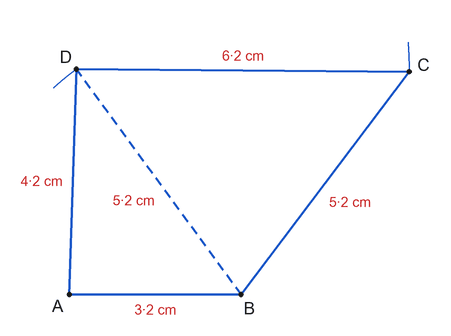
On measuring, the other diagonal AC is about 7·6 cm.
Watch out: C must be on the side of BD away from A; otherwise the figure folds over and is not the quadrilateral asked for.
Therefore, ABCD is the required quadrilateral.
- 73 marks
Question 7
Construct a quadrilateral ABCD, when :
AB = 7·2 cm, BC = 5·8 cm, CD = 6·3 cm, AD = 4·3 cm and angle A = 75°.
Solve with AIWritten solution
Solution:
Concept: Two sides and the included angle fix a triangle (SAS). Here AB, AD and ∠A fix triangle ABD, and then C is found from its distances to B and D.
Given: AB = 7·2 cm, BC = 5·8 cm, CD = 6·3 cm, AD = 4·3 cm and ∠A = 75°.
Step 1 — Plan with a rough sketch.
Triangle ABD is fixed by AB, AD and the angle between them, ∠A = 75°. Then C is 5·8 cm from B and 6·3 cm from D.
Step 2 — Draw the base AB.
Draw a line segment AB = 7·2 cm.
Step 3 — Construct the angle of 75° at A.
At A, construct ∠BAX = 90° and ∠BAY = 60°, and bisect the angle between AX and AY. The bisector makes 75° with AB, because 75° is half-way between 60° and 90°.
Step 4 — Locate D.
On the 75° arm, cut off AD = 4·3 cm with the compasses.
Step 5 — Locate C.
With B as centre and radius 5·8 cm, and with D as centre and radius 6·3 cm, draw two arcs that cut each other at C.
Step 6 — Complete the quadrilateral.
Join BC and DC.
Step 7 — Look at the finished figure and check it.
The finished construction is shown below; the given measurements are marked on it.

On measuring, the diagonal BD is about 7·4 cm.
Watch out: 75° is built as the bisector of the angle between 60° and 90°, not by halving 150°.
Therefore, ABCD is the required quadrilateral.
- 83 marks
Question 8
Construct a quadrilateral ABCD, when :
Angle A = 90°, AB = 4·6 cm, BD = 6·4 cm, AC = 6·0 cm and CD = 4·2 cm.
Solve with AIWritten solution
Solution:
Concept: When one angle of a triangle is 90°, one side and the hypotenuse fix it (RHS). Here ∠A = 90°, AB = 4·6 cm and the hypotenuse BD = 6·4 cm fix triangle ABD; then C is found from its distances to A and D.
Given: ∠A = 90°, AB = 4·6 cm, BD = 6·4 cm, AC = 6·0 cm and CD = 4·2 cm.
Step 1 — Plan with a rough sketch.
Triangle ABD has a right angle at A and hypotenuse BD = 6·4 cm, so it is fixed. Then C is 6·0 cm from A and 4·2 cm from D.
Step 2 — Draw the base AB.
Draw a line segment AB = 4·6 cm.
Step 3 — Construct the right angle at A.
At A, construct ∠BAX = 90°.
Step 4 — Locate D.
With B as centre and radius 6·4 cm, draw an arc cutting AX at D. Join BD.
Step 5 — Locate C.
With A as centre and radius 6·0 cm, and with D as centre and radius 4·2 cm, draw two arcs that cut each other at C, on the same side of AD as B.
Step 6 — Complete the quadrilateral.
Join BC and CD.
Step 7 — Look at the finished figure and check it.
The finished construction is shown below; the given measurements are marked on it.
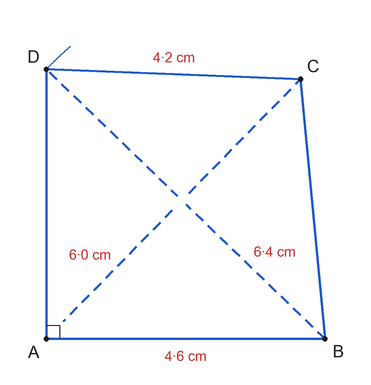
We can check AD by Pythagoras' theorem in the right triangle ABD:
On measuring, AD is about 4·5 cm and BC is about 4·3 cm.
Watch out: The arc for D is drawn from B (radius BD), not from A.
Therefore, ABCD is the required quadrilateral.
- 93 marks
Question 9
Construct a quadrilateral ABCD, when :
AB = 3·8 cm, AC = 4·8 cm, AD = 2·8 cm, angle A = 105° and angle B = 60°.
Solve with AIWritten solution
Solution:
Concept: A triangle is fixed by two sides and a non-included angle when the angle is at the end of the known side, as here: ∠B = 60° gives the direction of BC, and AC = 4·8 cm cuts that line at C.
Given: AB = 3·8 cm, AC = 4·8 cm, AD = 2·8 cm, ∠A = 105° and ∠B = 60°.
Step 1 — Plan with a rough sketch.
The arm of ∠B and the circle of radius 4·8 cm about A meet at C. The arm of ∠A gives the direction of AD, and AD = 2·8 cm fixes D.
Step 2 — Draw the base AB.
Draw a line segment AB = 3·8 cm.
Step 3 — Construct ∠B = 60°.
At B, construct ∠ABY = 60° with the compasses.
Step 4 — Locate C.
With A as centre and radius 4·8 cm, draw an arc cutting BY at C. Join AC.
Step 5 — Construct ∠A = 105°.
At A, construct ∠BAX = 90° and ∠BAZ = 120°, and bisect the angle between them. The bisector makes 105° with AB, because 105° is half-way between 90° and 120°.
Step 6 — Locate D and complete.
On the 105° arm, cut off AD = 2·8 cm. Join CD.
Step 7 — Look at the finished figure and check it.
The finished construction is shown below; the given measurements are marked on it.
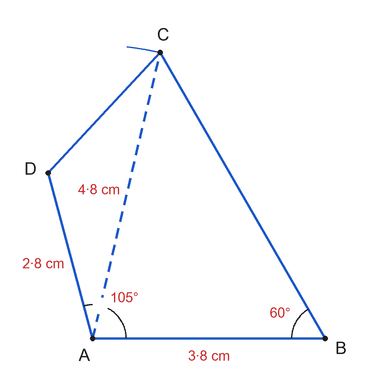
On measuring, BC is about 5·4 cm and CD is about 2·7 cm.
Watch out: Both angles are measured from AB: ∠A between AB and AD, and ∠B between BA and BC.
Therefore, ABCD is the required quadrilateral.
- 103 marks
Question 10
Construct a quadrilateral ABCD, when :
BC = 7·5 cm, AC = 5·8 cm, AD = 3·6 cm, CD = 4·2 cm and angle A = 120°.
Solve with AIWritten solution
Solution:
Concept: Triangle ACD is fixed by its three sides (SSS). Then ∠A, that is ∠DAB, of 120° gives the direction of AB, and B is cut off on it by an arc of radius BC = 7·5 cm about C.
Given: BC = 7·5 cm, AC = 5·8 cm, AD = 3·6 cm, CD = 4·2 cm and ∠A = 120°.
Step 1 — Plan with a rough sketch.
∠A of the quadrilateral is ∠DAB = 120°. The diagonal AC lies inside this angle. We construct triangle ACD first, then the arm AB, then B.
Step 2 — Draw the diagonal AC.
Draw a line segment AC = 5·8 cm.
Step 3 — Locate D.
With A as centre and radius 3·6 cm, and with C as centre and radius 4·2 cm, draw two arcs that cut each other at D. Join AD and CD.
Step 4 — Construct ∠DAB = 120°.
At A, construct ∠DAX = 120°, with the arm AX on the other side of AC from D.
Step 5 — Locate B and complete.
With C as centre and radius 7·5 cm, draw an arc cutting AX at B. Join BC.
Step 6 — Look at the finished figure and check it.
The finished construction is shown below; the given measurements are marked on it.
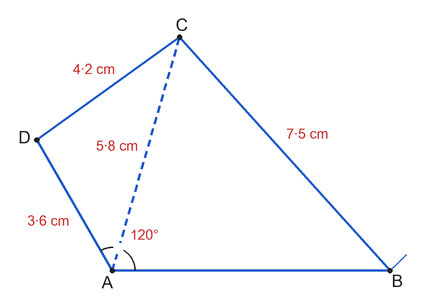
On measuring, AB is about 6·6 cm.
Watch out: The 120° angle is ∠DAB, measured from AD, not from AC.
Therefore, ABCD is the required quadrilateral.
- 113 marks
Question 11
Construct a quadrilateral ABCD, when :
AD = AB = 4 cm, BC = 2·8 cm, CD = 2·5 cm and angle BAD = 45°.
Solve with AIWritten solution
Solution:
Concept: Two sides and the included angle fix a triangle (SAS). Here the sides AB and AD (4 cm each) with ∠BAD = 45° fix triangle ABD; then C is found from its distances to B and D.
Given: AD = 4 cm, AB = 4 cm, BC = 2·8 cm, CD = 2·5 cm and ∠BAD = 45°.
Step 1 — Plan with a rough sketch.
Triangle ABD is fixed by AB, AD and ∠A. Then C is 2·8 cm from B and 2·5 cm from D.
Step 2 — Draw the base AB.
Draw a line segment AB = 4 cm.
Step 3 — Construct ∠A = 45°.
At A, construct a right angle and bisect it to get ∠BAX = 45°.
Step 4 — Locate D.
On AX, cut off AD = 4 cm.
Step 5 — Locate C.
With B as centre and radius 2·8 cm, and with D as centre and radius 2·5 cm, draw two arcs that cut each other at C, on the side of BD away from A.
Step 6 — Complete the quadrilateral.
Join BC and DC.
Step 7 — Look at the finished figure and check it.
The finished construction is shown below; the given measurements are marked on it.
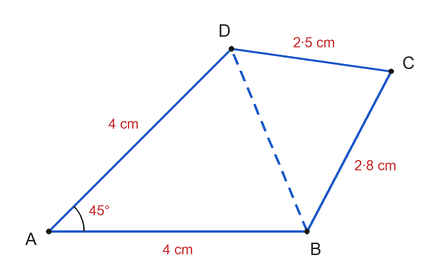
On measuring, BD is about 3·1 cm.
Watch out: C must be on the side of BD away from A, so that ABCD does not cross itself.
Therefore, ABCD is the required quadrilateral.
- 123 marks
Question 12
Construct a quadrilateral ABCD, when :
AB = 6·3 cm, BC = CD = 4·2 cm and ∠ABC = ∠BCD = 90°.
Solve with AIWritten solution
Solution:
Concept: When both angles at the ends of a side are right angles, the other two sides are perpendicular to it. So we draw BC and erect perpendiculars at B and C.
Given: AB = 6·3 cm, BC = 4·2 cm, CD = 4·2 cm, ∠ABC = 90° and ∠BCD = 90°.
Step 1 — Draw the base BC.
Draw a line segment BC = 4·2 cm.
Step 2 — Construct the right angle at B.
At B, construct ∠CBX = 90° and cut off BA = 6·3 cm on BX.
Step 3 — Construct the right angle at C.
At C, construct ∠BCY = 90° on the same side of BC, and cut off CD = 4·2 cm on CY.
Step 4 — Complete the quadrilateral.
Join AD.
Step 5 — Look at the finished figure and check it.
The finished construction is shown below; the given measurements are marked on it.
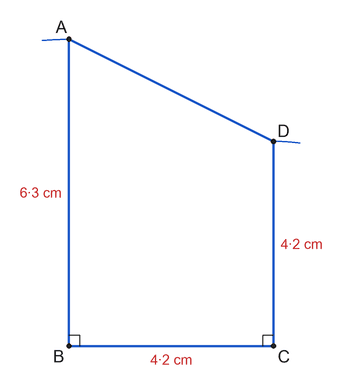
AD can be checked by Pythagoras' theorem: AD is the hypotenuse of a right triangle with legs BC = 4·2 cm and AB − CD = 2·1 cm.
On measuring, AD is about 4·7 cm.
Watch out: Both perpendiculars must be drawn on the same side of BC.
Therefore, ABCD is the required quadrilateral.
- 133 marks
Question 13
Construct a parallelogram ABCD, when :
AB = 4·4 cm, AD = 6·2 cm and AC = 4·8 cm.
Solve with AIWritten solution
Solution:
Concept: In a parallelogram the opposite sides are equal, so BC = AD and CD = AB. Then triangle ABC is fixed by its three sides, and D is found from its distances to A and C.
Given: AB = 4·4 cm, AD = 6·2 cm and diagonal AC = 4·8 cm.
Step 1 — Plan with a rough sketch.
Since BC equals AD (6·2 cm), triangle ABC has sides AB = 4·4 cm, BC = 6·2 cm and AC = 4·8 cm.
Step 2 — Draw the base AB.
Draw a line segment AB = 4·4 cm.
Step 3 — Locate C.
With A as centre and radius 4·8 cm, and with B as centre and radius 6·2 cm, draw two arcs that cut each other at C. Join AC and BC.
Step 4 — Locate D.
With A as centre and radius 6·2 cm, and with C as centre and radius 4·4 cm, draw two arcs that cut each other at D, on the other side of AC from B.
Step 5 — Complete the parallelogram.
Join AD and CD.
Step 6 — Look at the finished figure and check it.
The finished construction is shown below; the given measurements are marked on it.
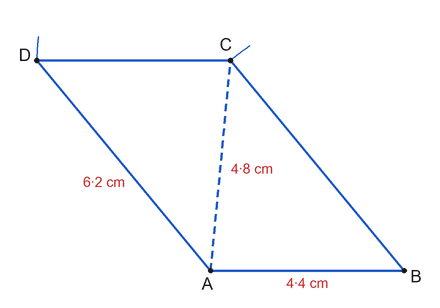
On measuring, the diagonal BD is about 9·6 cm.
Watch out: The arc for D from C has radius CD, which equals AB (4·4 cm), and the arc from A has radius AD (6·2 cm); swapping them gives a kite, not a parallelogram.
Therefore, ABCD is the required parallelogram.
- 143 marks
Question 14
Construct a parallelogram ABCD, when :
Diagonal AC = 6·4 cm, diagonal BD = 8·2 cm and angle between the diagonals = 60°.
Solve with AIWritten solution
Solution:
Concept: The diagonals of a parallelogram bisect each other. So their halves are OA = OC and OB = OD, where O is the point where they cross.
Given: AC = 6·4 cm, BD = 8·2 cm and the angle between the diagonals = 60°.
Step 1 — Find the half-diagonals.
Halving each diagonal gives the four distances from O.
Step 2 — Draw AC and mark O.
Draw AC = 6·4 cm and bisect it; the mid-point is O.
Step 3 — Draw the second diagonal.
At O, construct ∠COX = 60° and produce XO backwards to Y.
Step 4 — Locate B and D.
On OX cut off OD = 4·1 cm, and on OY cut off OB = 4·1 cm.
Step 5 — Complete the parallelogram.
Join AB, BC, CD and DA.
Step 6 — Look at the finished figure and check it.
The finished construction is shown below; the given measurements are marked on it.

On measuring, AB is about 3·7 cm and BC is about 6·3 cm.
Watch out: Use half of each diagonal from O, not the whole diagonal.
Therefore, ABCD is the required parallelogram.
- 153 marks
Question 15
Construct a parallelogram ABCD, when :
AB = 5·8 cm, diagonal AC = 8·2 cm and diagonal BD = 6·2 cm.
Solve with AIWritten solution
Solution:
Concept: The diagonals of a parallelogram bisect each other at O. So triangle AOB has sides AB, half of AC and half of BD, and can be constructed first.
Given: AB = 5·8 cm, diagonal AC = 8·2 cm and diagonal BD = 6·2 cm.
Step 1 — Find the half-diagonals.
Halving each diagonal gives OA and OB.
Step 2 — Draw the base AB.
Draw a line segment AB = 5·8 cm.
Step 3 — Locate O.
With A as centre and radius 4·1 cm, and with B as centre and radius 3·1 cm, draw two arcs that cut each other at O.
Step 4 — Locate C and D.
Join AO and produce it to C so that OC = 4·1 cm. Join BO and produce it to D so that OD = 3·1 cm.
Step 5 — Complete the parallelogram.
Join BC, CD and DA.
Step 6 — Look at the finished figure and check it.
The finished construction is shown below; the given measurements are marked on it.

On measuring, AD is about 4·4 cm.
Watch out: OA and OB are halves of the diagonals; using the whole diagonals as radii gives a wrong point O.
Therefore, ABCD is the required parallelogram.
- 163 marks
Question 16
Construct a parallelogram ABCD, when :
AB = 6·0 cm, AD = 5·0 cm and ∠A = 45°.
Solve with AIWritten solution
Solution:
Concept: Two adjacent sides and the angle between them fix a parallelogram: they fix triangle ABD, and C is then BC = AD from B and DC = AB from D.
Given: AB = 6·0 cm, AD = 5·0 cm and ∠A = 45°.
Step 1 — Draw the base AB.
Draw a line segment AB = 6·0 cm.
Step 2 — Construct ∠A = 45°.
At A, construct a right angle and bisect it to get ∠BAX = 45°.
Step 3 — Locate D.
On AX, cut off AD = 5·0 cm.
Step 4 — Locate C.
With B as centre and radius 5·0 cm, and with D as centre and radius 6·0 cm, draw two arcs that cut each other at C.
Step 5 — Complete the parallelogram.
Join BC and DC.
Step 6 — Look at the finished figure and check it.
The finished construction is shown below; the given measurements are marked on it.
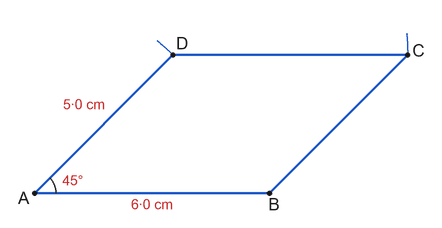
On measuring, AC is about 10·2 cm and BD is about 4·3 cm.
Watch out: The arc from B has radius BC, which equals AD (5·0 cm), and the arc from D has radius DC, which equals AB (6·0 cm).
Therefore, ABCD is the required parallelogram.
- 173 marks
Question 17
Construct a parallelogram ABCD, when :
Base AB = 6·5 cm, BC = 4 cm and the altitude corresponding to AB = 3·1 cm.
Solve with AIWritten solution
Solution:
Concept: The altitude on AB is the distance between the parallel sides AB and DC. So C and D lie on a line parallel to AB at a distance of 3·1 cm from it.
Given: Base AB = 6·5 cm, BC = 4 cm and the altitude on AB = 3·1 cm.
Step 1 — Draw the base AB.
Draw a line segment AB = 6·5 cm.
Step 2 — Draw the line for DC.
At A, draw AP ⟂ AB and cut off AP = 3·1 cm. Through P, draw a line XY parallel to AB. Every point of XY is 3·1 cm from AB.
Step 3 — Locate C.
With B as centre and radius 4 cm, draw an arc cutting XY at C.
Step 4 — Locate D.
With C as centre and radius 6·5 cm, cut XY at D on the side towards A, so that DC = AB.
Step 5 — Complete the parallelogram.
Join BC and AD. In the figure, DE is the altitude from D to AB.
Step 6 — Look at the finished figure and check it.
The finished construction is shown below; the given measurements are marked on it.
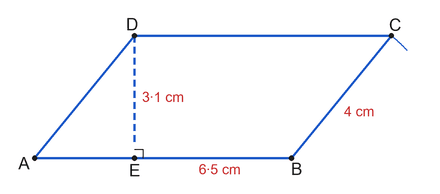
On measuring, ∠A is about 51°.
Watch out: The arc from B cuts XY at two points. The other point gives the mirror-image parallelogram, with ∠A about 129°; either one fits the data.
Therefore, ABCD is the required parallelogram.
- 183 marks
Question 18
Construct a parallelogram ABCD, when :
AB = 4·5 cm, ∠B = 120° and the distance between AB and DC = 3·0 cm.
Solve with AIWritten solution
Solution:
Concept: The distance between AB and DC is 3·0 cm, so DC lies on a line parallel to AB at that distance. The arm of ∠B meets that line at C.
Given: AB = 4·5 cm, ∠B = 120° and the distance between AB and DC = 3·0 cm.
Step 1 — Draw the base AB.
Draw a line segment AB = 4·5 cm.
Step 2 — Construct ∠B = 120°.
At B, construct ∠ABX = 120° with the compasses (two 60° steps from BA).
Step 3 — Draw the line for DC.
Draw a line YZ parallel to AB at a distance of 3·0 cm, on the same side as BX. Let it cut BX at C.
Step 4 — Locate D.
On YZ, cut off CD = 4·5 cm towards A, so that DC = AB.
Step 5 — Complete the parallelogram.
Join AD.
Step 6 — Look at the finished figure and check it.
The finished construction is shown below; the given measurements are marked on it.
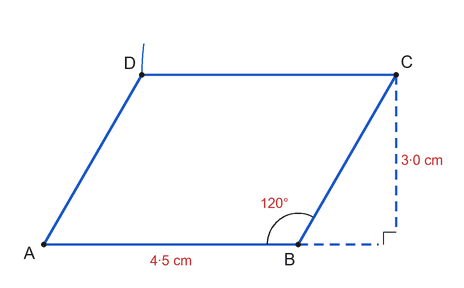
On measuring, BC is about 3·5 cm. In the figure, the dashed perpendicular from C to AB produced shows the 3·0 cm distance.
Watch out: The 120° angle at B is ∠ABC, inside the parallelogram; the 3·0 cm is measured at right angles to AB, not along BC.
Therefore, ABCD is the required parallelogram.
- 193 marks
Question 19
Construct a parallelogram ABCD, when :
Base BC = 5·6 cm, diagonal BD = 6·5 cm and altitude = 3·2 cm.
Solve with AIWritten solution
Solution:
Concept: The altitude on BC is the distance between the parallel sides BC and AD. So A and D lie on a line parallel to BC at a distance of 3·2 cm, and D is 6·5 cm from B.
Given: Base BC = 5·6 cm, diagonal BD = 6·5 cm and altitude = 3·2 cm.
Step 1 — Draw the base BC.
Draw a line segment BC = 5·6 cm.
Step 2 — Draw the line for AD.
Draw a line XY parallel to BC at a distance of 3·2 cm.
Step 3 — Locate D.
With B as centre and radius 6·5 cm, draw an arc cutting XY at D. Join BD.
Step 4 — Locate A.
With D as centre and radius 5·6 cm, cut XY at A on the side towards B, so that AD = BC.
Step 5 — Complete the parallelogram.
Join AB and CD.
Step 6 — Look at the finished figure and check it.
The finished construction is shown below; the given measurements are marked on it.

On measuring, AB is about 3·2 cm. The dashed perpendicular in the figure shows the 3·2 cm altitude.
Watch out: The altitude is the distance between the parallel lines, not the length of a slant side.
Therefore, ABCD is the required parallelogram.
- 203 marks
Question 20
Construct a rectangle ABCD, when :
Its sides are 6·0 cm and 7·2 cm.
Solve with AIWritten solution
Solution:
Concept: Every angle of a rectangle is 90°, and its opposite sides are equal.
Given: The sides are 6·0 cm and 7·2 cm.
Step 1 — Draw the base AB.
Draw a line segment AB = 7·2 cm.
Step 2 — Construct the right angles.
At A and at B, construct right angles on the same side of AB.
Step 3 — Locate D and C.
Cut off AD = 6·0 cm and BC = 6·0 cm on the two perpendiculars.
Step 4 — Complete the rectangle.
Join DC.
Step 5 — Look at the finished figure and check it.
The finished construction is shown below; the given measurements are marked on it.
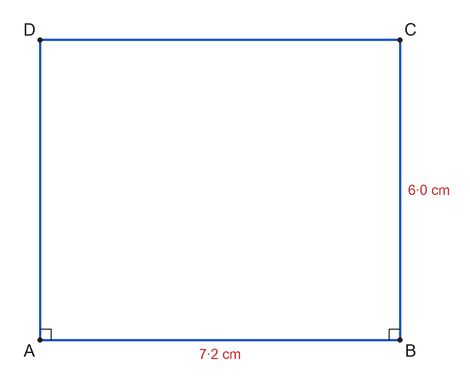
The diagonal can be checked with Pythagoras' theorem in the right triangle ABC:
On measuring, each diagonal is about 9·4 cm.
Watch out: Both perpendiculars must be on the same side of AB.
Therefore, ABCD is the required rectangle.
- 213 marks
Question 21
Construct a rectangle ABCD, when :
One side = 4 cm and one diagonal is 5 cm. Measure the length of other side.
Solve with AIWritten solution
Solution:
Concept: Every angle of a rectangle is 90°, so triangle ABC has a right angle at B. One side and the hypotenuse (the diagonal) fix it (RHS).
Given: One side AB = 4 cm and one diagonal AC = 5 cm.
Step 1 — Draw the base AB.
Draw a line segment AB = 4 cm.
Step 2 — Construct the right angle at B.
At B, construct ∠ABX = 90°.
Step 3 — Locate C.
With A as centre and radius 5 cm, draw an arc cutting BX at C. Join AC.
Step 4 — Locate D.
At A, construct ∠BAY = 90° and cut off AD = BC on AY.
Step 5 — Complete the rectangle.
Join DC.
Step 6 — Look at the finished figure and check it.
The finished construction is shown below; the given measurements are marked on it.
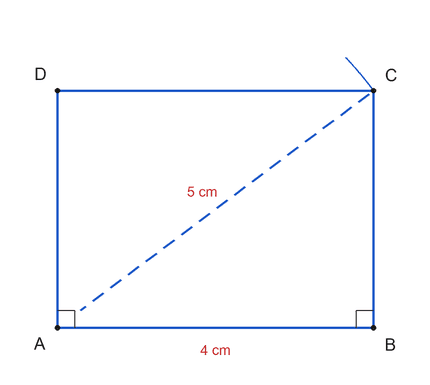
Measure BC. We can check it by Pythagoras' theorem in the right triangle ABC:
On measuring, BC = 3·0 cm.
Watch out: The diagonal is the hypotenuse, so subtract the squares: BC² = AC² − AB².
Therefore, ABCD is the required rectangle, and the other side BC = 3·0 cm.
- 223 marks
Question 22
Construct a rectangle ABCD, when :
One diagonal = 6·0 cm and the acute angle between the diagonals = 45°.
Solve with AIWritten solution
Solution:
Concept: The diagonals of a rectangle are equal and bisect each other, so all four half-diagonals OA, OB, OC and OD are equal.
Given: One diagonal = 6·0 cm and the acute angle between the diagonals = 45°.
Step 1 — Find the half-diagonal.
Both diagonals are 6·0 cm long, so each half is
Step 2 — Draw AC and mark O.
Draw AC = 6·0 cm and bisect it; the mid-point is O.
Step 3 — Draw the second diagonal.
At O, construct ∠COX = 45° and produce XO backwards to Y.
Step 4 — Locate B and D.
Cut off OB = 3·0 cm and OD = 3·0 cm on the two rays, so that the acute angle between the diagonals, ∠BOC, is 45°.
Step 5 — Complete the rectangle.
Join AB, BC, CD and DA.
Step 6 — Look at the finished figure and check it.
The finished construction is shown below; the given measurements are marked on it.
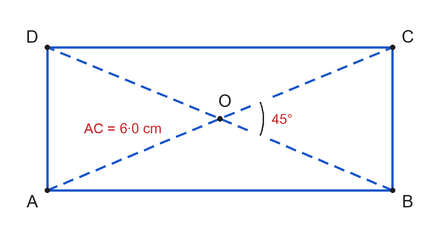
On measuring, AB is about 5·5 cm and BC is about 2·3 cm.
Watch out: The second diagonal is as long as the first in a rectangle, so OB and OD are 3·0 cm too.
Therefore, ABCD is the required rectangle.
- 233 marks
Question 23
Construct a rectangle ABCD, when :
Area = 24 cm² and base = 4·8 cm.
Solve with AIWritten solution
Solution:
Concept: The area of a rectangle is base × height, so the height is the area divided by the base.
Given: Area = 24 cm² and base = 4·8 cm.
Step 1 — Find the other side.
Divide the area by the base to get the height of the rectangle.
Step 2 — Draw the base AB.
Draw a line segment AB = 4·8 cm.
Step 3 — Construct the right angles.
At A and at B, construct right angles on the same side of AB.
Step 4 — Locate D and C.
Cut off AD = 5 cm and BC = 5 cm on the two perpendiculars.
Step 5 — Complete the rectangle.
Join DC.
Step 6 — Look at the finished figure and check it.
The finished construction is shown below; the given measurements are marked on it.
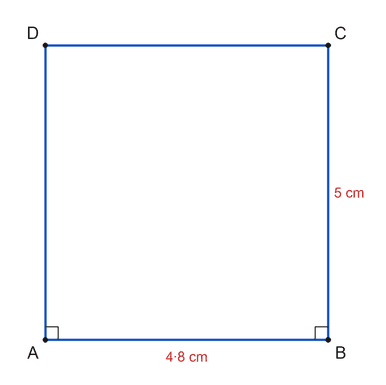
The area check is 4·8 cm × 5 cm = 24 cm², as required.
Watch out: Multiply the divisor and the dividend by 10 before dividing by a decimal.
Therefore, ABCD is the required rectangle, with sides 4·8 cm and 5 cm.
- 243 marks
Question 24
Construct a rectangle ABCD, when :
Area = 36 cm² and height = 4·5 cm.
Solve with AIWritten solution
Solution:
Concept: The area of a rectangle is base × height, so the base is the area divided by the height.
Given: Area = 36 cm² and height = 4·5 cm.
Step 1 — Find the base.
Divide the area by the height to get the base of the rectangle.
Step 2 — Draw the base AB.
Draw a line segment AB = 8 cm.
Step 3 — Construct the right angles.
At A and at B, construct right angles on the same side of AB.
Step 4 — Locate D and C.
Cut off AD = 4·5 cm and BC = 4·5 cm on the two perpendiculars.
Step 5 — Complete the rectangle.
Join DC.
Step 6 — Look at the finished figure and check it.
The finished construction is shown below; the given measurements are marked on it.
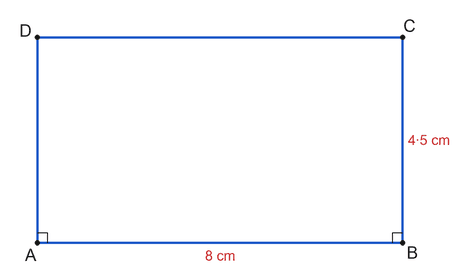
The area check is 8 cm × 4·5 cm = 36 cm², as required.
Watch out: The height is the side perpendicular to the base, so AD and BC are both 4·5 cm.
Therefore, ABCD is the required rectangle, with sides 8 cm and 4·5 cm.
- 253 marks
Question 25
Construct a trapezium ABCD, when :
AB = 4·8 cm, BC = 6·8 cm, CD = 5·4 cm, angle B = 60° and AD // BC.
Solve with AIWritten solution
Solution:
Concept: In trapezium ABCD with AD ∥ BC, the vertex D lies on the line through A parallel to BC. ∠B with BA and BC fixes A.
Given: AB = 4·8 cm, BC = 6·8 cm, CD = 5·4 cm, ∠B = 60° and AD ∥ BC.
Step 1 — Draw the base BC.
Draw a line segment BC = 6·8 cm.
Step 2 — Construct ∠B = 60°.
At B, construct ∠CBX = 60° and cut off BA = 4·8 cm on BX.
Step 3 — Draw the line for AD.
Through A, draw a line AY parallel to BC.
Step 4 — Locate D.
With C as centre and radius 5·4 cm, draw an arc cutting AY at D.
Step 5 — Complete the trapezium.
Join CD.
Step 6 — Look at the finished figure and check it.
The finished construction is shown below; the given measurements are marked on it.
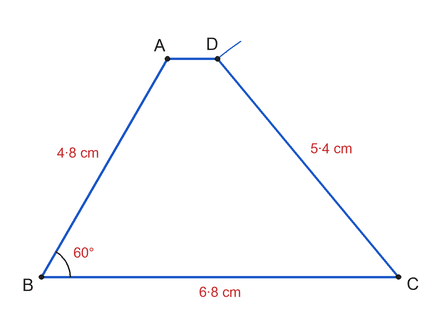
On measuring, AD is about 1·0 cm.
Watch out: The arc from C cuts AY at two points. The second point gives another trapezium that also fits the data, with AD about 7·8 cm; either is acceptable.
Therefore, ABCD is the required trapezium.
- 263 marks
Question 26
Construct a trapezium ABCD, when :
AB = CD = 3·2 cm, BC = 6·0 cm, AD = 4·4 cm and AD // BC.
Solve with AIWritten solution
Solution:
Concept: Draw DE ∥ AB to meet BC at E. Then ABED is a parallelogram, so BE = AD and DE = AB, and triangle DEC has all three sides known.
Given: AB = 3·2 cm, CD = 3·2 cm, BC = 6·0 cm, AD = 4·4 cm and AD ∥ BC.
Step 1 — Find the sides of triangle DEC.
ABED is a parallelogram, so DE equals AB (3·2 cm) and BE equals AD (4·4 cm). The rest of BC is EC.
Step 2 — Draw BC and mark E.
Draw BC = 6·0 cm and mark E on it with BE = 4·4 cm.
Step 3 — Locate D.
With E as centre and radius 3·2 cm, and with C as centre and radius 3·2 cm, draw two arcs that cut each other at D. Join DE and DC.
Step 4 — Locate A.
Through D, draw DY ∥ CB and cut off DA = 4·4 cm on it, towards B.
Step 5 — Complete the trapezium.
Join AB.
Step 6 — Look at the finished figure and check it.
The finished construction is shown below; the given measurements are marked on it.
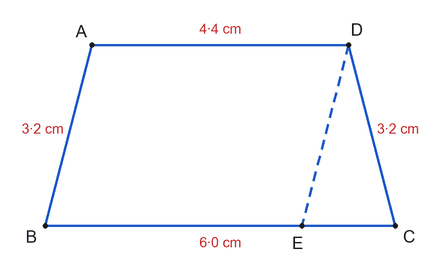
On measuring, AB = 3·2 cm, as required, and the height of the trapezium is about 3·1 cm.
Watch out: EC is the difference of the parallel sides, BC − AD, not their sum.
Therefore, ABCD is the required trapezium.
- 273 marks
Question 27
Construct a rhombus ABCD, when :
Its one side = 6 cm and ∠A = 60°.
Solve with AIWritten solution
Solution:
Concept: All four sides of a rhombus are equal, so the sides AB and AD (6 cm each) with ∠A = 60° fix triangle ABD, and C is 6 cm from both B and D.
Given: Side = 6 cm and ∠A = 60°.
Step 1 — Draw the base AB.
Draw a line segment AB = 6 cm.
Step 2 — Construct ∠A = 60°.
At A, construct ∠BAX = 60° and cut off AD = 6 cm on AX.
Step 3 — Locate C.
With B and D as centres and radius 6 cm, draw two arcs that cut each other at C.
Step 4 — Complete the rhombus.
Join BC and DC.
Step 5 — Look at the finished figure and check it.
The finished construction is shown below; the given measurements are marked on it.
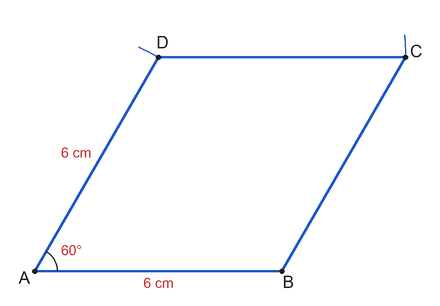
On measuring, BD = 6·0 cm (triangle ABD is equilateral, since AB = AD and ∠A = 60°) and AC is about 10·4 cm.
Watch out: Every side of a rhombus is 6 cm, so both arcs for C have radius 6 cm.
Therefore, ABCD is the required rhombus.
- 283 marks
Question 28
Construct a rhombus ABCD, when :
One side = 5·4 cm and one diagonal is 7·0 cm.
Solve with AIWritten solution
Solution:
Concept: All four sides of a rhombus are equal. So B and D are each 5·4 cm from both ends of the diagonal AC.
Given: Side = 5·4 cm and diagonal AC = 7·0 cm.
Step 1 — Draw the diagonal AC.
Draw a line segment AC = 7·0 cm.
Step 2 — Locate B and D.
With A and C as centres and radius 5·4 cm, draw arcs on both sides of AC. The arcs below AC meet at B, and the arcs above AC meet at D.
Step 3 — Complete the rhombus.
Join AB, BC, CD and DA.
Step 4 — Look at the finished figure and check it.
The finished construction is shown below; the given measurements are marked on it.

On measuring, the other diagonal BD is about 8·2 cm. It crosses AC at its mid-point O at right angles.
Watch out: The arcs are drawn on BOTH sides of AC, one pair for B and one for D.
Therefore, ABCD is the required rhombus.
- 293 marks
Question 29
Construct a rhombus ABCD, when :
Diagonal AC = 6·3 cm and diagonal BD = 5·8 cm.
Solve with AIWritten solution
Solution:
Concept: The diagonals of a rhombus bisect each other at right angles. So BD lies along the perpendicular bisector of AC.
Given: Diagonal AC = 6·3 cm and diagonal BD = 5·8 cm.
Step 1 — Find the half-diagonals.
Halving each diagonal gives OA and OB.
Step 2 — Draw AC and its perpendicular bisector.
Draw AC = 6·3 cm. Draw its perpendicular bisector XY, cutting AC at its mid-point O.
Step 3 — Locate B and D.
On XY, cut off OB = 2·9 cm and OD = 2·9 cm, on opposite sides of AC.
Step 4 — Complete the rhombus.
Join AB, BC, CD and DA.
Step 5 — Look at the finished figure and check it.
The finished construction is shown below; the given measurements are marked on it.
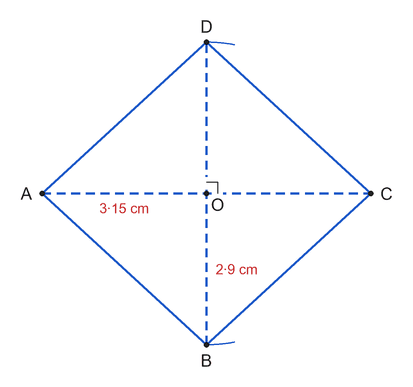
Each side can be checked by Pythagoras' theorem in the right triangle AOB:
On measuring, each side is about 4·3 cm.
Watch out: BD is cut off as 2·9 cm on EACH side of O, so that the whole diagonal is 5·8 cm.
Therefore, ABCD is the required rhombus.
- 303 marks
Question 30
Construct a rhombus ABCD, when :
One side = 5·0 cm and height = 2·6 cm.
Solve with AIWritten solution
Solution:
Concept: The height of a rhombus is the distance between a pair of opposite sides. So DC lies on a line parallel to AB at a distance of 2·6 cm, and every side is 5·0 cm.
Given: Side = 5·0 cm and height = 2·6 cm.
Step 1 — Draw the base AB.
Draw a line segment AB = 5·0 cm.
Step 2 — Draw the line for DC.
Draw a line XY parallel to AB at a distance of 2·6 cm.
Step 3 — Locate D.
With A as centre and radius 5·0 cm, draw an arc cutting XY at D. Join AD.
Step 4 — Locate C.
With B and D as centres and radius 5·0 cm, draw two arcs that cut each other at C.
Step 5 — Complete the rhombus.
Join BC and DC. In the figure, DE is the 2·6 cm height.
Step 6 — Look at the finished figure and check it.
The finished construction is shown below; the given measurements are marked on it.
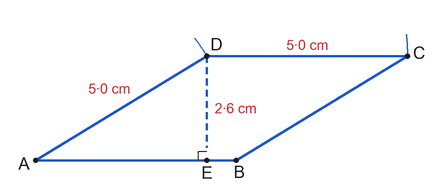
On measuring, ∠A is about 31°.
Watch out: The height is drawn at right angles to AB; it is not the length of a side.
Therefore, ABCD is the required rhombus.
- 313 marks
Question 31
Construct a rhombus ABCD, when :
∠A = 60° and height = 3·0 cm.
Solve with AIWritten solution
Solution:
Concept: Opposite sides AB and DC of the rhombus lie on two parallel lines 3·0 cm apart. The 60° arm at A meets the upper line at D, and every side equals AD.
Given: ∠A = 60° and height = 3·0 cm.
Step 1 — Draw the two parallel lines.
Draw a line PQ, and a line XY parallel to it at a distance of 3·0 cm.
Step 2 — Construct ∠A = 60°.
Take a point A on PQ and construct ∠QAZ = 60°. Let AZ cut XY at D.
Step 3 — Locate B.
With A as centre and radius AD, cut PQ at B, so that AB = AD.
Step 4 — Locate C.
With B and D as centres and radius AD, draw two arcs that cut each other at C.
Step 5 — Complete the rhombus.
Join BC and DC. In the figure, DE is the 3·0 cm height.
Step 6 — Look at the finished figure and check it.
The finished construction is shown below; the given measurements are marked on it.

On measuring, each side is about 3·5 cm.
Watch out: The side is not given; it is found from the drawing as AD, and then used for every side.
Therefore, ABCD is the required rhombus.
- 323 marks
Question 32
Construct a rhombus ABCD, when :
Diagonal AC = 6·0 cm and height = 3·5 cm.
Solve with AIWritten solution
Solution:
Concept: In a rhombus, A and B lie on one line and D and C on a parallel line, 3·5 cm apart (the height). The diagonals bisect each other at right angles, so BD is the perpendicular bisector of AC.
Given: Diagonal AC = 6·0 cm and height = 3·5 cm.
Step 1 — Draw the two parallel lines.
Draw a line PQ, and a line XY parallel to it at a distance of 3·5 cm.
Step 2 — Locate C.
Take a point A on PQ. With A as centre and radius 6·0 cm, draw an arc cutting XY at C. Join AC.
Step 3 — Locate B and D.
Draw the perpendicular bisector of AC. It cuts PQ at B and XY at D.
Step 4 — Complete the rhombus.
Join AB, BC, CD and DA.
Step 5 — Look at the finished figure and check it.
The finished construction is shown below; the given measurements are marked on it.

On measuring, each side is about 3·7 cm and ∠A is about 71°. The dashed perpendicular from C shows the 3·5 cm height.
Watch out: The perpendicular bisector of AC (not a perpendicular at A) gives B and D, because they are equidistant from A and C.
Therefore, ABCD is the required rhombus.
- 333 marks
Question 33
Construct a square ABCD, when :
One side = 4·5 cm.
Solve with AIWritten solution
Solution:
Concept: All sides of a square are equal and all its angles are 90°.
Given: Side = 4·5 cm.
Step 1 — Draw the base AB.
Draw a line segment AB = 4·5 cm.
Step 2 — Construct the right angles.
At A and at B, construct right angles on the same side of AB.
Step 3 — Locate D and C.
Cut off AD = 4·5 cm and BC = 4·5 cm on the two perpendiculars.
Step 4 — Complete the square.
Join DC.
Step 5 — Look at the finished figure and check it.
The finished construction is shown below; the given measurements are marked on it.
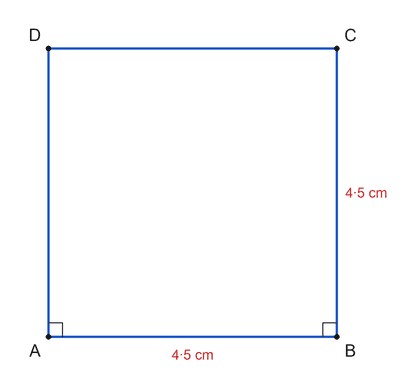
The diagonal can be checked by Pythagoras' theorem:
On measuring, each diagonal is about 6·4 cm.
Watch out: Check with the compasses that DC is also 4·5 cm before calling it a square.
Therefore, ABCD is the required square.
- 343 marks
Question 34
Construct a square ABCD, when :
One diagonal = 5·4 cm.
Solve with AIWritten solution
Solution:
Concept: The diagonals of a square are equal and bisect each other at right angles, so all four half-diagonals are equal.
Given: One diagonal = 5·4 cm.
Step 1 — Find the half-diagonal.
Both diagonals are 5·4 cm long, so each half is
Step 2 — Draw AC and its perpendicular bisector.
Draw AC = 5·4 cm. Draw its perpendicular bisector XY, cutting AC at O.
Step 3 — Locate B and D.
On XY, cut off OB = 2·7 cm and OD = 2·7 cm, on opposite sides of AC.
Step 4 — Complete the square.
Join AB, BC, CD and DA.
Step 5 — Look at the finished figure and check it.
The finished construction is shown below; the given measurements are marked on it.
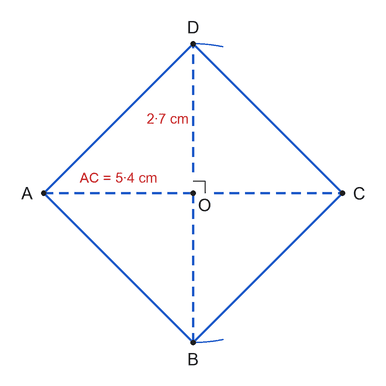
Each side can be checked by Pythagoras' theorem in triangle AOB:
On measuring, each side is about 3·8 cm.
Watch out: In a square the second diagonal is as long as the first, so OB and OD are 2·7 cm too.
Therefore, ABCD is the required square.
- 353 marks
Question 35
Construct a square ABCD, when :
Perimeter = 24 cm.
Solve with AIWritten solution
Solution:
Concept: A square has four equal sides, so its side is the perimeter divided by 4.
Given: Perimeter = 24 cm.
Step 1 — Find the side.
Divide the perimeter by 4.
Step 2 — Draw the base AB.
Draw a line segment AB = 6 cm.
Step 3 — Construct the right angles.
At A and at B, construct right angles on the same side of AB.
Step 4 — Locate D and C.
Cut off AD = 6 cm and BC = 6 cm on the two perpendiculars.
Step 5 — Complete the square.
Join DC.
Step 6 — Look at the finished figure and check it.
The finished construction is shown below; the given measurements are marked on it.
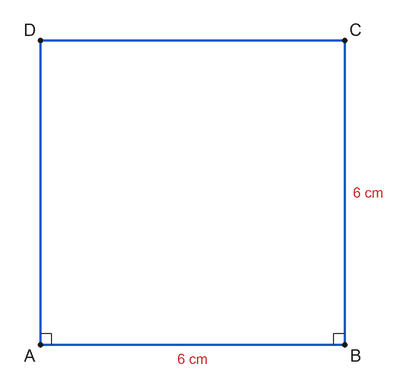
The perimeter check is 4 × 6 cm = 24 cm, as required.
Watch out: The perimeter is shared by four sides, so divide by 4, not by 2.
Therefore, ABCD is the required square, with side 6 cm.
- 363 marks
Question 36
Construct a rhombus, having given one side = 4·8 cm and one angle = 75°.
Solve with AIWritten solution
Solution:
Concept: All sides of a rhombus are 4·8 cm. Two sides with the 75° angle between them fix triangle ABD, and C is 4·8 cm from both B and D.
Given: Side = 4·8 cm and one angle = 75°.
Step 1 — Draw the base AB.
Draw a line segment AB = 4·8 cm.
Step 2 — Construct ∠A = 75°.
At A, construct 60° and 90° and bisect the angle between them, giving ∠BAX = 75°.
Step 3 — Locate D.
On AX, cut off AD = 4·8 cm.
Step 4 — Locate C.
With B and D as centres and radius 4·8 cm, draw two arcs that cut each other at C.
Step 5 — Complete the rhombus.
Join BC and DC.
Step 6 — Look at the finished figure and check it.
The finished construction is shown below; the given measurements are marked on it.
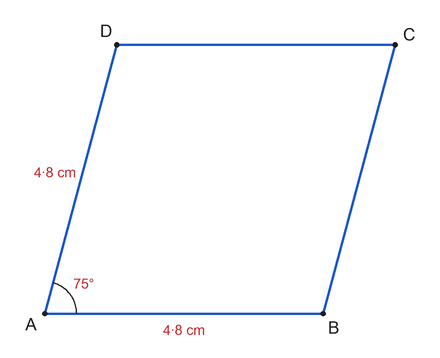
On measuring, AC is about 7·6 cm and BD is about 5·8 cm.
Watch out: 75° lies half-way between 60° and 90°; it is not the bisector of 90° (45°).
Therefore, ABCD is the required rhombus.
- 373 marks
Question 37
Construct a regular hexagon of side
(i) 2·5 cm
(ii) 3·2 cm.
Solve with AIWritten solution
Solution:
Concept: In a regular hexagon, the lines from the centre to the six vertices cut it into six equilateral triangles. So the side of the hexagon equals the radius of its circumcircle.
Given: Side (i) 2·5 cm and (ii) 3·2 cm.
Step 1 — Draw the circle.
Draw a circle with centre O and radius equal to the side (2·5 cm for part (i), 3·2 cm for part (ii)).
Step 2 — Step the side round the circle.
Take any point A on the circle. Keeping the same radius, put the compass point on A and cut the circle at B; from B cut it at C; then D, E and F in the same way.
Step 3 — Join the points.
Join AB, BC, CD, DE, EF and FA.
Step 4 — Look at the finished figure and check it.
The finished construction is shown below; the given measurements are marked on it.
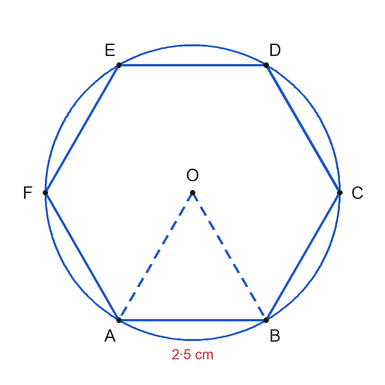
(i) Side 2·5 cm:
(ii) Side 3·2 cm:
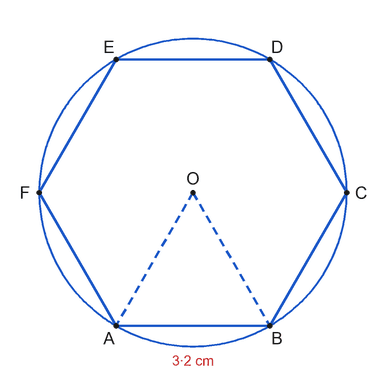
In each figure, triangle OAB is equilateral (OA, OB and AB are equal), so every side of the hexagon equals the radius.
Watch out: Keep the compass opening fixed while stepping round; the sixth cut must land back on A.
Therefore, ABCDEF is the required regular hexagon in each case.
- 383 marks
Question 38
Construct a quadrilateral ABCD with AB = 7 cm, BC = CD = 5 cm and ∠ABC = ∠BCD = 90°.
Solve with AIWritten solution
Solution:
Concept: When both angles at the ends of a side are right angles, the other two sides are perpendicular to it. So we draw BC and erect perpendiculars at B and C.
Given: AB = 7 cm, BC = 5 cm, CD = 5 cm, ∠ABC = 90° and ∠BCD = 90°.
Step 1 — Draw the base BC.
Draw a line segment BC = 5 cm.
Step 2 — Construct the right angle at B.
At B, construct ∠CBX = 90° and cut off BA = 7 cm on BX.
Step 3 — Construct the right angle at C.
At C, construct ∠BCY = 90° on the same side of BC, and cut off CD = 5 cm on CY.
Step 4 — Complete the quadrilateral.
Join AD.
Step 5 — Look at the finished figure and check it.
The finished construction is shown below; the given measurements are marked on it.
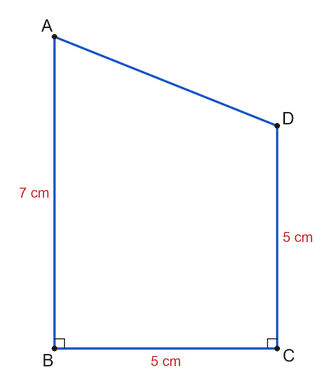
AD can be checked by Pythagoras' theorem: AD is the hypotenuse of a right triangle with legs BC = 5 cm and AB − CD = 2 cm.
On measuring, AD is about 5·4 cm.
Watch out: Both perpendiculars must be on the same side of BC.
Therefore, ABCD is the required quadrilateral.
- 393 marks
Question 39
Construct a trapezium ABCD in which AD//BC, AB = CD = 3·6 cm, BC = 5 cm and AD = 4·5 cm.
Solve with AIWritten solution
Solution:
Concept: Draw DE ∥ AB to meet BC at E. Then ABED is a parallelogram, so BE = AD and DE = AB, and triangle DEC has all three sides known.
Given: AD ∥ BC, AB = 3·6 cm, CD = 3·6 cm, BC = 5 cm and AD = 4·5 cm.
Step 1 — Find the sides of triangle DEC.
ABED is a parallelogram, so DE equals AB (3·6 cm) and BE equals AD (4·5 cm). The rest of BC is EC.
Step 2 — Draw BC and mark E.
Draw BC = 5 cm and mark E on it with BE = 4·5 cm.
Step 3 — Locate D.
With E as centre and radius 3·6 cm, and with C as centre and radius 3·6 cm, draw two arcs that cut each other at D. Join DC.
Step 4 — Locate A.
Through D, draw DY ∥ CB and cut off DA = 4·5 cm on it, towards B.
Step 5 — Complete the trapezium.
Join AB.
Step 6 — Look at the finished figure and check it.
The finished construction is shown below; the given measurements are marked on it.
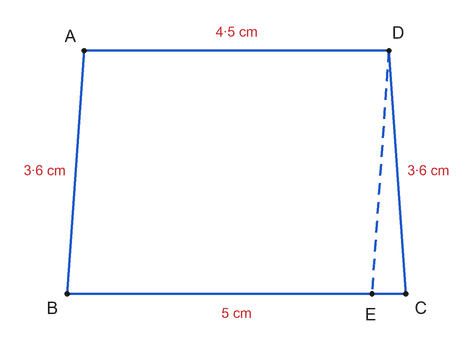
On measuring, AB = 3·6 cm, as required, and the height is about 3·6 cm.
Watch out: EC = BC − AD is only 0·5 cm, so E is very close to C; mark it carefully.
Therefore, ABCD is the required trapezium.
- 403 marks
Question 40
Using ruler and compasses, construct a rectangle ABCD with AB = 5 cm and AD = 3·6 cm.
Solve with AIWritten solution
Solution:
Concept: Every angle of a rectangle is 90° and its opposite sides are equal.
Given: AB = 5 cm and AD = 3·6 cm.
Step 1 — Draw the base AB.
Draw a line segment AB = 5 cm.
Step 2 — Construct the right angle at A.
At A, construct ∠BAX = 90° and cut off AD = 3·6 cm on AX.
Step 3 — Locate C.
With B as centre and radius 3·6 cm, and with D as centre and radius 5 cm, draw two arcs that cut each other at C.
Step 4 — Complete the rectangle.
Join BC and DC.
Step 5 — Look at the finished figure and check it.
The finished construction is shown below; the given measurements are marked on it.
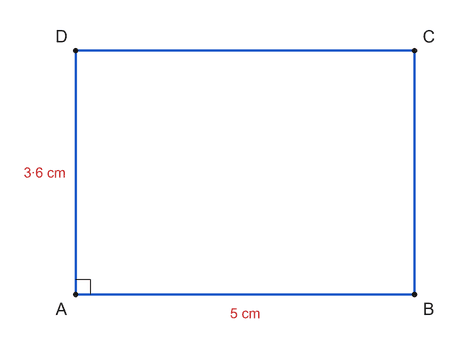
On measuring, each diagonal is about 6·2 cm.
Watch out: Use only a ruler and compasses: the right angle at A is constructed, not drawn with a set square.
Therefore, ABCD is the required rectangle.
- 413 marks
Question 41
Using ruler and compasses only, construct the quadrilateral ABCD, having given AB = 5 cm, BC = 2·5 cm, CD = 6 cm, angle BAD = 90° and the diagonal AC = 5·5 cm.
Solve with AIWritten solution
Solution:
Concept: Triangle ABC is fixed by its three sides (SSS). Then D lies on the perpendicular to AB at A (since ∠BAD = 90°), 6 cm from C.
Given: AB = 5 cm, BC = 2·5 cm, CD = 6 cm, ∠BAD = 90° and diagonal AC = 5·5 cm.
Step 1 — Draw the base AB.
Draw a line segment AB = 5 cm.
Step 2 — Locate C.
With A as centre and radius 5·5 cm, and with B as centre and radius 2·5 cm, draw two arcs that cut each other at C. Join AC and BC.
Step 3 — Construct the right angle at A.
At A, construct ∠BAX = 90°, on the same side of AB as C.
Step 4 — Locate D.
With C as centre and radius 6 cm, draw an arc cutting AX at D.
Step 5 — Complete the quadrilateral.
Join CD.
Step 6 — Look at the finished figure and check it.
The finished construction is shown below; the given measurements are marked on it.
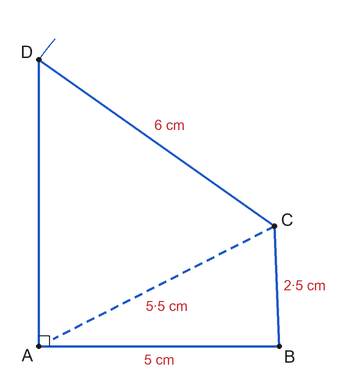
On measuring, AD is about 6·0 cm and BD is about 7·8 cm.
Watch out: The arc for D is centred at C (CD = 6 cm), not at B.
Therefore, ABCD is the required quadrilateral.
- 423 marks
Question 42
Using ruler and compasses only, construct a trapezium ABCD, in which the parallel sides AB and DC are 3·3 cm apart; AB = 4·5 cm, angle A = 120°, BC = 3·6 cm and angle B is obtuse.
Solve with AIWritten solution
Solution:
Concept: DC lies on a line parallel to AB at a distance of 3·3 cm. The 120° arm at A meets that line at D, and an arc of radius 3·6 cm about B meets it at C.
Given: AB ∥ DC, 3·3 cm apart; AB = 4·5 cm, ∠A = 120°, BC = 3·6 cm and ∠B is obtuse.
Step 1 — Draw the base AB.
Draw a line segment AB = 4·5 cm.
Step 2 — Draw the line for DC.
Draw a line XY parallel to AB at a distance of 3·3 cm.
Step 3 — Construct ∠A = 120°.
At A, construct ∠BAZ = 120°. Let AZ meet XY at D.
Step 4 — Locate C.
With B as centre and radius 3·6 cm, draw an arc cutting XY. It cuts XY at two points; take the point farther from D, because that one makes ∠ABC obtuse.
Step 5 — Complete the trapezium.
Join BC.
Step 6 — Look at the finished figure and check it.
The finished construction is shown below; the given measurements are marked on it.
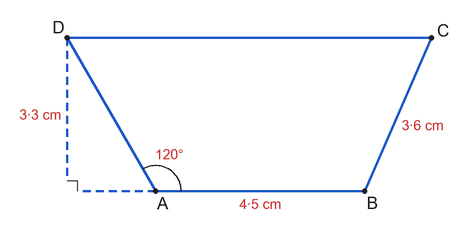
On measuring, AD is about 3·8 cm, DC is about 7·8 cm and ∠B is about 114°, which is obtuse as required.
Watch out: The nearer point of the arc gives ∠B about 66°, which is acute, so it does not fit the data.
Therefore, ABCD is the required trapezium.
- 433 marks
Question 43
Using ruler and compasses only, construct the quadrilateral ABCD, having given AB = 5 cm, BC = 2·5cm, CD = 6 cm, ∠BAD = 90° and diagonal BD = 5·5 cm.
Solve with AIWritten solution
Solution:
Concept: When one angle of a triangle is 90°, one side and the hypotenuse fix it (RHS). Here ∠BAD = 90°, AB = 5 cm and BD = 5·5 cm fix triangle ABD; then C is found from B and D.
Given: AB = 5 cm, BC = 2·5 cm, CD = 6 cm, ∠BAD = 90° and diagonal BD = 5·5 cm.
Step 1 — Draw the base AB.
Draw a line segment AB = 5 cm.
Step 2 — Construct the right angle at A.
At A, construct ∠BAX = 90°.
Step 3 — Locate D.
With B as centre and radius 5·5 cm, draw an arc cutting AX at D. Join BD.
Step 4 — Locate C.
With B as centre and radius 2·5 cm, and with D as centre and radius 6 cm, draw two arcs that cut each other at C, on the side of BD away from A.
Step 5 — Complete the quadrilateral.
Join BC and DC.
Step 6 — Look at the finished figure and check it.
The finished construction is shown below; the given measurements are marked on it.
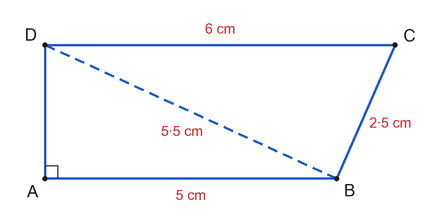
AD can be checked by Pythagoras' theorem in the right triangle ABD:
On measuring, AD is about 2·3 cm and AC is about 6·4 cm.
Watch out: This question looks like Q4 but gives the diagonal BD (not AC), so D is found first.
Therefore, ABCD is the required quadrilateral.
- 443 marks
Question 44
Using ruler and compasses only, construct a parallelogram ABCD using the following data:
AB = 6 cm, AD = 3 cm and ∠DAB = 45°. If the bisector of ∠DAB meets DC at P, prove that ∠APB is a right angle.
Solve with AIWritten solution
Solution:
Concept: In a parallelogram, opposite sides are parallel and equal, and co-interior angles add up to 180°. A bisector of an angle, together with a pair of parallel lines, makes an isosceles triangle.
Given: AB = 6 cm, AD = 3 cm, ∠DAB = 45°; the bisector of ∠DAB meets DC at P. To prove: ∠APB = 90°.
Step 1 — Draw the base AB.
Draw a line segment AB = 6 cm.
Step 2 — Construct ∠A = 45° and locate D.
At A, construct a right angle and bisect it to get ∠BAX = 45°, and then cut off AD = 3 cm on AX.
Step 3 — Locate C.
With B as centre and radius 3 cm, and with D as centre and radius 6 cm, draw two arcs that cut each other at C. Join BC and DC.
Step 4 — Locate P.
Bisect ∠DAB. Let the bisector meet DC at P. Join PB.
Step 5 — Show that DP = AD.
AB ∥ DC and AP is a transversal, so ∠DPA = ∠PAB (alternate angles).
AP bisects ∠A, so ∠PAB = ∠DAP.
Hence ∠DPA = ∠DAP. Triangle ADP is isosceles, and the sides opposite these equal angles are equal: DP equals AD, which is 3 cm.
Step 6 — Show that PC = BC.
DC equals AB, which is 6 cm, so PC is what is left of DC after DP.
BC equals AD, which is 3 cm. So PC = BC, and triangle PCB is isosceles with ∠CPB = ∠CBP.
Step 7 — Show that BP bisects ∠B.
AB ∥ DC with PB as a transversal, so ∠CPB = ∠PBA (alternate angles). Together with the last step, ∠CBP = ∠PBA, so BP bisects ∠ABC.
Step 8 — Add the half-angles.
∠A + ∠B = 180°, because they are co-interior angles between the parallels AD and BC. Each of ∠PAB and ∠PBA is half of these angles.
Step 9 — Use the angle sum of triangle APB.
The angles of triangle APB add up to 180°, so the third angle is what is left over.
Step 10 — Look at the finished figure and check it.
The finished construction is shown below; the given measurements are marked on it.
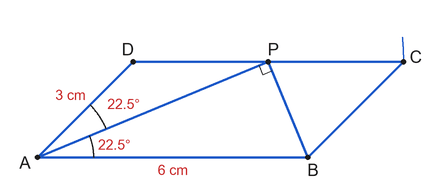
On the figure, DP measures 3·0 cm and ∠APB measures 90°, as proved.
Watch out: ∠DPA = ∠PAB uses the parallels AB and DC; it is not the same as ∠DAP until we use the bisector.
Therefore, ∠APB = 90°, that is, ∠APB is a right angle. Hence proved.
- 453 marks
Question 45
The perpendicular distances between the pair of opposite sides of a parallelogram are 3 cm and 4 cm, and one of its angles measures 60°. Using ruler and compasses only, construct the parallelogram.
Solve with AIWritten solution
Solution:
Concept: In parallelogram ABCD with ∠A = 60°, the distance between AB and DC is AD sin 60°, and the distance between AD and BC is AB sin 60°. So each pair of opposite sides lies on two parallel lines at the given distance.
Given: Distances between opposite sides 3 cm and 4 cm; one angle = 60°.
Step 1 — Draw the first angle.
Draw a line AX and, at A, construct ∠XAY = 60°.
Step 2 — Locate D.
Draw a line parallel to AX at a distance of 3 cm; let it cut AY at D. So the distance between AB and DC will be 3 cm.
Step 3 — Locate B.
Draw a line parallel to AY at a distance of 4 cm, on the same side as AX; let it cut AX at B. So the distance between AD and BC will be 4 cm.
Step 4 — Locate C.
Through B draw a line parallel to AD, and through D a line parallel to AB; let them meet at C.
Step 5 — Check the sides by calculation.
The distance 3 cm is AD sin 60°, so AD is
In the same way, the distance 4 cm is AB sin 60°, so AB is
Step 6 — Look at the finished figure and check it.
The finished construction is shown below; the given measurements are marked on it.
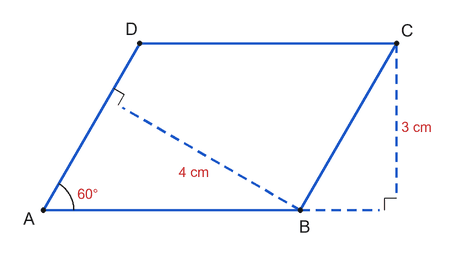
On measuring, AD is about 3·5 cm and AB is about 4·6 cm, as calculated. The dashed perpendiculars in the figure show the two distances.
Watch out: The 3 cm distance fixes AD (not AB), because it is measured between AB and DC across AD.
Therefore, ABCD is the required parallelogram.
- 463 marks
Question 46
Draw parallelogram ABCD with the following data :
AB = 6 cm, AD = 5 cm and ∠DAB = 45°.
Let AC and DB meet in O and let E be the mid-point of BC. Join OE. Prove that :
(i) OE // AB
(ii) OE = AB.
Solve with AIWritten solution
Solution:
Concept: The diagonals of a parallelogram bisect each other. The mid-point theorem says: the line joining the mid-points of two sides of a triangle is parallel to the third side and half of it.
Given: AB = 6 cm, AD = 5 cm, ∠DAB = 45°; AC and BD meet at O; E is the mid-point of BC. To prove: OE ∥ AB and OE = ½ AB.
Step 1 — Draw the base AB.
Draw a line segment AB = 6 cm.
Step 2 — Construct ∠A = 45° and locate D.
At A, construct a right angle and bisect it to get ∠BAX = 45°, and then cut off AD = 5 cm on AX.
Step 3 — Locate C.
With B as centre and radius 5 cm, and with D as centre and radius 6 cm, draw two arcs that cut each other at C. Join BC and DC.
Step 4 — Draw the diagonals and OE.
Join AC and BD; they meet at O. Bisect BC to get its mid-point E, and join OE.
Step 5 — O is the mid-point of AC.
The diagonals of a parallelogram bisect each other, so O is the mid-point of AC.
Step 6 — Use the mid-point theorem in triangle CAB.
In triangle CAB, O is the mid-point of CA and E is the mid-point of CB. So the line OE joining them is parallel to the third side AB and half of it.
Step 7 — Look at the finished figure and check it.
The finished construction is shown below; the given measurements are marked on it.
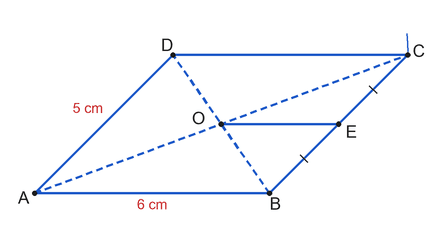
On the figure, OE measures 3·0 cm, which is half of AB = 6 cm.
Watch out: The triangle to use is CAB (it contains both O and E), not triangle ABD.
Therefore, (i) OE ∥ AB and (ii) OE = ½ AB. Hence proved.
- 473 marks
Question 47
Using ruler and compasses only, construct a rectangle each of whose diagonals measure 6 cm and the diagonals intersect at an angle of 45°.
Solve with AIWritten solution
Solution:
Concept: The diagonals of a rectangle are equal and bisect each other, so all four half-diagonals OA, OB, OC and OD are equal.
Given: Each diagonal = 6 cm and the angle between the diagonals = 45°.
Step 1 — Find the half-diagonal.
Each diagonal is 6 cm long, so each half is
Step 2 — Draw AC and mark O.
Draw AC = 6 cm and bisect it; the mid-point is O.
Step 3 — Draw the second diagonal.
At O, construct ∠COX = 45° and produce XO backwards to Y.
Step 4 — Locate B and D.
Cut off OB = 3 cm and OD = 3 cm on the two rays, so that the acute angle between the diagonals, ∠BOC, is 45°.
Step 5 — Complete the rectangle.
Join AB, BC, CD and DA.
Step 6 — Look at the finished figure and check it.
The finished construction is shown below; the given measurements are marked on it.

On measuring, AB is about 5·5 cm and BC is about 2·3 cm.
Watch out: Use only a ruler and compasses: 45° is made by bisecting a constructed right angle.
Therefore, ABCD is the required rectangle.
What Class 9 Maths Ch 15 covers
The sections of the chapter, in the order the book takes them. Every question above comes from one of these.
- 01Construction of Quadrilaterals
- 02Construction of Parallelograms
- 03Construction of Trapezium
- 04Construction of Rectangles
- 05Construction of Rhombus
- 06Construction of Square
More ways to study this chapter
The same chapter asked three other ways. Practise it, revise it, and see what the board has set on Ch 15 before.
Class 9 Maths Ch 15 questions students ask
How many questions are there in Class 9 Maths Ch 15?
47 questions. Every one is solved step by step on this page.
Are these Class 9 Maths solutions free?
Yes. Every question and its full working is free to read, with no account needed.
Can I download the Class 9 Maths Ch 15 solutions as a PDF?
There is no PDF to download. Every solution is on this page instead, which means it is searchable, always the current syllabus, and readable on a phone. Use your browser's print option if you want it on paper.