
Question 443 marksHard
Using ruler and compasses only, construct a parallelogram ABCD using the following data:
AB = 6 cm, AD = 3 cm and ∠DAB = 45°. If the bisector of ∠DAB meets DC at P, prove that ∠APB is a right angle.
Confirming your payment
Sign up now and get 250 free tokens.
Construction of Polygons · Question 44 of 47
Using ruler and compasses only, construct a parallelogram ABCD using the following data:
AB = 6 cm, AD = 3 cm and ∠DAB = 45°. If the bisector of ∠DAB meets DC at P, prove that ∠APB is a right angle.
Solution:
Concept: In a parallelogram, opposite sides are parallel and equal, and co-interior angles add up to 180°. A bisector of an angle, together with a pair of parallel lines, makes an isosceles triangle.
Given: AB = 6 cm, AD = 3 cm, ∠DAB = 45°; the bisector of ∠DAB meets DC at P. To prove: ∠APB = 90°.
Step 1 — Draw the base AB.
Draw a line segment AB = 6 cm.
Step 2 — Construct ∠A = 45° and locate D.
At A, construct a right angle and bisect it to get ∠BAX = 45°, and then cut off AD = 3 cm on AX.
Step 3 — Locate C.
With B as centre and radius 3 cm, and with D as centre and radius 6 cm, draw two arcs that cut each other at C. Join BC and DC.
Step 4 — Locate P.
Bisect ∠DAB. Let the bisector meet DC at P. Join PB.
Step 5 — Show that DP = AD.
AB ∥ DC and AP is a transversal, so ∠DPA = ∠PAB (alternate angles).
AP bisects ∠A, so ∠PAB = ∠DAP.
Hence ∠DPA = ∠DAP. Triangle ADP is isosceles, and the sides opposite these equal angles are equal: DP equals AD, which is 3 cm.
Step 6 — Show that PC = BC.
DC equals AB, which is 6 cm, so PC is what is left of DC after DP.
BC equals AD, which is 3 cm. So PC = BC, and triangle PCB is isosceles with ∠CPB = ∠CBP.
Step 7 — Show that BP bisects ∠B.
AB ∥ DC with PB as a transversal, so ∠CPB = ∠PBA (alternate angles). Together with the last step, ∠CBP = ∠PBA, so BP bisects ∠ABC.
Step 8 — Add the half-angles.
∠A + ∠B = 180°, because they are co-interior angles between the parallels AD and BC. Each of ∠PAB and ∠PBA is half of these angles.
Step 9 — Use the angle sum of triangle APB.
The angles of triangle APB add up to 180°, so the third angle is what is left over.
Step 10 — Look at the finished figure and check it.
The finished construction is shown below; the given measurements are marked on it.
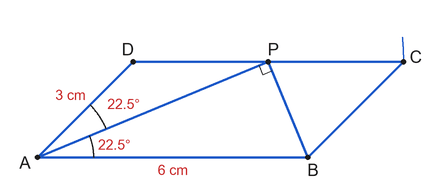
On the figure, DP measures 3·0 cm and ∠APB measures 90°, as proved.
Watch out: ∠DPA = ∠PAB uses the parallels AB and DC; it is not the same as ∠DAP until we use the bisector.
Therefore, ∠APB = 90°, that is, ∠APB is a right angle. Hence proved.