
Question 453 marksHard
The perpendicular distances between the pair of opposite sides of a parallelogram are 3 cm and 4 cm, and one of its angles measures 60°. Using ruler and compasses only, construct the parallelogram.
Confirming your payment
Sign up now and get 250 free tokens.
Construction of Polygons · Question 45 of 47
The perpendicular distances between the pair of opposite sides of a parallelogram are 3 cm and 4 cm, and one of its angles measures 60°. Using ruler and compasses only, construct the parallelogram.
Solution:
Concept: In parallelogram ABCD with ∠A = 60°, the distance between AB and DC is AD sin 60°, and the distance between AD and BC is AB sin 60°. So each pair of opposite sides lies on two parallel lines at the given distance.
Given: Distances between opposite sides 3 cm and 4 cm; one angle = 60°.
Step 1 — Draw the first angle.
Draw a line AX and, at A, construct ∠XAY = 60°.
Step 2 — Locate D.
Draw a line parallel to AX at a distance of 3 cm; let it cut AY at D. So the distance between AB and DC will be 3 cm.
Step 3 — Locate B.
Draw a line parallel to AY at a distance of 4 cm, on the same side as AX; let it cut AX at B. So the distance between AD and BC will be 4 cm.
Step 4 — Locate C.
Through B draw a line parallel to AD, and through D a line parallel to AB; let them meet at C.
Step 5 — Check the sides by calculation.
The distance 3 cm is AD sin 60°, so AD is
In the same way, the distance 4 cm is AB sin 60°, so AB is
Step 6 — Look at the finished figure and check it.
The finished construction is shown below; the given measurements are marked on it.
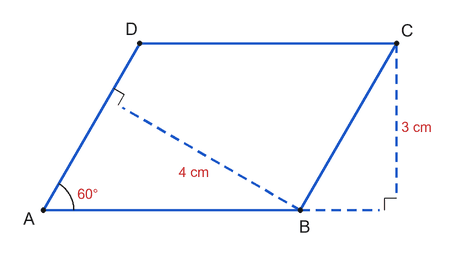
On measuring, AD is about 3·5 cm and AB is about 4·6 cm, as calculated. The dashed perpendiculars in the figure show the two distances.
Watch out: The 3 cm distance fixes AD (not AB), because it is measured between AB and DC across AD.
Therefore, ABCD is the required parallelogram.