
Question 433 marksMedium
Using ruler and compasses only, construct the quadrilateral ABCD, having given AB = 5 cm, BC = 2·5cm, CD = 6 cm, ∠BAD = 90° and diagonal BD = 5·5 cm.
Confirming your payment
Sign up now and get 250 free tokens.
Construction of Polygons · Question 43 of 47
Using ruler and compasses only, construct the quadrilateral ABCD, having given AB = 5 cm, BC = 2·5cm, CD = 6 cm, ∠BAD = 90° and diagonal BD = 5·5 cm.
Solution:
Concept: When one angle of a triangle is 90°, one side and the hypotenuse fix it (RHS). Here ∠BAD = 90°, AB = 5 cm and BD = 5·5 cm fix triangle ABD; then C is found from B and D.
Given: AB = 5 cm, BC = 2·5 cm, CD = 6 cm, ∠BAD = 90° and diagonal BD = 5·5 cm.
Step 1 — Draw the base AB.
Draw a line segment AB = 5 cm.
Step 2 — Construct the right angle at A.
At A, construct ∠BAX = 90°.
Step 3 — Locate D.
With B as centre and radius 5·5 cm, draw an arc cutting AX at D. Join BD.
Step 4 — Locate C.
With B as centre and radius 2·5 cm, and with D as centre and radius 6 cm, draw two arcs that cut each other at C, on the side of BD away from A.
Step 5 — Complete the quadrilateral.
Join BC and DC.
Step 6 — Look at the finished figure and check it.
The finished construction is shown below; the given measurements are marked on it.
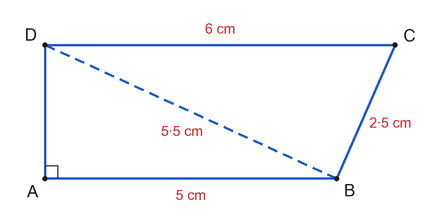
AD can be checked by Pythagoras' theorem in the right triangle ABD:
On measuring, AD is about 2·3 cm and AC is about 6·4 cm.
Watch out: This question looks like Q4 but gives the diagonal BD (not AC), so D is found first.
Therefore, ABCD is the required quadrilateral.