
Opening your dashboard
Class 9 Maths Chapter 15 Construction of Polygons: Competency-Based Questions (CBQ)
40 questions on Chapter 15, each worked through on its own page with the AI tutor. Class 9 Maths, ICSE 2026-27.
40 questions
1–5 marks · Mixed difficulty
- 11 mark
Question 1
Competency: Understanding
Four bamboo strips of lengths 30 cm, 40 cm, 35 cm and 45 cm are pinned end to end to make a four-sided frame. The frame is loose: it can be pushed into many different shapes.
Which one extra measurement, if fixed, gives the frame a single definite shape?
- 21 mark
Question 2
Competency: Application
A regular hexagonal sign board is to be marked on a metal sheet by drawing a circle and stepping off arcs round it. The distance between two opposite corners of the sign must be 18 cm.
To what radius should the compasses be opened?
- 31 mark
Question 3
Competency: Analysis
A parallelogram ABCD is to be constructed with diagonal AC = 7.0 cm, diagonal BD = 4.5 cm and the angle between the diagonals 60°. Half of BD is 2.25 cm, which cannot be read exactly on a ruler marked in millimetres.
Which is the best way to begin?
- 41 mark
Question 4
Competency: Application
Tanvi constructs a square whose diagonal is 8 cm, using the method of the chapter. To check her work she measures a side of the square.

Which length should she expect, to the nearest millimetre?
- 51 mark
Question 5
Competency: Evaluation
Assertion (A): A parallelogram ABCD can be constructed with BC = 6 cm, AB = 4 cm and the height corresponding to the side BC equal to 5 cm.
Reason (R): The height corresponding to BC is the perpendicular distance of A from the line BC, and the perpendicular is the shortest line segment from a point to a line.
- 61 mark
Question 6
Competency: Analysis
A draughtsman has to copy a four-sided plot ABCD exactly. Which of these sets of measurements does not fix the shape and size of the plot, so that the plot cannot be constructed from it?
- 72 marks
Question 7
Competency: Application
A kite in the shape of a rhombus is to have diagonals 60 cm and 32 cm. Sameer makes a scale drawing of it with ruler and compasses, taking 1 cm for 4 cm.
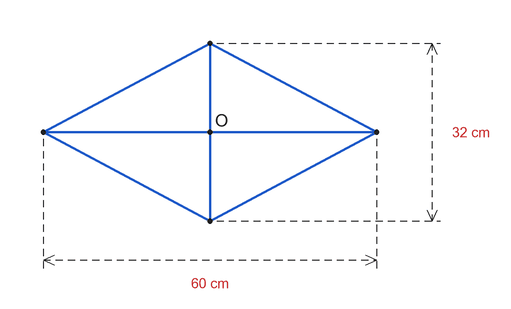
(a) What lengths must he mark on each side of the point O where the diagonals cross?
(b) What length should each side measure in his drawing? What is the actual length of each edge of the kite?
- 82 marks
Question 8
Competency: Evaluation
A worksheet asks for a rectangle ABCD to be constructed with side BC = 6 cm and diagonal AC = 5.5 cm.
Rohit says, "It is easy. Draw BC, make a right angle at B, and cut the perpendicular with an arc of radius 5.5 cm from C." Will his method work for this data? Justify. If the diagonal must be a whole number of centimetres, what is the least value for which the rectangle can be drawn?
- 92 marks
Question 9
Competency: Analysis
Neha has to construct a trapezium ABCD in which AD ∥ BC, AD = 3.0 cm, BC = 6.5 cm, AB = 3.2 cm and CD = 4.0 cm. She writes these steps.
- Draw BC = 6.5 cm.
- From BC, cut BE = 3.2 cm.
- Draw ΔDEC with DE = 3.0 cm and CD = 4.0 cm.
- With B and D as centres and radii 3.2 cm and 3.0 cm, draw arcs cutting each other at A. Join AB and AD.
Two of the lengths in her steps are wrong. Find them and correct them, giving a reason.
- 102 marks
Question 10
Competency: Analysis
A parallelogram ABCD is to be constructed with BC = 6 cm, AB = 4.2 cm and height 3.5 cm corresponding to BC. In the chapter's method, a line QR is drawn parallel to BC at a distance of 3.5 cm from it. Then an arc with centre B and radius 4.2 cm is drawn to cut QR at A.
(a) At how many points does this arc cut QR? What does this mean for the parallelogram?
(b) What happens if AB is given as 3 cm instead of 4.2 cm?
- 113 marks
Question 11
Competency: Application
A plot of land is a parallelogram. Two adjacent sides are 60 m and 45 m long and the angle between them is 60°.
(a) Using a scale of 1 cm to 10 m, write the measurements needed for a scale drawing ABCD of the plot.
(b) Construct the drawing with ruler and compasses only. Write the steps.
(c) Measure the longer diagonal in your drawing. Hence find the actual distance between the two farthest corners of the plot.
- 123 marks
Question 12
Competency: Creativity
Design a table-top in the shape of a trapezium ABCD with AD ∥ BC, to be drawn on paper by the method of the chapter (four sides given).
(a) Choose the lengths of the four sides, in centimetres, so that the construction is possible. Show the check you make.
(b) Write the steps of construction for your trapezium.
- 133 marks
Question 13
Competency: Analysis & Evaluation
Two students are asked to construct "a square of side 5 cm".
Arun draws AB = 5 cm, constructs right angles at A and B, cuts off AD = BC = 5 cm on them and joins DC.
Bela draws AC = 5 cm, draws its perpendicular bisector to meet AC at O, cuts off OB = OD = 2.5 cm on it and joins AB, BC, CD and DA.
(a) Whose figure is the required square? Give a reason.
(b) What has the other student constructed? Find the length of its side, correct to one decimal place. (Take .)
(c) What length of diagonal is needed for a square of side 5 cm, correct to one decimal place?
- 145 marks
Question 14
Competency: Application & Analysis
Case study — A surveyor's field book
A surveyor measures a four-sided field ABCD and one of its diagonals. His field book shows :
Measurement AB BC CD DA Diagonal AC Length 50 m 60 m 45 m 40 m 70 m A plan of the field is to be drawn with a scale of 1 cm to 10 m.
(a) Write the five lengths for the plan. Check, without drawing, that both ΔABC and ΔACD can be constructed.
(b) Construct the plan ABCD with ruler and compasses only. Write the steps.
(c) Measure the diagonal BD on your plan. Hence find the length of a straight path from B to D in the field.
- 154 marks
Question 15
Competency: Application & Analysis
Case study — A rangoli pattern
Kavya is drawing a rangoli pattern. She first constructs a regular hexagon ABCDEF of side 4 cm inside a circle with centre O. Then she joins O to the alternate corners A, C and E. This divides the hexagon into three four-sided pieces OABC, OCDE and OEFA, which she fills with three colours.
(a) Write the steps to construct the hexagon and complete the pattern, using ruler and compasses only.
(b) Explain why the piece OABC is a rhombus.
(c) Find the four angles of the rhombus OABC. State the length of its diagonal OB.
- 161 mark
Question 16
Competency: Analysis
Rina is constructing a quadrilateral ABCD with AB = 4.0 cm, BC = 4.5 cm, CD = 4.7 cm, ∠A = 120° and ∠B = 60°. She draws BC, makes ∠B = 60° and cuts BA = 4.0 cm. Then she draws the ray AP, on the same side of AB as C, so that ∠BAP = 120°. Her teacher says that AP will be parallel to BC, even before D is found.
Why?
- 171 mark
Question 17
Competency: Analysis
Four parallelograms are constructed from their diagonals. In each, the diagonals AC and BD meet at O. The data are in the table.
Figure AC BD ∠AOB P 6.0 cm 6.0 cm 90° Q 8.0 cm 8.0 cm 60° R 8.0 cm 6.0 cm 90° S 7.0 cm 5.0 cm 75° Which figure is a rhombus but not a square?
- 181 mark
Question 18
Competency: Application
A trapezium ABCD with AD ∥ BC is constructed from its four sides by the chapter's method: AD = 4.0 cm, BC = 9.0 cm, AB = 3.0 cm and CD = 4.0 cm. BE = AD is cut off on BC, and ΔDEC is drawn with DE = AB.
Which angle of ΔDEC is a right angle?
- 191 mark
Question 19
Competency: Analysis & Evaluation
Ravi plans a rhombus-shaped tile whose four sides are 5 cm each and whose longer diagonal AC is 10 cm.
Assertion (A) : Ravi can draw such a tile with ruler and compasses.
Reason (R) : In a triangle, the sum of any two sides is greater than the third side.
- 201 mark
Question 20
Competency: Analysis
Riya constructs a square ABCD with diagonal AC = 9 cm. She draws the perpendicular bisector of AC, which meets AC at O. By mistake she cuts OB = OD = 5 cm on it, instead of the correct length, and joins AB, BC, CD and DA.
What figure does she get?
- 211 mark
Question 21
Competency: Understanding & Application
Sara constructs a four-sided figure ABCD in which AB = CD and BC = DA. She wants to confirm, by measuring one more pair of lengths, that ABCD is a rectangle and not just a parallelogram. The diagonals AC and BD meet at O.
Which check is correct?
- 221 mark
Question 22
Competency: Analysis
A regular hexagon ABCDEF of side 3 cm is constructed. The corner A is joined to the corner C.

What is the measure of ∠BAC?
- 231 mark
Question 23
Competency: Understanding
A teacher asks which of these figures needs the greatest number of independent measurements for its construction. (A measurement can be a side, a diagonal or an angle.)
- 241 mark
Question 24
Competency: Analysis
A trapezium ABCD with AD ∥ BC is constructed by the chapter's method. The point E is marked on BC so that BE = AD.
Assertion (A) : The length DE is equal to AB.
Reason (R) : In ABED, the sides AD and BE are equal and parallel. So ABED is a parallelogram, and its opposite sides DE and AB are equal.
- 251 mark
Question 25
Competency: Application
The figure shows a rough sketch of a four-sided plot ABCD. The side AD is not given.

Which of these describes the data given in the sketch?
- 262 marks
Question 26
Competency: Application
(Hypothetical data.) A school plot is a trapezium ABCD with AD ∥ BC and ∠ABC = 90°, drawn in the figure. A plan is to be made by the four-sides method of the chapter, which needs the length of CD.
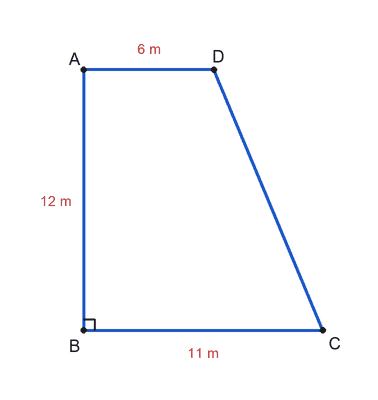
(a) Find CD without measuring.
(b) Write the three sides of ΔDEC, where E is the point on BC with BE = AD. What kind of triangle is it?
- 272 marks
Question 27
Competency: Evaluation
Meena draws a rough sketch of a quadrilateral ABCD and writes these data: AB = 4 cm, AD = 3 cm, ∠A = 90° and BD = 6 cm. She says she will construct ΔABD from all four.
(a) Explain why she cannot do it.
(b) What length must BD have if the other three data are correct?
- 282 marks
Question 28
Competency: Application & Analysis
Ria writes these steps in her notebook.
- Draw AC = 9.6 cm.
- Draw the perpendicular bisector of AC, meeting AC at O.
- On this bisector, cut OB = OD = 6.4 cm on either side of O.
- Join AB, BC, CD and DA.
(a) What figure has Ria constructed, and which two lengths were given for it?
(b) Find the length of each side without measuring.
- 292 marks
Question 29
Competency: Application & Evaluation
A tile shop wants identical tiles that fit together round a point with no gap and no overlap.
(a) Each angle of a regular hexagonal tile is 120°. Show that three such tiles fit round a point.
(b) A regular octagonal tile has each angle equal to 135°. Can identical octagonal tiles alone fit round a point with no gap? Explain.
- 302 marks
Question 30
Competency: Understanding & Application
A square sheet of paper ABCD has a diagonal of 20 cm. It is folded along both diagonals, and the two creases meet at O.
(a) Find the length OA.
(b) Find ∠AOB and ∠OAB. Give a reason for each.
- 312 marks
Question 31
Competency: Application
A kite-shaped frame ABCD has AB = AD = 3 cm and CB = CD = 5 cm. The cross-bar AC is 6 cm long.
(a) Show that ΔABC can be constructed.
(b) After ΔABC is drawn, how is the corner D located? Give the reason that this works.
- 323 marks
Question 32
Competency: Understanding & Analysis
A parallelogram ABCD is to be constructed from its diagonals AC = 7.0 cm and BD = 5.0 cm, which meet at O. The angle between the diagonals is given as 50°.
(a) Aman draws ∠AOB = 50°. Find ∠AOD.
(b) Meera draws ∠AOB = 130° instead. Are the two parallelograms the same size and shape? Give a reason.
(c) Which side of Aman's parallelogram is equal to the side AB of Meera's parallelogram?
- 333 marks
Question 33
Competency: Understanding
Priya wants to check, by calculation, the angles used in the methods for a regular hexagon ABCDEF of side 3.0 cm.
(a) Using the sum of the angles of a hexagon, show that each angle of a regular hexagon is 120°. This is the angle used in Method I.
(b) In Method III, O is the centre of the circle through the six corners. Find ∠AOB, and show that OA = 3 cm.
(c) Show that the result of (b) agrees with the 120° in (a) at the corner B.
- 343 marks
Question 34
Competency: Application & Evaluation
(Hypothetical data.) A tile-maker's order sheet lists three rectangular tiles. The diagonal of each tile is written beside its sides.
Tile Length Breadth Diagonal X 12 cm 9 cm 15 cm Y 15 cm 8 cm 16 cm Z 24 cm 7 cm 25 cm (a) Which tiles have data that agree with each other?
(b) Correct the entry for the tile whose data do not agree.
(c) Rakesh constructs tile Y from its breadth 8 cm and the diagonal 16 cm. Will its length be 15 cm? Explain.
- 353 marks
Question 35
Competency: Creativity
A mat-maker wants rectangular mats whose length, breadth and diagonal are all whole numbers of centimetres, so that she can mark every length exactly.
(a) Choose a length and a breadth, each at most 15 cm, for which the diagonal is also a whole number. Show your check.
(b) Write the steps to construct your rectangle ABCD from its length AB and its diagonal AC.
- 363 marks
Question 36
Competency: Evaluation
Three students are asked to construct a parallelogram ABCD that is exactly the same as a given one. Each writes down the measurements she will use.
Asha: AB = 5 cm, BC = 4 cm and ∠ABC = 70°.
Bilal: AB = 5 cm, BC = 4 cm, ∠ABC = 70° and ∠BCD = 110°.
Chetna: AB = 5 cm, CD = 5 cm and ∠ABC = 70°.
(a) Whose measurements are enough, with none to spare?
(b) Whose list contains a measurement that is not needed? Which one, and why?
(c) Whose list is not enough? What should be added?
- 375 marks
Question 37
Competency: Analysis & Evaluation
Case study: (Hypothetical data.) A teacher gives four groups the data for a quadrilateral ABCD with a right angle at A. Each group is to find BD, and then decide whether ABCD can be constructed by drawing ΔABD first and ΔBCD next. All lengths are in cm.
Group AB AD ∠A BC CD 1 6 8 90° 7 5 2 3 4 90° 1 3 3 5 12 90° 6 7 4 8 15 90° 10 12 (a) Find BD for each group, without measuring.
(b) For each group, test whether ΔBCD can be drawn, and say whether ABCD can be constructed.
(c) For Group 3, to what whole number should BC be changed, keeping every other length, so that ABCD can be constructed? Give the smallest such number.
- 384 marks
Question 38
Competency: Application & Analysis
Case study: (Hypothetical data.) A model of a folding gate has four metal bars AB, BC, CD and DA, each 10 cm long, joined by hinges at the corners. Whatever the position of the gate, ABCD stays a rhombus. The model is set so that the diagonal BD = 12 cm.
(a) Find the length of the diagonal AC.
(b) Write the steps to construct this rhombus from its side and the diagonal BD.
(c) Can the model be set so that a diagonal is 20 cm long? What about 22 cm? Explain.
- 395 marks
Question 39
Competency: Application & Analysis
Case study: (Hypothetical data.) A craft class makes a table-top in the shape of an isosceles trapezium ABCD with AD ∥ BC, AD = 7 cm, BC = 13 cm and AB = CD = 5 cm. A drawing is to be made by the four-sides method of the chapter.
(a) Find EC, where E is the point on BC with BE = AD, and write the three sides of ΔDEC. Check that ΔDEC can be drawn.
(b) Write the steps of construction.
(c) Let F be the foot of the perpendicular from D to EC. Show that F is the mid-point of EC, and find the distance between AD and BC. Hence find the area of the table-top. (Area of a trapezium = ½ × sum of the parallel sides × distance between them.)
- 404 marks
Question 40
Competency: Analysis & Evaluation
Case study: (Hypothetical data.) Karan constructs a parallelogram ABCD with AB = 5 cm, BC = 12 cm and the diagonal AC = 13 cm. When he measures, ∠ABC looks like a right angle, and the other diagonal BD also comes out as 13 cm. He says, "I must have made a mistake, because a parallelogram should not have equal diagonals."
(a) Show, without measuring, that ∠ABC = 90°.
(b) What figure is ABCD? Is Karan's belief about parallelograms correct? Use BD in your answer.
(c) Karan wants a parallelogram that is not a rectangle with the same sides AB = 5 cm and BC = 12 cm. Name a whole-number length of AC, in cm, that he can use, and show that it works.