
Opening your dashboard
Class 9 Maths Chapter 15 Construction of Polygons: Practice Questions
40 questions on Chapter 15, each worked through on its own page with the AI tutor. Class 9 Maths, ICSE 2026-27.
40 questions
1–5 marks · Mixed difficulty
- 11 mark
Question 1
Bloom's level: Remember
Before starting the actual construction of a quadrilateral, we should always :
- 21 mark
Question 2
Bloom's level: Remember
The length of each side of a regular hexagon is equal to :
- 31 mark
Question 3
Bloom's level: Remember
When a rhombus is constructed from its two diagonals, the property used is that the diagonals of a rhombus :
- 41 mark
Question 4
Bloom's level: Understand
In general, how many independent measurements (sides, diagonals or angles) are needed to construct a unique quadrilateral?
- 51 mark
Question 5
Bloom's level: Understand
A parallelogram is to be constructed with diagonals 7.0 cm and 5.0 cm and a given angle between them. After drawing the angle at the point of intersection O, the lengths cut off from O along the two diagonals are :
- 61 mark
Question 6
Bloom's level: Understand
Which of the following sets of data is enough to construct a unique rectangle ABCD?
- 71 mark
Question 7
Bloom's level: Apply
A square ABCD is to be constructed with diagonal 6.4 cm. The diagonals meet at O.
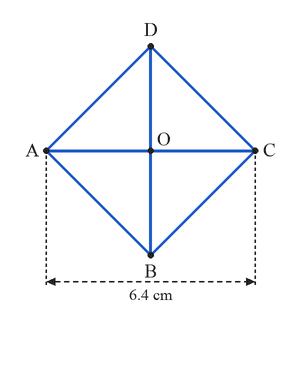
The length OA = OB = OC = OD to be marked is :
- 81 mark
Question 8
Bloom's level: Apply
Trapezium ABCD has AD ∥ BC, AD = 3.5 cm, BC = 6.0 cm, AB = 3.0 cm and CD = 4.0 cm. Following the chapter's method, BC is drawn, BE = AD is cut off and is constructed first.
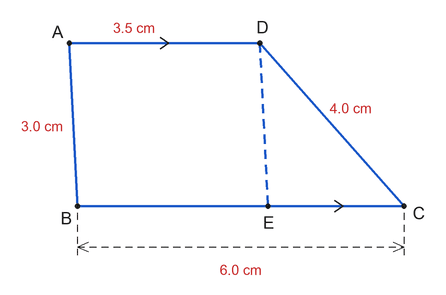
The sides of are :
- 91 mark
Question 9
Bloom's level: Apply
A regular hexagon is constructed inside a circle of radius 4 cm (all six vertices on the circle). The perimeter of the hexagon is :
- 101 mark
Question 10
Bloom's level: Understand
Assertion (A) : A rhombus can be constructed when only the lengths of its two diagonals are given.
Reason (R) : The diagonals of a rhombus bisect each other at right angles.
- 111 mark
Question 11
Bloom's level: Analyse
Assertion (A) : A unique quadrilateral can be constructed if only its four sides are given.
Reason (R) : In general, five independent measurements are needed to construct a unique quadrilateral.
- 121 mark
Question 12
Bloom's level: Evaluate
Assertion (A) : A parallelogram ABCD with AB = 5 cm, BC = 3 cm and diagonal AC = 9 cm cannot be constructed.
Reason (R) : In any triangle, the sum of any two sides must be greater than the third side.
- 131 mark
Question 13
Bloom's level: Remember
What does it mean "to construct a quadrilateral"?
- 142 marks
Question 14
Bloom's level: Understand
Explain why a square can be constructed when only its diagonal is given, but a rhombus needs both its diagonals.
- 152 marks
Question 15
Bloom's level: Understand
In Method II for a regular hexagon, arcs of radius equal to the radius of the circle are stepped round the circle. Explain why exactly six such steps take us back to the starting point.
- 162 marks
Question 16
Bloom's level: Understand
To construct trapezium ABCD (AD ∥ BC) from its four sides, the chapter cuts BE = AD on BC and then draws with DE = AB.
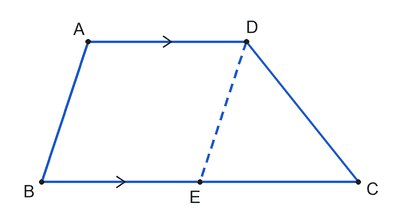
Explain why DE must be equal to AB.
- 172 marks
Question 17
Bloom's level: Apply
A rectangle is to be constructed with one side 4.8 cm and a diagonal 5.2 cm.
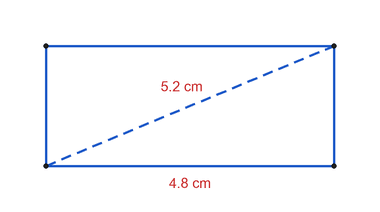
Find by calculation the length of the other side, which you should get on measuring.
- 182 marks
Question 18
Bloom's level: Apply
Using ruler and compasses only, construct a parallelogram ABCD with AB = 4.5 cm, BC = 5.0 cm and . Measure the diagonal AC.
- 192 marks
Question 19
Bloom's level: Apply
Construct a square whose area is 18 cm². (Hint: first find its diagonal.)
- 202 marks
Question 20
Bloom's level: Analyse
A rhombus is to be constructed with diagonals 8 cm and 6 cm.

Before constructing it, find the length of each side and the perimeter you expect to measure.
- 212 marks
Question 21
Bloom's level: Analyse
A student is asked to construct a quadrilateral ABCD with AB = 3 cm, BC = 4 cm, CD = 5 cm, DA = 6 cm and diagonal AC = 7.5 cm. Explain why the construction is impossible.
- 222 marks
Question 22
Bloom's level: Evaluate
Riya draws a hexagon with all six sides 3 cm long and says it must be a regular hexagon. Kabir draws a circle of radius 3 cm and steps off six chords of 3 cm round it, and says his hexagon must be regular. Who is right? Justify.
- 233 marks
Question 23
Bloom's level: Apply
The sides of a quadrilateral ABCD are AB = 4.5 cm, BC = 5.5 cm, CD = 4.0 cm and DA = 6.0 cm, and its diagonal AC is 6.5 cm. Construct it with ruler and compasses, then measure the other diagonal BD.
- 244 marks
Question 24
Bloom's level: Apply
(i) Using ruler and compasses only, construct a parallelogram ABCD in which BC = 5 cm, diagonal AC = 8 cm and diagonal BD = 6 cm.
(ii) Measure AB and CD. What do you notice?
(iii) Prove your observation using , where O is the point where the diagonals meet.
- 254 marks
Question 25
Bloom's level: Analyse
(i) Using ruler and compasses only, construct a rectangle ABCD whose diagonals are each 6 cm long and meet at O so that .
(ii) Without measuring, find the length of AB and of BC. Check your answers by measuring.
- 264 marks
Question 26
Bloom's level: Evaluate
Aman is asked to construct a trapezium ABCD with AD ∥ BC, AD = 3 cm, BC = 7 cm, AB = 2.5 cm and CD = 1 cm.
(a) Using the chapter's method (cut BE = AD, then draw ), decide whether the construction is possible. Justify.
(b) His teacher changes CD to 3 cm. Check that the construction is now possible, and construct the trapezium.
- 274 marks
Question 27
Bloom's level: Apply
Case study: An art teacher wants her class to make coasters in the shape of a regular hexagon of side 4 cm, using ruler and compasses only.
(a) What radius should the students use for the circle in Method II? Why?
(b) Write the steps of construction and construct one coaster.
(c) Each coaster needs a coloured tape along its edge, and must be cut from a rectangular card. Find the length of tape for 6 coasters, and the smallest rectangle of card that one coaster fits in (take ).
- 285 marks
Question 28
Bloom's level: Analyse
Case study: A tile designer wants rhombus-shaped tiles in which each side is 5.0 cm and the shorter diagonal is also 5.0 cm.
(a) Find the angles of each tile. Explain your reasoning.
(b) Construct one tile ABCD with diagonal BD = 5.0 cm, using ruler and compasses only.
(c) Find the longer diagonal AC (take ) and check it by measuring. How many tiles can meet at a point if they are placed with their corners together? With their corners together?
- 294 marks
Question 29
Bloom's level: Create
(a) Frame two sets of data (four sides and one diagonal) for a quadrilateral PQRS: one set from which PQRS can be constructed, and one from which it cannot. Justify each.
(b) Construct PQRS from your first set of data and measure the other diagonal QS.
- 305 marks
Question 30
Bloom's level: Create
A rectangle is required whose perimeter is 14 cm and whose diagonal is 5 cm.
(a) Plan the construction: find the lengths of the sides first. Show your working.
(b) Construct the rectangle using ruler and compasses only.
(c) Explain why your plan in (a) is needed — that is, why the perimeter and diagonal cannot be used directly in the construction.
- 311 mark
Question 31
A quadrilateral is to be constructed with cm, cm, cm, cm and the diagonal cm. The two triangles that are constructed on the common base are :
- 321 mark
Question 32
A rhombus is to be constructed with side 6.5 cm and the diagonal cm.
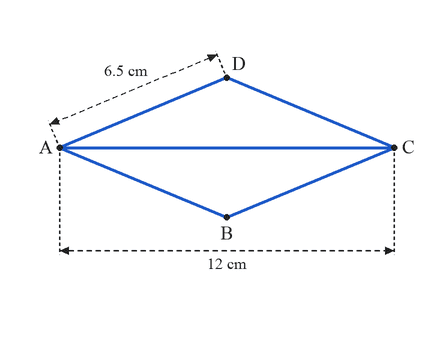
The length of the other diagonal , as measured on the finished figure, is :
- 331 mark
Question 33
Which of the following data is not enough to construct a square ?
- 342 marks
Question 34
(i) Construct a parallelogram in which cm, cm and .
(ii) Measure its two diagonals.
- 353 marks
Question 35
Construct a trapezium in which , cm, cm and cm.
(i) Write the steps of construction.
(ii) Measure the distance between the parallel sides and .
(iii) Measure .
- 362 marks
Question 36
Construct a rectangle in which cm and the diagonals and meet at with . Measure .
- 373 marks
Question 37
Construct a rhombus in which the diagonal cm and .
(i) Write the steps of construction.
(ii) Measure the side of the rhombus.
(iii) Measure the other diagonal .
- 384 marks
Question 38
Construct a quadrilateral in which cm, cm, cm, and .
(i) Write the steps of construction.
(ii) Measure the length of .
(iii) Measure and , and check that the four angles of the quadrilateral add up to .
- 394 marks
Question 39
(i) Construct a regular hexagon of side 3.4 cm, and say why the radius of the circle you use is 3.4 cm.
(ii) Join the alternate vertices , and . Measure the sides of .
(iii) What kind of triangle is ? Give a reason.
- 404 marks
Question 40
Construct a parallelogram in which cm, cm and the diagonal cm.
(i) Write the steps of construction.
(ii) Measure the other diagonal .
(iii) Measure and , and show that their sum is .