
Question 263 marksMedium
Construct a trapezium ABCD, when :
AB = CD = 3·2 cm, BC = 6·0 cm, AD = 4·4 cm and AD // BC.
Confirming your payment
Sign up now and get 250 free tokens.
Construction of Polygons · Question 26 of 47
Construct a trapezium ABCD, when :
AB = CD = 3·2 cm, BC = 6·0 cm, AD = 4·4 cm and AD // BC.
Solution:
Concept: Draw DE ∥ AB to meet BC at E. Then ABED is a parallelogram, so BE = AD and DE = AB, and triangle DEC has all three sides known.
Given: AB = 3·2 cm, CD = 3·2 cm, BC = 6·0 cm, AD = 4·4 cm and AD ∥ BC.
Step 1 — Find the sides of triangle DEC.
ABED is a parallelogram, so DE equals AB (3·2 cm) and BE equals AD (4·4 cm). The rest of BC is EC.
Step 2 — Draw BC and mark E.
Draw BC = 6·0 cm and mark E on it with BE = 4·4 cm.
Step 3 — Locate D.
With E as centre and radius 3·2 cm, and with C as centre and radius 3·2 cm, draw two arcs that cut each other at D. Join DE and DC.
Step 4 — Locate A.
Through D, draw DY ∥ CB and cut off DA = 4·4 cm on it, towards B.
Step 5 — Complete the trapezium.
Join AB.
Step 6 — Look at the finished figure and check it.
The finished construction is shown below; the given measurements are marked on it.
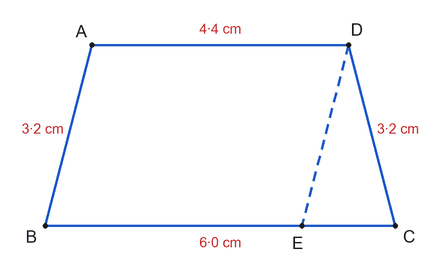
On measuring, AB = 3·2 cm, as required, and the height of the trapezium is about 3·1 cm.
Watch out: EC is the difference of the parallel sides, BC − AD, not their sum.
Therefore, ABCD is the required trapezium.