
Question 63 marksMedium
Construct a quadrilateral ABCD, when :
AB = 3·2 cm, BC = 5·2 cm, CD = 6·2 cm, DA = 4·2 cm and BD = 5·2 cm.
Confirming your payment
Sign up now and get 250 free tokens.
Construction of Polygons · Question 6 of 47
Construct a quadrilateral ABCD, when :
AB = 3·2 cm, BC = 5·2 cm, CD = 6·2 cm, DA = 4·2 cm and BD = 5·2 cm.
Solution:
Concept: A quadrilateral is constructed by splitting it into two triangles along a diagonal and constructing each triangle from its three sides (the SSS construction).
Given: AB = 3·2 cm, BC = 5·2 cm, CD = 6·2 cm, DA = 4·2 cm and diagonal BD = 5·2 cm.
Step 1 — Plan with a rough sketch.
The diagonal BD splits ABCD into triangle ABD (sides 3·2 cm, 4·2 cm, 5·2 cm) and triangle BCD (sides 5·2 cm, 6·2 cm, 5·2 cm). We construct triangle ABD first and then triangle BCD on BD.
Step 2 — Draw the base AB.
Draw a line segment AB = 3·2 cm.
Step 3 — Locate D.
With A as centre and radius 4·2 cm, draw an arc. With B as centre and radius 5·2 cm, draw another arc cutting the first one at D. Join AD and BD. Point D is now 4·2 cm from A and 5·2 cm from B.
Step 4 — Locate C.
With B as centre and radius 5·2 cm, draw an arc on the side of BD away from A. With D as centre and radius 6·2 cm, draw an arc cutting it at C.
Step 5 — Complete the quadrilateral.
Join BC and CD.
Step 6 — Look at the finished figure and check it.
The finished construction is shown below; the given measurements are marked on it.
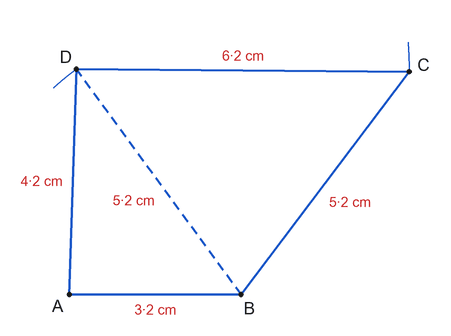
On measuring, the other diagonal AC is about 7·6 cm.
Watch out: C must be on the side of BD away from A; otherwise the figure folds over and is not the quadrilateral asked for.
Therefore, ABCD is the required quadrilateral.