
Question 383 marksEasy
Construct a quadrilateral ABCD with AB = 7 cm, BC = CD = 5 cm and ∠ABC = ∠BCD = 90°.
Confirming your payment
Sign up now and get 250 free tokens.
Construction of Polygons · Question 38 of 47
Construct a quadrilateral ABCD with AB = 7 cm, BC = CD = 5 cm and ∠ABC = ∠BCD = 90°.
Solution:
Concept: When both angles at the ends of a side are right angles, the other two sides are perpendicular to it. So we draw BC and erect perpendiculars at B and C.
Given: AB = 7 cm, BC = 5 cm, CD = 5 cm, ∠ABC = 90° and ∠BCD = 90°.
Step 1 — Draw the base BC.
Draw a line segment BC = 5 cm.
Step 2 — Construct the right angle at B.
At B, construct ∠CBX = 90° and cut off BA = 7 cm on BX.
Step 3 — Construct the right angle at C.
At C, construct ∠BCY = 90° on the same side of BC, and cut off CD = 5 cm on CY.
Step 4 — Complete the quadrilateral.
Join AD.
Step 5 — Look at the finished figure and check it.
The finished construction is shown below; the given measurements are marked on it.
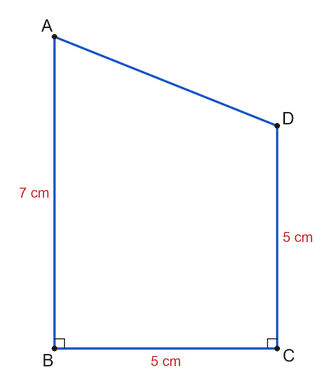
AD can be checked by Pythagoras' theorem: AD is the hypotenuse of a right triangle with legs BC = 5 cm and AB − CD = 2 cm.
On measuring, AD is about 5·4 cm.
Watch out: Both perpendiculars must be on the same side of BC.
Therefore, ABCD is the required quadrilateral.