
Question 343 marksMedium
Construct a square ABCD, when :
One diagonal = 5·4 cm.
Confirming your payment
Sign up now and get 250 free tokens.
Construction of Polygons · Question 34 of 47
Construct a square ABCD, when :
One diagonal = 5·4 cm.
Solution:
Concept: The diagonals of a square are equal and bisect each other at right angles, so all four half-diagonals are equal.
Given: One diagonal = 5·4 cm.
Step 1 — Find the half-diagonal.
Both diagonals are 5·4 cm long, so each half is
Step 2 — Draw AC and its perpendicular bisector.
Draw AC = 5·4 cm. Draw its perpendicular bisector XY, cutting AC at O.
Step 3 — Locate B and D.
On XY, cut off OB = 2·7 cm and OD = 2·7 cm, on opposite sides of AC.
Step 4 — Complete the square.
Join AB, BC, CD and DA.
Step 5 — Look at the finished figure and check it.
The finished construction is shown below; the given measurements are marked on it.
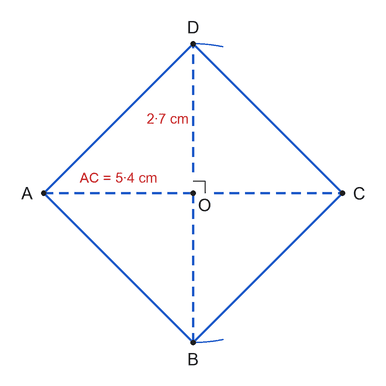
Each side can be checked by Pythagoras' theorem in triangle AOB:
On measuring, each side is about 3·8 cm.
Watch out: In a square the second diagonal is as long as the first, so OB and OD are 2·7 cm too.
Therefore, ABCD is the required square.