
Opening your dashboard
Class 9 Maths Chapter 13: Pythagoras Theorem Solutions
41 textbook questions with step-by-step answers, free to read, for ICSE 2026-27.
Get talked through Ch 13, not just shown the answer
Reading a finished solution is not the same as being able to do it. The AI tutor takes one question at a time and works it with you, in your own words, until you can.
- Ask it out loud, in your own words
- It gives you the next step, not the answer
- Stuck on part (ii)? Start there
41 questions with solutions
1–3 marks · Mixed difficulty
The first 40 solutions are on this page. This chapter is a long one, so the rest open on their own page to keep this one quick to load.
- 11 mark
Question 1
If the lengths of the sides of a triangle are in the ratio 5 : 12 : 13; then the triangle is:
Solve with AIAnswer
(A) acute-angled triangle
(B) scalene triangle
- Correct
(C) right-angled triangle
(D) obtuse-angled triangle
Answer: (C) right-angled triangle
Concept: Converse of Pythagoras' theorem: if the square of the longest side of a triangle equals the sum of the squares of the other two sides, the angle opposite the longest side is a right angle.
Step 1 — Write the sides with a common multiplier.
Sides in the ratio 5 : 12 : 13 are , and for some positive number . The longest side is .
Step 2 — Add the squares of the two shorter sides.
We square the two shorter sides and add them.
Step 3 — Compare with the square of the longest side.
Now we square the longest side.
The two results are equal, so by the converse of Pythagoras' theorem the angle opposite the side is .
Watch out: Compare the square of the LONGEST side with the sum of the other two squares, not any two sides.
Note: Strictly, option (B) is also true, because no two sides are equal. The question is about the type of angle the ratio fixes, so the printed key (C) is kept.
Why the other options are wrong:
- (A) acute-angled triangle: An acute-angled triangle needs to be less than the sum of the other two squares; here they are equal.
- (B) scalene triangle: The sides , and are all different, so the triangle is in fact scalene too. But the special property this ratio shows is the right angle (5, 12, 13 is a Pythagorean triplet), and that is what the question tests.
- (D) obtuse-angled triangle: An obtuse-angled triangle needs to be more than the sum of the other two squares; here they are equal.
Therefore, the triangle is right-angled, option (C).
- 21 mark
Question 2
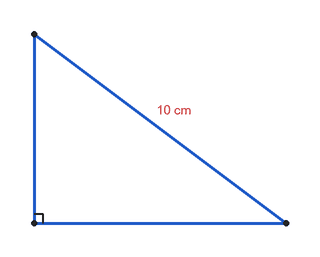
In a right-angled triangle, hypotenuse is 10 cm and the ratio of the other two sides is 3 : 4, the sides are :
 Solve with AI
Answer
(A) 6 cm and 4 cm
- Correct
(B) 8 cm and 6 cm
(C) 3 cm and 4 cm
(D) 8 cm and 4 cm
Answer: (B) 8 cm and 6 cm
Concept: Pythagoras' theorem: in a right-angled triangle, the square on the hypotenuse (the side opposite the right angle) equals the sum of the squares on the other two sides: .
Step 1 — Write the two sides with a common multiplier.
The sides in the ratio 3 : 4 are cm and cm, and the hypotenuse is 10 cm.
Step 2 — Use Pythagoras' theorem.
The hypotenuse squared equals the sum of the squares of the other two sides.
A length is positive, so .
Step 3 — Find the sides.
We multiply each part of the ratio by 2.
Watch out: is not the answer; the sides are and .
Why the other options are wrong:
- (A) 6 cm and 4 cm: 6 and 4 are in the ratio 3 : 2, not 3 : 4, and , not 100.
- (C) 3 cm and 4 cm: , which gives a hypotenuse of 5 cm, not 10 cm.
- (D) 8 cm and 4 cm: 8 and 4 are in the ratio 2 : 1, not 3 : 4, and , not 100.
Therefore, the sides are 6 cm and 8 cm, option (B).
- 31 mark
Question 3
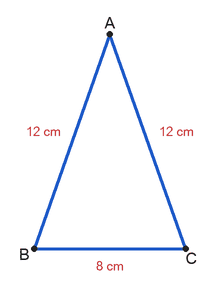
ABC is an isosceles triangle with AB = AC = 12 cm and BC = 8 cm. The area of the triangle is :
 Solve with AI
Answer
- Correct
(A) cm²
(B) cm²
(C) cm²
(D) cm²
Answer: (A) cm²
Concept: In an isosceles triangle (and so in an equilateral triangle), the perpendicular from the top vertex to the base bisects the base. It splits the triangle into two right-angled triangles, where Pythagoras' theorem applies.
Step 1 — Draw the height.
Draw AD perpendicular to BC. Since AB = AC, D is the mid-point of BC, so BD = 4 cm.

Step 2 — Find AD in right triangle ABD.
AB is the hypotenuse of right triangle ABD.
So AD is cm.
Step 3 — Find the area.
The area of a triangle is half the base times the height.
So the area is cm².
Watch out: Use half the base (4 cm), not the whole base, inside Pythagoras' theorem.
Why the other options are wrong:
- (B) cm²: is half the correct area; it comes from using the twice.
- (C) cm²: cm is the height AD, not the area.
- (D) cm²: With base 8 cm, an area of cm² would need a height of cm, but the height is cm.
Therefore, the area is cm², option (A).
- 41 mark
Question 4
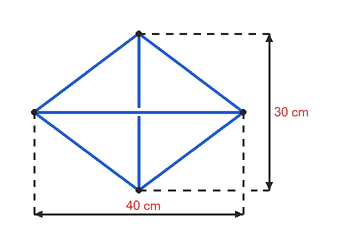
In a rhombus, its diagonals are 30 cm and 40 cm, its perimeter is :
 Solve with AI
Answer
(A) 20 cm
(B) 10 cm
(C) 60 cm
- Correct
(D) 100 cm
Answer: (D) 100 cm
Concept: The diagonals of a rhombus bisect each other at right angles, and all four sides of a rhombus are equal.
Step 1 — Use the diagonal property.
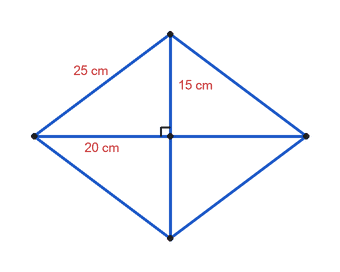
The diagonals of a rhombus bisect each other at right angles. So the half-diagonals, 15 cm and 20 cm, are the two shorter sides of a right triangle whose hypotenuse is a side of the rhombus.
Step 2 — Find a side.
We use Pythagoras' theorem.
So each side is 25 cm.
Step 3 — Find the perimeter.
A rhombus has four equal sides.
Watch out: Use HALF of each diagonal in the right triangle, not the whole diagonals.
Why the other options are wrong:
- (A) 20 cm: 20 cm is half of the 40 cm diagonal, not the perimeter.
- (B) 10 cm: 10 cm cannot be the perimeter, because one side alone is 25 cm.
- (C) 60 cm: 60 cm is ; it wrongly uses a half-diagonal as the side.
Therefore, the perimeter is 100 cm, option (D).
- 51 mark
Question 5
In the given figure, AD = 13 cm, DC = 12 cm and BC = 3 cm, then AB is equal to :
 Solve with AI
Answer
- Correct
(A) 4 cm
(B) 3 cm
(C) 5 cm
(D) 6 cm
Answer: (A) 4 cm
Concept: Pythagoras' theorem: in a right-angled triangle, the square on the hypotenuse (the side opposite the right angle) equals the sum of the squares on the other two sides: . Here it is used twice, once in each right triangle.
Step 1 — Find DB in right triangle DCB.
The figure marks a right angle at C, so DB is the hypotenuse of triangle DCB.
Step 2 — Find AB in right triangle ABD.
The figure marks ∠ABD = 90°, so AD is the hypotenuse of triangle ABD.
So AB is 4 cm.
Watch out: There is no need to find DB itself; keep and use it directly.
Why the other options are wrong:
- (B) 3 cm: 3 cm is BC, not AB.
- (C) 5 cm: With AB = 5 cm, would come to 178 (25 + 153), not 169.
- (D) 6 cm: With AB = 6 cm, would come to 189 (36 + 153), not 169.
Therefore, AB = 4 cm, option (A).
- 63 marks
Question 6
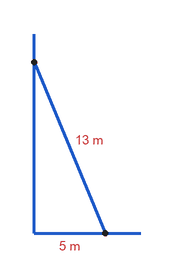
A ladder 13 m long rests against a vertical wall. If the foot of the ladder is 5 m from the foot of the wall, find the distance of the other end of the ladder from the ground.
 Solve with AI
Written solution
Solution:
Concept: Pythagoras' theorem: in a right-angled triangle, the square on the hypotenuse (the side opposite the right angle) equals the sum of the squares on the other two sides: .
Given: Ladder 13 m, foot of the ladder 5 m from the wall.
Step 1 — Picture the right triangle.
The wall is vertical and the ground is horizontal, so they meet at a right angle. The ladder is the hypotenuse (13 m), the foot is 5 m from the wall, and let the top be m above the ground.
Step 2 — Use Pythagoras' theorem.
The square of the ladder equals the sum of the squares of the other two sides.
A height is positive, so .
Watch out: The ladder is the hypotenuse; subtract the squares, do not add them.
Therefore, the top of the ladder is 12 m above the ground.
- 73 marks
Question 7
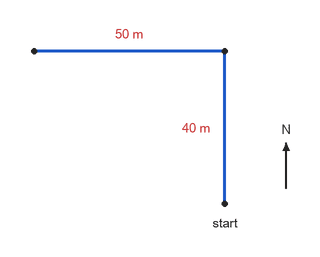
A man goes 40 m due north and then 50 m due west. Find his distance from the starting point.
 Solve with AI
Written solution
Solution:
Concept: Pythagoras' theorem: in a right-angled triangle, the square on the hypotenuse (the side opposite the right angle) equals the sum of the squares on the other two sides: .
Given: 40 m due north, then 50 m due west.
Step 1 — Picture the right triangle.
North and west are at right angles, so the two walks (40 m and 50 m) are the two shorter sides of a right triangle. Let the distance from the start be m; it is the hypotenuse.
Step 2 — Use Pythagoras' theorem.
We add the squares of the two walks.
Step 3 — Take the square root.
The distance is the positive square root.
Watch out: The distance from the start is not 40 + 50 = 90 m; the man did not walk in a straight line.
Therefore, the man is m ≈ 64.03 m from the starting point.
- 83 marks
Question 8
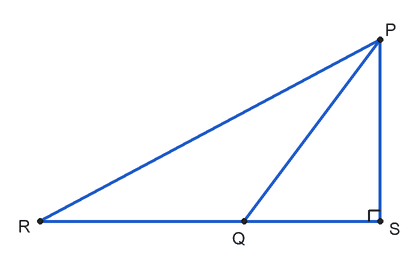
In the figure : ∠PSQ = 90°, PQ = 10 cm, QS = 6 cm and RQ = 9 cm. Calculate the length of PR.
 Solve with AI
Written solution
Solution:
Concept: Pythagoras' theorem: in a right-angled triangle, the square on the hypotenuse (the side opposite the right angle) equals the sum of the squares on the other two sides: .
Given: ∠PSQ = 90°, PQ = 10 cm, QS = 6 cm and RQ = 9 cm.
Step 1 — Find PS in right triangle PSQ.
∠PSQ = 90°, so PQ is the hypotenuse of triangle PSQ.
So PS = 8 cm.
Step 2 — Find RS.
R, Q and S lie on one straight line with Q between R and S.
So RS = 15 cm.
Step 3 — Find PR in right triangle PSR.
The angle at S is still 90°, so PR is the hypotenuse of triangle PSR.
Watch out: RS is RQ + QS = 15 cm, not RQ = 9 cm.
Therefore, PR = 17 cm.
- 93 marks
Question 9
The given figure shows a quadrilateral ABCD in which AD = 13 cm, DC = 12 cm, BC = 3 cm and ∠ABD = ∠BCD = 90°. Calculate the length of AB.
 Solve with AI
Written solution
Solution:
Concept: Pythagoras' theorem: in a right-angled triangle, the square on the hypotenuse (the side opposite the right angle) equals the sum of the squares on the other two sides: . Here it is used twice, once in each right triangle.
Given: AD = 13 cm, DC = 12 cm, BC = 3 cm, ∠ABD = 90° and ∠BCD = 90°.
Step 1 — Find BD in right triangle BCD.
∠BCD = 90°, so BD is the hypotenuse of triangle BCD.
Step 2 — Find AB in right triangle ABD.
∠ABD = 90°, so AD is the hypotenuse of triangle ABD.
Watch out: Keep as it is; rounding first would spoil the exact answer.
Therefore, AB = 4 cm.
- 103 marks
Question 10
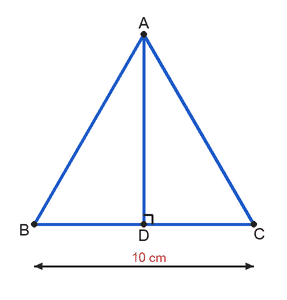
AD is drawn perpendicular to base BC of an equilateral triangle ABC. Given BC = 10 cm, find the length of AD, correct to 1 place of decimal.
 Solve with AI
Written solution
Solution:
Concept: In an isosceles triangle (and so in an equilateral triangle), the perpendicular from the top vertex to the base bisects the base. It splits the triangle into two right-angled triangles, where Pythagoras' theorem applies.
Given: Equilateral triangle ABC, BC = 10 cm, AD ⟂ BC.
Step 1 — Find BD.
In an equilateral triangle the perpendicular AD bisects BC, so BD = 5 cm. Also, AB = 10 cm, because all three sides are equal.
Step 2 — Find AD in right triangle ADB.
AB is the hypotenuse of right triangle ADB.
Watch out: Round only at the end: 8.66 rounds to 8.7.
Therefore, AD = cm ≈ 8.7 cm (correct to 1 decimal place).
- 113 marks
Question 11
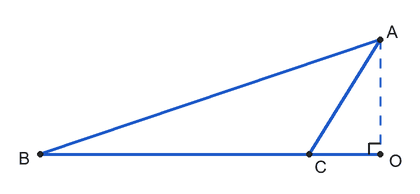
In triangle ABC, given below, AB = 8 cm, BC = 6 cm and AC = 3 cm. Calculate the length of OC.
 Solve with AI
Written solution
Solution:
Concept: Pythagoras' theorem: in a right-angled triangle, the square on the hypotenuse (the side opposite the right angle) equals the sum of the squares on the other two sides: . When two right triangles share a side, write that side's square from each triangle and equate.
Given: AB = 8 cm, BC = 6 cm, AC = 3 cm, AO ⟂ BC produced.
Step 1 — Name the unknown.
The figure shows AO perpendicular to BC produced, with C between B and O. Let OC = cm; then OB is cm, because OB is made up of BC and CO.
Step 2 — Write AO² from right triangle AOC.
AC is the hypotenuse of right triangle AOC.
Step 3 — Write AO² from right triangle AOB.
AB is the hypotenuse of right triangle AOB.
Step 4 — Equate the two expressions and solve.
Both expressions equal AO², so they are equal to each other.
So OC is cm, or cm.
Watch out: , not ; the terms then cancel.
Therefore, OC = cm.
- 123 marks
Question 12
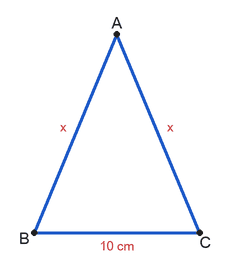
In triangle ABC,
AB = AC = ; BC = 10 cm and the area of the triangle is 60 cm². Find .
 Solve with AI
Written solution
Solution:
Concept: In an isosceles triangle (and so in an equilateral triangle), the perpendicular from the top vertex to the base bisects the base. It splits the triangle into two right-angled triangles, where Pythagoras' theorem applies.
Given: AB = , AC = , BC = 10 cm, area of ΔABC = 60 cm².
Step 1 — Find the height from the area.
Draw AD perpendicular to BC. The area is half the base times the height.
So the height AD is 12 cm, because only 12 makes the area 60 cm².
Step 2 — Find BD.
AB = AC, so the perpendicular AD bisects BC: BD = 5 cm.
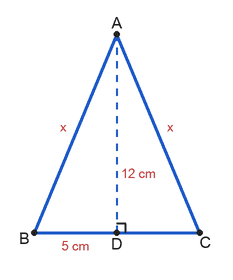
Step 3 — Use Pythagoras' theorem in right triangle ADB.
AB = is the hypotenuse.
A length is positive, so .
Watch out: Use half the base, BD = 5 cm, in the right triangle.
Therefore, = 13 cm.
- 133 marks
Question 13
If the sides of a triangle are in the ratio , show that it is a right-angled triangle.
Solve with AIWritten solution
Solution:
Concept: Converse of Pythagoras' theorem: if the square of the longest side of a triangle equals the sum of the squares of the other two sides, the angle opposite the longest side is a right angle.
Given: The sides are in the ratio .
Step 1 — Write the sides with a common multiplier.
Let the sides be , and , where is positive. The longest side is .
Step 2 — Add the squares of the two shorter sides.
We add the squares of the two equal sides.
Step 3 — Square the longest side.
Now we square the longest side.
The two results are equal, so by the converse of Pythagoras' theorem the angle opposite the side is .
Watch out: The longest side is the middle term , not the last term.
Therefore, the triangle is right-angled, with the right angle opposite the side . Hence proved.
- 143 marks
Question 14
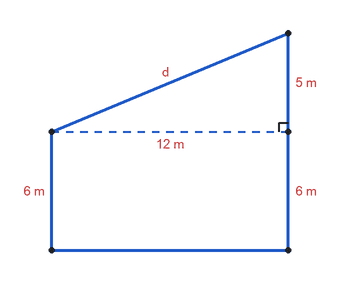
Two poles of heights 6 m and 11 m stand vertically on a plane ground. If the distance between their feet is 12 m; find the distance between their tips.
 Solve with AI
Written solution
Solution:
Concept: Pythagoras' theorem: in a right-angled triangle, the square on the hypotenuse (the side opposite the right angle) equals the sum of the squares on the other two sides: .
Given: Poles 6 m and 11 m high, 12 m apart.
Step 1 — Make a right triangle.
Draw a horizontal line from the top of the 6 m pole to the 11 m pole. It is 12 m long (the distance between the feet) and meets the taller pole 6 m above the ground.
Step 2 — Find the vertical side.
The rest of the taller pole above that line is the vertical side of the right triangle.
Step 3 — Use Pythagoras' theorem.
The line joining the tips, m, is the hypotenuse.
Watch out: The vertical side is the difference of the heights, 5 m, not 11 m or 6 m.
Therefore, the distance between the tips is 13 m.
- 151 mark
Question 15
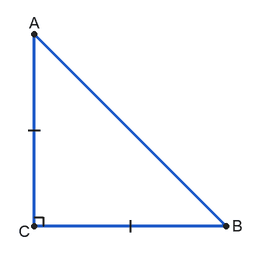
In ΔABC, ∠C = 90° and AC = BC, then AB² is equal to :
 Solve with AI
Answer
(A) AC²
- Correct
(B) 2AC²
(C) BC²
(D) 2BC² – AC²
Answer: (B) 2AC²
Concept: Pythagoras' theorem: in a right-angled triangle, the square on the hypotenuse (the side opposite the right angle) equals the sum of the squares on the other two sides: .
Step 1 — Find the hypotenuse.
∠C = 90°, so AB is the hypotenuse.
Step 2 — Use AC = BC.
We replace BC by AC.
Watch out: AB is the side opposite the right angle at C, so it is the hypotenuse.
Why the other options are wrong:
- (A) AC²: is only one of the two equal terms that make up .
- (C) BC²: equals here, so it is also only half of .
- (D) 2BC² – AC²: equals (since BC = AC), which is again half of .
Therefore, , option (B).
- 161 mark
Question 16
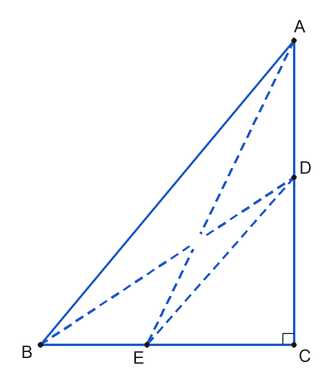
In the given diagram, AE² + BD² is equal to :
 Solve with AI
Answer
(A) AB² – DE²
(B) DE² – AB²
- Correct
(C) AB² + DE²
(D) DE × AB
Answer: (C) AB² + DE²
Concept: Pythagoras' theorem: in a right-angled triangle, the square on the hypotenuse (the side opposite the right angle) equals the sum of the squares on the other two sides: .
Step 1 — Spot the right triangles.
The figure marks ∠C = 90°. D lies on CA and E lies on CB, so the triangles ACE, BCD, ACB and DCE are all right-angled at C.
Step 2 — Write the two given squares.
AE is the hypotenuse of triangle ACE, and BD is the hypotenuse of triangle BCD.
Step 3 — Add and regroup.
We add the two lines and group the terms in pairs.
The first bracket is AB² (triangle ACB) and the second is DE² (triangle DCE).
Watch out: Every segment in the figure that joins a point of CA to a point of CB is a hypotenuse.
Why the other options are wrong:
- (A) AB² – DE²: is less than , while is more than .
- (B) DE² – AB²: is negative here (DE < AB, since D and E lie on the legs), but a sum of squares is positive.
- (D) DE × AB: is at least , so it is always larger than .
Therefore, , option (C).
- 171 mark
Question 17
In the given figure, the value of AB × CD is :
 Solve with AI
Answer
- Correct
(A) AC × BC
(B) AC × CD
(C) AC × AB
(D) AC² + BC²
Answer: (A) AC × BC
Concept: The area of a triangle is half of any side times the height drawn to that side, so one triangle's area can be written in two ways.
Step 1 — Area with base BC.
The figure marks ∠C = 90°, so AC is the height on the base BC.
Step 2 — Area with base AB.
CD is perpendicular to AB, so CD is the height on the base AB.
Step 3 — Equate the two areas.
Both expressions give the area of the same triangle, so they are equal; we then multiply both sides by 2.
Watch out: Pair each base with the height perpendicular to it (BC with AC, AB with CD).
Note: The printed answer, AC × CD, is a misprint; the area argument above gives AC × BC.
Why the other options are wrong:
- (B) AC × CD: AC × CD is smaller than AC × BC, because CD < BC (CD is a leg of right ΔCDB, whose hypotenuse is BC).
- (C) AC × AB: AC × AB is larger than AB × CD, because AC > CD (CD is a leg of right ΔCDA, whose hypotenuse is AC).
- (D) AC² + BC²: , and is larger than AB × CD because CD < AB.
Therefore, AB × CD = AC × BC, option (A).
- 181 mark
Question 18
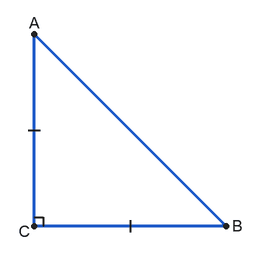
ABC is an isosceles triangle right-angled at C. Then 2AC² is equal to :
 Solve with AI
Answer
(A) BC²
(B) AC²
(C) AC² – BC²
- Correct
(D) AB²
Answer: (D) AB²
Concept: Pythagoras' theorem: in a right-angled triangle, the square on the hypotenuse (the side opposite the right angle) equals the sum of the squares on the other two sides: .
Step 1 — Find the hypotenuse.
The right angle is at C, so AB is the hypotenuse. The equal sides are the two arms of the right angle, AC = BC.
Step 2 — Use Pythagoras' theorem.
We replace BC by AC.
Watch out: In a right isosceles triangle the equal sides are the two sides that make the right angle.
Why the other options are wrong:
- (A) BC²: , which is only half of .
- (B) AC²: is only half of .
- (C) AC² – BC²: , because AC = BC.
Therefore, , option (D).
- 193 marks
Question 19
In the figure, given below, AD ⊥ BC.
Prove that : .
 Solve with AI
Written solution
Solution:
Concept: Pythagoras' theorem: in a right-angled triangle, the square on the hypotenuse (the side opposite the right angle) equals the sum of the squares on the other two sides: . The common height links the two right triangles, so we eliminate it.
Given: AD ⟂ BC, AB = , AC = , BC = , DC = , AD = .
Step 1 — Right triangle ADC.
AD ⟂ BC, so triangle ADC is right-angled at D. Its sides are (AD), (DC) and the hypotenuse (AC).
Step 2 — Right triangle ADB.
Triangle ADB is right-angled at D, with BD = (BC minus DC) and hypotenuse (AB).
Step 3 — Replace h².
We put from Step 1 into Step 2; the terms cancel.
Watch out: ; keep the middle term .
Therefore, . Hence proved.
- 203 marks
Question 20
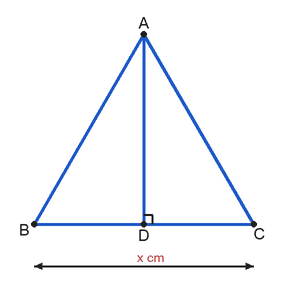
In equilateral Δ ABC, AD ⊥ BC and BC = cm. Find, in terms of x, the length of AD.
 Solve with AI
Written solution
Solution:
Concept: In an isosceles triangle (and so in an equilateral triangle), the perpendicular from the top vertex to the base bisects the base. It splits the triangle into two right-angled triangles, where Pythagoras' theorem applies.
Given: Equilateral ΔABC, BC = cm, AD ⟂ BC.
Step 1 — Find BD.
In an equilateral triangle the perpendicular AD bisects BC, so BD = cm. Also, AB = cm, because all three sides are equal.
Step 2 — Use Pythagoras' theorem in right triangle ADB.
AB is the hypotenuse.
A length is positive, so AD = cm.
Watch out: , not .
Therefore, AD = cm.
- 213 marks
Question 21
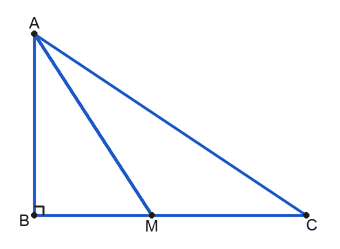
ABC is a triangle, right-angled at B. M is a point on BC. Prove that :
AM² + BC² = AC² + BM².
 Solve with AI
Written solution
Solution:
Concept: Pythagoras' theorem: in a right-angled triangle, the square on the hypotenuse (the side opposite the right angle) equals the sum of the squares on the other two sides: .
Given: ΔABC with ∠B = 90°, M a point on BC.
Step 1 — Two right triangles at B.
∠B = 90° and M lies on BC, so triangles ABM and ABC are both right-angled at B.
Step 2 — Work out the left side.
We replace AM² using the first line.
Step 3 — Work out the right side.
We replace AC² using the second line.
Both sides equal AB² + BM² + BC².
Watch out: AM and AC are the hypotenuses here, because each is opposite the right angle at B.
Therefore, AM² + BC² = AC² + BM². Hence proved.
- 223 marks
Question 22
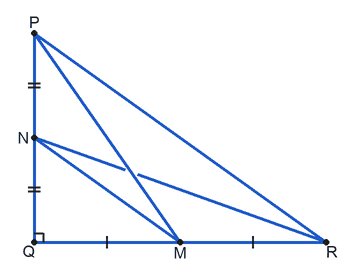
M and N are the mid-points of the sides QR and PQ respectively of a Δ PQR, right-angled at Q.
Prove that :
(i) PM² + RN² = 5 MN²
(ii) 4 PM² = 4 PQ² + QR²
(iii) 4 RN² = PQ² + 4 QR²
(iv) 4 (PM² + RN²) = 5 PR²
Solve with AIWritten solution
Solution:
Concept: Pythagoras' theorem: in a right-angled triangle, the square on the hypotenuse (the side opposite the right angle) equals the sum of the squares on the other two sides: . A mid-point halves a side, so its square is a quarter: .
Given: ΔPQR with ∠Q = 90°, M the mid-point of QR, N the mid-point of PQ.
Step 1 — List the right triangles.
∠Q = 90°, and M, N lie on QR, PQ. So triangles PQM, NQR, NQM and PQR are all right-angled at Q, with QM = ½QR and QN = ½PQ.
Step 2 — Write each square.
We use Pythagoras' theorem in each of the four triangles.
Step 3 — Part (i).
We add PM² and RN² and take out the common factor.
Step 4 — Part (ii).
We multiply the expression for PM² by 4.
Step 5 — Part (iii).
We multiply the expression for RN² by 4.
Step 6 — Part (iv).
We add the results of parts (ii) and (iii).
Watch out: , not .
Therefore, all four results are true: PM² + RN² = 5MN², 4PM² = 4PQ² + QR², 4RN² = PQ² + 4QR² and 4(PM² + RN²) = 5PR². Hence proved.
- 233 marks
Question 23
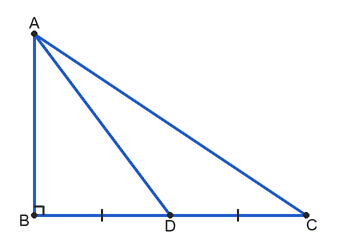
In triangle ABC, ∠B = 90° and D is the mid-point of BC. Prove that : AC² = AD² + 3CD².
 Solve with AI
Written solution
Solution:
Concept: Pythagoras' theorem: in a right-angled triangle, the square on the hypotenuse (the side opposite the right angle) equals the sum of the squares on the other two sides: .
Given: ΔABC with ∠B = 90°, D the mid-point of BC.
Step 1 — Use the mid-point.
D is the mid-point of BC, so BD = CD and BC = 2CD.
Step 2 — Right triangle ABC.
∠B = 90°, so AC is the hypotenuse of triangle ABC.
Step 3 — Right triangle ABD.
Triangle ABD is also right-angled at B, with BD = CD.
Step 4 — Substitute.
We put this value of AB² into the result of Step 2.
Watch out: , not .
Therefore, AC² = AD² + 3CD². Hence proved.
- 243 marks
Question 24
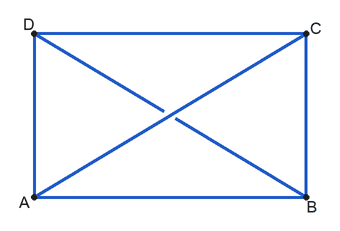
In a rectangle ABCD, prove that :
AC² + BD² = AB² + BC² + CD² + DA².
 Solve with AI
Written solution
Solution:
Concept: Pythagoras' theorem: in a right-angled triangle, the square on the hypotenuse (the side opposite the right angle) equals the sum of the squares on the other two sides: . Each diagonal of a rectangle is the hypotenuse of a right triangle formed by two sides.
Given: ABCD is a rectangle.
Step 1 — Diagonal AC.
Every angle of a rectangle is 90°. In right triangle ABC (∠B = 90°), AC is the hypotenuse.
Step 2 — Diagonal BD.
In right triangle BAD (∠A = 90°), BD is the hypotenuse; and AB = CD (opposite sides of a rectangle).
Step 3 — Add the two results.
We add the squares of the two diagonals.
Watch out: Use AB = CD in the second diagonal so that all four sides appear.
Therefore, AC² + BD² = AB² + BC² + CD² + DA². Hence proved.
- 253 marks
Question 25
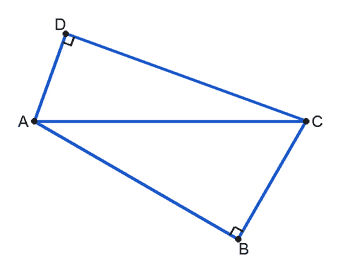
In a quadrilateral ABCD, ∠B = 90° and ∠D = 90°. Prove that :
2AC² – AB² = BC² + CD² + DA².
 Solve with AI
Written solution
Solution:
Concept: Pythagoras' theorem: in a right-angled triangle, the square on the hypotenuse (the side opposite the right angle) equals the sum of the squares on the other two sides: . Here AC is the hypotenuse of two right triangles.
Given: Quadrilateral ABCD with ∠B = 90° and ∠D = 90°.
Step 1 — Right triangle ABC.
∠B = 90°, so the diagonal AC is the hypotenuse of triangle ABC.
Step 2 — Right triangle ADC.
∠D = 90°, so AC is also the hypotenuse of triangle ADC.
Step 3 — Add and rearrange.
We add the two lines, then subtract AB² from both sides.
Watch out: AC is opposite both right angles, so it is the hypotenuse both times.
Therefore, 2AC² − AB² = BC² + CD² + DA². Hence proved.
- 263 marks
Question 26
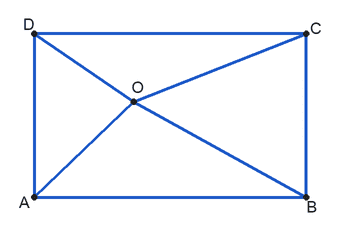
O is any point inside a rectangle ABCD. Prove that : OB² + OD² = OC² + OA².
 Solve with AI
Written solution
Solution:
Concept: Pythagoras' theorem: in a right-angled triangle, the square on the hypotenuse (the side opposite the right angle) equals the sum of the squares on the other two sides: . Dropping perpendiculars from O makes four right triangles.
Given: O is any point inside rectangle ABCD.
Step 1 — Construction.
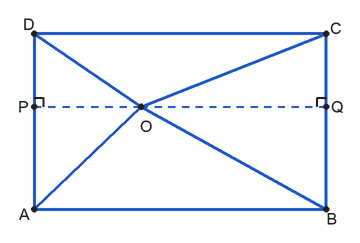
Through O draw PQ parallel to AB, with P on AD and Q on BC. Then PQ ⟂ AD and PQ ⟂ BC, and APQB and PDCQ are rectangles, so AP = BQ and DP = CQ.
Step 2 — Write each square.
Each of OA, OB, OC, OD is the hypotenuse of a right triangle with a right angle at P or Q.
Step 3 — Add in pairs.
We add the squares for B and D, and then for A and C.
Since BQ = AP and DP = CQ, the two right-hand sides are equal.
Watch out: Draw PQ through O parallel to AB; without it there are no right triangles to use.
Therefore, OB² + OD² = OC² + OA². Hence proved.
- 273 marks
Question 27
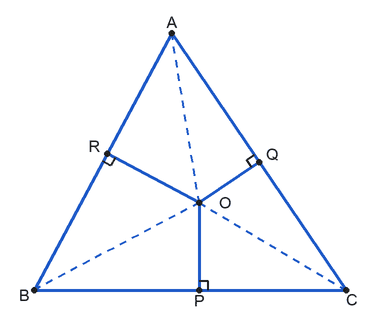
In the following figure, OP, OQ and OR are drawn perpendiculars to the sides BC, CA and AB respectively of triangle ABC. Prove that :
AR² + BP² + CQ² = AQ² + CP² + BR²
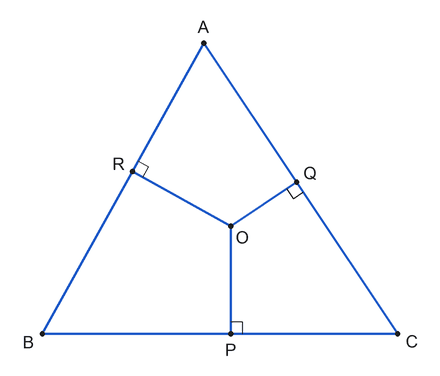
(Join OA, OB and OC. Now find the values of AR² + BP² + CQ² and AQ² + CP² + BR²)
Solve with AIWritten solution
Solution:
Concept: Pythagoras' theorem: in a right-angled triangle, the square on the hypotenuse (the side opposite the right angle) equals the sum of the squares on the other two sides: . Each vertex is joined to O, and each perpendicular foot gives two right triangles.
Given: OP ⟂ BC, OQ ⟂ CA, OR ⟂ AB.
Step 1 — Join OA, OB and OC.
Each of the six triangles ORA, OQA, OPB, ORB, OQC and OPC is right-angled at the foot of a perpendicular.
Step 2 — The first sum.
In triangles ORA, OPB and OQC the hypotenuses are OA, OB and OC.
Adding these three lines:
Step 3 — The second sum.
In triangles OQA, OPC and ORB the hypotenuses are again OA, OC and OB.
Adding these three lines:
Step 4 — Compare.
Both sums equal the same expression, so they are equal.
Watch out: Match each foot with the right vertex: R lies on AB, so AR and BR both come from it.
Therefore, AR² + BP² + CQ² = AQ² + CP² + BR². Hence proved.
- 283 marks
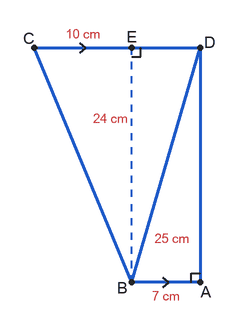
Question 28
In the given figure, AB//CD, AB = 7 cm, BD = 25 cm and CD = 17 cm; find the length of side BC.
 Solve with AI
Written solution
Solution:
Concept: Pythagoras' theorem: in a right-angled triangle, the square on the hypotenuse (the side opposite the right angle) equals the sum of the squares on the other two sides: . A perpendicular between the parallel sides makes a rectangle and a new right triangle.
Given: AB ∥ CD, AB = 7 cm, BD = 25 cm, CD = 17 cm, ∠BAD = 90° (marked in the figure).
Step 1 — Find AD in right triangle BAD.
The figure marks ∠BAD = 90°, so BD is the hypotenuse of triangle BAD.
Step 2 — Complete a right triangle on BC.
Draw BE ⟂ CD, meeting it at E. Since AB ∥ CD and ∠BAD = 90°, ABED is a rectangle, so BE equals AD (24 cm) and DE equals AB (7 cm). E lies between C and D because CD = 17 cm is longer than 7 cm.
Step 3 — Find BC in right triangle BEC.
BC is the hypotenuse of right triangle BEC.
Watch out: CE is CD − DE = 10 cm, not the whole of CD.
Therefore, BC = 26 cm.
- 293 marks
Question 29
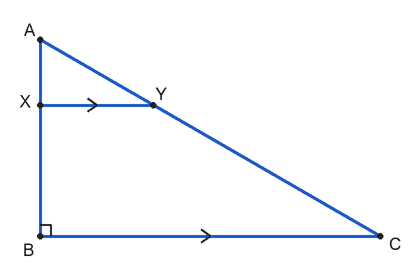
In the given figure, ∠B = 90°, XY//BC, AB = 12 cm, AY = 8 cm and AX : XB = 1 : 2 = AY : YC. Find the lengths of AC and BC.
 Solve with AI
Written solution
Solution:
Concept: Pythagoras' theorem: in a right-angled triangle, the square on the hypotenuse (the side opposite the right angle) equals the sum of the squares on the other two sides: .
Given: ∠B = 90°, XY ∥ BC, AB = 12 cm, AY = 8 cm, AX : XB = 1 : 2 and AY : YC = 1 : 2.
Step 1 — Find AC.
AY : YC = 1 : 2 and AY = 8 cm, so YC = 16 cm.
Step 2 — Find BC in right triangle ABC.
∠B = 90°, so AC is the hypotenuse.
Watch out: YC is twice AY, so AC is 3 × 8 = 24 cm, not 16 cm.
Therefore, AC = 24 cm and BC = cm ≈ 20.78 cm.
- 303 marks
Question 30
In ΔABC, ∠B = 90°.

Find the sides of the triangle, if :
(i) AB = cm, BC = cm and AC = cm
(ii) AB = cm, BC = cm and AC = cm
Solve with AIWritten solution
Solution:
Concept: Pythagoras' theorem: in a right-angled triangle, the square on the hypotenuse (the side opposite the right angle) equals the sum of the squares on the other two sides: . Form a quadratic equation and keep only the root that makes every side positive.
Given: ∠B = 90° in ΔABC.
Step 1 — Part (i): set up the equation.
∠B = 90°, so AC is the hypotenuse: .
Step 2 — Part (i): choose the root.
The root would make AB negative (−4 cm), which is impossible; so .
Step 3 — Part (ii): set up the equation.
Again AC is the hypotenuse.
Step 4 — Part (ii): choose the root.
The root makes AB negative, so .
AB = 9 cm.
Watch out: Check each root against every side; a negative length is rejected.
Therefore, (i) AB = 8 cm, BC = 15 cm, AC = 17 cm; (ii) AB = 9 cm, BC = 40 cm, AC = 41 cm.
- 313 marks
Question 31
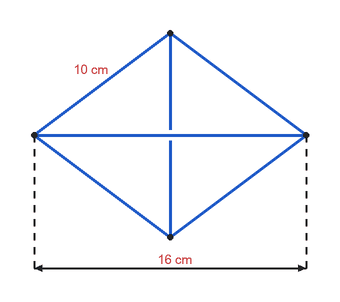
If a side of a rhombus is 10 cm and one of the diagonals is 16 cm, find the other diagonal.
 Solve with AI
Written solution
Solution:
Concept: The diagonals of a rhombus bisect each other at right angles, so a side is the hypotenuse of a right triangle whose legs are half of each diagonal.
Given: Side 10 cm, one diagonal 16 cm.
Step 1 — Use the diagonal property.
The diagonals of a rhombus bisect each other at right angles. Half of the 16 cm diagonal is 8 cm; let half of the other diagonal be cm. A side (10 cm) is the hypotenuse.
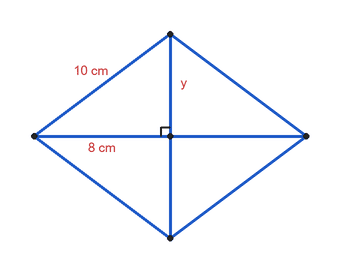
Step 2 — Use Pythagoras' theorem.
We subtract the known square from the square of the side.
A length is positive, so .
Step 3 — Double it.
The other diagonal is twice its half.
Watch out: 6 cm is only half of the diagonal; double it.
Therefore, the other diagonal is 12 cm.
- 323 marks
Question 32
In the given figure, diagonals AC and BD intersect at right angle. Show that :
AB² + CD² = AD² + BC²
 Solve with AI
Written solution
Solution:
Concept: Pythagoras' theorem: in a right-angled triangle, the square on the hypotenuse (the side opposite the right angle) equals the sum of the squares on the other two sides: .
Given: Diagonals AC and BD meet at O at right angles.
Step 1 — Four right triangles.
The diagonals meet at O at right angles, so triangles AOB, BOC, COD and DOA are right-angled at O.
Step 2 — Add in pairs.
We add the first two lines, and then the last two.
Both sums equal OA² + OB² + OC² + OD².
Watch out: Each side of the quadrilateral is the hypotenuse of the triangle it makes with O.
Therefore, AB² + CD² = AD² + BC². Hence proved.
- 333 marks
Question 33
Diagonals of rhombus ABCD intersect each other at point O. Prove that :
 Solve with AI
Written solution
Solution:
Concept: Pythagoras' theorem: in a right-angled triangle, the square on the hypotenuse (the side opposite the right angle) equals the sum of the squares on the other two sides: .
Given: ABCD is a rhombus; its diagonals meet at O.
Step 1 — Use the diagonal properties.
The diagonals of a rhombus bisect each other at right angles, so OA = OC, OD = ½BD and triangle AOD is right-angled at O.
Step 2 — Right triangle AOD.
AD is the hypotenuse.
Step 3 — Rearrange.
We multiply by 2 and move the BD term to the other side.
Step 4 — Use OA = OC.
Since OC = OA, the two equal squares can be written as one of each.
Watch out: OD is half of BD, so .
Therefore, . Hence proved.
- 343 marks
Question 34
In the figure AB = BC and AD is perpendicular to CD. Prove that :
AC² = 2.BC.DC.
 Solve with AI
Written solution
Solution:
Concept: Pythagoras' theorem: in a right-angled triangle, the square on the hypotenuse (the side opposite the right angle) equals the sum of the squares on the other two sides: . Two right triangles share the side AD.
Given: AB = BC, AD ⟂ CD.
Step 1 — Right triangle ADC.
AD ⟂ CD, so AC is the hypotenuse of triangle ADC.
Step 2 — Right triangle ADB.
Triangle ADB is also right-angled at D, and AB = BC.
Step 3 — Substitute and expand.
D, B and C lie on one line with B between D and C, so DC = DB + BC.
Watch out: Write DC as DB + BC before expanding; the DB² terms then cancel.
Therefore, AC² = 2·BC·DC. Hence proved.
- 353 marks
Question 35
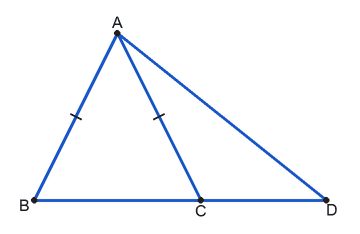
In an isosceles triangle ABC; AB = AC and D is a point on BC produced. Prove that :
AD² = AC² + BD.CD.
 Solve with AI
Written solution
Solution:
Concept: Pythagoras' theorem: in a right-angled triangle, the square on the hypotenuse (the side opposite the right angle) equals the sum of the squares on the other two sides: .
A difference of squares factorises: .
Given: AB = AC, D on BC produced.
Step 1 — Construction.
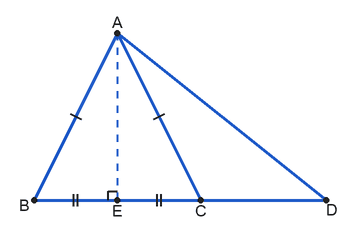
Draw AE ⟂ BC. Since AB = AC, E is the mid-point of BC, so BE = EC.
Step 2 — Two right triangles.
Triangles AED and AEC are right-angled at E.
Step 3 — Subtract.
We subtract the second line from the first; AE² cancels, and we factorise the difference of squares.
Step 4 — Read the two brackets.
D lies on BC produced beyond C, so ED − EC = CD. Also, EC = BE; so ED + EC equals ED + BE, which is the whole of BD.
Watch out: ED + EC equals BD only because EC = BE (E is the mid-point).
Therefore, AD² = AC² + BD·CD. Hence proved.
- 363 marks
Question 36
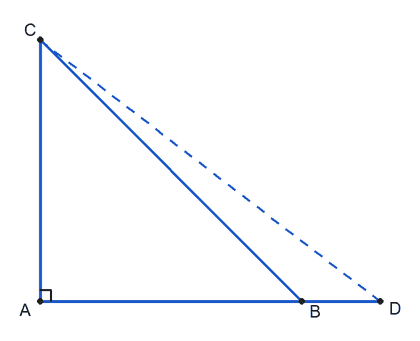
In triangle ABC, angle A = 90°, CA = AB and D is a point on AB produced. Prove that :
DC² – BD² = 2AB.AD.
 Solve with AI
Written solution
Solution:
Concept: Pythagoras' theorem: in a right-angled triangle, the square on the hypotenuse (the side opposite the right angle) equals the sum of the squares on the other two sides: .
Given: ∠A = 90°, CA = AB, D on AB produced.
Step 1 — Right triangle CAD.
∠A = 90° and D is on AB produced, so ∠CAD = 90° and DC is the hypotenuse. Also CA = AB.
Step 2 — Square BD.
B lies between A and D, so BD = AD − AB.
Step 3 — Subtract.
We subtract the second result from the first.
Watch out: Subtracting a bracket changes every sign inside it: −(AD² − 2AB·AD + AB²).
Therefore, DC² − BD² = 2AB·AD. Hence proved.
- 373 marks
Question 37
In triangle ABC, AB = AC and BD is perpendicular to AC. Prove that :
BD² – CD² = 2CD × AD
 Solve with AI
Written solution
Solution:
Concept: Pythagoras' theorem: in a right-angled triangle, the square on the hypotenuse (the side opposite the right angle) equals the sum of the squares on the other two sides: .
Given: AB = AC, BD ⟂ AC.
Step 1 — Right triangle BDA.
BD ⟂ AC, so triangle BDA is right-angled at D, with hypotenuse AB = AC. D lies on AC, so AC = AD + CD.
Step 2 — Rearrange.
We subtract CD² from both sides.
Watch out: Use AB = AC to bring in the side AC, which is split into AD + CD.
Therefore, BD² − CD² = 2CD × AD. Hence proved.
- 383 marks
Question 38
In the following figure, AD is perpendicular to BC and D divides BC in the ratio 1 : 3.

Prove that : 2AC² = 2AB² + BC²
Solve with AIWritten solution
Solution:
Concept: Pythagoras' theorem: in a right-angled triangle, the square on the hypotenuse (the side opposite the right angle) equals the sum of the squares on the other two sides: .
Given: AD ⟂ BC, BD : DC = 1 : 3.
Step 1 — Write BD and CD in terms of BC.
D divides BC in the ratio 1 : 3, so BD = ¼BC and CD = ¾BC.
Step 2 — Eliminate AD.
AD ⟂ BC, so triangles ADC and ADB are right-angled at D; we subtract their Pythagoras results so AD² cancels.
Step 3 — Multiply by 2.
We clear the fraction and rearrange.
Watch out: ; square the fraction too.
Therefore, 2AC² = 2AB² + BC². Hence proved.
- 393 marks
Question 39
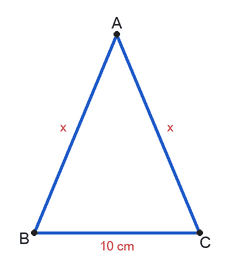
In ΔABC, AB = AC = , BC = 10 cm and area of ΔABC = 60 cm². Find the value of .
 Solve with AI
Written solution
Solution:
Concept: In an isosceles triangle (and so in an equilateral triangle), the perpendicular from the top vertex to the base bisects the base. It splits the triangle into two right-angled triangles, where Pythagoras' theorem applies.
Given: AB = , AC = , BC = 10 cm, area of ΔABC = 60 cm².
Step 1 — Find the height from the area.
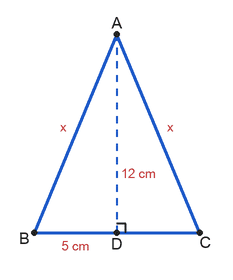
Draw AD perpendicular to BC. The area is half the base times the height.
So the height AD is 12 cm.
Step 2 — Find BD.
AB = AC, so the perpendicular AD bisects BC: BD = 5 cm.
Step 3 — Use Pythagoras' theorem in right triangle ADB.
AB = is the hypotenuse.
A length is positive, so .
Watch out: Use half the base, BD = 5 cm, in the right triangle.
Therefore, = 13 cm.
- 403 marks
Question 40
In the given figure, AB = 16 cm, BC = 12 cm and CA = 6 cm; find the length of CD.
 Solve with AI
Written solution
Solution:
Concept: Pythagoras' theorem: in a right-angled triangle, the square on the hypotenuse (the side opposite the right angle) equals the sum of the squares on the other two sides: . When two right triangles share a side, write that side's square from each and equate.
Given: AB = 16 cm, BC = 12 cm, CA = 6 cm, AD ⟂ BC produced.
Step 1 — Name the unknown.
The figure shows AD perpendicular to BC produced, with C between B and D. Let CD = cm; then BD = cm.
Step 2 — Write AD² in two ways.
AC is the hypotenuse of right triangle ADC, and AB is the hypotenuse of right triangle ADB.
Step 3 — Equate and solve.
Both expressions equal AD², so they are equal.
So CD is cm, or cm.
Watch out: ; the terms cancel.
Therefore, CD = cm.
- 413 marks
Question 41
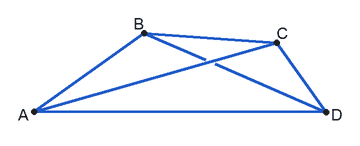
In a quadrilateral ABCD, ∠A + ∠D = 90°, prove that : AC² + BD² = AD² + BC².
What Class 9 Maths Ch 13 covers
The sections of the chapter, in the order the book takes them. Every question above comes from one of these.
- 01Pythagoras Theorem
- 02Converse of Pythagoras Theorem
- 03Pythagorean Triplets
More ways to study this chapter
The same chapter asked three other ways. Practise it, revise it, and see what the board has set on Ch 13 before.
Class 9 Maths Ch 13 questions students ask
How many questions are there in Class 9 Maths Ch 13?
41 questions. Every one is solved step by step on this page.
Are these Class 9 Maths solutions free?
Yes. Every question and its full working is free to read, with no account needed.
Can I download the Class 9 Maths Ch 13 solutions as a PDF?
There is no PDF to download. Every solution is on this page instead, which means it is searchable, always the current syllabus, and readable on a phone. Use your browser's print option if you want it on paper.