
Opening your dashboard
Class 9 Maths Chapter 13 Pythagoras Theorem: Competency-Based Questions (CBQ)
40 questions on Chapter 13, each worked through on its own page with the AI tutor. Class 9 Maths, ICSE 2026-27.
40 questions
1–5 marks · Mixed difficulty
- 11 mark
Question 1
Competency: Application
Each step of a staircase is 24 cm deep and 18 cm high. A straight handrail runs parallel to the slope of the stairs. It is just long enough to cover 10 steps.
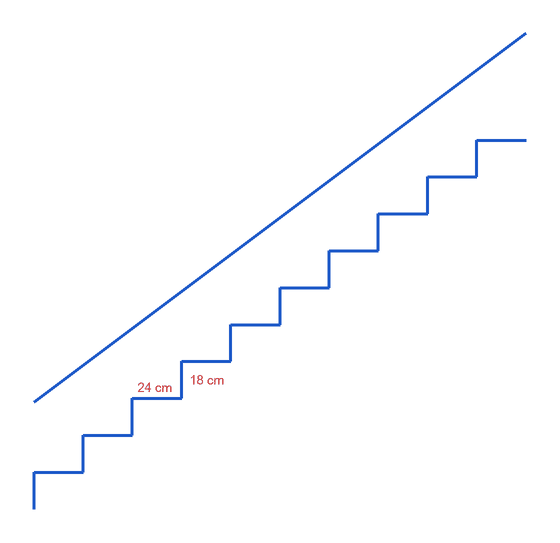
The length of the handrail is
- 21 mark
Question 2
Competency: Analysis
A carpenter cuts a triangular shelf to fit into the corner of a room, where two walls meet at 90°. The edges of the shelf are 20 cm, 21 cm and 28 cm. The 20 cm and 21 cm edges are to go against the two walls.
Which statement about the shelf is correct?
- 31 mark
Question 3
Competency: Understanding
The numbers 7, 24 and 25 form a Pythagorean triplet. A tile maker wants a larger right-angled triangular tile of the same shape as a 7 cm, 24 cm, 25 cm tile. Its shortest side must be 21 cm.
The other two sides of the larger tile are
- 41 mark
Question 4
Competency: Application
A river with straight parallel banks is 60 m wide. A swimmer starts from one bank and tries to swim straight across. Because of the current, he lands on the other bank 25 m downstream of the point directly opposite his starting point. He moves in a straight line.
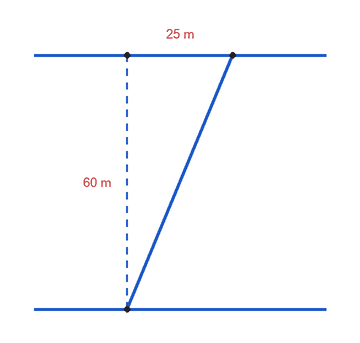
The distance he actually swims is
- 51 mark
Question 5
Competency: Evaluation
Assertion (A): In a triangle with sides 5 cm, 12 cm and 13 cm, the angle opposite to the 13 cm side is 90°.
Reason (R): In a right-angled triangle, the hypotenuse is the longest side.
- 61 mark
Question 6
Competency: Analysis
A doorway is a rectangle 1.5 m wide and 2.0 m high. Thin, stiff, square sheets of plywood have to be carried through it without bending. A sheet may be tilted in any way.
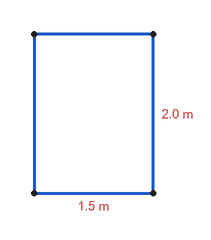
Which is the largest of these square sheets that can pass through the doorway?
- 72 marks
Question 7
Competency: Application
A ship leaves a port and sails 24 km due east. It then turns and sails 7 km due south. From there it returns straight to the port.
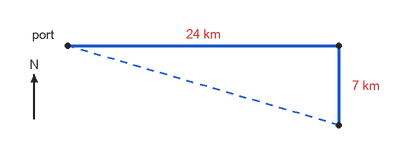
Find the length of the return journey and the total distance of the trip.
- 82 marks
Question 8
Competency: Evaluation
Mira is asked to classify a triangle with sides 8 cm, 15 cm and 18 cm. She writes:
" and . These are not equal, so the triangle is not right-angled. Hence it is an acute-angled triangle."
Which part of her answer is correct and which part is wrong? Classify the triangle correctly.
- 92 marks
Question 9
Competency: Analysis
Study these Pythagorean triplets.
Smallest number Other two numbers 3 4, 5 5 12, 13 7 24, 25 9 40, 41 (a) In each row, how is the square of the smallest number related to the other two numbers?
(b) Use the pattern to write the triplet whose smallest number is 11. Verify that it is a Pythagorean triplet.
- 102 marks
Question 10
Competency: Application
The front of a tent is an isosceles triangle. Each slanting edge is 2.5 m long and the base on the ground is 3 m wide. A pole stands upright at the middle of the base and reaches the top of the tent.
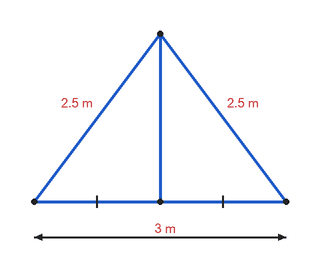
Find the height of the pole.
- 113 marks
Question 11
Competency: Application & Analysis
A hall is 12 m long, 9 m wide and 8 m high. ABCD is its floor and G is the ceiling corner directly above C. An electrician has to take a cable from the floor corner A to the ceiling corner G.
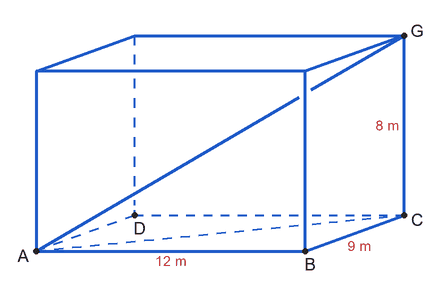
(a) Find the length of the floor diagonal AC.
(b) Find the length of a cable stretched straight from A to G.
(c) If the cable is instead laid along the floor from A to C and then up the wall from C to G, how much more cable is needed?
- 123 marks
Question 12
Competency: Creativity
A gardener has exactly 60 m of fencing. Design a flower bed in the shape of a right-angled triangle that uses all the fencing, with every side a whole number of metres.
(a) Write the three sides of your flower bed. Show that it is right-angled and that its perimeter is 60 m.
(b) Find the area of your flower bed.
- 133 marks
Question 13
Competency: Analysis & Evaluation
A ladder 2.5 m long leans against a vertical wall. Its foot P is 0.7 m from the wall and its top is at A. The foot is then pulled 0.8 m further away from the wall, to Q, and the top slides down to B.
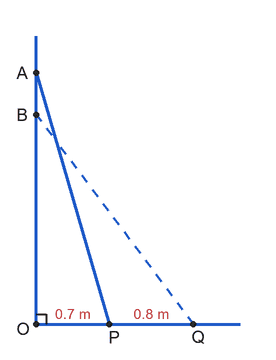
Sana says, "The foot moved 0.8 m, so the top also came down by 0.8 m."
(a) Find the height OA reached by the ladder at first.
(b) Find the height OB reached after the foot is pulled out.
(c) Is Sana right? Justify your answer.
- 145 marks
Question 14
Competency: Application & Analysis
Case study — A delivery drone
A drone starts from a warehouse W. House A is 15 km east and 8 km north of W. House B is 15 km east and 20 km south of W. In the sketch, M is the point 15 km due east of W, so A, M and B lie on one north–south line.
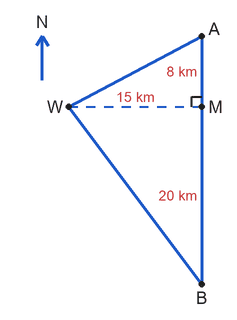
(a) Find the straight-line distances WA and WB.
(b) The drone flies W → A → B → W in straight lines. On one charge it can fly 65 km. Can it complete the round trip on one charge? Show your working.
(c) Without measuring, decide whether ∠AWB is a right angle, an acute angle or an obtuse angle.
- 154 marks
Question 15
Competency: Analysis & Evaluation
Case study — Checking steel brackets
A workshop makes triangular steel brackets. Each bracket must have a right angle between its two shorter sides. An inspector measures the sides of three brackets.
Bracket Side 1 Side 2 Side 3 P 12 cm 35 cm 37 cm Q 10 cm 15 cm 18 cm R 16 cm 30 cm 35 cm (a) Which bracket passes the test? Show the working.
(b) For each of the other two brackets, decide whether the angle between the two shorter sides is acute or obtuse.
(c) Bracket R is to be corrected by changing only its longest side. What should the new length be? Name the basic Pythagorean triplet of which the corrected bracket is a multiple.
- 161 mark
Question 16
Competency: Analysis
A lotus bud stands 0.3 m above the still water of a pond, on a straight stem fixed at the bottom of the pond. A gentle wind pushes the stem sideways until the bud just touches the water surface at a point 0.9 m from the place where the stem first came out of the water. The stem stays straight. The depth of the pond is
- 171 mark
Question 17
Competency: Analysis
A triangle has sides 9 cm, 12 cm and cm, where is a whole number. For which of the following values of is the triangle obtuse-angled?
- 181 mark
Question 18
Competency: Evaluation
Assertion (A): The numbers 15, 36 and 39 form a Pythagorean triplet.
Reason (R): If the same number is added to each member of a Pythagorean triplet, the three new numbers also form a Pythagorean triplet.
- 191 mark
Question 19
Competency: Analysis
Assertion (A): In , cm and cm. The perpendicular AD drawn from A to BC is 15 cm long.
Reason (R): The perpendicular drawn from the vertex joining the two equal sides of an isosceles triangle to the base bisects the base.
- 201 mark
Question 20
Competency: Application
A vertical pole 15 m high is held straight by two taut steel wires. Each wire is tied to the top of the pole and to a peg in the level ground. The pegs are on opposite sides of the pole, 8 m and 20 m from its foot. The total length of the two wires is
- 211 mark
Question 21
Competency: Analysis
The three sides of a right-angled triangle are consecutive whole numbers of centimetres. The perimeter of the triangle is
- 221 mark
Question 22
Competency: Understanding
In , it is given that . Which statement is true?
- 231 mark
Question 23
Competency: Application
The figure shows a vegetable plot ABCD. Side , , m, m and m. A fence is to be put along the slanting side BC.
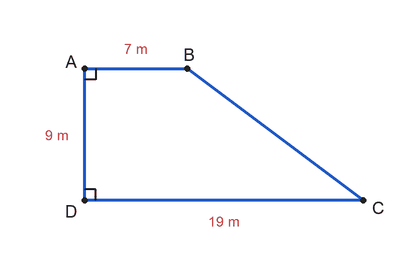
The length of the fence is
- 241 mark
Question 24
Competency: Application
The sides of a right-angled triangle are in the ratio and its perimeter is 120 cm. The area of the triangle is
- 251 mark
Question 25
Competency: Application
A straight plank 4.1 m long is used as a ramp for a goods trolley. Its upper end rests on a platform 0.9 m above the level ground. The horizontal distance between the lower end of the plank and the foot of the platform is
- 262 marks
Question 26
Competency: Creativity
A tile-maker wants a right-angled triangular tile whose three sides are whole numbers of centimetres. The longest side is to be between 50 cm and 60 cm, and the three sides must not be a multiple of .
(a) Write down one set of three side lengths that meets these conditions.
(b) Check your answer with Pythagoras theorem.
- 272 marks
Question 27
Competency: Analysis
A Wi-Fi router is fixed at a point O in a school playground. Its signal is strong enough at every point that is 50 m or less from O. The table shows where three classrooms are, measured from O along two straight paths at right angles to each other. (Hypothetical data.)
Classroom Distance east of O (m) Distance north of O (m) P 21 28 Q 30 40 R 45 28 Which classrooms get a strong signal? Show your working.
- 282 marks
Question 28
Competency: Evaluation
Hamid says, "A square of side 5 cm has a diagonal of 10 cm, because the diagonal goes across two sides of 5 cm each."
(a) Is Hamid correct? Support your answer with Pythagoras theorem.
(b) Find the length of the diagonal correct to one decimal place.
- 292 marks
Question 29
Competency: Application
A park swing has a seat hanging from a horizontal bar by straight chains 2.5 m long. At rest, the seat hangs straight down and is 0.5 m above the level ground. A child on the swing is pulled back until the seat is 1.5 m, measured horizontally, from its rest position, with the chains still straight. (Treat the seat as a point.)
(a) How far below the bar is the seat now?
(b) How high above the ground is the seat now?
- 302 marks
Question 30
Competency: Application
A rescue helicopter hovers 150 m vertically above a point H on level ground. A stranded trekker stands on the ground at a point 200 m from H.
(a) Find the straight-line distance from the helicopter to the trekker.
(b) The pilot flies in a straight line from the hovering point down to the trekker at a steady 10 m/s. How long does this take?
- 312 marks
Question 31
Competency: Application
A square glass window pane ABCD has sides of 60 cm. A decorative strip is fixed from the corner A to the middle point E of the side BC, as shown.
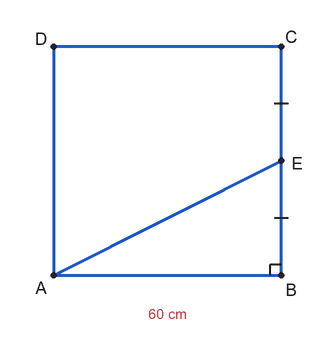
Find the length of the strip to the nearest centimetre. Take .
- 323 marks
Question 32
Competency: Analysis
A rectangular vegetable plot has a fence of total length 34 m all round it. A wire stretched between two opposite corners is 13 m long. Find the length and breadth of the plot and its area.
- 333 marks
Question 33
Competency: Analysis & Evaluation
A boat is pulled towards a vertical wall of a pier, 6 m high, by a rope tied to the boat. The rope passes over a pulley fixed at the top of the wall. Treat the boat as a point at water level. At first the boat is 8 m from the foot of the wall. Then 3.5 m of rope is pulled in at the pulley end, and the rope stays straight and tight.
Asha says, "I pulled in 3.5 m of rope, so the boat has moved 3.5 m." Is Asha correct? Find how far the boat really moved.
- 343 marks
Question 34
Competency: Analysis & Evaluation
Rani writes Pythagorean triplets with the rule , where is a whole number greater than 1.
(a) Write the triplet that Rani gets for and check it.
(b) Rani says, "Every Pythagorean triplet can be written in this form." Show that she is wrong by using the numbers 9, 40 and 41.
- 353 marks
Question 35
Competency: Application & Analysis
Two friends start together from a crossing. Kabir cycles due east at 12 km/h and Leena cycles due north at 9 km/h.
(a) How far apart are they after 40 minutes?
(b) After how many minutes will they be exactly 25 km apart?
- 363 marks
Question 36
Competency: Application & Understanding
A triangular park has sides 35 m, 37 m and 12 m.
(a) Show that the park has a right-angled corner. Between which two sides does the right angle lie?
(b) Grass is to be laid over the whole park at ₹ 60 per m. Find the cost.
- 375 marks
Question 37
Competency: Application & Analysis
Case study — A village map
On the map, each small square is 100 m by 100 m. A school S, a temple T and a market M are at corners of squares. People now go from S to M by the road S → T → M. The panchayat plans a new straight road directly from S to M, shown by the dashed line. (Hypothetical data.)

(a) Count squares and find the lengths of the roads ST and TM, in metres.
(b) Is a right angle, an acute angle or an obtuse angle? Give a reason.
(c) Find the length of the new road SM to the nearest 10 m, and say how much shorter it is than the road S → T → M.
- 384 marks
Question 38
Competency: Analysis & Evaluation
Case study — Ladder safety in a school store
A school store has three ladders. A safety rule says that when a ladder leans on a wall, its foot must be at least one-third as far from the wall as the height reached by its top. The table gives the length of each ladder and how far its foot is from the wall. (Hypothetical data.)
Ladder Length (m) Foot from the wall (m) P 5 1.4 Q 6.5 2.5 R 8.5 4 (a) Find the height on the wall reached by each ladder.
(b) Which ladders follow the safety rule?
(c) Ladder P does not follow the rule. Find the least distance from the wall at which its foot can be placed so that it follows the rule. Give the answer correct to two decimal places, taking .
- 394 marks
Question 39
Competency: Application & Evaluation
Case study — A ropeway to a hill temple
A hill temple is reached by a two-stage ropeway. The cable car moves at a steady 5 m/s along straight cables. The road to the temple is 2.4 km long. The table shows the two stages of the ropeway. (Hypothetical data.)
Stage Horizontal distance (m) Height gained (m) 1 480 140 2 400 300 (a) Find the length of the cable in each stage.
(b) Find the total length of the ropeway and the time taken for the whole journey.
(c) A tourist says, "The ropeway journey is less than half the distance by road." Is she correct? Give a reason.
- 404 marks
Question 40
Competency: Analysis & Evaluation
Case study — Raising a wardrobe
In Dev's bedroom the ceiling is 2.6 m high. A new wardrobe is a box 2.4 m high. It is delivered lying on its back and has to be turned upright. While it is being raised, it turns about the lower edge of its side, and the top corner of the side moves in a circle. The wardrobe can be raised only if the diagonal of its side (height by depth) is less than the ceiling height. (Hypothetical data.)
(a) The depth of wardrobe A is 0.7 m. Find the diagonal of its side and say whether it can be raised.
(b) The depth of wardrobe B is 1.0 m. Find the diagonal of its side and explain why B cannot be raised in this room.
(c) The shop offers a 2.4 m high wardrobe C with a depth of 0.9 m. By comparing squares, decide whether C can be raised.