
Question 113 marksMedium
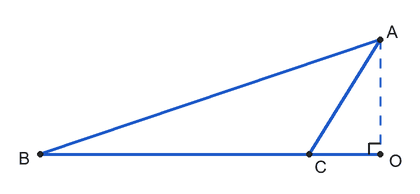
In triangle ABC, given below, AB = 8 cm, BC = 6 cm and AC = 3 cm. Calculate the length of OC.
Confirming your payment
Sign up now and get 250 free tokens.
Pythagoras Theorem · Question 11 of 41
In triangle ABC, given below, AB = 8 cm, BC = 6 cm and AC = 3 cm. Calculate the length of OC.
Solution:
Concept: Pythagoras' theorem: in a right-angled triangle, the square on the hypotenuse (the side opposite the right angle) equals the sum of the squares on the other two sides: . When two right triangles share a side, write that side's square from each triangle and equate.
Given: AB = 8 cm, BC = 6 cm, AC = 3 cm, AO ⟂ BC produced.
Step 1 — Name the unknown.
The figure shows AO perpendicular to BC produced, with C between B and O. Let OC = cm; then OB is cm, because OB is made up of BC and CO.
Step 2 — Write AO² from right triangle AOC.
AC is the hypotenuse of right triangle AOC.
Step 3 — Write AO² from right triangle AOB.
AB is the hypotenuse of right triangle AOB.
Step 4 — Equate the two expressions and solve.
Both expressions equal AO², so they are equal to each other.
So OC is cm, or cm.
Watch out: , not ; the terms then cancel.
Therefore, OC = cm.