
Question 123 marksEasy
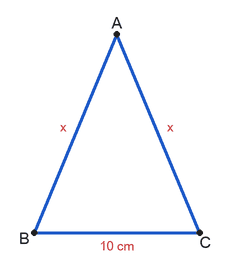
In triangle ABC,
AB = AC = ; BC = 10 cm and the area of the triangle is 60 cm². Find .
Confirming your payment
Sign up now and get 250 free tokens.
Pythagoras Theorem · Question 12 of 41
In triangle ABC,
AB = AC = ; BC = 10 cm and the area of the triangle is 60 cm². Find .
Solution:
Concept: In an isosceles triangle (and so in an equilateral triangle), the perpendicular from the top vertex to the base bisects the base. It splits the triangle into two right-angled triangles, where Pythagoras' theorem applies.
Given: AB = , AC = , BC = 10 cm, area of ΔABC = 60 cm².
Step 1 — Find the height from the area.
Draw AD perpendicular to BC. The area is half the base times the height.
So the height AD is 12 cm, because only 12 makes the area 60 cm².
Step 2 — Find BD.
AB = AC, so the perpendicular AD bisects BC: BD = 5 cm.
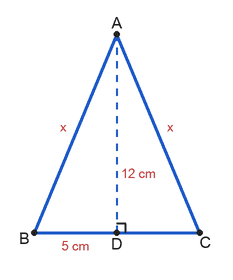
Step 3 — Use Pythagoras' theorem in right triangle ADB.
AB = is the hypotenuse.
A length is positive, so .
Watch out: Use half the base, BD = 5 cm, in the right triangle.
Therefore, = 13 cm.