
Question 103 marksEasy
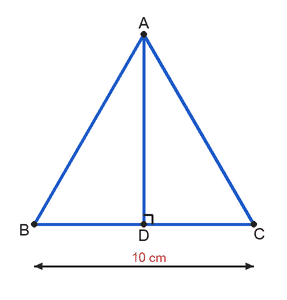
AD is drawn perpendicular to base BC of an equilateral triangle ABC. Given BC = 10 cm, find the length of AD, correct to 1 place of decimal.
Confirming your payment
Sign up now and get 250 free tokens.
Pythagoras Theorem · Question 10 of 41
AD is drawn perpendicular to base BC of an equilateral triangle ABC. Given BC = 10 cm, find the length of AD, correct to 1 place of decimal.
Solution:
Concept: In an isosceles triangle (and so in an equilateral triangle), the perpendicular from the top vertex to the base bisects the base. It splits the triangle into two right-angled triangles, where Pythagoras' theorem applies.
Given: Equilateral triangle ABC, BC = 10 cm, AD ⟂ BC.
Step 1 — Find BD.
In an equilateral triangle the perpendicular AD bisects BC, so BD = 5 cm. Also, AB = 10 cm, because all three sides are equal.
Step 2 — Find AD in right triangle ADB.
AB is the hypotenuse of right triangle ADB.
Watch out: Round only at the end: 8.66 rounds to 8.7.
Therefore, AD = cm ≈ 8.7 cm (correct to 1 decimal place).