
Question 223 marksMedium
M and N are the mid-points of the sides QR and PQ respectively of a Δ PQR, right-angled at Q.
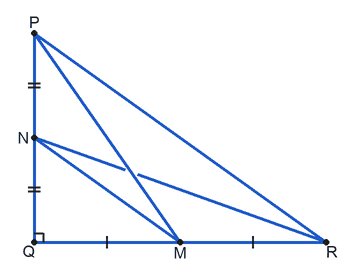
Prove that :
(i) PM² + RN² = 5 MN²
(ii) 4 PM² = 4 PQ² + QR²
(iii) 4 RN² = PQ² + 4 QR²
(iv) 4 (PM² + RN²) = 5 PR²
Confirming your payment
Sign up now and get 250 free tokens.
Pythagoras Theorem · Question 22 of 41
M and N are the mid-points of the sides QR and PQ respectively of a Δ PQR, right-angled at Q.
Prove that :
(i) PM² + RN² = 5 MN²
(ii) 4 PM² = 4 PQ² + QR²
(iii) 4 RN² = PQ² + 4 QR²
(iv) 4 (PM² + RN²) = 5 PR²
Solution:
Concept: Pythagoras' theorem: in a right-angled triangle, the square on the hypotenuse (the side opposite the right angle) equals the sum of the squares on the other two sides: . A mid-point halves a side, so its square is a quarter: .
Given: ΔPQR with ∠Q = 90°, M the mid-point of QR, N the mid-point of PQ.
Step 1 — List the right triangles.
∠Q = 90°, and M, N lie on QR, PQ. So triangles PQM, NQR, NQM and PQR are all right-angled at Q, with QM = ½QR and QN = ½PQ.
Step 2 — Write each square.
We use Pythagoras' theorem in each of the four triangles.
Step 3 — Part (i).
We add PM² and RN² and take out the common factor.
Step 4 — Part (ii).
We multiply the expression for PM² by 4.
Step 5 — Part (iii).
We multiply the expression for RN² by 4.
Step 6 — Part (iv).
We add the results of parts (ii) and (iii).
Watch out: , not .
Therefore, all four results are true: PM² + RN² = 5MN², 4PM² = 4PQ² + QR², 4RN² = PQ² + 4QR² and 4(PM² + RN²) = 5PR². Hence proved.