
Question 31 markMCQEasy
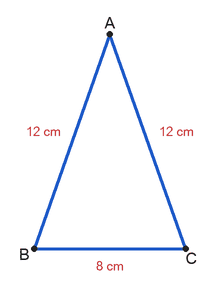
ABC is an isosceles triangle with AB = AC = 12 cm and BC = 8 cm. The area of the triangle is :
Confirming your payment
Sign up now and get 250 free tokens.
Pythagoras Theorem · Question 3 of 41
ABC is an isosceles triangle with AB = AC = 12 cm and BC = 8 cm. The area of the triangle is :
(A) cm²
(B) cm²
(C) cm²
(D) cm²
Answer: (A) cm²
Concept: In an isosceles triangle (and so in an equilateral triangle), the perpendicular from the top vertex to the base bisects the base. It splits the triangle into two right-angled triangles, where Pythagoras' theorem applies.
Step 1 — Draw the height.
Draw AD perpendicular to BC. Since AB = AC, D is the mid-point of BC, so BD = 4 cm.

Step 2 — Find AD in right triangle ABD.
AB is the hypotenuse of right triangle ABD.
So AD is cm.
Step 3 — Find the area.
The area of a triangle is half the base times the height.
So the area is cm².
Watch out: Use half the base (4 cm), not the whole base, inside Pythagoras' theorem.
Why the other options are wrong:
Therefore, the area is cm², option (A).