
Question 353 marksMedium
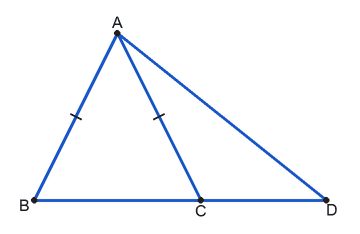
In an isosceles triangle ABC; AB = AC and D is a point on BC produced. Prove that :
AD² = AC² + BD.CD.
Confirming your payment
Sign up now and get 250 free tokens.
Pythagoras Theorem · Question 35 of 41
In an isosceles triangle ABC; AB = AC and D is a point on BC produced. Prove that :
AD² = AC² + BD.CD.
Solution:
Concept: Pythagoras' theorem: in a right-angled triangle, the square on the hypotenuse (the side opposite the right angle) equals the sum of the squares on the other two sides: .
A difference of squares factorises: .
Given: AB = AC, D on BC produced.
Step 1 — Construction.
Draw AE ⟂ BC. Since AB = AC, E is the mid-point of BC, so BE = EC.
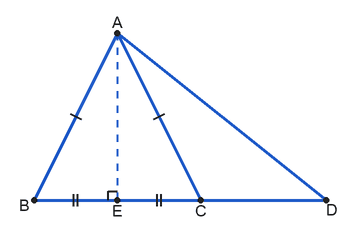
Step 2 — Two right triangles.
Triangles AED and AEC are right-angled at E.
Step 3 — Subtract.
We subtract the second line from the first; AE² cancels, and we factorise the difference of squares.
Step 4 — Read the two brackets.
D lies on BC produced beyond C, so ED − EC = CD. Also, EC = BE; so ED + EC equals ED + BE, which is the whole of BD.
Watch out: ED + EC equals BD only because EC = BE (E is the mid-point).
Therefore, AD² = AC² + BD·CD. Hence proved.