
Question 313 marksEasy
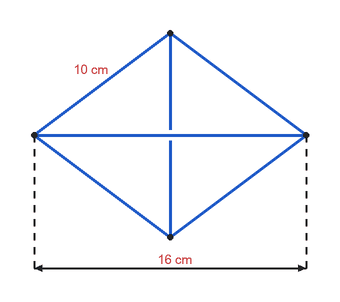
If a side of a rhombus is 10 cm and one of the diagonals is 16 cm, find the other diagonal.
Confirming your payment
Sign up now and get 250 free tokens.
Pythagoras Theorem · Question 31 of 41
If a side of a rhombus is 10 cm and one of the diagonals is 16 cm, find the other diagonal.
Solution:
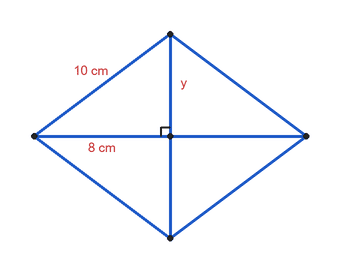
Concept: The diagonals of a rhombus bisect each other at right angles, so a side is the hypotenuse of a right triangle whose legs are half of each diagonal.
Given: Side 10 cm, one diagonal 16 cm.
Step 1 — Use the diagonal property.
The diagonals of a rhombus bisect each other at right angles. Half of the 16 cm diagonal is 8 cm; let half of the other diagonal be cm. A side (10 cm) is the hypotenuse.
Step 2 — Use Pythagoras' theorem.
We subtract the known square from the square of the side.
A length is positive, so .
Step 3 — Double it.
The other diagonal is twice its half.
Watch out: 6 cm is only half of the diagonal; double it.
Therefore, the other diagonal is 12 cm.