
Question 161 markMCQEasy
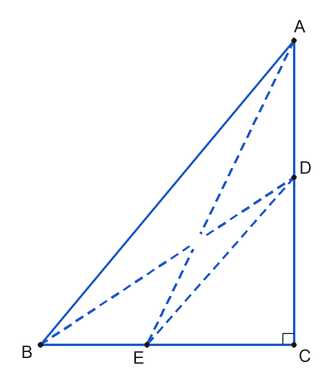
In the given diagram, AE² + BD² is equal to :
Confirming your payment
Sign up now and get 250 free tokens.
Pythagoras Theorem · Question 16 of 41
In the given diagram, AE² + BD² is equal to :
(A) AB² – DE²
(B) DE² – AB²
(C) AB² + DE²
(D) DE × AB
Answer: (C) AB² + DE²
Concept: Pythagoras' theorem: in a right-angled triangle, the square on the hypotenuse (the side opposite the right angle) equals the sum of the squares on the other two sides: .
Step 1 — Spot the right triangles.
The figure marks ∠C = 90°. D lies on CA and E lies on CB, so the triangles ACE, BCD, ACB and DCE are all right-angled at C.
Step 2 — Write the two given squares.
AE is the hypotenuse of triangle ACE, and BD is the hypotenuse of triangle BCD.
Step 3 — Add and regroup.
We add the two lines and group the terms in pairs.
The first bracket is AB² (triangle ACB) and the second is DE² (triangle DCE).
Watch out: Every segment in the figure that joins a point of CA to a point of CB is a hypotenuse.
Why the other options are wrong:
Therefore, , option (C).