
Opening your dashboard
Class 9 Chemistry Chapter 4: Atomic Structure and Chemical Bonding Solutions
122 textbook questions with step-by-step answers, free to read, for ICSE 2026-27.
Get talked through Ch 4, not just shown the answer
Reading a finished solution is not the same as being able to do it. The AI tutor takes one question at a time and works it with you, in your own words, until you can.
- Ask it out loud, in your own words
- It gives you the next step, not the answer
- Stuck on part (ii)? Start there
122 questions with solutions
1–5 marks · Mixed difficulty
- 14 marks
Question 1
What is the contribution of the following in Atomic structure
(a) Maharshi Kanada
(b) Democritus ?
Solve with AIWritten solution
Solution:
Concept: Long before any experiment, thinkers in India and Greece suggested that matter cannot be divided forever: it must end in tiny particles that cannot be divided further.
Step 1 — (a) Maharshi Kanada.
The Indian philosopher Maharshi Kanada said that if we keep dividing matter, we finally reach extremely small particles that cannot be divided any further. He called these particles parmanu.
Step 2 — (a) How parmanu join.
He also said that parmanu combine with one another to form bigger particles, which he called anu (today we would call them molecules).
Step 3 — (b) Democritus.
The Greek philosopher Democritus also said that matter is made of tiny indivisible particles. He called them atomos, which means 'that which cannot be divided'.
Step 4 — (b) Link to today's word.
Our word atom comes from his word 'atomos'.
Watch out: These were ideas based on reasoning, not on experiments; experimental atomic theory began with Dalton.
Therefore, Maharshi Kanada called the smallest particles of matter parmanu (which join to form anu), and Democritus called them atomos, the origin of the word atom.
- 22 marks
Question 2
State Dalton's atomic theory.
Solve with AIWritten solution
Solution:
Concept: In 1808 John Dalton gave the first atomic theory based on experimental laws of chemical combination. It has a set of statements called postulates.
Step 1 — What matter is made of.
All matter is made up of extremely small particles called atoms.
Step 2 — Atoms cannot be divided, created or destroyed.
Atoms are indivisible: they cannot be broken into smaller particles. Atoms can neither be created nor destroyed.
Step 3 — Atoms of the same and of different elements.
Atoms of the same element are identical in size, mass and properties. Atoms of different elements differ in size, mass and properties.
Step 4 — How atoms form compounds.
Atoms of different elements combine in simple whole-number ratios to form compounds (Dalton called the particles of a compound 'compound atoms').
Step 5 — What happens in a reaction.
In a chemical reaction, atoms are only rearranged; no atom is lost or made.
Watch out: Parts of this theory were later found to be wrong: atoms can be divided (into electrons, protons and neutrons), and atoms of one element can have different masses (isotopes).
Therefore, Dalton's theory states that matter is made of indivisible, indestructible atoms; atoms of one element are identical and differ from those of other elements; and atoms combine in simple whole-number ratios and are only rearranged in reactions.
- 32 marks
Question 3
What is an (alpha) particle ?
Solve with AIWritten solution
Solution:
Concept: Some radioactive elements give out fast-moving particles called alpha (α) particles.
Step 1 — Say what the particle is.
An alpha particle is the nucleus of a helium atom, without its two electrons, written .
Step 2 — Count its particles.
It contains 2 protons and 2 neutrons and no electrons.
Step 3 — Work out its charge and mass.
The 2 protons give it a charge of +2, and its 4 nucleons give it a mass of about 4 u.
Step 4 — Where it was used.
Rutherford fired fast alpha particles at a thin gold foil in his scattering experiment, which led to the discovery of the nucleus.
Watch out: An alpha particle is not a helium atom; it has no electrons, so it is positively charged.
Therefore, an alpha particle is a helium nucleus with 2 protons and 2 neutrons, a charge of +2 and a mass of 4 u.
- 42 marks
Question 4
What are cathode rays? How are these rays formed?
Solve with AIWritten solution
Solution:
Concept: A discharge tube is a sealed glass tube with two metal electrodes: the cathode (negative) and the anode (positive). Gases normally do not conduct electricity, but at very low pressure and high voltage they do.
Step 1 — Define cathode rays.
Cathode rays are streams of fast-moving, negatively charged particles (electrons) that travel from the cathode towards the anode in a discharge tube.
Step 2 — Set up the tube.
A gas is taken in the discharge tube and pumped out until its pressure is very low (about 0.01 mm of mercury).
Step 3 — Apply a high voltage.
A high voltage (about 10,000 volts) is applied across the two electrodes.
Step 4 — Observe the rays.
Rays now start from the cathode and travel in straight lines towards the anode. When they strike the glass at the far end, it glows (fluorescence). These rays are the cathode rays.

Watch out: Cathode rays come out of the cathode, but they are made of electrons, which are present in the atoms of every substance.
Therefore, cathode rays are streams of electrons, formed when a high voltage is applied across a gas at very low pressure in a discharge tube.
- 52 marks
Question 5
What is the nature of charge on
(i) cathode rays
(ii) anode rays ?
Solve with AIWritten solution
Solution:
Concept: Cathode rays are streams of electrons. Anode rays (canal rays) are streams of positive ions, formed when electrons knock other electrons out of the gas atoms.
Step 1 — (i) Cathode rays.
Cathode rays are made of electrons, so they carry a negative charge. They bend towards the positive plate in an electric field.
Step 2 — (ii) Anode rays.
Anode rays are made of positively charged ions of the gas, so they carry a positive charge. They bend towards the negative plate in an electric field.
Watch out: The names describe where the rays come from, not their charge: rays coming from the cathode side are negative.
Therefore, (i) cathode rays are negatively charged and (ii) anode rays are positively charged.
- 62 marks
Question 6
How are X-rays produced ?
Solve with AIWritten solution
Solution:
Concept: When very fast-moving electrons are suddenly stopped, part of their energy is given out as highly penetrating radiation called X-rays.
Step 1 — Produce fast cathode rays.
A discharge tube (X-ray tube) produces a stream of fast-moving cathode rays (electrons).
Step 2 — Stop them with a metal target.
A target of a heavy metal with a very high melting point, such as tungsten, is placed in the path of the cathode rays.
Step 3 — Energy is changed into X-rays.
When the electrons strike the target they stop suddenly. A small part of their energy (about 1 %) is given out as X-rays; the rest becomes heat. This is why the target must have a very high melting point.
Watch out: X-rays are not a kind of cathode ray; they are electromagnetic radiation (like light, but far more penetrating) and carry no charge.
Therefore, X-rays are produced when fast-moving cathode rays strike a heavy metal target of high melting point, such as tungsten.
- 72 marks
Question 7
Why were anode rays also called as 'canal rays' ?
Solve with AIWritten solution
Solution:
Concept: In 1886 Goldstein found rays of positive particles in a discharge tube. They move in the opposite direction to cathode rays, that is, towards the cathode.
Step 1 — Describe the cathode used.
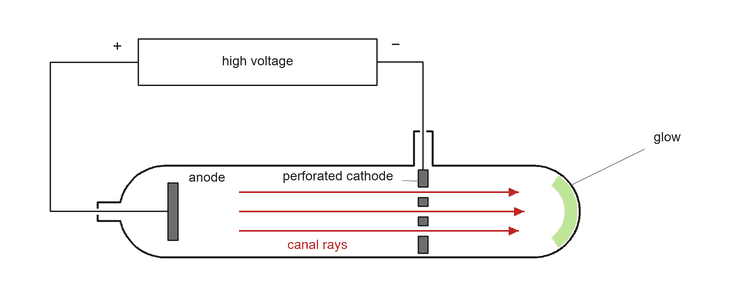
Goldstein used a perforated cathode: a cathode with small holes, or 'canals', in it.
Step 2 — Follow the positive rays.
The positive rays travelled towards the cathode, passed through the holes (canals) and were seen as a glow behind the cathode.
Step 3 — Give the reason for the name.
Because these rays came through the canals of the cathode, they were called canal rays.
Watch out: Anode rays are not given out by the anode itself; they are positive ions formed from the gas in the tube.
Therefore, anode rays were called canal rays because they passed through the holes (canals) of the perforated cathode.
- 82 marks
Question 8
How do cathode rays differ from anode rays ?
Solve with AIWritten solution
Solution:
Concept: Both kinds of rays are seen in a discharge tube. Cathode rays are electrons; anode rays are positive ions of the gas in the tube.
Step 1 — Compare the two kinds of rays point by point.
The table compares their particles, direction, behaviour in an electric field, dependence on the gas and mass.
Property Cathode rays Anode rays Particles Negatively charged electrons Positively charged ions of the gas Direction From the cathode towards the anode Towards the cathode (and through holes in it) In an electric field Bend towards the positive plate Bend towards the negative plate Effect of the gas Same particles whatever the gas Particles depend on the gas in the tube Mass of a particle Very small (1/1837 of a hydrogen atom) About the mass of an atom of the gas Watch out: The electron is the same in every gas, but the anode-ray particle changes with the gas; only with hydrogen gas is it a single proton.
Therefore, cathode rays are light, negative electrons moving towards the anode and are the same for every gas, while anode rays are heavier positive ions moving towards the cathode and depend on the gas.
- 92 marks
Question 9
State one observation which shows that atom is not indivisible.
Solve with AIWritten solution
Solution:
Concept: Dalton said atoms cannot be divided. If smaller particles can be taken out of an atom, the atom must be made of those smaller particles.
Step 1 — Recall the observation.
In a discharge tube, cathode rays (electrons) are given out whatever gas is used, and the electrons are always the same.
Step 2 — Explain what it shows.
These electrons come from inside the atoms of the gas. So every atom contains still smaller particles, which means the atom can be divided.
Therefore, the discharge of electrons (cathode rays) from the atoms of every gas shows that the atom is not indivisible.
- 103 marks
Question 10
(a) Name an element which does not contain neutron.
(b) If an atom contains one electron and one proton, will it carry any charge or not ?
Solve with AIWritten solution
Solution:
Concept: An atom is neutral when its positive charge (protons, +1 each) equals its negative charge (electrons, −1 each). Neutrons have no charge.
Step 1 — (a) Find an atom with no neutron.
The ordinary hydrogen atom, protium , has 1 proton and 1 electron but no neutron.
Step 2 — (b) Add up the charges.
The proton carries +1 and the electron carries −1:
Step 3 — (b) Draw the conclusion.
The charges cancel, so the atom carries no charge. Such an atom is a hydrogen atom.
Watch out: Deuterium and tritium are also hydrogen but do have neutrons; only protium has none.
Therefore, (a) hydrogen (protium) has no neutron, and (b) an atom with one proton and one electron carries no charge.
- 112 marks
Question 11
On the basis of Thomson's model of an atom, explain how an atom as a whole is neutral.
Solve with AIWritten solution
Solution:
Concept: In 1904 J.J. Thomson suggested that an atom is a sphere of positive charge with electrons embedded in it, like seeds in a watermelon (the 'plum pudding' model).
Step 1 — Describe the model.
The atom is a uniform sphere of positive charge, and the electrons are embedded in it here and there.
Step 2 — Compare the two charges.
According to Thomson, the total positive charge of the sphere is equal to the total negative charge of all the electrons in it.
Step 3 — Conclude.
Equal and opposite charges cancel each other, so the atom as a whole is electrically neutral.
Therefore, in Thomson's model the positive charge of the sphere exactly balances the negative charge of the embedded electrons, so the atom is neutral.
- 123 marks
Question 12
Which sub-atomic particle was discovered by
(a) Thomson
(b) Goldstein
(c) Chadwick ?
Solve with AIWritten solution
Solution:
Concept: The three sub-atomic particles were discovered by different scientists using different experiments.
Step 1 — (a) Thomson.
J.J. Thomson studied cathode rays and in 1897 showed that they are made of electrons.
Step 2 — (b) Goldstein.
Goldstein discovered the positive anode (canal) rays in 1886. They led to the discovery of the proton (the particle itself was identified and named later by Rutherford).
Step 3 — (c) Chadwick.
James Chadwick discovered the neutral neutron in 1932.
Therefore, Thomson discovered the electron, Goldstein the proton (through canal rays) and Chadwick the neutron.
- 133 marks
Question 13
Name the sub-atomic particle whose charge is :
(a) +1
(b) −1
(c) 0.
Solve with AIWritten solution
Solution:
Concept: Each sub-atomic particle has a fixed relative charge: proton +1, electron −1, neutron 0.
Step 1 — (a) Charge +1.
The positively charged particle is the proton.
Step 2 — (b) Charge −1.
The negatively charged particle is the electron.
Step 3 — (c) Charge 0.
The particle with no charge is the neutron.
Therefore, the particles are (a) proton, (b) electron and (c) neutron.
- 145 marks
Question 14
(a) Which metal did Rutherford select for his particle scattering experiment and why ?
(b) What do you think would be the observation of -particle scattering experiment if carried out on
(i) heavy nucleus like platinum
(ii) light nuclei like lithium ?
Solve with AIWritten solution
Solution:
Concept: In the alpha-scattering experiment, alpha particles (+2) are deflected by the positive nucleus. The bigger the charge of the nucleus, the more often and the more strongly they are turned aside.
Step 1 — (a) Name the metal.
Rutherford used a foil of gold.
Step 2 — (a) Give the reason.
Gold is the most malleable metal, so it can be beaten into an extremely thin foil, about 0.00004 cm thick. A gold atom is about 0.29 nm across, so the foil is only about 1,400 atoms thick:
Alpha particles can pass through so thin a foil, so their deflections can be studied. Gold atoms are also heavy, with a large nuclear charge (+79).
Step 3 — (b)(i) Platinum, a heavy nucleus.
Platinum (+78) has a heavy nucleus with a large positive charge, like gold. So the results would be the same as with gold: most alpha particles pass straight through, some are deflected through small angles and a very few bounce back.
Step 4 — (b)(ii) Lithium, a light nucleus.
Lithium has a nucleus of charge only +3 and mass about 7 u. It repels the alpha particles far more weakly. Most alpha particles would pass straight through with only small deflections, and hardly any would bounce back. Large deflections become rarer as the square of the nuclear charge falls:
Watch out: The light nucleus still deflects some alpha particles; the point is that large deflections and rebounds become very rare.
Therefore, (a) Rutherford chose gold because it can be beaten into an extremely thin foil; (b) platinum would give the same results as gold, while lithium would give only small deflections with hardly any alpha particles bouncing back.
- 151 mark
Question 15
On the basis of Rutherford's model of an atom, which subatomic particle is present in the nucleus of an atom ?
Solve with AIWritten solution
Solution:
Concept: Rutherford concluded that an atom has a tiny, heavy, positively charged centre called the nucleus.
Step 1 — Link the charge to a particle.
The nucleus is positively charged, and the positive particles of an atom are the protons. So, on the basis of Rutherford's model, the protons are present in the nucleus.
Step 2 — Add what was found later.
The neutrons were discovered later (Chadwick, 1932) and are also in the nucleus.
Therefore, according to Rutherford's model, the protons are present in the nucleus of an atom.
- 161 mark
Question 16
Which part of an atom was discovered by Rutherford ?
Solve with AIWritten solution
Solution:
Concept: In the alpha-scattering experiment a very few alpha particles bounced back from the gold foil, which showed a small, heavy, positive centre inside the atom.
Step 1 — Name the part.
Rutherford called this small, dense, positively charged centre the nucleus.
Therefore, Rutherford discovered the nucleus of the atom.
- 172 marks
Question 17
How was it shown that atom has empty space ?
Solve with AIWritten solution
Solution:
Concept: If an atom were solid all through, alpha particles could not pass through even a very thin metal foil without being turned aside.
Step 1 — Recall the observation.
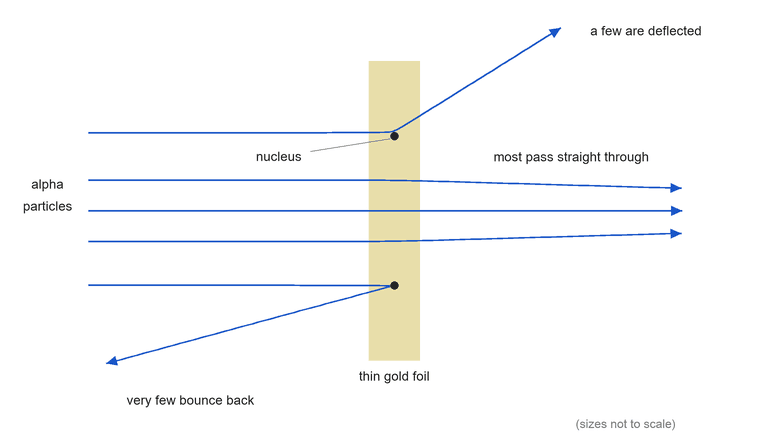
In Rutherford's alpha-scattering experiment, most of the alpha particles passed straight through the thin gold foil without any deflection.
Step 2 — Explain what it shows.
Since most alpha particles met nothing in their path, most of the space inside an atom must be empty.
Therefore, the straight passage of most alpha particles through the gold foil showed that an atom is mostly empty space.
- 182 marks
Question 18
State one major drawback of Rutherford's model.
Solve with AIWritten solution
Solution:
Concept: In Rutherford's model, electrons revolve round the nucleus like planets round the sun. By the laws of physics known then, a charged particle moving in a circle should keep giving out energy as radiation.
Step 1 — Apply the law to the electron.
A revolving electron should lose energy continuously.
Step 2 — Follow the result.
Losing energy, it would move in a smaller and smaller spiral and finally fall into the nucleus, so the atom would collapse.
Step 3 — State the drawback.
Atoms are in fact stable, so Rutherford's model could not explain the stability of the atom.
Therefore, the major drawback of Rutherford's model is that it could not explain the stability of the atom.
- 195 marks
Question 19
In the figure given alongside :

(a) Name the shells denoted by A, B and C. Which shell has least energy ?
(b) Name X and state the charge on it.
(c) The above sketch is of ________ model of an atom.
Solve with AIWritten solution
Solution:
Concept: In Bohr's model the electrons move in fixed shells round a small, positive nucleus. The shells are named K, L, M, N … outwards from the nucleus, and their energy increases outwards.
Step 1 — (a) Name the shells.
Counting outwards from the nucleus, A is the first shell (K shell), B is the second (L shell) and C is the third (M shell).
Step 2 — (a) Find the shell of least energy.
Energy increases as we move away from the nucleus, so the K shell (A), nearest the nucleus, has the least energy.
Step 3 — (b) Name X.
X is the centre of the atom, the nucleus. It contains the protons, so it carries a positive charge.
Step 4 — (c) Name the model.
A nucleus with electrons in fixed circular shells is the Bohr model of an atom.
Watch out: The outermost shell has the highest energy, not the lowest, even though it is the biggest.
Therefore, (a) A, B and C are the K, L and M shells, with K (A) of least energy; (b) X is the positively charged nucleus; (c) the sketch is of Bohr's model.
- 202 marks
Question 20
Give the postulates of Bohr's atomic model.
Solve with AIWritten solution
Solution:
Concept: In 1913 Niels Bohr improved Rutherford's model by placing electrons in fixed orbits of definite energy, which explained why atoms are stable.
Step 1 — Orbits.
Electrons revolve round the nucleus in definite circular paths called orbits, shells or energy levels.
Step 2 — Naming the orbits.
The orbits are numbered 1, 2, 3, 4 … or named K, L, M, N …, starting from the nucleus.
Step 3 — Fixed energy.
Each orbit has a fixed amount of energy, and the energy increases as we move away from the nucleus.
Step 4 — No energy change in an orbit.
While an electron stays in its orbit it neither loses nor gains energy, so it does not spiral into the nucleus.
Step 5 — Jumps between orbits.
An electron absorbs energy when it jumps from a lower orbit to a higher one, and gives out energy when it falls back from a higher orbit to a lower one.
Watch out: Energy is given out only when an electron falls to a lower orbit; staying in one orbit costs no energy.
Therefore, Bohr's postulates are: electrons move in fixed orbits (K, L, M, N …) of definite energy that rises outwards; no energy is lost in an orbit; and energy is absorbed or given out only when an electron jumps between orbits.
- 212 marks
Question 21
(a) Name the three fundamental particles of an atom.
(b) Give the symbol and charge of each particle.
Solve with AIWritten solution
Solution:
Concept: Every atom is built from three fundamental particles. Protons and neutrons are in the nucleus; electrons move in shells round it.
Step 1 — (a) Name the particles.
The three fundamental particles are the electron, the proton and the neutron.
Step 2 — (b) Give their symbols and charges.
The table lists each particle's symbol and relative charge.
Particle Symbol Charge Electron e (or ) −1 Proton p (or ) +1 Neutron n (or ) 0 (neutral) Therefore, the fundamental particles are the electron (e, −1), the proton (p, +1) and the neutron (n, 0).
- 224 marks
Question 22
Complete the table given below by identifying P, Q, R and S.
Element Symbol No. of Protons No. of Neutrons No. of Electrons Sodium 11 P 11 Chlorine Q 18 17 Uranium R 92 146 92 S 9 10 9 Solve with AIWritten solution
Solution:
Concept: In the symbol , the lower number Z is the atomic number. It equals the number of protons, and also the number of electrons in a neutral atom. The upper number A is the mass number, the total of protons and neutrons.
Step 1 — Find P, the neutrons in sodium.
Neutrons are found by subtracting the atomic number from the mass number:
Step 2 — Find Q, the protons in chlorine.
A neutral atom has as many protons as electrons. Chlorine has 17 electrons, so Q = 17 (its atomic number, as the symbol also shows).
Step 3 — Find R, the symbol of uranium.
The atomic number is the number of protons, 92. The mass number is protons plus neutrons:
So R = .
Step 4 — Find S, the element.
The symbol F with atomic number 9 belongs to fluorine. Its 10 neutrons check out:
Watch out: The symbol's top number is the mass number, not the number of neutrons.
Therefore, P = 12, Q = 17, R = ²³⁸₉₂U and S = fluorine.
- 232 marks
Question 23
The atom of an element is made up of 4 protons, 5 neutrons and 4 electrons. What are its atomic number and mass number ?
Solve with AIWritten solution
Solution:
Concept: The atomic number is the number of protons. The mass number is the number of protons plus neutrons.
Step 1 — Find the atomic number.
The atom has 4 protons, so its atomic number is 4.
Step 2 — Find the mass number.
Add the protons and the neutrons:
Step 3 — Identify the element.
The element with atomic number 4 is beryllium, .
Watch out: Electrons are not counted in the mass number; their mass is negligible.
Therefore, the atomic number is 4 and the mass number is 9.
- 242 marks
Question 24
The atomic number and mass number of sodium are 11 and 23 respectively. What information is conveyed by this statement?
Solve with AIWritten solution
Solution:
Concept: The atomic number gives the number of protons (and, in a neutral atom, of electrons). The mass number gives the number of nucleons, that is, protons plus neutrons.
Step 1 — Read the atomic number, 11.
A sodium atom has 11 protons in its nucleus. Being neutral, it also has 11 electrons, arranged 2, 8, 1 in the K, L and M shells.
Step 2 — Read the mass number, 23.
The nucleus contains 23 nucleons (protons + neutrons).
Step 3 — Work out the neutrons.
Subtract the protons from the nucleons:
Therefore, a sodium atom has 11 protons, 11 electrons (2, 8, 1) and 12 neutrons, with 23 nucleons in all.
- 252 marks
Question 25
Write down the names of the particles represented by the following symbols and explain the meaning of superscript and subscript numbers attached.
Solve with AIWritten solution
Solution:
Concept: In this older notation, the number written below (subscript) is the particle's charge, and the number written above (superscript) is its mass in atomic mass units (u).
Step 1 — The proton, .
This is the proton. The subscript 1 means a charge of +1, and the superscript 1 means a mass of about 1 u.
Step 2 — The neutron, .
This is the neutron. The subscript 0 means no charge, and the superscript 1 means a mass of about 1 u.
Step 3 — The electron, .
This is the electron. The subscript −1 means a charge of −1. The superscript 0 means its mass is negligible: about 1/1837 of the mass of a hydrogen atom.
Watch out: The electron's mass is not exactly zero; it is only so small that it is written as 0 on this scale.
Therefore, the symbols are the proton (charge +1, mass 1 u), the neutron (charge 0, mass 1 u) and the electron (charge −1, negligible mass); the subscript shows charge and the superscript shows mass.
- 262 marks
Question 26
From the symbol , state the mass number, the atomic number and electronic configuration of magnesium.
Solve with AIWritten solution
Solution:
Concept: In the symbol , the upper number A is the mass number and the lower number Z is the atomic number. Electrons are filled as K = 2, L = 8, then M.
Step 1 — Read the mass number.
The upper number is 24, so the mass number is 24.
Step 2 — Read the atomic number.
The lower number is 12, so the atomic number is 12, and a neutral atom has 12 electrons.
Step 3 — Arrange the 12 electrons.
The K shell takes 2, the L shell takes 8, and the remaining 2 go into the M shell:
Therefore, magnesium has mass number 24, atomic number 12 and electronic configuration 2, 8, 2.
- 272 marks
Question 27
Sulphur has an atomic number 16 and a mass number of 32. State the number of protons and neutrons in the nucleus of sulphur. Give a simple diagram to show the arrangement of electrons in an atom of sulphur.
Solve with AIWritten solution
Solution:
Concept: Number of protons = atomic number; number of neutrons = mass number − atomic number. Electrons fill the K, L and M shells as 2, 8, then the rest.
Step 1 — Find the protons.
The atomic number is 16, so the nucleus has 16 protons.
Step 2 — Find the neutrons.
Subtract the atomic number from the mass number:
Step 3 — Arrange the electrons.
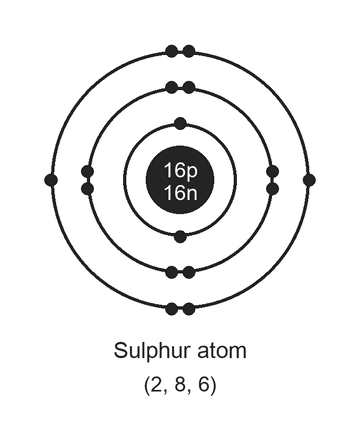
A neutral sulphur atom has 16 electrons: 2 in K, 8 in L and 6 in M, that is 2, 8, 6.
Step 4 — Draw the atom.
The diagram shows the nucleus (16p, 16n) and the three shells holding 2, 8 and 6 electrons.
Watch out: The neutrons are inside the nucleus; only the electrons are drawn on the shells.
Therefore, sulphur has 16 protons and 16 neutrons in its nucleus, and its 16 electrons are arranged 2, 8, 6.
- 282 marks
Question 28
Explain the rule according to which electrons are filled in various energy levels.
Solve with AIWritten solution
Solution:
Concept: The Bohr–Bury scheme gives the rules for filling electrons into the shells K, L, M, N (n = 1, 2, 3, 4).
Step 1 — Rule 1 — maximum electrons in a shell.
A shell can hold at most electrons, where n is the shell number:
Shell n Working Maximum electrons K 1 2 × 1² 2 L 2 2 × 2² 8 M 3 2 × 3² 18 N 4 2 × 4² 32 Step 2 — Rule 2 — the outermost shell.
The outermost shell cannot hold more than 8 electrons (or 2 when the K shell is the only shell).
Step 3 — Rule 3 — filling step by step.
Electrons fill the shells step by step: a shell of lower energy (nearer the nucleus) is filled before electrons enter the next shell.
Step 4 — Apply the rules to potassium.
Potassium has 19 electrons. After K (2) and L (8), 9 electrons are left. Putting all 9 in M would break Rule 2, so M takes 8 and the last electron goes into N: 2, 8, 8, 1.
Watch out: The M shell can hold 18 in total, but not while it is the outermost shell, where the limit is 8.
Therefore, electrons are filled step by step from the K shell outwards, each shell holding at most 2n² electrons and the outermost shell at most 8.
- 292 marks
Question 29
Draw the orbital diagram of ion and state the number of three fundamental particles present in it.
Solve with AIWritten solution
Solution:
Concept: An ion has the same nucleus as its atom; only the number of electrons changes. is formed when a calcium atom (2, 8, 8, 2) loses its two outermost electrons.
Step 1 — Count the protons.
The atomic number is 20, so there are 20 protons.
Step 2 — Count the neutrons.
Subtract the atomic number from the mass number:
Step 3 — Count the electrons.
The atom has 20 electrons, and the 2+ charge means 2 have been lost:
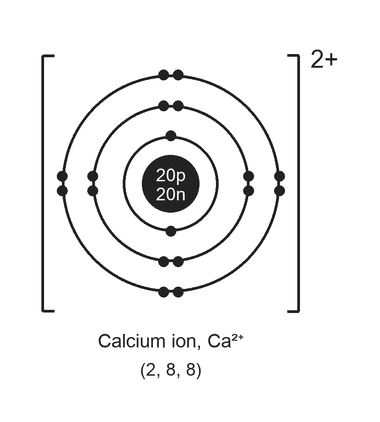
They are arranged 2, 8, 8.
Step 4 — Draw the ion.
The diagram shows the nucleus (20p, 20n), three shells holding 2, 8 and 8 electrons, and the ion in brackets with its 2+ charge.
Watch out: A positive ion has fewer electrons than protons; the charge comes from the electrons lost, not from extra protons.
Therefore, Ca²⁺ has 20 protons, 20 neutrons and 18 electrons, arranged 2, 8, 8.
- 304 marks
Question 30
Write down the electronic configuration of the following :
(a)
(b)
Write down the number of electrons in X and neutrons in Y.
Solve with AIWritten solution
Solution:
Concept: The lower number is the atomic number (= electrons in a neutral atom); the upper number is the mass number. Neutrons = mass number − atomic number.
Step 1 — (a) Configuration of X.
X has atomic number 13, so it has 13 electrons: 2 in K, 8 in L and 3 in M, that is 2, 8, 3.
Step 2 — (b) Configuration of Y.
Y has atomic number 17, so it has 17 electrons: 2 in K, 8 in L and 7 in M, that is 2, 8, 7.
Step 3 — Electrons in X.
A neutral atom has as many electrons as its atomic number, so X has 13 electrons.
Step 4 — Neutrons in Y.
Subtract the atomic number of Y from its mass number:
Watch out: Use the lower number (atomic number) for the electrons, not the upper one.
Therefore, X is 2, 8, 3 with 13 electrons, and Y is 2, 8, 7 with 18 neutrons.
- 311 mark
Question 31
Rutherford's alpha-particle scattering experiment led to the discovery of :
Solve with AIAnswer
(A) Electron
(B) Proton
- Correct
(C) Atomic nucleus
(D) Neutron
Answer: (C) Atomic nucleus
Concept: In Rutherford's experiment, fast alpha particles were fired at a very thin gold foil and their deflections were observed.
Step 1 — Recall the key observation.
Most alpha particles went straight through, but a very few bounced back almost the way they came.
Step 2 — Interpret it.
Only a tiny, heavy, positively charged centre could turn an alpha particle back. Rutherford called this centre the nucleus.
Why the other options are wrong:
- (A) Electron: This is not right: the electron was discovered by J.J. Thomson from cathode rays.
- (B) Proton: This is not right: the positive particles were first seen by Goldstein as anode (canal) rays.
- (D) Neutron: This is not right: the neutron was discovered by Chadwick in 1932.
Therefore, the alpha-scattering experiment led to the discovery of the atomic nucleus, option (C).
- 321 mark
Question 32
The number of valence electrons in is :
Solve with AIAnswer
(A) 6
- Correct
(B) 8
(C) 10
(D) 4
Answer: (B) 8
Concept: Valence electrons are the electrons in the outermost shell of an atom or ion.
Step 1 — Write the configuration of the atom.
Oxygen has 8 electrons, arranged 2, 6.
Step 2 — Form the ion.
The 2− charge means it gains 2 electrons, so has 10 electrons, arranged 2, 8.
Step 3 — Count the outermost electrons.
The outermost (L) shell now holds 8 electrons.
Watch out: Valence electrons are only those in the outermost shell, not all the electrons of the ion.
Why the other options are wrong:
- (A) 6: This is the number of valence electrons in the neutral oxygen atom, not in the ion.
- (C) 10: This is the total number of electrons in the ion, not those in its outermost shell.
- (D) 4: This fits neither the oxygen atom (6) nor the oxide ion (8).
Therefore, the oxide ion has 8 valence electrons, option (B).
- 331 mark
Question 33
Which of the following is the correct electronic configuration of potassium ?
Solve with AIAnswer
(A) 2, 8, 9
(B) 8, 2, 9
- Correct
(C) 2, 8, 8, 1
(D) 1, 2, 8, 8
Answer: (C) 2, 8, 8, 1
Concept: By the Bohr–Bury scheme, shells fill from the inside out (K 2, L 8, …) and the outermost shell cannot hold more than 8 electrons.
Step 1 — Count the electrons.
Potassium (atomic number 19) has 19 electrons.
Step 2 — Fill the shells.
K takes 2 and L takes 8, leaving 9. The M shell is now the outermost, so it can take only 8, and the last electron goes into the N shell: 2, 8, 8, 1.
Watch out: The M shell can hold up to 18 electrons, but never more than 8 while it is the outermost shell.
Why the other options are wrong:
- (A) 2, 8, 9: This puts 9 electrons in the outermost shell, which is more than the limit of 8.
- (B) 8, 2, 9: This puts 8 electrons in the K shell, which can hold only 2.
- (D) 1, 2, 8, 8: This puts only 1 electron in the K shell; the K shell must be filled with 2 before the L shell is used.
Therefore, the electronic configuration of potassium is 2, 8, 8, 1, option (C).
- 341 mark
Question 34
The mass number of an atom whose unipositive ion has 10 electrons and 12 neutrons is :
Solve with AIAnswer
- Correct
(A) 23
(B) 22
(C) 20
(D) 21
Answer: (A) 23
Concept: A unipositive ion (charge +1) has lost one electron. Mass number = protons + neutrons.
Step 1 — Find the electrons in the atom.
The ion has 10 electrons and lost one, so the neutral atom had 11 electrons:
Step 2 — Find the protons.
A neutral atom has as many protons as electrons, so there are 11 protons.
Step 3 — Find the mass number.
Add the protons and the neutrons:
The atom is sodium, .
Watch out: The ion's electrons are one fewer than its protons; do not use 10 as the number of protons.
Why the other options are wrong:
- (B) 22: This adds the ion's 10 electrons to the 12 neutrons, treating 10 as the number of protons.
- (C) 20: This would need only 8 protons with 12 neutrons.
- (D) 21: This would need only 9 protons with 12 neutrons.
Therefore, the mass number is 23, option (A).
- 351 mark
Question 35
The number of valence electrons in ion is :
Solve with AIAnswer
(A) 16
- Correct
(B) 8
(C) 17
(D) 18
Answer: (B) 8
Concept: Valence electrons are the electrons in the outermost shell of an atom or ion.
Step 1 — Write the configuration of the atom.
Chlorine has 17 electrons, arranged 2, 8, 7.
Step 2 — Form the ion.
The 1− charge means it gains 1 electron, so has 18 electrons, arranged 2, 8, 8.
Step 3 — Count the outermost electrons.
The outermost (M) shell holds 8 electrons.
Why the other options are wrong:
- (A) 16: This matches no shell of the chloride ion (2, 8, 8).
- (C) 17: This is the atomic number of chlorine, the total electrons of the neutral atom.
- (D) 18: This is the total number of electrons in the ion, not the number in its outermost shell.
Therefore, the chloride ion has 8 valence electrons, option (B).
- 361 mark
Question 36
The correct electronic configuration of Fluorine is :
Solve with AIAnswer
(A) 2, 8
(B) 8, 2, 1
(C) 7, 2
- Correct
(D) 2, 7
Answer: (D) 2, 7
Concept: Electrons fill the K shell (at most 2) first, then the L shell (at most 8).
Step 1 — Count the electrons.
Fluorine (atomic number 9) has 9 electrons.
Step 2 — Fill the shells.
K takes 2 and the remaining 7 go into L, giving 2, 7.
Why the other options are wrong:
- (A) 2, 8: This has 10 electrons; it is the configuration of neon or of the fluoride ion.
- (B) 8, 2, 1: This puts 8 electrons in the K shell, which can hold only 2.
- (C) 7, 2: This puts 7 electrons in the K shell, which can hold only 2.
Therefore, the electronic configuration of fluorine is 2, 7, option (D).
- 371 mark
Question 37
An element 'A' has 15 electrons and 16 neutrons. The correct representation of this element is :
Solve with AIAnswer
(A)
(B)
- Correct
(C)
(D)
Answer: (C)
Concept: In the symbol of an atom, the mass number (protons + neutrons) is written above, and the atomic number (protons) is written below, both on the left of the letter.
Step 1 — Find the atomic number.
A neutral atom has as many protons as electrons, so element A has 15 protons and its atomic number is 15.
Step 2 — Find the mass number.
Add the protons and the neutrons:
Step 3 — Write the symbol.
The mass number 31 goes on top and the atomic number 15 below: .
Watch out: The upper number is the mass number, not the number of neutrons.
Why the other options are wrong:
- (A) : This writes the number of neutrons (16) on top in place of the mass number.
- (B) : This writes the number of neutrons (16) below as if it were the atomic number.
- (D) : This puts the neutron count below and the electron count above, so neither number is right.
Therefore, the correct representation is ³¹₁₅A, option (C).
- 381 mark
Question 38
An atom having 3 protons and 4 neutrons will have a valency of :
Solve with AIAnswer
(A) 3
(B) 7
- Correct
(C) 1
(D) 4
Answer: (C) 1
Concept: Valency is the number of electrons an atom loses, gains or shares to get a stable configuration. It depends on the valence electrons, not on the neutrons.
Step 1 — Find the electrons.
3 protons means 3 electrons in the neutral atom, arranged 2, 1 (lithium).
Step 2 — Find the valency.
The atom easily loses its single outer electron to reach the stable 2 (helium) arrangement, so its valency is 1.
Why the other options are wrong:
- (A) 3: This is the atomic number (3 protons), not the valency.
- (B) 7: This is the mass number (3 + 4), not the valency.
- (D) 4: This is the number of neutrons, which has nothing to do with valency.
Therefore, the valency of the atom is 1, option (C).
- 391 mark
Question 39
Elements with valency 2 are :
Solve with AIAnswer
(A) Always metals
(B) Always non-metals
- Correct
(C) Can be metals or non-metals
(D) Metalloids (semi metals)
Answer: (C) Can be metals or non-metals
Concept: An element's valency comes from its valence electrons. Metals reach a stable configuration by losing electrons and non-metals by gaining or sharing them.
Step 1 — Take a metal of valency 2.
Magnesium (2, 8, 2) loses 2 electrons, so its valency is 2, and it is a metal.
Step 2 — Take a non-metal of valency 2.
Oxygen (2, 6) gains 2 electrons, so its valency is also 2, but it is a non-metal.
Step 3 — Conclude.
Elements with valency 2 can be metals or non-metals.
Why the other options are wrong:
- (A) Always metals: This is false: oxygen and sulphur have valency 2 and are non-metals.
- (B) Always non-metals: This is false: magnesium and calcium have valency 2 and are metals.
- (D) Metalloids (semi metals): This is false: valency 2 is shown by ordinary metals and non-metals, not only by metalloids.
Therefore, elements with valency 2 can be metals or non-metals, option (C).
- 401 mark
Question 40
Nucleus of an atom is composed of :
Solve with AIAnswer
(A) Electrons and neutrons
- Correct
(B) Protons and neutrons
(C) Protons, neutrons and electrons
(D) Electrons and protons
Answer: (B) Protons and neutrons
Concept: The nucleus is the tiny, heavy centre of the atom. The particles in it are called nucleons.
Step 1 — List the particles in the nucleus.
The nucleus holds the protons (positive) and the neutrons (neutral).
Step 2 — Place the electrons.
The electrons are outside the nucleus, moving in shells round it.
Why the other options are wrong:
- (A) Electrons and neutrons: This is false: electrons are not in the nucleus, and the protons are left out.
- (C) Protons, neutrons and electrons: This is false: electrons are outside the nucleus, so all three together do not make up the nucleus.
- (D) Electrons and protons: This is false: electrons are not in the nucleus, and the neutrons are left out.
Therefore, the nucleus is composed of protons and neutrons, option (B).
- 411 mark
Question 41
There are 3 electrons in M shell of an atom. Its atomic number is :
Solve with AIAnswer
(A) 11
- Correct
(B) 13
(C) 15
(D) 3
Answer: (B) 13
Concept: The M shell starts filling only after the K shell (2) and L shell (8) are full.
Step 1 — Write the configuration.
With 3 electrons in M, the arrangement is 2, 8, 3.
Step 2 — Add the electrons.
The total number of electrons equals the atomic number:
The element is aluminium.
Why the other options are wrong:
- (A) 11: This gives 2, 8, 1, with only one electron in the M shell.
- (C) 15: This gives 2, 8, 5, with five electrons in the M shell.
- (D) 3: This gives 2, 1, and such an atom has no M shell at all.
Therefore, the atomic number is 13, option (B).
- 421 mark
Question 42
The maximum number of electrons that M shell can occupy is :
Solve with AIAnswer
- Correct
(A) 18
(B) 8
(C) 2
(D) 10
Answer: (A) 18
Concept: The maximum number of electrons a shell can hold is , where n is the shell number.
Step 1 — Find n for the M shell.
K, L, M are shells 1, 2, 3, so for M, n = 3.
Step 2 — Work out the capacity.
Put n = 3 in the formula:
Watch out: 8 is only the limit while M is the outermost shell; its full capacity is 18.
Why the other options are wrong:
- (B) 8: This is the limit for any outermost shell (and the capacity of the L shell), not the M shell's capacity.
- (C) 2: This is the capacity of the K shell.
- (D) 10: This is not the capacity of any shell.
Therefore, the M shell can hold at most 18 electrons, option (A).
- 431 mark
Question 43
Which orbit is the nearest to the nucleus of an atom ?
Solve with AIAnswer
- Correct
(A) K
(B) L
(C) M
(D) N
Answer: (A) K
Concept: Shells (orbits) are named K, L, M, N … starting from the nucleus.
Step 1 — Order the shells.
K is shell 1, L is shell 2, M is shell 3 and N is shell 4.
Step 2 — Pick the nearest.
Shell 1, the K shell, is the nearest to the nucleus.
Why the other options are wrong:
- (B) L: This is the second shell.
- (C) M: This is the third shell.
- (D) N: This is the fourth shell.
Therefore, the K orbit is nearest to the nucleus, option (A).
- 441 mark
Question 44
Atoms combine to attain an electronic configuration similar to their nearest :
Solve with AIAnswer
(A) Metal
- Correct
(B) Noble gas
(C) Non-metal
(D) Semi metal
Answer: (B) Noble gas
Concept: Noble gases have a completely filled outermost shell (an octet, or a duplet for helium), which is very stable.
Step 1 — State why atoms combine.
Atoms lose, gain or share electrons so that their outermost shell becomes like that of the nearest noble gas.
Step 2 — Give an example.
Sodium (2, 8, 1) loses 1 electron to become 2, 8 like neon; chlorine (2, 8, 7) gains 1 to become 2, 8, 8 like argon.
Why the other options are wrong:
- (A) Metal: This is wrong: a metal's configuration is not stable; metals themselves lose electrons to become stable.
- (C) Non-metal: This is wrong: non-metals themselves gain or share electrons to become stable.
- (D) Semi metal: This is wrong: semi-metals also lack a completely filled outer shell.
Therefore, atoms combine to attain the configuration of their nearest noble gas, option (B).
- 451 mark
Question 45
Isotopes differ in the number of their :
Solve with AIAnswer
(A) Electrons
(B) Protons
- Correct
(C) Neutrons
(D) Electrons and protons
Answer: (C) Neutrons
Concept: Isotopes are atoms of the same element with the same atomic number but different mass numbers.
Step 1 — Compare the protons.
Same element means the same atomic number, so the number of protons is the same.
Step 2 — Find what changes.
Mass number = protons + neutrons. Since the protons are the same, a different mass number means a different number of neutrons. For example, has 18 neutrons and has 20.
Why the other options are wrong:
- (A) Electrons: This is false: isotopes have the same number of electrons.
- (B) Protons: This is false: isotopes have the same number of protons (the same atomic number).
- (D) Electrons and protons: This is false: neither the electrons nor the protons differ between isotopes.
Therefore, isotopes differ in the number of their neutrons, option (C).
- 465 marks
Question 46
Name the following :
(a) The element which does not contain any neutron in its nucleus.
(b) An element having valency 'zero'.
(c) Metal with valency 2.
(d) Two atoms having the same number of protons and electrons but different number of neutrons.
(e) The shell closest to the nucleus of an atom.
Solve with AIWritten solution
Solution:
Concept: Each part asks for a particular element, shell or kind of atom described in the chapter.
Step 1 — (a) No neutron.
The ordinary hydrogen atom, protium , has 1 proton, 1 electron and no neutron. So the element is hydrogen.
Step 2 — (b) Valency zero.
Noble gases already have a full outer shell, so they neither lose, gain nor share electrons. Neon (2, 8) has valency zero (helium and argon too).
Step 3 — (c) Metal of valency 2.
Magnesium (2, 8, 2) loses its 2 outer electrons, so its valency is 2 (calcium too).
Step 4 — (d) Same protons and electrons, different neutrons.
Such atoms are isotopes of one element, for example and .
Step 5 — (e) Shell closest to the nucleus.
The first shell, the K shell, is the closest to the nucleus.
Therefore, (a) hydrogen, (b) neon, (c) magnesium, (d) isotopes such as ³⁵₁₇Cl and ³⁷₁₇Cl, and (e) the K shell.
- 474 marks
Question 47
Match the atomic numbers 4, 14, 8, 15, and 19 with each of the following :
(a) A solid non-metal of valency 3.
(b) A gas of valency 2.
(c) A metal of valency 1.
(d) A non-metal of valency 4.
Solve with AIWritten solution
Solution:
Concept: Valency is the number of electrons an atom loses, gains or shares to complete its outer shell. Write each configuration first.
Step 1 — Write the configurations.
The table identifies each atomic number.
Atomic number Element Configuration Type 4 Beryllium 2, 2 metal 14 Silicon 2, 8, 4 metalloid (non-metal in the book) 8 Oxygen 2, 6 non-metal (gas) 15 Phosphorus 2, 8, 5 non-metal (solid) 19 Potassium 2, 8, 8, 1 metal Step 2 — (a) Solid non-metal of valency 3.
Phosphorus (2, 8, 5) needs 3 more electrons to complete its octet, so its valency is 3: 15.
Step 3 — (b) Gas of valency 2.
Oxygen (2, 6) is a gas and needs 2 electrons, so its valency is 2: 8.
Step 4 — (c) Metal of valency 1.
Potassium (2, 8, 8, 1) loses its 1 outer electron, so its valency is 1: 19.
Step 5 — (d) Non-metal of valency 4.
Silicon (2, 8, 4) shares its 4 outer electrons, so its valency is 4: 14.
Note: Silicon is usually called a metalloid; the book counts it as a non-metal here, and 14 is the only given atomic number with valency 4.
Therefore, (a) 15, (b) 8, (c) 19 and (d) 14.
- 485 marks
Question 48
(a) What are inert elements ?
(b) Why do they exist as monoatoms in molecules?
(c) What are valence electrons ?
Solve with AIWritten solution
Solution:
Concept: An atom whose outermost shell is completely filled (8 electrons, or 2 for helium) is very stable and has almost no tendency to react.
Step 1 — (a) Define inert elements.
Inert elements (noble gases) are elements whose atoms have a completely filled outermost shell: 8 electrons, or 2 in helium. They are helium, neon, argon, krypton, xenon and radon, and they are chemically very unreactive.
Step 2 — (b) Explain why they are monoatomic.
Their atoms already have a stable octet (or duplet), so they have no tendency to lose, gain or share electrons. An atom does not even combine with another atom of the same element, so each molecule is a single atom (a monoatomic molecule).
Step 3 — (c) Define valence electrons.
The electrons in the outermost shell (valence shell) of an atom are called valence electrons. For example, chlorine (2, 8, 7) has 7 valence electrons.
Watch out: The word 'inert' is an old name: xenon and krypton do form a few compounds (for example with fluorine), so today we call them noble gases.
Therefore, inert elements have a completely filled outer shell, they exist as single atoms because that stable shell gives them no reason to combine, and valence electrons are the electrons of the outermost shell.
- 492 marks
Question 49
In what respects do the three isotopes of hydrogen differ ? Give their structures.
Solve with AIWritten solution
Solution:
Concept: Isotopes are atoms of the same element with the same number of protons but different numbers of neutrons, so their mass numbers differ.
Step 1 — Name the isotopes.
Hydrogen has three isotopes: protium , deuterium (D) and tritium (T).
Step 2 — State what is the same.
Each has 1 proton and 1 electron, so they are all hydrogen.
Step 3 — State how they differ.
They differ in the number of neutrons (0, 1 and 2) and so in their mass numbers (1, 2 and 3).
Step 4 — Show their structures.
Each diagram shows the nucleus with its protons and neutrons, and one electron in the K shell.
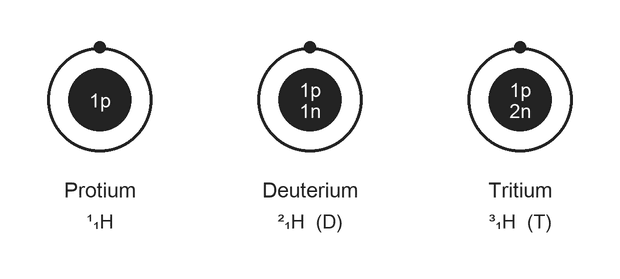
Watch out: All three have the same chemistry; only the mass changes.
Therefore, the three isotopes of hydrogen differ only in the number of neutrons (0, 1, 2) and hence in mass number (1, 2, 3).
- 502 marks
Question 50
What is the significance of the number of protons found in the atoms of different elements ?
Solve with AIWritten solution
Solution:
Concept: The number of protons in an atom is its atomic number.
Step 1 — It identifies the element.
No two elements have the same number of protons. So the number of protons tells us which element an atom belongs to: every atom with 6 protons is carbon, every atom with 8 is oxygen.
Step 2 — It fixes the chemical properties.
In a neutral atom the number of electrons equals the number of protons. This fixes the electronic configuration, and so the valency and chemical properties of the element.
Therefore, the number of protons (the atomic number) identifies an element and, through the number of electrons, decides its chemical properties.
- 514 marks
Question 51
Element X has electronic configuration 2, 8, 18, 8, 1. Without identifying X,
(a) predict the sign and charge on a simple ion of X.
(b) write if X will be an oxidising agent or a reducing agent. Why ?
Solve with AIWritten solution
Solution:
Concept: An atom with 1, 2 or 3 valence electrons tends to lose them to reach a stable noble-gas configuration. A substance that loses (donates) electrons is a reducing agent.
Step 1 — (a) Count the valence electrons.
The outermost shell of X has 1 electron.
Step 2 — (a) Find the ion.
X loses this electron to reach the stable configuration 2, 8, 18, 8. Losing one negative electron leaves one extra positive charge, so the ion is : sign positive, charge +1.
Step 3 — (b) Decide oxidising or reducing.
X gives away its electron readily:
A substance that donates electrons is a reducing agent (it is itself oxidised).
Watch out: Losing an electron makes the ion positive, not negative.
Therefore, (a) X forms a positive ion X⁺ with charge +1, and (b) X is a reducing agent because it donates its electron.
- 525 marks
Question 52
Define the terms :
(a) mass number
(b) ion
(c) cation
(d) anion
(e) element
(f) orbit.
Solve with AIWritten solution
Solution:
Concept: These are basic terms of atomic structure; each definition should name exactly what is counted or what changes.
Step 1 — (a) Mass number.
The total number of protons and neutrons (nucleons) in the nucleus of an atom.
Step 2 — (b) Ion.
A charged particle formed when an atom gains or loses one or more electrons.
Step 3 — (c) Cation.
A positively charged ion, formed when an atom loses electron(s), for example .
Step 4 — (d) Anion.
A negatively charged ion, formed when an atom gains electron(s), for example .
Step 5 — (e) Element.
A pure substance made up of only one kind of atoms (all with the same atomic number), which cannot be broken into simpler substances by chemical means.
Step 6 — (f) Orbit.
A definite circular path round the nucleus in which electrons revolve; it is also called a shell or energy level.
Watch out: A cation forms by LOSING electrons, not by gaining protons.
Therefore, the terms are defined as above: mass number = protons + neutrons; an ion is a charged atom; a cation is positive and an anion negative; an element has one kind of atom; an orbit is an electron's fixed path.
- 532 marks
Question 53
From the symbol for the element helium, write down the mass number and the atomic number of the element.
Solve with AIWritten solution
Solution:
Concept: In the symbol , the upper number is the mass number and the lower number is the atomic number.
Step 1 — Read the mass number.
The upper number is 4, so the mass number is 4 (2 protons + 2 neutrons).
Step 2 — Read the atomic number.
The lower number is 2, so the atomic number is 2 (2 protons).
Therefore, helium has mass number 4 and atomic number 2.
- 542 marks
Question 54
An atom of an element has two electrons in the M shell. What is the
(a) atomic number
(b) number of protons in this element ?
Solve with AIWritten solution
Solution:
Concept: The M shell is filled only after the K shell (2) and the L shell (8) are full.
Step 1 — (a) Write the configuration and add.
Two electrons in M means the arrangement 2, 8, 2:
The element is magnesium.
Step 2 — (b) Find the protons.
The number of protons equals the atomic number, so there are 12 protons.
Therefore, (a) the atomic number is 12 and (b) there are 12 protons.
- 555 marks
Question 55
Five atoms are labelled A to E.
Atoms Mass No Atomic No. A 40 20 B 19 9 C 7 3 D 16 8 E 14 7 (a) Which one of these atoms :
(i) contains 7 protons
(ii) has electronic configuration 2, 7 ?
(b) Write down the formula of the compound formed between C and D.
(c) Predict : (i) metals (ii) non-metals.
Solve with AIWritten solution
Solution:
Concept: The atomic number gives the protons and electrons. From the configuration, atoms with 1–3 valence electrons are metals and those with 5–7 are non-metals.
Step 1 — Identify the atoms.
The table gives each atom's element and configuration.
Atom Atomic no. Element Configuration Valency A 20 Calcium 2, 8, 8, 2 2 B 9 Fluorine 2, 7 1 C 3 Lithium 2, 1 1 D 8 Oxygen 2, 6 2 E 7 Nitrogen 2, 5 3 Step 2 — (a)(i) 7 protons.
The atomic number equals the protons, so E (atomic number 7) has 7 protons.
Step 3 — (a)(ii) Configuration 2, 7.
2 + 7 = 9 electrons, so it is B (atomic number 9).
Step 4 — (b) Formula of the compound of C and D.
C (lithium) has valency 1 and D (oxygen) has valency 2. Two C atoms each give one electron to one D atom, so the formula is (lithium oxide, ).
Step 5 — (c) Metals and non-metals.
A (2 valence electrons) and C (1) lose electrons, so they are metals. B (7), D (6) and E (5) gain or share electrons, so they are non-metals.
Watch out: The formula takes the valencies crosswise: valency of D goes with C and valency of C goes with D.
Therefore, (a)(i) E, (ii) B; (b) C₂D (Li₂O); (c)(i) metals A and C, (ii) non-metals B, D and E.
- 565 marks
Question 56
and are symbols of two isotopes of magnesium.
(a) Compare the atoms of these isotopes with respect to :
(i) the composition of their nuclei.
(ii) their electronic configurations.
(b) Give reasons why the two isotopes of magnesium have different mass numbers.
Solve with AIWritten solution
Solution:
Concept: Isotopes of an element have the same number of protons (and electrons) but different numbers of neutrons.
Step 1 — (a)(i) Composition of the nuclei.
Neutrons = mass number − atomic number.
Isotope Protons Neutrons 12 24 − 12 = 12 12 26 − 12 = 14 Step 2 — (a)(ii) Electronic configurations.
Both atoms have 12 electrons, so both have the same configuration, 2, 8, 2.
Step 3 — (b) Why the mass numbers differ.
Mass number = protons + neutrons. Both have 12 protons, but they have different numbers of neutrons (12 and 14), so their mass numbers are different (24 and 26).
Therefore, the two isotopes have the same 12 protons and the same configuration 2, 8, 2, but 12 and 14 neutrons, which is why their mass numbers are 24 and 26.
- 572 marks
Question 57
What are nucleons? How many nucleons are present in phosphorus ? Draw its structure.
Solve with AIWritten solution
Solution:
Concept: Nucleons are the particles present in the nucleus: the protons and the neutrons. Their total is the mass number.
Step 1 — Define nucleons.
The protons and neutrons in the nucleus of an atom are together called nucleons.
Step 2 — Count the nucleons in phosphorus.
Phosphorus is . Its mass number, 31, is the number of nucleons: 15 protons and 16 neutrons.
Step 3 — Draw the structure.
Phosphorus has 15 electrons arranged 2, 8, 5. The diagram shows the nucleus (15p, 16n) and the three shells.

Therefore, nucleons are the protons and neutrons of the nucleus, and phosphorus has 31 nucleons (15 p + 16 n), with electrons 2, 8, 5.
- 582 marks
Question 58
What are isotopes ? With reference to which fundamental particle do isotopes differ ? Give two uses of isotopes.
Solve with AIWritten solution
Solution:
Concept: Atoms of one element always have the same number of protons, but the number of neutrons can vary.
Step 1 — Define isotopes.
Isotopes are atoms of the same element that have the same atomic number but different mass numbers.
Step 2 — Name the particle that differs.
Since the protons are the same, the difference is in the number of neutrons.
Step 3 — Give two uses.
Some isotopes are radioactive and very useful:
- Cobalt-60, , is used in radiotherapy to treat cancer.
- Carbon-14, , is used to find the age of old wood, bones and other once-living material (carbon dating).
Watch out: Carbon dating works only for things that were once alive, and only up to about 50,000 years.
Therefore, isotopes are atoms of the same element with different mass numbers, they differ in the number of neutrons, and cobalt-60 (cancer treatment) and carbon-14 (dating) are two useful isotopes.
- 592 marks
Question 59
Why do and have the same chemical properties ? In what respect do these atoms differ ?
Solve with AIWritten solution
Solution:
Concept: Chemical properties depend on the number of valence electrons. Mass depends on the number of neutrons.
Step 1 — Compare the electrons.
Both atoms have atomic number 17, so both have 17 electrons arranged 2, 8, 7, with 7 valence electrons.
Step 2 — Explain the same chemistry.
Atoms with the same valence electrons react in the same way, so the two isotopes have the same chemical properties.
Step 3 — State how they differ.
They differ in the number of neutrons:
Atom Neutrons Mass number 35 − 17 = 18 35 37 − 17 = 20 37 Therefore, ³⁵₁₇Cl and ³⁷₁₇Cl have the same chemical properties because both have the configuration 2, 8, 7, and they differ in neutrons (18 and 20) and mass number (35 and 37).
- 602 marks
Question 60
Explain fractional atomic mass. What is the fractional mass of chlorine ?
Solve with AIWritten solution
Solution:
Concept: Most elements are a mixture of isotopes. Their atomic mass is the average of the isotope masses, weighted by how much of each is present, so it usually comes out as a fraction.
Step 1 — Explain fractional atomic mass.
Because the atomic mass is a weighted average of different whole-number isotope masses, it is usually not a whole number. Such an atomic mass is called a fractional atomic mass.
Step 2 — Take the isotopes of chlorine.
Chlorine contains and in the ratio 3 : 1 (75 % and 25 %).
Step 3 — Work out the average.
Multiply each mass by its share, add, and divide by the total of 4 parts:
Watch out: Do not take the simple average (35 + 37) ÷ 2 = 36; the lighter isotope is three times as common.
Therefore, fractional atomic mass is the weighted average of an element's isotope masses, and for chlorine it is 35.5 u.
- 615 marks
Question 61
(a) What is meant by "atomic number of an element"?
(b) Complete the table given below :
No. of Protons No. of Electrons No. of Neutrons Atomic number Mass number (c) Write down the electronic configuration of (i) chlorine atom (ii) chloride ion.
Solve with AIWritten solution
Solution:
Concept: The atomic number is the number of protons, which in a neutral atom also equals the number of electrons. The number of neutrons is the mass number minus the atomic number.
Step 1 — (a) Atomic number.
The atomic number of an element is the number of protons in the nucleus of its atom. In a neutral atom it also equals the number of electrons.
Step 2 — (b) Complete the table.
Both isotopes have atomic number 17, so 17 protons and 17 electrons; the neutrons are 35 − 17 = 18 and 37 − 17 = 20.
No. of Protons No. of Electrons No. of Neutrons Atomic number Mass number 17 17 18 17 35 17 17 20 17 37 Step 3 — (c)(i) Chlorine atom.
17 electrons fill as 2, 8, 7, so the configuration is 2, 8, 7.
Step 4 — (c)(ii) Chloride ion.
The chloride ion has gained 1 electron, so it has 18 electrons: 2, 8, 8.
Therefore, (a) the atomic number is the number of protons; (b) the isotopes have 17 p and 17 e each, with 18 and 20 neutrons; (c) Cl is 2, 8, 7 and Cl⁻ is 2, 8, 8.
- 625 marks
Question 62
Draw diagrams representing the atomic structures of the following :
(a) Sodium atom
(b) Chloride ion
(c) Carbon atom
(d) Oxide ion.
Solve with AIWritten solution
Solution:
Concept: An atomic-structure diagram shows the nucleus (protons p and neutrons n) and the electrons in their shells. An ion has the same nucleus as its atom but a different number of electrons.
Step 1 — (a) Sodium atom.
Sodium has 11 protons and 23 − 11 = 12 neutrons; its 11 electrons are arranged 2, 8, 1.

Step 2 — (b) Chloride ion.
The chloride ion has 17 protons and 18 neutrons; it has gained 1 electron (shown as a cross), so its 18 electrons are arranged 2, 8, 8.
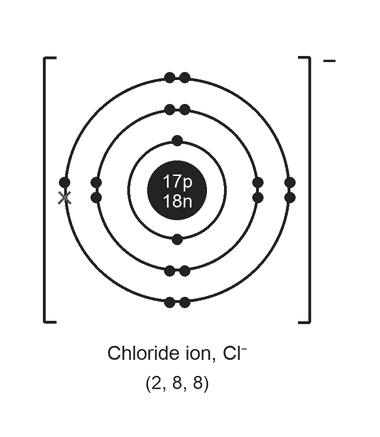
Step 3 — (c) Carbon atom.
Carbon has 6 protons and 6 neutrons; its 6 electrons are arranged 2, 4.
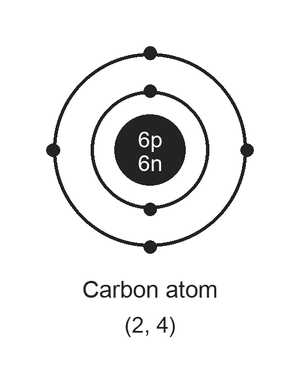
Step 4 — (d) Oxide ion.
The oxide ion has 8 protons and 8 neutrons; it has gained 2 electrons (crosses), so its 10 electrons are arranged 2, 8.

Watch out: An ion is drawn inside square brackets with its charge; its nucleus is the same as the atom's.
Therefore, the structures are Na 2, 8, 1 (11p, 12n), Cl⁻ 2, 8, 8 (17p, 18n), C 2, 4 (6p, 6n) and O²⁻ 2, 8 (8p, 8n), as drawn.
- 632 marks
Question 63
Complete the following table relating to the atomic structure of some elements.
Element Symbol Atomic Number Mass Number Number of Neutrons Number of Electrons Number of Protons Li 3 6 Cl 17 20 Na 12 11 Al 27 13 S 32 16 Solve with AIWritten solution
Solution:
Concept: In a neutral atom the numbers of protons and electrons both equal the atomic number. The mass number is the number of protons plus the number of neutrons.
Step 1 — Fill each row from what is given.
For each element we use the two known facts to find the rest:
Element What is given Working Missing values Li Z 3, A 6 neutrons: 6 − 3 n 3, e 3, p 3 Cl Z 17, n 20 mass number: 17 + 20 A 37, e 17, p 17 Na p 11, n 12 mass number: 11 + 12 Z 11, A 23, e 11 Al A 27, p 13 neutrons: 27 − 13 Z 13, n 14, e 13 S A 32, n 16 protons: 32 − 16 Z 16, e 16, p 16 Step 2 — Write the completed table.
The filled values are in bold.
Element Symbol Atomic Number Mass Number Number of Neutrons Number of Electrons Number of Protons Li 3 6 3 3 3 Cl 17 37 20 17 17 Na 11 23 12 11 11 Al 13 27 14 13 13 S 16 32 16 16 16 Therefore, the missing values are Li 3, 3, 3; Cl 37, 17, 17; Na 11, 23, 11; Al 13, 14, 13; S 16, 16, 16.
- 645 marks
Question 64
Give reasons
(a) Physical properties of isotopes are different
(b) Argon does not react.
(c) Actual atomic mass is greater than mass number.
(d) and do not differ in their chemical reactions.
Solve with AIWritten solution
Solution:
Concept: Neutrons decide an atom's mass; electrons (especially valence electrons) decide how it reacts.
Step 1 — (a) Physical properties of isotopes differ.
Isotopes have different numbers of neutrons, so their atoms have different masses. Physical properties that depend on mass, such as density, melting point and boiling point, are therefore different.
Step 2 — (b) Argon does not react.
Argon (2, 8, 8) already has a stable octet in its outermost shell. It has no tendency to lose, gain or share electrons, so it does not react.
Step 3 — (c) Atomic mass is greater than the mass number.
The atomic mass of an element is the average mass of all its naturally occurring isotopes. The heavier isotopes raise this average above the mass number of the common lighter isotope. For example, chlorine's atomic mass is 35.5, more than the mass number 35 of , because 25 % of chlorine atoms are .
Step 4 — (d) The chlorine isotopes react alike.
Both have 17 electrons arranged 2, 8, 7. Chemical reactions depend on the valence electrons, so the two isotopes react in the same way.
Note: Part (c) holds for the average atomic mass the book means. The exact mass of a single atom is usually a little less than its mass number (³⁵Cl is 34.97 u), because some mass is lost as the energy binding the nucleus.
Therefore, isotopes differ physically because their masses differ, argon is unreactive because of its octet, the average atomic mass exceeds the lighter isotope's mass number because heavier isotopes are present, and the chlorine isotopes react alike because their electrons are the same.
- 655 marks
Question 65
Give the use of the following isotopes :
(a) Radioactive isotope
(b)
(c)
(d)
(e)
Solve with AIWritten solution
Solution:
Concept: Radioactive isotopes give out radiation that can be detected easily or used to destroy cells; some heavy isotopes release energy when their nuclei split.
Step 1 — (a) Radioactive isotopes in general.
They are used as tracers: a little radioactive material added to oil, gas or water shows where an underground pipeline leaks, because the radiation can be detected above the ground.
Step 2 — (b) Uranium-235.
Its nuclei split (fission) and release a huge amount of energy, so it is used as fuel in nuclear reactors to generate electricity.
Step 3 — (c) Cobalt-60.
It gives out strong gamma rays and is used in radiotherapy to treat cancer.
Step 4 — (d) Iodine-131.
The thyroid gland takes up iodine, so iodine-131 is used to treat thyroid disorders: an overactive thyroid (toxic goitre) and thyroid cancer. It is also used to study how the thyroid works.
Step 5 — (e) Carbon-14.
It is used in carbon dating: finding the age of old wood, bones and other once-living material, up to about 50,000 years old.
Watch out: Carbon-14 cannot date rocks; it works only for things that were once alive.
Note: The usual goitre caused by too little iodine is prevented with iodised salt; iodine-131 is used for an overactive thyroid and thyroid cancer.
Therefore, radioactive isotopes detect pipeline leaks, U-235 fuels nuclear reactors, Co-60 treats cancer, I-131 treats thyroid disorders and C-14 is used for carbon dating.
- 662 marks
Question 66
How does the Modern atomic theory contradict and correlate with Dalton's atomic theory?
Solve with AIWritten solution
Solution:
Concept: Modern atomic theory grew from Dalton's theory. It keeps the idea of the atom as the unit of chemical change, but discoveries of sub-atomic particles, isotopes and isobars changed several of Dalton's points.
Step 1 — Where it contradicts Dalton.
These points of Dalton's theory are no longer accepted:
- The atom is divisible: it is made of electrons, protons and neutrons.
- Atoms of the same element can have different masses (isotopes, such as and ).
- Atoms of different elements can have the same mass number (isobars, such as and ).
- Atoms can be changed into atoms of other elements in nuclear reactions, so they are not indestructible.
- Atoms do not always combine in simple ratios: a sugar molecule, , has 12 : 22 : 11.
Step 2 — Where it agrees with Dalton.
These points are still accepted:
- The atom is the smallest particle that takes part in a chemical reaction.
- Atoms are neither created nor destroyed in a chemical reaction; they are only rearranged.
- Atoms of different elements combine in fixed ratios to form compounds.
Therefore, modern theory contradicts Dalton on indivisibility, identical atoms, indestructibility and simple ratios, but agrees that atoms take part in reactions unchanged and combine in fixed ratios.
- 674 marks
Question 67
Explain :
(a) octet rule for formation of a chemical compound.
(b) duplet rule for formation of hydrogen.
Solve with AIWritten solution
Solution:
Concept: Noble gases are stable because their outermost shell is full: 8 electrons (an octet), or 2 for helium (a duplet). Other atoms combine so as to reach the same arrangement.
Step 1 — (a) State the octet rule.
During chemical combination, atoms lose, gain or share electrons so as to have 8 electrons in their outermost shell, the stable configuration of the nearest noble gas.
Step 2 — (a) Give an example.
Sodium (2, 8, 1) loses 1 electron to become (2, 8), and chlorine (2, 8, 7) gains it to become (2, 8, 8). Both now have an octet, and they form sodium chloride.
Step 3 — (b) State the duplet rule.
A hydrogen atom has only 1 electron in its only shell, the K shell, which can hold 2. It needs 2 electrons (a duplet), like helium.
Step 4 — (b) Apply it to hydrogen.
Two hydrogen atoms share their electrons as one pair, so each atom has 2 electrons round it, forming the hydrogen molecule:
Watch out: The duplet rule is for atoms whose only shell is K (hydrogen, and lithium or beryllium ions); all others aim for 8.
Therefore, by the octet rule atoms combine to get 8 outer electrons, and by the duplet rule two hydrogen atoms share one pair so that each gets 2 electrons like helium.
- 685 marks
Question 68
An element
A has atomic number 7, mass number 14
B has electronic configuration 2, 8, 8
C has 13 electrons, 14 neutrons
D has 18 protons 22 neutrons
E has electronic configuration 2, 8, 8, 1
State (i) valency of each element (ii) which one is a metal (iii) which is a non-metal (iv) which is an inert gas.
Solve with AIWritten solution
Solution:
Concept: Identify each element from its configuration. Valency = electrons lost (1–3 valence electrons), gained (5–7) or zero for a full outer shell.
Step 1 — Identify the elements.
Use the atomic number (protons or electrons) to write each configuration.
Given Element Configuration Valency Type A Z = 7 Nitrogen 2, 5 3 non-metal B 2, 8, 8 Argon 2, 8, 8 0 inert gas C 13 electrons Aluminium 2, 8, 3 3 metal D 18 protons Argon () 2, 8, 8 0 inert gas E 2, 8, 8, 1 Potassium 2, 8, 8, 1 1 metal Step 2 — (i) Valencies.
A gains 3 electrons (valency 3), C loses 3 (valency 3), E loses 1 (valency 1), and B and D have a full outer shell (valency 0).
Step 3 — (ii) Metals.
C (aluminium) and E (potassium) lose electrons, so they are metals.
Step 4 — (iii) Non-metal.
A (nitrogen) gains electrons, so it is a non-metal.
Step 5 — (iv) Inert gas.
B and D both have the octet 2, 8, 8; both are argon, an inert gas.
Watch out: The neutrons of C and D do not affect valency; only the electrons do.
Therefore, (i) A 3, B 0, C 3, D 0, E 1; (ii) C and E are metals; (iii) A is a non-metal; (iv) B and D are inert gases.
- 693 marks
Question 69
Elements X, Y and Z have atomic numbers 6, 9 and 12 respectively. Which one :
(a) forms an anion
(b) forms a cation
(c) has four electrons in its valence shell ?
Solve with AIWritten solution
Solution:
Concept: Atoms with 5–7 valence electrons gain electrons and form anions; atoms with 1–3 lose them and form cations.
Step 1 — Write the configurations.
X (6) is 2, 4 (carbon); Y (9) is 2, 7 (fluorine); Z (12) is 2, 8, 2 (magnesium).
Step 2 — (a) Anion.
Y has 7 valence electrons and gains 1 to complete its octet, forming : Y forms an anion.
Step 3 — (b) Cation.
Z has 2 valence electrons and loses them, forming : Z forms a cation.
Step 4 — (c) Four valence electrons.
X has the configuration 2, 4, so X has four electrons in its valence shell.
Therefore, (a) Y forms an anion, (b) Z forms a cation and (c) X has four valence electrons.
- 702 marks
Question 70
How do atoms attain noble gas configuration ?
Solve with AIWritten solution
Solution:
Concept: Noble gases are stable because their outermost shell is full: 8 electrons (an octet), or 2 for helium (a duplet). Other atoms combine with one another to reach the same arrangement.
Step 1 — By losing electrons.
Metals, which have 1, 2 or 3 valence electrons, lose them and become positive ions. For example, sodium (2, 8, 1) loses one electron and becomes 2, 8 like neon:
Step 2 — By gaining electrons.
Non-metals, which have 5, 6 or 7 valence electrons, gain electrons and become negative ions. For example, chlorine (2, 8, 7) gains one electron and becomes 2, 8, 8 like argon:
Step 3 — By sharing electrons.
Non-metal atoms can also share pairs of electrons. In each chlorine atom shares one pair, so each has 8 electrons round it.
Therefore, atoms attain a noble gas configuration by losing, gaining or sharing electrons.
- 712 marks
Question 71
Define electrovalent bond.
Solve with AIWritten solution
Solution:
Concept: When one atom gives electrons to another, both become ions with opposite charges, and opposite charges attract.
Step 1 — State what happens to the electrons.
One or more electrons are transferred from one atom (usually a metal) to another (usually a non-metal).
Step 2 — State what holds the ions.
The positive and negative ions formed are held together by strong electrostatic attraction.
Step 3 — Write the definition.
An electrovalent (ionic) bond is the chemical bond formed by the transfer of one or more electrons from one atom to another, the ions so formed being held together by electrostatic attraction.
Therefore, an electrovalent bond is the bond formed by the transfer of electrons from one atom to another, holding the resulting ions together by electrostatic attraction.
- 722 marks
Question 72
Elements are classified as metals, non-metals, metalloids and inert gases. Which among them form electrovalent bonds?
Solve with AIWritten solution
Solution:
Concept: An electrovalent bond needs one atom that readily gives electrons and another that readily takes them.
Step 1 — Find the electron givers.
Metals have 1, 2 or 3 valence electrons and lose them easily to form positive ions.
Step 2 — Find the electron takers.
Non-metals have 5, 6 or 7 valence electrons and gain electrons to form negative ions.
Step 3 — Rule out the others.
Inert gases already have a stable outer shell and do not form such bonds. Metalloids generally form covalent rather than ionic bonds.
Therefore, electrovalent bonds are formed between metals and non-metals.
- 735 marks
Question 73
(a) An atom X has three electrons more than the noble gas configuration. What type of ion will it form ?
(b) Write the formula of its (X) (i) sulphate (ii) nitrate (iii) phosphate (iv) carbonate (v) hydroxide.
Solve with AIWritten solution
Solution:
Concept: An atom with a few electrons more than a noble gas configuration loses those extra electrons. The number lost is its valency, and the formula of a compound balances the positive and negative charges.
Step 1 — (a) Find the ion.
X loses its 3 extra electrons to reach the noble gas configuration, so it forms a cation with charge +3, (valency 3).
Step 2 — (b) Write the formulae.
Exchange the valencies of and each radical, and simplify where possible. In each formula the total positive charge equals the total negative charge.
Radical Charge Formula Charge check (i) Sulphate −2 2 × (+3) and 3 × (−2) (ii) Nitrate −1 +3 and 3 × (−1) (iii) Phosphate −3 +3 and −3 (iv) Carbonate −2 2 × (+3) and 3 × (−2) (v) Hydroxide −1 +3 and 3 × (−1) Watch out: Put brackets round a radical when more than one is needed, as in X(NO₃)₃, not XNO₃₃.
Therefore, (a) X forms the cation X³⁺, and (b) its salts are X₂(SO₄)₃, X(NO₃)₃, XPO₄, X₂(CO₃)₃ and X(OH)₃.
- 742 marks
Question 74
Mention the basic tendency of an atom which causes it to combine with other atoms.
Solve with AIWritten solution
Solution:
Concept: Noble gases, with a full outer shell, are stable and hardly react. Other atoms are less stable.
Step 1 — State the tendency.
Every atom tends to attain a stable electronic configuration like that of the nearest noble gas: 8 electrons in the outermost shell (octet), or 2 for hydrogen (duplet).
Step 2 — Show how this leads to combination.
To reach it, the atom loses, gains or shares electrons, and it can do this only by combining with other atoms.
Therefore, the basic tendency is to attain the stable octet (or duplet) of the nearest noble gas, which makes atoms combine.
- 752 marks
Question 75
What type of compounds are usually formed between metals and non-metals and why ?
Solve with AIWritten solution
Solution:
Concept: Metals have few valence electrons and lose them easily; non-metals have many and gain electrons easily.
Step 1 — Name the type of compound.
Metals and non-metals usually form electrovalent (ionic) compounds.
Step 2 — Explain the metal's part.
Metals have 1, 2 or 3 valence electrons and lose them easily to form positive ions (cations).
Step 3 — Explain the non-metal's part.
Non-metals have 5, 6 or 7 valence electrons and gain electrons to form negative ions (anions).
Step 4 — Join the two.
The electrons are therefore transferred from the metal to the non-metal, and the oppositely charged ions are held by strong electrostatic forces.
Therefore, metals and non-metals form electrovalent compounds, because electrons pass from the metal to the non-metal and the ions formed attract each other.
- 764 marks
Question 76
(a) In the formation of the compound , an atom X gives one electron to each Y atom. What is the nature of bond in ?
(b) Draw the orbit structure of this compound ().
Solve with AIWritten solution
Solution:
Concept: When electrons are transferred from one atom to another, ions are formed, and the bond between them is electrovalent.
Step 1 — (a) Follow the electrons.
X gives one electron to each of the two Y atoms, so X loses 2 electrons and becomes , while each Y gains 1 and becomes .
Step 2 — (a) Name the bond.
The electrons are transferred, not shared, so the bond in is electrovalent (ionic).
Step 3 — (b) Choose configurations.
To draw it, take X as 2, 8, 2 (like magnesium) and Y as 2, 8, 7 (like chlorine). X's electrons are crosses and Y's are dots.
Step 4 — (b) Draw the orbit structure.
X gives one electron to each Y, forming (2, 8) and two ions (2, 8, 8).

Therefore, (a) the bond in XY₂ is electrovalent, and (b) the diagram shows X²⁺ with two Y⁻ ions.
- 773 marks
Question 77
An atom X has electronic configuration 2,8,7. It combines with Y having 1 electron in its outermost shell.
(a) What type of bond will be formed between X and Y ?
(b) Write the formula of the compound formed.
Solve with AIWritten solution
Solution:
Concept: An atom with 1 valence electron (a metal) gives it away; an atom with 7 valence electrons (a non-metal) takes one electron. Transfer of electrons gives an electrovalent bond.
Step 1 — (a) Decide what each atom does.
X (2, 8, 7) needs 1 electron to complete its octet; Y has 1 outer electron to give. So Y transfers its electron to X.
Step 2 — (a) Name the bond.
Electrons are transferred, so an electrovalent (ionic) bond is formed.
Step 3 — (b) Write the formula.
Y becomes and X becomes . One of each balances the charges, so the formula is YX.
Watch out: Write the metal (the positive ion) first in the formula: YX, not XY.
Therefore, (a) an electrovalent bond is formed and (b) the formula is YX.
- 784 marks
Question 78
Draw the orbit structure diagram of :
(a) sodium chloride (NaCl), (b) calcium oxide (CaO).
[Atomic numbers Na = 11, Ca = 20, Cl = 17, O = 8].
Solve with AIWritten solution
Solution:
Concept: In an electrovalent compound the metal atom transfers its valence electron(s) to the non-metal atom, and both reach a noble gas configuration. In the diagrams, the metal's electrons are crosses and the non-metal's are dots.
Step 1 — (a) Electron transfer in sodium chloride.
Sodium (2, 8, 1) loses its one valence electron and chlorine (2, 8, 7) gains it:
Step 2 — (a) Draw the orbit structure.
The diagram shows (2, 8) and (2, 8, 8), held together by electrostatic attraction.

Step 3 — (b) Electron transfer in calcium oxide.
Calcium (2, 8, 8, 2) loses its two valence electrons and oxygen (2, 6) gains both:
Step 4 — (b) Draw the orbit structure.
The diagram shows (2, 8, 8) and (2, 8).
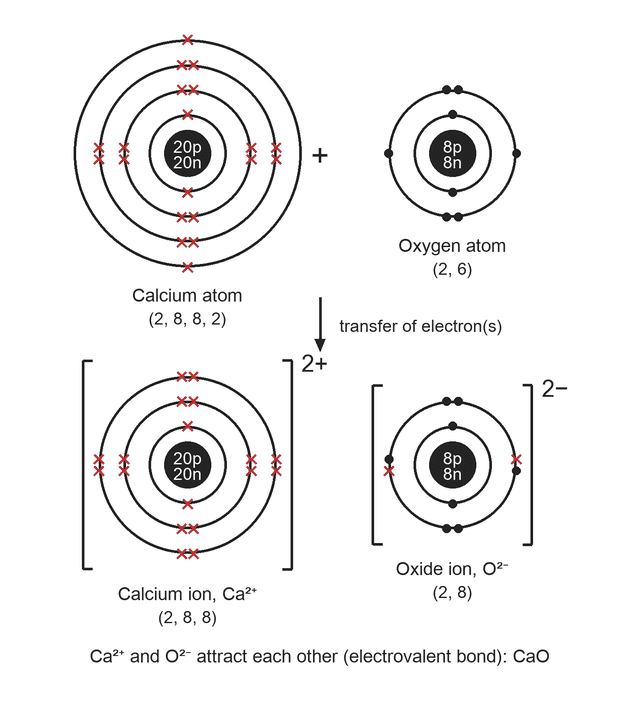
Watch out: The nucleus does not change when an ion forms; only the outer electrons move.
Therefore, NaCl forms by transfer of one electron from Na to Cl, and CaO by transfer of two electrons from Ca to O, as shown in the orbit diagrams.
- 795 marks
Question 79
Compare :
(a) sodium atom and sodium ion
(b) chlorine atom and chloride ion, with respect to
(i) atomic structure,
(ii) electrical state
Solve with AIWritten solution
Solution:
Concept: An ion has the same nucleus as its atom; only the number of electrons is different, and that changes the charge.
Step 1 — (a) Sodium atom and sodium ion.
The sodium atom loses its single outer electron to form .
Sodium atom (Na) Sodium ion () (i) Atomic structure 11 p, 12 n, 11 electrons: 2, 8, 1 (3 shells) 11 p, 12 n, 10 electrons: 2, 8 (2 shells) (ii) Electrical state Neutral Positively charged (+1) Step 2 — (b) Chlorine atom and chloride ion.
The chlorine atom gains one electron to form .
Chlorine atom (Cl) Chloride ion () (i) Atomic structure 17 p, 18 n, 17 electrons: 2, 8, 7 17 p, 18 n, 18 electrons: 2, 8, 8 (ii) Electrical state Neutral Negatively charged (−1) Watch out: The protons and neutrons are the same in the atom and its ion.
Therefore, Na⁺ has one electron fewer than Na (2, 8 against 2, 8, 1) and is positive, and Cl⁻ has one electron more than Cl (2, 8, 8 against 2, 8, 7) and is negative; both atoms are neutral.
- 802 marks
Question 80
The electronic configuration of fluoride ion is the same as that of a neon atom. What is the difference between the two?
Solve with AIWritten solution
Solution:
Concept: Particles with the same electronic configuration can still differ in their nucleus. The number of protons decides which element a particle belongs to.
Step 1 — Compare the protons and charge.
The fluoride ion has 9 protons and 10 electrons, so it carries a charge of −1. The neon atom has 10 protons and 10 electrons, so it is neutral.
Step 2 — Compare the elements.
They belong to different elements (atomic numbers 9 and 10).
Step 3 — Compare their behaviour.
The fluoride ion is a charged particle that attracts positive ions and forms compounds such as sodium fluoride, while neon is an unreactive (inert) atom.
Therefore, F⁻ and Ne have the same configuration (2, 8), but F⁻ has 9 protons and a −1 charge while Ne has 10 protons and is neutral.
- 814 marks
Question 81
(a) What do you understand by redox reactions?
(b) Explain oxidation and reduction in terms of loss or gain of electrons.
Solve with AIWritten solution
Solution:
Concept: Oxidation and reduction always take place together: whatever electrons one substance loses, another must gain.
Step 1 — (a) Define a redox reaction.
A redox reaction is a reaction in which oxidation and reduction take place at the same time: the electrons lost by one substance are gained by another.
Step 2 — (a) Give an example.
Sodium burns in chlorine to form sodium chloride:
Step 3 — (b) Oxidation.
Oxidation is the loss of electrons:
Step 4 — (b) Reduction.
Reduction is the gain of electrons:
Watch out: An easy way to remember: OIL RIG — Oxidation Is Loss, Reduction Is Gain.
Therefore, (a) a redox reaction is one in which oxidation and reduction occur together, and (b) oxidation is loss of electrons and reduction is gain of electrons.
- 825 marks
Question 82
Potassium (At. No. 19) and chlorine (At. No. 17) form a compound. Explain the formation of the compound on the basis of :
(a) oxidation
(b) reduction
(c) oxidising agent
(d) reducing agent.
Solve with AIWritten solution
Solution:
Concept: Potassium (2, 8, 8, 1) has 1 valence electron and chlorine (2, 8, 7) needs 1. The electron passes from potassium to chlorine, forming potassium chloride:
Step 1 — Write the overall reaction.
Potassium reacts with chlorine to form potassium chloride:
Step 2 — (a) Oxidation.
Potassium loses its valence electron and becomes (2, 8, 8). Loss of electrons is oxidation, so potassium is oxidised:
Step 3 — (b) Reduction.
Each chlorine atom gains that electron and becomes (2, 8, 8). Gain of electrons is reduction, so chlorine is reduced:
Step 4 — (c) Oxidising agent.
Chlorine accepts the electron and so causes potassium to be oxidised; it is the oxidising agent.
Step 5 — (d) Reducing agent.
Potassium donates the electron and so causes chlorine to be reduced; it is the reducing agent.
Watch out: The oxidising agent is itself reduced, and the reducing agent is itself oxidised.
Therefore, in forming KCl potassium is oxidised and is the reducing agent, while chlorine is reduced and is the oxidising agent.
- 831 mark
Question 83
The bond formed between a metal and a non-metal is called :
Solve with AIAnswer
(A) Polar covalent
- Correct
(B) Electrovalent
(C) Covalent
(D) Coordinate
Answer: (B) Electrovalent
Concept: A metal transfers electrons to a non-metal; the ions formed are held by an electrovalent (ionic) bond.
Step 1 — Decide what the two atoms do.
The metal loses electrons and the non-metal gains them, so electrons are transferred.
Step 2 — Name the bond.
A bond formed by transfer of electrons is an electrovalent bond.
Why the other options are wrong:
- (A) Polar covalent: This is a bond formed by unequal sharing of electrons between two non-metals, as in HCl.
- (C) Covalent: This is a bond formed by sharing electrons, usually between non-metals.
- (D) Coordinate: This is a bond in which one atom supplies both electrons of the shared pair; it is not the typical metal–non-metal bond.
Therefore, the bond between a metal and a non-metal is electrovalent, option (B).
- 841 mark
Question 84
The most ionic compound is :
Solve with AIAnswer
(A) NaCl
(B) KBr
- Correct
(C) CsF
(D)
Answer: (C) CsF
Concept: A compound is most ionic when its metal gives up electrons most easily (most electropositive) and its non-metal takes them most strongly (most electronegative).
Step 1 — Pick the best electron giver.
Caesium is the most electropositive of the metals given: its single outer electron is far from the nucleus and is lost very easily.
Step 2 — Pick the best electron taker.
Fluorine is the most electronegative element of all.
Step 3 — Combine.
So caesium fluoride, CsF, is the most ionic compound.
Why the other options are wrong:
- (A) NaCl: This is less ionic: sodium holds its electron more firmly than caesium, and chlorine is less electronegative than fluorine.
- (B) KBr: This is less ionic: potassium is less electropositive than caesium, and bromine is much less electronegative than fluorine.
- (D) : This is less ionic: magnesium is far less electropositive than caesium, and its small, doubly charged ion pulls on the chloride ions' electrons, giving some covalent character.
Therefore, the most ionic compound is caesium fluoride, option (C).
- 851 mark
Question 85
The electronic configuration of is :
Solve with AIAnswer
(A) 2, 8, 8, 2
- Correct
(B) 2, 8, 8
(C) 2, 8, 8, 4
(D) 2, 8, 2
Answer: (B) 2, 8, 8
Concept: A positive ion has lost electrons from its outermost shell; its nucleus is unchanged.
Step 1 — Write the atom's configuration.
Calcium (atomic number 20) is 2, 8, 8, 2.
Step 2 — Remove two electrons.
The 2+ charge means the 2 outermost electrons are lost, leaving 18 electrons: 2, 8, 8.
Why the other options are wrong:
- (A) 2, 8, 8, 2: This is the neutral calcium atom, before it loses any electrons.
- (C) 2, 8, 8, 4: This has 22 electrons, two more than the atom, which would give a negative ion.
- (D) 2, 8, 2: This has only 12 electrons; it is the magnesium atom.
Therefore, the electronic configuration of Ca²⁺ is 2, 8, 8, option (B).
- 861 mark
Question 86
The formation of electrovalent bond is an example of :
Solve with AIAnswer
(A) Oxidation reaction
(B) Reduction reaction
(C) Displacement reaction
- Correct
(D) Redox reaction
Answer: (D) Redox reaction
Concept: Oxidation is loss of electrons and reduction is gain of electrons. When both happen together, the reaction is a redox reaction.
Step 1 — Look at the metal.
In forming an electrovalent bond, the metal atom loses electrons, so it is oxidised.
Step 2 — Look at the non-metal.
At the same time the non-metal atom gains those electrons, so it is reduced.
Step 3 — Conclude.
Oxidation and reduction take place together, so it is a redox reaction.
Why the other options are wrong:
- (A) Oxidation reaction: This names only the half that happens to the metal.
- (B) Reduction reaction: This names only the half that happens to the non-metal.
- (C) Displacement reaction: This does not fit: no element is pushed out of a compound when two elements combine.
Therefore, the formation of an electrovalent bond is a redox reaction, option (D).
- 871 mark
Question 87
Ionic compounds are generally :
Solve with AIAnswer
(A) Liquids
(B) Gases
(C) Liquids of very low boiling points
- Correct
(D) Solids
Answer: (D) Solids
Concept: In an ionic compound, oppositely charged ions attract each other strongly in every direction and are packed into a crystal lattice.
Step 1 — Link the force to the state.
Strong electrostatic forces hold the ions firmly in place, so ionic compounds are hard, crystalline solids with high melting and boiling points.
Why the other options are wrong:
- (A) Liquids: This is typical of covalent compounds with weak forces between their molecules, such as water.
- (B) Gases: This is typical of covalent compounds such as hydrogen chloride and ammonia.
- (C) Liquids of very low boiling points: This is false: ionic compounds have high, not very low, boiling points.
Therefore, ionic compounds are generally solids, option (D).
- 881 mark
Question 88
An example of a double covalent bond is :
Solve with AIAnswer
(A) Nitrogen molecule
(B) Hydrogen molecule
- Correct
(C) Oxygen molecule
(D) Chlorine molecule
Answer: (C) Oxygen molecule
Concept: A double covalent bond is formed when two atoms share two pairs of electrons.
Step 1 — Look at oxygen.
Each oxygen atom (2, 6) needs 2 more electrons for an octet.
Step 2 — Count the shared pairs.
The two atoms share two pairs of electrons, so the oxygen molecule has a double bond, O = O.
Why the other options are wrong:
- (A) Nitrogen molecule: This has a triple covalent bond: each nitrogen (2, 5) shares three pairs.
- (B) Hydrogen molecule: This has a single covalent bond: one shared pair.
- (D) Chlorine molecule: This has a single covalent bond: each chlorine (2, 8, 7) shares one pair.
Therefore, the oxygen molecule is an example of a double covalent bond, option (C).
- 891 mark
Question 89
Which of the following is not a non polar covalent molecule ?
Solve with AIAnswer
(A) Chlorine
(B) Methane
- Correct
(C) Hydrogen chloride
(D) Carbon tetrachloride
Answer: (C) Hydrogen chloride
Concept: A covalent molecule is polar when the shared electrons are pulled more towards one atom, so that one end is slightly negative and the other slightly positive.
Step 1 — Look at hydrogen chloride.
Chlorine attracts the shared pair more strongly than hydrogen, so the pair lies nearer chlorine. Hydrogen becomes slightly positive and chlorine slightly negative: HCl is a polar covalent molecule.
Step 2 — Answer the question.
The question asks which is NOT non-polar, so the answer is hydrogen chloride.
Watch out: Read the double negative carefully: 'not non-polar' means polar.
Why the other options are wrong:
- (A) Chlorine: This is non-polar: its two identical atoms share the pair equally.
- (B) Methane: This is non-polar: the molecule is symmetrical, so its slightly polar C–H bonds cancel out.
- (D) Carbon tetrachloride: This is non-polar: the molecule is symmetrical, so its four polar C–Cl bonds cancel out.
Therefore, hydrogen chloride is not a non-polar molecule, option (C).
- 901 mark
Question 90
The total number of atoms present in a carbon tetrachloride molecule is :
Solve with AIAnswer
(A) 4
(B) 3
- Correct
(C) 5
(D) 6
Answer: (C) 5
Concept: The formula of a molecule tells how many atoms of each element it contains.
Step 1 — Read the formula.
Carbon tetrachloride is : 1 carbon atom and 4 chlorine atoms.
Step 2 — Add the atoms.
Count every atom in the molecule:
Why the other options are wrong:
- (A) 4: This counts only the chlorine atoms.
- (B) 3: This matches no part of the formula.
- (D) 6: This is one atom more than the formula shows.
Therefore, a carbon tetrachloride molecule has 5 atoms, option (C).
- 911 mark
Question 91
Three pair of electrons are shared in a molecule of :
Solve with AIAnswer
(A) Oxygen
(B) Hydrogen
(C) Methane
- Correct
(D) Nitrogen
Answer: (D) Nitrogen
Concept: Three shared pairs of electrons between two atoms make a triple covalent bond.
Step 1 — Look at nitrogen.
Each nitrogen atom (2, 5) needs 3 more electrons for an octet.
Step 2 — Count the shared pairs.
The two atoms share three pairs of electrons, forming N ≡ N.
Why the other options are wrong:
- (A) Oxygen: This molecule shares two pairs (a double bond).
- (B) Hydrogen: This molecule shares only one pair (a single bond).
- (C) Methane: This molecule shares four pairs, one in each of its four C–H single bonds.
Therefore, three pairs of electrons are shared in a nitrogen molecule, option (D).
- 921 mark
Question 92
In the formation of molecule, the nearest noble gas configurations attained by carbon and chlorine respectively are :
Solve with AIAnswer
(A) Argon and Neon
(B) Helium and Neon
- Correct
(C) Neon and Argon
(D) Helium and Argon
Answer: (C) Neon and Argon
Concept: In a covalent molecule, each atom shares electrons until its outer shell matches the nearest noble gas.
Step 1 — Look at carbon.
Carbon (2, 4) shares 4 pairs, one with each chlorine, so it has 2, 8 like neon.
Step 2 — Look at chlorine.
Each chlorine (2, 8, 7) shares 1 pair, so it has 2, 8, 8 like argon.
Step 3 — Keep the order.
Carbon first, then chlorine: neon and argon.
Watch out: The question says 'respectively', so the order carbon then chlorine matters.
Why the other options are wrong:
- (A) Argon and Neon: This gives the right gases in the wrong order: carbon reaches neon and chlorine reaches argon.
- (B) Helium and Neon: This is wrong: carbon reaches an octet like neon, not a duplet like helium, and chlorine reaches argon.
- (D) Helium and Argon: This is wrong: carbon reaches neon, not helium.
Therefore, carbon and chlorine attain the configurations of neon and argon, option (C).
- 931 mark
Question 93
The characteristic of an electrovalent compound is that :
Solve with AIAnswer
(A) It is formed by sharing of electrons.
- Correct
(B) It is formed between metals and non-metals.
(C) It is formed between two non-metals.
(D) It often exists as a liquid.
Answer: (B) It is formed between metals and non-metals.
Concept: An electrovalent compound forms when a metal transfers electrons to a non-metal.
Step 1 — Identify the atoms involved.
The electron giver is a metal and the electron taker is a non-metal, so electrovalent compounds form between metals and non-metals.
Why the other options are wrong:
- (A) It is formed by sharing of electrons: This describes covalent compounds, which form by sharing electrons.
- (C) It is formed between two non-metals: This describes covalent compounds: two non-metals share electrons.
- (D) It often exists as a liquid: This is false: electrovalent compounds are usually hard crystalline solids.
Therefore, an electrovalent compound is formed between metals and non-metals, option (B).
- 941 mark
Question 94
When a metal atom becomes an ion :
Solve with AIAnswer
- Correct
(A) It loses electrons and is oxidized
(B) It gains electrons and is reduced
(C) It gains electrons and is oxidized
(D) It loses electrons and is reduced
Answer: (A) It loses electrons and is oxidized
Concept: A metal atom forms a positive ion by losing electrons, and loss of electrons is oxidation.
Step 1 — Decide what the metal does.
Metal atoms have 1–3 valence electrons and lose them, for example:
Step 2 — Name the process.
Loss of electrons is oxidation, so the metal is oxidised.
Why the other options are wrong:
- (B) It gains electrons and is reduced: This is false: metal atoms do not gain electrons; gaining electrons is how non-metals form anions.
- (C) It gains electrons and is oxidized: This is false on both counts: metals do not gain electrons, and gaining electrons is reduction.
- (D) It loses electrons and is reduced: This is false: losing electrons is oxidation, not reduction.
Therefore, a metal atom becomes an ion by losing electrons and is oxidised, option (A).
- 951 mark
Question 95
An element Y has 2 electrons in its 2nd orbit and X has 7 electrons in its 3rd orbit. The compound formed between them has the formula :
Solve with AIAnswer
(A)
- Correct
(B)
(C) YX
(D)
Answer: (B)
Concept: Work out each element's valency from its configuration; then cross the valencies to get the formula.
Step 1 — Identify Y.
Y has 2 electrons in its 2nd shell, so it is 2, 2 (beryllium). It loses 2 electrons: valency 2.
Step 2 — Identify X.
X has 7 electrons in its 3rd shell, so it is 2, 8, 7 (chlorine). It needs 1 electron: valency 1.
Step 3 — Write the formula.
One Y (valency 2) combines with two X (valency 1 each), so the formula is .
Watch out: The subscripts come from the valencies, not from the numbers of outer electrons.
Why the other options are wrong:
- (A) : This would need X to have valency 2 and Y valency 1.
- (C) YX: This would need X and Y to have the same valency.
- (D) : This wrongly uses the outer-electron counts (2 and 7) as subscripts instead of the valencies.
Therefore, the compound has the formula YX₂, option (B).
- 964 marks
Question 96
Match the atomic numbers 4, 8, 10, 15 and 19 with each of the following :
(a) Element which can form trivalent ion.
(b) An element with 4 shells.
(c) Element with 6 valence electrons.
(d) Element which does not form an ion.
Solve with AIWritten solution
Solution:
Concept: Write the configuration of each atomic number first; the number of shells and the valence electrons then answer each part.
Step 1 — Write the configurations.
4 is 2, 2 (beryllium); 8 is 2, 6 (oxygen); 10 is 2, 8 (neon); 15 is 2, 8, 5 (phosphorus); 19 is 2, 8, 8, 1 (potassium).
Step 2 — (a) Trivalent ion.
Phosphorus has 5 valence electrons and gains 3 to complete its octet, forming : 15.
Step 3 — (b) Four shells.
Potassium (2, 8, 8, 1) has electrons in four shells, K, L, M and N: 19.
Step 4 — (c) Six valence electrons.
Oxygen (2, 6) has 6 valence electrons: 8.
Step 5 — (d) Does not form an ion.
Neon (2, 8) already has a stable octet, so it neither loses nor gains electrons: 10.
Therefore, (a) 15, (b) 19, (c) 8 and (d) 10.
- 974 marks
Question 97
Identify the following reactions as either oxidation or reduction :
(i)
(ii)
(iii)
(iv)
Solve with AIWritten solution
Solution:
Concept: Oxidation is loss of electrons; reduction is gain of electrons. Electrons on the left of the arrow are being gained, and electrons on the right are being lost.
Step 1 — (i) Oxygen.
Oxygen gains 2 electrons (they are on the left), so this is reduction.
Step 2 — (ii) Potassium.
Potassium loses 1 electron (written as − e⁻ on the left), so this is oxidation.
Step 3 — (iii) Iron(III) ion.
gains 1 electron and becomes , so this is reduction.
Step 4 — (iv) Zinc.
Zinc loses 2 electrons (they are on the right), so this is oxidation.
Watch out: A positive ion can still be reduced: when changes to it gains an electron.
Therefore, (i) reduction, (ii) oxidation, (iii) reduction and (iv) oxidation.
- 982 marks
Question 98
Give the terms for the following definitions.
(a) A bond formed by a shared pair of electrons, each bonding atom contributing one electron to the pair.
(b) A bond formed by transfer of electron(s).
Solve with AIWritten solution
Solution:
Concept: Atoms are bonded either by sharing electrons or by transferring them.
Step 1 — (a) Shared pair, one electron from each atom.
A bond formed by a shared pair of electrons, each atom giving one electron, is a covalent bond (a single covalent bond).
Step 2 — (b) Transfer of electrons.
A bond formed by the transfer of electrons is an electrovalent (ionic) bond.
Therefore, (a) is a covalent bond and (b) is an electrovalent bond.
- 995 marks
Question 99
Name or state the following :
(a) An element having valency zero.
(b) Metal with valency one.
(c) Atoms of the same element differing in mass numbers.
(d) Elements having same mass number but different atomic number.
(e) Bond formed by transfer of electron(s).
(f) Ion formed by gain of electron(s).
Solve with AIWritten solution
Solution:
Concept: Each part names a term or example from the chapter.
Step 1 — (a) Valency zero.
Neon (any noble gas, such as helium or argon), because its outer shell is already full.
Step 2 — (b) Metal with valency one.
Sodium (or potassium), which loses its single outer electron.
Step 3 — (c) Same element, different mass numbers.
Isotopes, for example and .
Step 4 — (d) Same mass number, different atomic numbers.
Isobars, for example and .
Step 5 — (e) Bond formed by transfer of electrons.
Electrovalent (ionic) bond.
Step 6 — (f) Ion formed by gain of electrons.
Anion (a negative ion), for example .
Watch out: Isotopes share the atomic number; isobars share the mass number.
Therefore, (a) neon, (b) sodium, (c) isotopes, (d) isobars, (e) electrovalent bond and (f) anion.
- 1005 marks
Question 100
(a) Define covalent (molecular) bond.
(b) Give an example of covalent bond formed by (i) similar atoms (ii) dissimilar atoms.
Solve with AIWritten solution
Solution:
Concept: Non-metal atoms reach a noble gas configuration by sharing pairs of electrons; each shared pair is one covalent bond.
Step 1 — (a) Define a covalent bond.
A covalent (molecular) bond is the bond formed between two atoms by the mutual sharing of one or more pairs of electrons, each atom contributing one electron to each shared pair.
Step 2 — (b)(i) Similar atoms — chlorine.
Two chlorine atoms (2, 8, 7) each need 1 electron, so they share one pair, forming (Cl–Cl). Hydrogen, oxygen and nitrogen molecules are other examples.
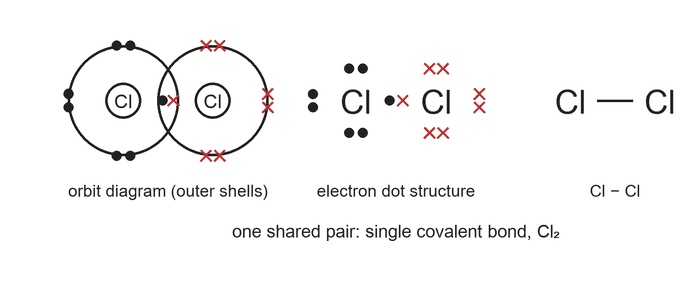
Step 3 — (b)(ii) Dissimilar atoms — hydrogen chloride.
A hydrogen atom (1) and a chlorine atom (2, 8, 7) each need 1 electron, so they share one pair, forming (H–Cl). Water and methane are other examples.
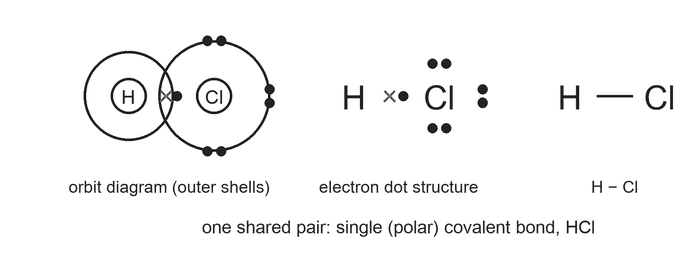
Watch out: In a covalent bond no electron changes owner completely, so no ions are formed.
Therefore, a covalent bond is formed by mutual sharing of electron pairs; Cl₂ is an example between similar atoms and HCl between dissimilar atoms.
- 1012 marks
Question 101
An element A has 1 electron in its first shell. It combines with element B having 7 electrons in its third shell. What type of bond is formed ?
Solve with AIWritten solution
Solution:
Concept: Two non-metal atoms that both need electrons cannot transfer electrons to each other; they share a pair instead.
Step 1 — Identify the elements.
A has 1 electron in its first (only) shell, so it is hydrogen. B is 2, 8, 7, so it is chlorine.
Step 2 — Decide how they combine.
Each needs one more electron (hydrogen for a duplet, chlorine for an octet), so they share one electron pair.
Step 3 — Name the bond.
A shared pair makes a covalent bond. Chlorine pulls the pair more strongly, so it is a polar covalent bond, as in HCl (AB).
Therefore, A and B form a (polar) covalent bond, giving AB, like HCl.
- 1024 marks
Question 102
If electrons are getting added to an element Y; then
(a) what charge will Y have ?
(b) is Y getting oxidized or reduced ?
Solve with AIWritten solution
Solution:
Concept: Electrons are negatively charged. Gaining electrons gives a negative ion, and gain of electrons is reduction.
Step 1 — (a) Find the charge.
Each added electron brings a negative charge, so Y becomes a negative ion (anion).
Step 2 — (b) Oxidised or reduced.
Gain of electrons is reduction, so Y is being reduced.
Therefore, (a) Y will carry a negative charge, and (b) Y is getting reduced.
- 1035 marks
Question 103
(a) Elements X, Y and Z have atomic numbers 6, 9 and 12 respectively. Which one :
(i) forms an anion ,
(ii) forms a cation ?
(b) State the type of bond between Y and Z and give its molecular formula.
Solve with AIWritten solution
Solution:
Concept: Atoms with 5–7 valence electrons gain electrons (anions); atoms with 1–3 lose them (cations). A metal and a non-metal form an electrovalent bond.
Step 1 — Write the configurations.
X (6) is 2, 4 (carbon); Y (9) is 2, 7 (fluorine); Z (12) is 2, 8, 2 (magnesium).
Step 2 — (a)(i) Anion.
Y gains 1 electron to complete its octet: Y forms the anion .
Step 3 — (a)(ii) Cation.
Z loses its 2 valence electrons: Z forms the cation .
Step 4 — (b) Bond and formula.
Z gives one electron to each of two Y atoms. Electrons are transferred, so the bond is electrovalent (ionic). One balances two , so the formula is (magnesium fluoride, ).
Watch out: An ionic compound is made of ions, not molecules, so ZY₂ is the formula of the compound rather than of a molecule.
Therefore, (a) Y forms an anion and Z a cation, and (b) Y and Z form an electrovalent bond with the formula ZY₂.
- 1042 marks
Question 104
Potassium chloride is an electrovalent compound, while hydrogen chloride is a covalent compound. But, both conduct electricity in their aqueous solutions. Why ?
Solve with AIWritten solution
Solution:
Concept: A solution conducts electricity only if it contains ions that are free to move.
Step 1 — Potassium chloride solution.
Potassium chloride is already made of ions. In water they separate and move freely:
Step 2 — Hydrogen chloride solution.
Hydrogen chloride is a polar covalent compound with no ions when pure. In water it reacts and ionises:
Step 3 — Conclude.
Both solutions now contain mobile ions, which carry the current.
Watch out: Pure (dry) hydrogen chloride does not conduct; it conducts only after ions form in water.
Therefore, both conduct in water because both solutions contain free ions: KCl simply separates into its ions, while HCl reacts with water to form ions.
- 1052 marks
Question 105
Name two compounds that are covalent when taken pure but produce ions when dissolved in water.
Solve with AIWritten solution
Solution:
Concept: Some polar covalent compounds react with water and form ions, although the pure compound has no ions.
Step 1 — Hydrogen chloride.
Pure hydrogen chloride is a covalent gas. In water it ionises completely:
Step 2 — Ammonia.
Pure ammonia is a covalent gas. In water a small part of it forms ions:
Therefore, hydrogen chloride and ammonia are covalent when pure but produce ions in water.
- 1062 marks
Question 106
An element M burns in oxygen to form an ionic compound MO. Write the formula of the compounds formed if this element is made to combine with chlorine and sulphur separately.
Solve with AIWritten solution
Solution:
Concept: The formula of an ionic compound balances the charges of its ions. In MO the oxide ion is , so M must form (valency 2).
Step 1 — Find the valency of M.
One balances one M ion, so M carries +2.
Step 2 — With chlorine.
Chlorine forms ; two are needed to balance : .
Step 3 — With sulphur.
Sulphur forms ; one balances : MS.
Therefore, M forms MCl₂ with chlorine and MS with sulphur.
- 1075 marks
Question 107
State the type of bonding in the following molecules.
(a) water,
(b) calcium oxide,
(c) hydrogen chloride
Solve with AIWritten solution
Solution:
Concept: Two non-metals share electrons (covalent bond); a metal and a non-metal transfer electrons (electrovalent bond).
Step 1 — (a) Water.
Hydrogen and oxygen are both non-metals; they share electron pairs, giving covalent (polar) bonds.
Step 2 — (b) Calcium oxide.
Calcium is a metal and oxygen a non-metal; calcium transfers 2 electrons to oxygen, giving an electrovalent (ionic) bond.
Step 3 — (c) Hydrogen chloride.
Hydrogen and chlorine are non-metals; they share one pair, giving a covalent (polar) bond.
Therefore, water and hydrogen chloride have covalent bonds, and calcium oxide has an electrovalent bond.
- 1085 marks
Question 108
The atomic species X and Y have different number of protons but the same number of nucleons. While atoms A and B have the same number of protons but different number of nucleons.
(a) Which of them are (i) isotopes (ii) isobars ?
(b) Give one example of each.
Solve with AIWritten solution
Solution:
Concept: Isotopes have the same number of protons but different numbers of nucleons. Isobars have the same number of nucleons (mass number) but different numbers of protons.
Step 1 — (a)(i) Isotopes.
A and B have the same protons but different nucleons, so A and B are isotopes.
Step 2 — (a)(ii) Isobars.
X and Y have different protons but the same nucleons, so X and Y are isobars.
Step 3 — (b) Examples.
Isotopes: and . Isobars: and .
Therefore, A and B are isotopes (e.g. ³⁵Cl and ³⁷Cl), and X and Y are isobars (e.g. ⁴⁰Ar and ⁴⁰Ca).
- 1095 marks
Question 109
Covalent bonds can be single, double or triple covalent bond.
(a) How many electrons are shared in each ?
(b) Give an example of each type.
Solve with AIWritten solution
Solution:
Concept: A shared pair contains 2 electrons, one from each atom. One shared pair makes a single bond, two pairs a double bond and three pairs a triple bond.
Step 1 — (a) Count the electrons shared.
Multiply the number of shared pairs by 2.
Bond Shared pairs Electrons shared Single 1 2 Double 2 4 Triple 3 6 Step 2 — (b) Single bond — hydrogen.
Two hydrogen atoms share one pair: H–H ( is another example).

Step 3 — (b) Double bond — oxygen.
Two oxygen atoms (2, 6) each need 2 electrons, so they share two pairs: O = O.
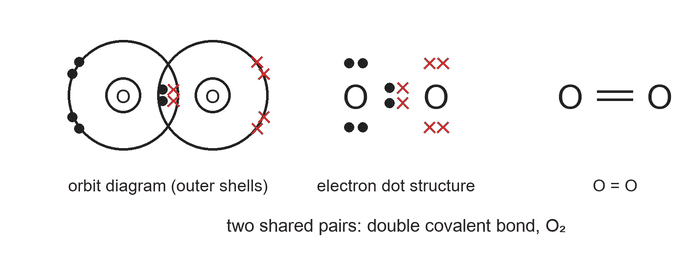
Step 4 — (b) Triple bond — nitrogen.
Two nitrogen atoms (2, 5) each need 3 electrons, so they share three pairs: N ≡ N.
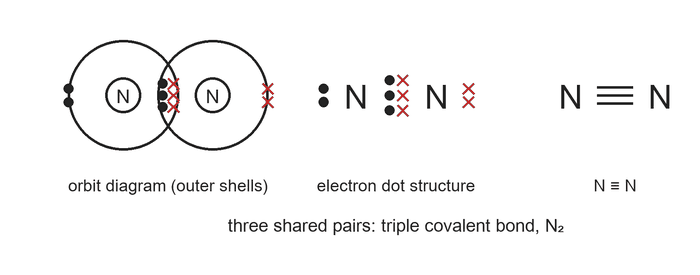
Watch out: Count electrons, not pairs: a double bond shares 4 electrons.
Therefore, single, double and triple covalent bonds share 2, 4 and 6 electrons, as in H₂, O₂ and N₂.
- 1103 marks
Question 110
Taking as an example of electrovalent bond and as a covalent bond, give a difference between electrovalent and covalent bonds.
Solve with AIWritten solution
Solution:
Concept: In magnesium transfers electrons to chlorine (electrovalent bond). In carbon shares electron pairs with chlorine (covalent bond).
Step 1 — Compare the two bonds.
The table sets the two compounds side by side.
Electrovalent bond () Covalent bond () Formed by transfer of electrons: Mg gives one electron to each of two Cl atoms. Formed by sharing of electrons: C shares one pair with each of four Cl atoms. Made of ions, and . Made of molecules; no ions. Formed between a metal and a non-metal. Formed between two non-metals. Hard crystalline solid with high melting and boiling points. Volatile liquid with a low boiling point. Conducts electricity when molten or in water. Does not conduct electricity. Soluble in water. Insoluble in water; soluble in organic solvents. Therefore, the main difference is that MgCl₂ is formed by transfer of electrons and is made of ions, while CCl₄ is formed by sharing of electrons and is made of molecules.
- 1115 marks
Question 111
Give orbital diagrams of the following :
(a) magnesium chloride
(b) nitrogen
(c) methane
(d) hydrogen chloride
Solve with AIWritten solution
Solution:
Concept: An orbital (orbit) diagram shows how electrons move between or are shared by the atoms. Magnesium chloride forms by transfer; nitrogen, methane and hydrogen chloride form by sharing. One atom's electrons are dots and the other's are crosses.
Step 1 — (a) Magnesium chloride.
Magnesium (2, 8, 2) gives one electron to each of two chlorine atoms (2, 8, 7), forming (2, 8) and two ions (2, 8, 8).
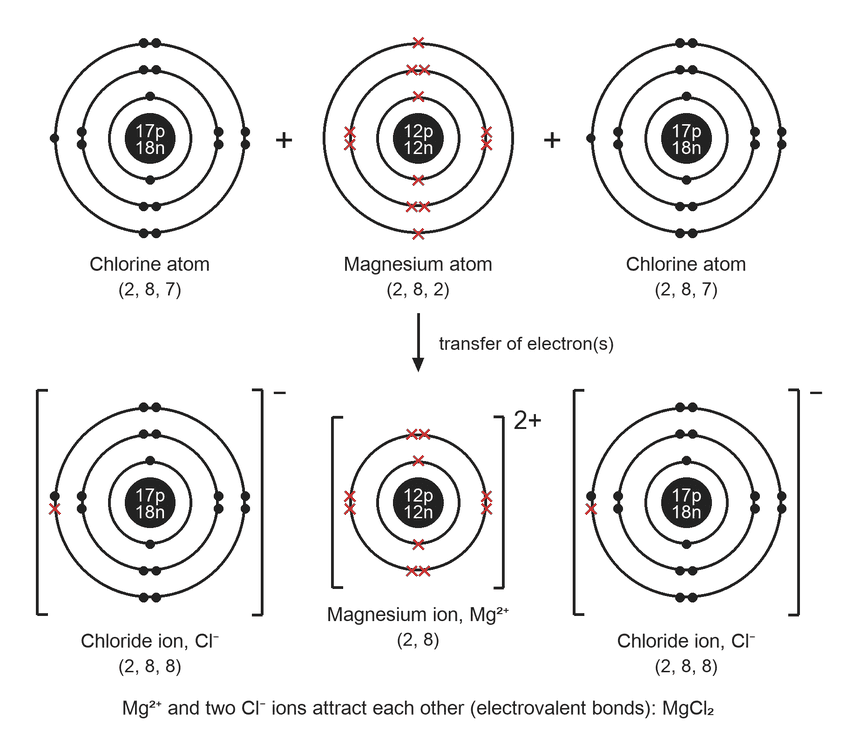
Step 2 — (b) Nitrogen.
Two nitrogen atoms (2, 5) share three electron pairs, forming a triple bond, N ≡ N.
Step 3 — (c) Methane.
Carbon (2, 4) shares one electron pair with each of four hydrogen atoms, forming four C–H single bonds.
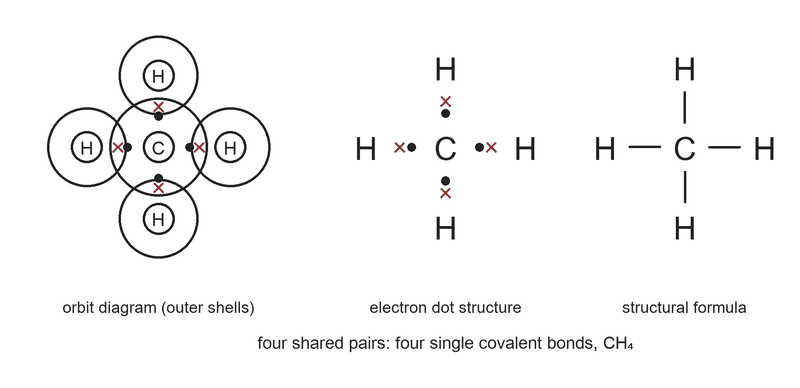
Step 4 — (d) Hydrogen chloride.
Hydrogen (1) and chlorine (2, 8, 7) share one electron pair, forming H–Cl.
Watch out: The ionic diagram shows brackets and charges; the covalent diagrams show overlapping outer shells with the shared electrons in the overlap.
Therefore, the diagrams show electron transfer in MgCl₂ and electron sharing in N₂ (three pairs), CH₄ (four pairs) and HCl (one pair).
- 1123 marks
Question 112
Metal M forms a chloride with the formula . What type of bond is in ? Write the formula of the compound when M combines with sulphur, oxygen and nitrogen.
Solve with AIWritten solution
Solution:
Concept: In there are two ions, so M forms (valency 2). A metal combined with a non-metal is held by an electrovalent bond.
Step 1 — Name the bond.
M is a metal and chlorine a non-metal, so the bond in is electrovalent (ionic).
Step 2 — With sulphur and oxygen (valency 2).
Both form ions with charge 2−, which balance one to one: MS and MO.
Step 3 — With nitrogen (valency 3).
Nitrogen forms . Three ions (+6) balance two ions (−6), so the formula is .
Watch out: Cross the valencies: M (2) and N (3) give M₃N₂.
Therefore, the bond in MCl₂ is electrovalent, and M forms MS, MO and M₃N₂ with sulphur, oxygen and nitrogen.
- 1135 marks
Question 113
Explain the following :
(a) Mass of an atom is concentrated inside the nucleus of the atom.
(b) Atoms combine by transfer and sharing of electron(s).
(c) An element has atoms with different mass number.
(d) Carbon-12 and carbon-14 both show similar chemical properties.
Solve with AIWritten solution
Solution:
Concept: Protons and neutrons (in the nucleus) carry almost all the mass of an atom; the electrons decide how it reacts.
Step 1 — (a) Mass is in the nucleus.
A proton and a neutron each have a mass of about 1 u, while an electron's mass is only about 1/1837 of a hydrogen atom. The protons and neutrons are all in the nucleus, so almost the whole mass is in the nucleus. Rutherford's experiment agreed: the few alpha particles that bounced back had met a tiny, very heavy centre.
Step 2 — (b) Atoms combine by transfer and sharing.
Atoms combine to reach the stable configuration of the nearest noble gas. A metal with 1–3 valence electrons can reach it by transferring them to a non-metal (electrovalent bond). Two non-metals both need electrons, so they reach it by sharing pairs (covalent bond).
Step 3 — (c) Atoms of one element with different mass numbers.
Atoms of the same element always have the same number of protons, but they may have different numbers of neutrons, so their mass numbers differ. These atoms are isotopes, such as and .
Step 4 — (d) Carbon-12 and carbon-14 react alike.
Both have 6 electrons arranged 2, 4. Chemical properties depend on the valence electrons, so both show similar chemical properties; they differ only in neutrons (6 and 8).
Therefore, the nucleus holds almost all the mass, atoms transfer or share electrons to gain a noble gas configuration, isotopes differ in neutrons, and C-12 and C-14 react alike because their electrons are the same.
- 1145 marks
Question 114
With the help of a diagram, state the number of bonds and the type of bonds in :
(a) ethene molecule
(b) ethyne molecule
Solve with AIWritten solution
Solution:
Concept: Carbon (2, 4) has 4 valence electrons and forms 4 bonds. In ethene and ethyne the two carbon atoms share more than one pair with each other, giving a double or triple bond.
Step 1 — (a) Ethene, .
Each carbon shares one pair with each of its two hydrogen atoms and two pairs with the other carbon. So there are 5 covalent bonds: 1 double bond (C = C) and 4 single bonds (C–H).

Step 2 — (b) Ethyne, .
Each carbon shares one pair with its hydrogen atom and three pairs with the other carbon. So there are 3 covalent bonds: 1 triple bond (C ≡ C) and 2 single bonds (C–H).
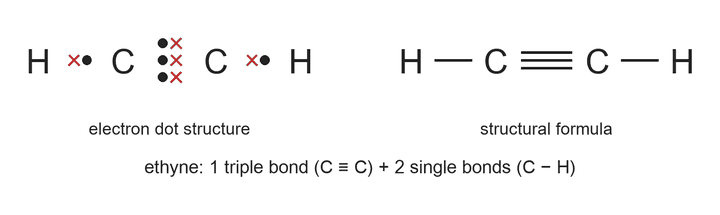
Watch out: Count each carbon's shared pairs: they must add up to 4 (the valency of carbon).
Therefore, ethene has 1 double bond and 4 single bonds, and ethyne has 1 triple bond and 2 single bonds, all covalent.
- 1155 marks
Question 115
The atom of an element A has 6 electrons in its M shell.
(a) Write the electronic configuration of element A.
(b) What is the atomic number of element A ?
(c) Is it a metal or a non-metal ?
(d) What type of ion will be formed by an atom of element A ? Write the symbol of the ion formed.
(e) What could element A be ?
(f) Draw the orbital structure of A and its ion.
Solve with AIWritten solution
Solution:
Concept: The M shell starts filling only after the K shell (2) and the L shell (8) are full. Atoms with 6 valence electrons gain 2 electrons.
Step 1 — (a) Configuration.
6 electrons in M means 2, 8, 6.
Step 2 — (b) Atomic number.
Add the electrons in all shells:
Step 3 — (c) Metal or non-metal.
With 6 valence electrons it gains electrons rather than losing them, so it is a non-metal.
Step 4 — (d) Ion formed.
It gains 2 electrons to complete its octet and forms a negative ion (anion), .
Step 5 — (e) Identify A.
The element with atomic number 16 is sulphur; its ion is .
Step 6 — (f) Draw the atom and its ion.
The sulphur atom (16p, 16n) is 2, 8, 6:
The sulphide ion has gained 2 electrons (crosses) and is 2, 8, 8:
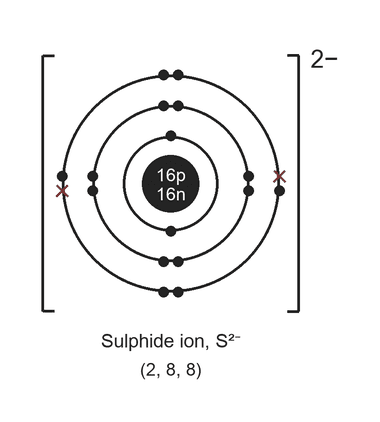
Therefore, A is sulphur: 2, 8, 6, atomic number 16, a non-metal forming the anion A²⁻ (S²⁻).
- 1165 marks
Question 116
An atom of an element Y may be written as .
(a) What does the figure 9 indicate ?
(b) What does the figure 4 indicate ?
(c) What is the number of protons in atom Y ?
(d) What is the number of neutrons in atom Y ?
(e) What is the number of electrons in atom Y ?
(f) How many electrons are there in the outermost shell of an atom of element Y ?
(g) Write the symbol of ion formed by an atom of element Y ?
Solve with AIWritten solution
Solution:
Concept: In , the upper number is the mass number and the lower number is the atomic number. Y is beryllium (atomic number 4).
Step 1 — (a) The figure 9.
9 is the mass number: the total of protons and neutrons.
Step 2 — (b) The figure 4.
4 is the atomic number: the number of protons.
Step 3 — (c) Protons.
The number of protons equals the atomic number, so there are 4 protons.
Step 4 — (d) Neutrons.
Subtract the atomic number from the mass number:
Step 5 — (e) Electrons.
A neutral atom has as many electrons as protons: 4.
Step 6 — (f) Outermost electrons.
The 4 electrons are arranged 2, 2, so there are 2 electrons in the outermost shell.
Step 7 — (g) Ion formed.
Y loses its 2 valence electrons to reach the stable 2 (helium) arrangement: .
Therefore, 9 is the mass number and 4 the atomic number; Y has 4 protons, 5 neutrons, 4 electrons (2 in the outer shell) and forms Y²⁺.
- 1175 marks
Question 117
Atom A is represented as , atom B as and atom C as .
(a) How many electrons, protons and neutrons do A, B and C have ?
(b) Which two atoms have the different number of nucleons?
(c) Name the term which can be used for A and C atoms.
(d) Define the term mentioned in part (c) above.
Solve with AIWritten solution
Solution:
Concept: The lower number is the atomic number, which equals the number of protons and, in a neutral atom, of electrons. The upper number is the mass number, the number of nucleons. Neutrons are nucleons minus protons.
Step 1 — (a) Count the particles.
Use the two numbers of each symbol.
Atom Electrons Protons Neutrons A () 82 82 209 − 82 = 127 B () 83 83 209 − 83 = 126 C () 82 82 211 − 82 = 129 Step 2 — (b) Different numbers of nucleons.
A and B both have 209 nucleons, while C has 211. So A and C have different numbers of nucleons (and so do B and C).
Step 3 — (c) Name the term for A and C.
A and C have the same atomic number (82) but different mass numbers, so they are isotopes.
Step 4 — (d) Define the term.
Isotopes are atoms of the same element having the same atomic number but different mass numbers; they differ in the number of neutrons.
Watch out: A and B have the same mass number but different atomic numbers; they are isobars, not isotopes.
Therefore, A has 82 e, 82 p, 127 n; B has 83 e, 83 p, 126 n; C has 82 e, 82 p, 129 n; A and C differ in nucleons and are isotopes.
- 1185 marks
Question 118
(a) Name the charged particles which attract one another to form electrovalent compounds.
(b) In the formation of electrovalent compounds, electrons are transferred from one element to another. How are electrons involved in the formation of a covalent compound ?
(c) The electronic configuration of nitrogen is (2, 5). How many electrons in the outer shell of a nitrogen atom are not involved in the formation of a nitrogen molecule ?
(d) In the formation of magnesium chloride (by direct combination between magnesium and chlorine), name the substance that is oxidized and the substance that is reduced.
Solve with AIWritten solution
Solution:
Concept: Ionic compounds are held together by attraction between ions; covalent compounds by shared electron pairs.
Step 1 — (a) Charged particles in electrovalent compounds.
Cations and anions (positive and negative ions) attract one another, for example and .
Step 2 — (b) Electrons in covalent compounds.
The electrons are shared: each combining atom contributes electrons to form one or more shared pairs, which belong to both atoms.
Step 3 — (c) Electrons not used in the nitrogen molecule.
Each nitrogen atom has 5 outer electrons and shares 3 of them in N ≡ N:
These 2 electrons form one lone pair on each atom.
Step 4 — (d) Oxidised and reduced in forming magnesium chloride.
Magnesium burns in chlorine:
Magnesium loses 2 electrons, so magnesium is oxidised; chlorine gains them, so chlorine is reduced.
Therefore, (a) cations and anions attract, (b) electrons are shared in pairs, (c) 2 outer electrons of each N atom are not used, and (d) magnesium is oxidised while chlorine is reduced.
- 1195 marks
Question 119
An element X has 2 electrons in its M shell, it forms bond with an element Y which has 7 electrons in its third orbit.
(a) Write the formula of the compound formed.
(b) Which nearest inert gas electronic configuration will element X and Y acquire ?
(c) Show using an orbital diagram the formation of compound between X and Y.
Solve with AIWritten solution
Solution:
Concept: The M shell is the third shell. An atom with 2 electrons there loses them; an atom with 7 in its third shell gains one. Electrons are transferred, so an electrovalent compound forms.
Step 1 — Identify X and Y.
X is 2, 8, 2 (like magnesium) and loses 2 electrons; Y is 2, 8, 7 (like chlorine) and gains 1 electron.
Step 2 — (a) Write the formula.
One needs two to balance its charge, so the formula is (like ).
Step 3 — (b) Noble gas configurations.
is 2, 8, like neon; is 2, 8, 8, like argon.
Step 4 — (c) Orbital diagram.
X gives one electron (cross) to each of two Y atoms:
Watch out: The two ions reach different noble gases: X falls back to neon, Y moves up to argon.
Therefore, (a) the formula is XY₂, (b) X attains neon's configuration and Y attains argon's, and (c) the diagram shows X²⁺ between two Y⁻ ions.
- 1205 marks
Question 120
In the formation of (i) oxygen molecule (ii) carbon tetrachloride molecule, state the following :
(a) Electronic configuration of nearest inert gas attained.
(b) How many electrons are shared/transferred in bond formation ?
(c) Which type of bonds these compounds form ?
(d) Draw their orbital diagrams.
Solve with AIWritten solution
Solution:
Concept: Both molecules are formed by sharing electron pairs; each atom ends up with an octet like the nearest noble gas.
Step 1 — (a)(i) Oxygen molecule.
Each oxygen atom (2, 6) gets 8 outer electrons, 2, 8, like neon.
Step 2 — (a)(ii) Carbon tetrachloride.
Carbon (2, 4) reaches 2, 8 (neon), and each chlorine (2, 8, 7) reaches 2, 8, 8 (argon).
Step 3 — (b) Electrons shared.
No electrons are transferred in either molecule. Count the shared electrons (2 per pair):
Molecule Shared pairs Electrons shared 2 4 4 (one per Cl) 8 Step 4 — (c) Type of bonds.
has one double covalent bond (non-polar). has four single covalent bonds.
Step 5 — (d)(i) Orbital diagram of oxygen.
The two oxygen atoms share two pairs in the overlap of their outer shells.
Step 6 — (d)(ii) Orbital diagram of carbon tetrachloride.
Carbon shares one pair with each of the four chlorine atoms.
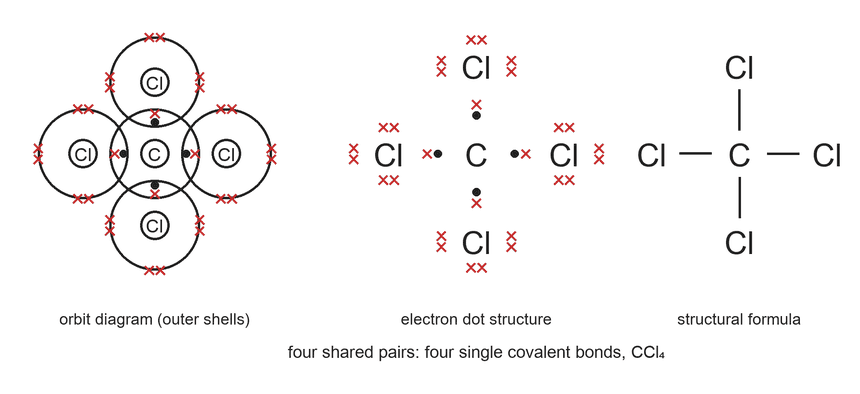
Therefore, O₂ shares 4 electrons in one double bond (each O like neon), and CCl₄ shares 8 electrons in four single bonds (C like neon, each Cl like argon).
- 1213 marks
Question 121
What is the average atomic mass of bromine if it has 49.7% and 50.3% ?
Solve with AIWritten solution
Solution:
Concept: The average atomic mass is the weighted average of the isotope masses: multiply each mass by its percentage, add, and divide by 100.
Step 1 — Set up the average.
Bromine is 49.7 % and 50.3 % :
Step 2 — Round sensibly.
To the nearest whole number this is about 80 u.
Watch out: The two percentages must add up to 100 (49.7 + 50.3 = 100).
Therefore, the average atomic mass of bromine is 80.006 u, that is about 80 u.
- 1223 marks
Question 122
A sample of an element A contains two isotopes and . If the average atomic mass of the element is 16.2 amu, calculate the percentage of the two isotopes in this sample.
Solve with AIWritten solution
Solution:
Concept: The average atomic mass is the weighted average of the isotope masses. If one isotope makes up x %, the other makes up (100 − x) %.
Step 1 — Choose the unknown.
Let the percentage of be x, so that of is (100 − x).
Step 2 — Write the average.
The weighted average must equal 16.2:
Step 3 — Clear the fraction.
Multiply both sides by 100:
Step 4 — Expand the bracket.
Multiply out 18(100 − x):
Step 5 — Collect the terms.
Combine 16x − 18x and move 1800 to the right:
Step 6 — Solve for x.
Divide both sides by −2:
Step 7 — Find the other percentage.
The rest is the heavier isotope:
Step 8 — Check.
Put the percentages back:
Watch out: 16.2 is close to 16, so the lighter isotope must be by far the more common; a large x is expected.
Therefore, the sample contains 90 % of ¹⁶₈A and 10 % of ¹⁸₈A.
What Class 9 Chemistry Ch 4 covers
The sections of the chapter, in the order the book takes them. Every question above comes from one of these.
- 01Discovery of Electrons
- 02Discovery of Protons
- 03Discovery of Nucleus
- 04Bohr's Atomic Model
- 05Atom – Its Structure
- 06Distribution of Electrons – Bohr-Bury Scheme
More ways to study this chapter
The same chapter asked three other ways. Practise it, revise it, and see what the board has set on Ch 4 before.
Class 9 Chemistry Ch 4 questions students ask
How many questions are there in Class 9 Chemistry Ch 4?
122 questions. Every one is solved step by step on this page.
Are these Class 9 Chemistry solutions free?
Yes. Every question and its full working is free to read, with no account needed.
Can I download the Class 9 Chemistry Ch 4 solutions as a PDF?
There is no PDF to download. Every solution is on this page instead, which means it is searchable, always the current syllabus, and readable on a phone. Use your browser's print option if you want it on paper.